
MARKET INSIGHTS
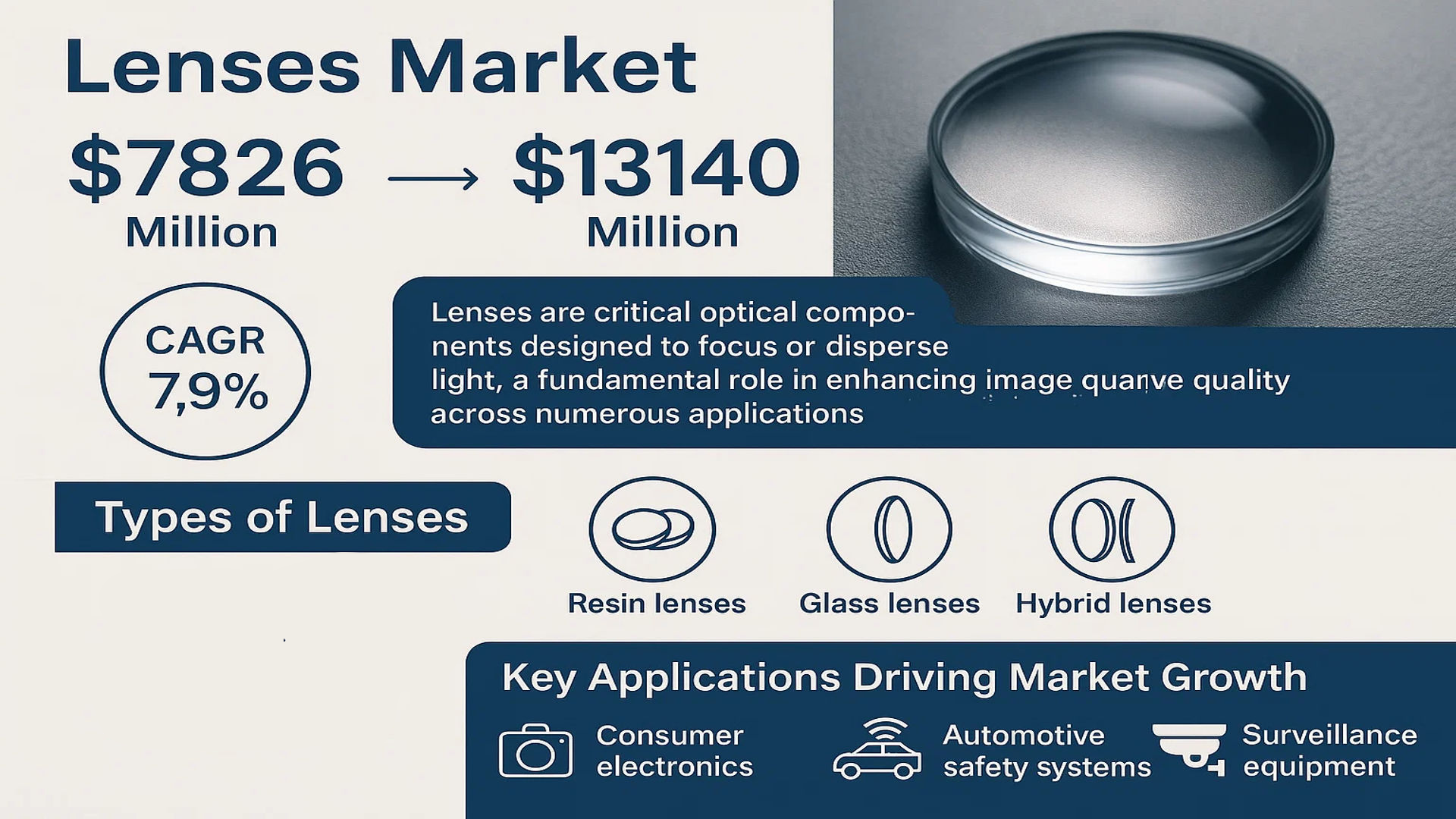
The global Lenses Market was valued at 7826 million in 2024 and is projected to reach US$ 13140 million by 2032, at a CAGR of 7.9% during the forecast period.
Lenses are critical optical components designed to focus or disperse light, playing a fundamental role in enhancing image quality and performance across numerous applications. These components are categorized into several types, including resin lenses, glass lenses, and hybrid lenses, each offering distinct advantages in terms of clarity, weight, durability, and aberration correction.
The market is experiencing robust growth driven by escalating demand for high-quality optics in consumer electronics, automotive safety systems, and surveillance equipment. The proliferation of smartphones with advanced multi-camera setups, which often incorporate multiple lenses per device, is a primary growth driver. Furthermore, the automotive sector’s rapid integration of Advanced Driver Assistance Systems (ADAS), relying heavily on high-precision camera lenses for functions like lane departure warning and adaptive cruise control, is significantly propelling market expansion. The rising adoption of augmented reality (AR) and virtual reality (VR) devices, which require sophisticated lens systems for immersive experiences, further contributes to this upward trajectory. Key industry players such as Sunny Optical, Largan Precision, and Canon are continuously innovating, focusing on developing advanced aspherical and hybrid lenses to meet the evolving demands for miniaturization and superior optical performance.
MARKET DYNAMICS
MARKET DRIVERS
Rising Demand for High-Quality Optics in Consumer Electronics to Drive Market Growth
The global lenses market is experiencing robust growth driven by the escalating demand for high-quality optics in consumer electronics, particularly smartphones. Over 1.5 billion smartphones are shipped annually, each equipped with multiple advanced camera lenses. Aspherical and hybrid lenses are increasingly favored for their ability to reduce optical aberrations, enhance image clarity, and support features like night mode and computational photography. The integration of multiple lenses in smartphones—often three or more per device—has become standard, fueling volume demand. Additionally, the trend toward higher megapixel cameras and improved low-light performance necessitates more sophisticated lens designs, pushing manufacturers to innovate and adopt advanced materials. This surge is further amplified by consumer expectations for professional-grade photography capabilities in handheld devices.
Expansion of Automotive Safety and ADAS Technologies to Boost Market Growth
Advanced Driver Assistance Systems (ADAS) and in-vehicle imaging applications represent a major growth driver for the lenses market. Modern vehicles incorporate numerous cameras for functions like lane departure warnings, adaptive cruise control, and parking assistance, each requiring high-precision lenses. The automotive camera market is projected to grow significantly, with some estimates indicating that a single vehicle may use up to twelve cameras by 2030. Aspherical lenses are particularly critical in these applications due to their ability to provide wider fields of view, reduce distortion, and enhance reliability in varying environmental conditions. Regulatory mandates in regions like Europe and North America for enhanced vehicle safety features are accelerating adoption, while consumer demand for luxury and safety upgrades in emerging markets further propels this segment.
Proliferation of AR/VR and Surveillance Applications to Fuel Demand
Augmented reality (AR), virtual reality (VR), and surveillance systems are creating substantial opportunities for lens manufacturers. The AR/VR market is expanding rapidly, with applications spanning gaming, healthcare, education, and industrial training. These systems rely on high-performance lenses to deliver immersive, distortion-free experiences. Similarly, the global surveillance market continues to grow, driven by security concerns and smart city initiatives. High-resolution cameras with advanced lenses are essential for facial recognition, license plate detection, and monitoring in low-light conditions. Innovations such as wafer-level optics enable smaller form factors and cost-effective production, making advanced lenses accessible for a broader range of applications. This diversification across industries ensures sustained demand and encourages continuous technological advancement.
MARKET RESTRAINTS
High Manufacturing Costs and Complex Production Processes to Restrain Market Growth
While the lenses market shows strong growth potential, it is constrained by high manufacturing costs and complex production processes. Aspherical and hybrid lenses require precision grinding, polishing, and coating techniques that involve significant capital investment and specialized equipment. The yield rates for high-quality lenses can be low, leading to increased per-unit costs. These expenses are often passed on to consumers, making advanced lenses less accessible in price-sensitive markets. Additionally, the need for stringent quality control to meet industry standards adds to operational overheads. As a result, manufacturers face pressure to balance innovation with affordability, which can slow down the adoption rate in cost-conscious segments such as budget smartphones and entry-level automotive systems.
Supply Chain Vulnerabilities and Material Shortages to Hinder Market Expansion
The lenses market is susceptible to supply chain disruptions and material shortages, which can impede growth. Optical glass and high-purity plastics are essential raw materials, and their availability can be affected by geopolitical tensions, trade restrictions, and logistical challenges. For instance, disruptions in the supply of specialized glass from key manufacturing regions can lead to production delays and increased costs. Furthermore, the reliance on rare earth elements for coatings and specific optical properties introduces additional volatility. These vulnerabilities are exacerbated by the growing demand from multiple industries, creating competition for resources and potentially leading to inflated prices. Companies must navigate these complexities while ensuring consistent quality and timely delivery to maintain market competitiveness.
Technical Challenges in Miniaturization and Performance Consistency to Act as a Restraint
As electronic devices become smaller and more powerful, the demand for miniaturized lenses with uncompromised performance intensifies. However, achieving this balance presents significant technical challenges. Designing lenses that maintain high optical quality while reducing size and weight requires advanced engineering and materials, which can be difficult to scale economically. Issues such as chromatic aberration, field curvature, and distortion become more pronounced in compact designs, necessitating innovative solutions that may not be cost-effective. Additionally, ensuring consistency in mass production—where even minor deviations can impact performance—requires rigorous testing and calibration processes. These technical hurdles can delay product launches and increase R&D expenditures, acting as a restraint on market growth especially for applications requiring extreme precision like medical imaging and aerospace.
MARKET OPPORTUNITIES
Emerging Applications in Healthcare and Biomedical Imaging to Unlock New Opportunities
The healthcare sector presents significant growth opportunities for advanced lenses, particularly in biomedical imaging and diagnostic equipment. High-resolution lenses are critical for devices such as endoscopes, microscopes, and optical coherence tomography (OCT) systems. The global medical imaging market is expanding due to rising healthcare expenditure, an aging population, and increasing prevalence of chronic diseases. Innovations in minimally invasive surgeries and diagnostic techniques require lenses that offer superior clarity, durability, and sterilization compatibility. Furthermore, the integration of AI and machine learning with imaging systems drives demand for lenses that can capture detailed data for analysis. This convergence of healthcare and advanced optics opens new avenues for lens manufacturers to develop specialized products tailored to medical applications.
Advancements in Autonomous Vehicles and Smart Infrastructure to Create Lucrative Opportunities
Autonomous vehicles and smart infrastructure represent transformative opportunities for the lenses market. Self-driving cars rely heavily on LiDAR, cameras, and sensors equipped with high-performance lenses to perceive their environment accurately. The autonomous vehicle industry is projected to grow substantially, with significant investments from technology and automotive companies. Similarly, smart city initiatives worldwide are deploying advanced surveillance and traffic management systems that depend on robust optical components. These applications demand lenses that can perform reliably under diverse conditions, including extreme temperatures, vibrations, and low-light scenarios. Manufacturers that can meet these rigorous requirements stand to gain considerable market share, driven by the ongoing push toward automation and connected ecosystems.
Growth in Sustainable and Eco-Friendly Lens Production to Offer Future Potential
Sustainability and eco-friendly production practices are emerging as key opportunities in the lenses market. With increasing regulatory focus on environmental impact and consumer preference for green products, manufacturers are exploring ways to reduce waste, energy consumption, and use of hazardous materials in lens production. Advances in recycling optical glass and developing biodegradable hybrid materials are gaining attention. Additionally, innovations in coating technologies that avoid toxic substances while maintaining performance are becoming priorities. Companies that lead in sustainable practices may not only comply with evolving regulations but also differentiate themselves in the market. This shift toward eco-conscious manufacturing aligns with global sustainability goals and can open new segments among environmentally aware consumers and industries.
MARKET CHALLENGES
Intense Competition and Price Pressure to Challenge Market Growth
The lenses market is characterized by intense competition and significant price pressure, which poses challenges for sustained growth. Numerous players, ranging from large multinational corporations to specialized regional manufacturers, compete on factors such as price, quality, and innovation. This competition often leads to price wars, especially in consumer electronics, where cost sensitivity is high. Profit margins can be thin, forcing companies to continuously optimize production processes and reduce costs without compromising quality. Additionally, the rapid pace of technological change requires constant investment in R&D to stay ahead, which can be financially straining for smaller players. These dynamics make it challenging for companies to maintain profitability while investing in future growth initiatives.
Other Challenges
Rapid Technological Obsolescence
The fast evolution of optical technologies means that products can become obsolete quickly. Innovations in materials, design software, and manufacturing techniques continually redefine performance standards. Companies must anticipate market trends and invest proactively to avoid being left behind. This requires not only financial resources but also agility in adapting to new technologies, which can be a significant challenge especially for established players with legacy systems and processes.
Stringent Regulatory and Quality Standards
Lenses used in critical applications such as automotive, healthcare, and aerospace must comply with stringent regulatory and quality standards. These standards vary by region and application, adding complexity to product development and market entry. Ensuring compliance often involves extensive testing, certification, and documentation, which can delay time-to-market and increase costs. Non-compliance can result in recalls, legal issues, and reputational damage, making it essential for companies to navigate these requirements carefully while maintaining competitiveness.
LENSES MARKET TRENDS
Advancements in Aspherical Lens Technology Driving Market Growth
The global lenses market is experiencing a significant transformation driven by technological advancements in aspherical lens design and manufacturing. Unlike traditional spherical lenses, aspherical lenses are engineered to minimize optical aberrations such as spherical aberration, coma, and astigmatism, resulting in superior image quality, enhanced light transmission, and higher resolution. This technological leap is crucial for applications demanding precision optics, including high-end smartphone cameras, automotive imaging systems, and augmented reality devices. The adoption rate of aspherical lenses in premium smartphone models has surpassed 85%, as manufacturers strive to offer consumers professional-grade photography capabilities in compact form factors. Furthermore, the integration of these lenses in automotive Advanced Driver Assistance Systems (ADAS) has improved object detection accuracy by over 30%, significantly enhancing vehicle safety. The continuous refinement of manufacturing techniques, such as precision glass molding and wafer-level optics, has also reduced production costs while maintaining high optical performance, making advanced lenses more accessible across various industries.
Other Trends
Proliferation of Hybrid Lenses in Consumer Electronics
Hybrid lenses, which combine the optical clarity of glass with the lightweight and impact-resistant properties of polymers, are gaining substantial traction in the consumer electronics sector. These lenses are particularly favored in smartphone and wearable device applications where both performance and durability are paramount. The market for hybrid lenses in mobile phones is projected to grow at a compound annual growth rate of approximately 9.2% over the next five years, driven by consumer demand for devices that can withstand daily use while delivering exceptional image quality. Moreover, the development of advanced coating technologies has further enhanced the scratch resistance and anti-reflective properties of hybrid lenses, extending their lifespan and improving user experience. The versatility of hybrid lenses also allows for innovative designs in compact cameras and VR headsets, where weight reduction is critical for user comfort without compromising on optical fidelity.
Expansion of Automotive and Surveillance Applications
The automotive and surveillance sectors are emerging as major growth drivers for the lenses market, fueled by increasing investments in safety and security technologies. In the automotive industry, the integration of multiple camera systems per vehicle for ADAS, rearview imaging, and driver monitoring has created a robust demand for high-performance lenses. The average number of cameras in new vehicles is expected to rise from 2.8 in 2024 to 4.5 by 2030, necessitating lenses that can perform reliably under diverse environmental conditions. Similarly, the surveillance industry is transitioning towards higher resolution systems, with 4K and 8K cameras becoming standard in both commercial and residential security setups. This shift requires lenses with superior resolving power and minimal distortion, particularly in wide-angle and zoom applications. The global market for surveillance camera lenses is anticipated to exceed 450 million units annually by 2028, reflecting the critical role of optical components in modern security infrastructure. These trends underscore the growing interdependence between lens technology and broader advancements in automotive safety and digital security solutions.
COMPETITIVE LANDSCAPE
Key Industry Players
Technological Innovation and Strategic Expansions Drive Market Competition
The global lenses market exhibits a semi-consolidated competitive structure, characterized by the presence of several established multinational corporations alongside numerous specialized regional manufacturers. Canon Inc. and Zeiss Group are dominant forces, leveraging their extensive heritage in optical engineering and robust distribution networks across North America, Europe, and Asia-Pacific. Their market leadership is reinforced by continuous investment in research and development, particularly in high-growth segments like aspherical and hybrid lenses for automotive and consumer electronics applications.
Sunny Optical Technology (Group) Company Limited and Largan Precision Co., Ltd. have secured significant market share, driven by their pivotal role as key suppliers to the global smartphone industry. Their growth is underpinned by mastering advanced manufacturing techniques, such as Wafer-Level Packaging (WLP), which allows for the mass production of high-precision, miniaturized lenses essential for modern mobile phone cameras. These companies benefit from strong relationships with leading consumer electronics brands and their strategic positioning within the Asia-Pacific manufacturing ecosystem.
Furthermore, these leading players are actively pursuing growth through strategic mergers and acquisitions, geographical expansion into emerging markets, and the launch of next-generation products tailored for augmented reality (AR), virtual reality (VR), and Advanced Driver Assistance Systems (ADAS). This focus on innovation and market diversification is crucial for maintaining a competitive edge.
Meanwhile, other significant participants like Tamron Co., Ltd. and GeniuS Electronic Optical (GSEO) are strengthening their positions through specialized product offerings and targeted technological advancements. Companies are increasingly focusing on developing lenses with enhanced durability, improved light transmission, and reduced optical aberrations to meet the evolving demands of the automotive and surveillance sectors, ensuring their sustained relevance in a dynamic market landscape.
List of Key Companies Profiled in the Lenses Market
- Canon Inc. (Japan)
- Carl Zeiss AG (Germany)
- Sunny Optical Technology (Group) Company Limited (China)
- Largan Precision Co., Ltd. (Taiwan)
- Tamron Co., Ltd. (Japan)
- GeniuS Electronic Optical (GSEO) (Taiwan)
- Sekonix Co., Ltd. (South Korea)
- OFILM Group Co., Ltd. (China)
- AAC Optics Solutions (China)
- Nidec Corporation (Japan)
- Phenix Optical (China)
- Newmax Technology Co., Ltd. (Taiwan)
Segment Analysis:
By Type
Glass Lens Segment Leads Due to Superior Optical Clarity and Rising Demand in High-End Applications
The market is segmented based on type into:
- Glass Lens
- Subtypes: Aspherical, Spherical, and others
- Resin Lens
- Hybrid Lens
- Subtypes: Glass-Plastic Composite and others
- Others
By Application
Mobile Phone Segment Dominates Owing to Proliferation of Multi-Camera Systems and High-Resolution Imaging
The market is segmented based on application into:
- Mobile Phone
- Automotive
- Subtypes: ADAS, HUD, Rearview Cameras
- Surveillance
- Cameras
- Subtypes: DSLR, Mirrorless, Action Cameras
- Others
By End User
Consumer Electronics Sector Holds Largest Share Driven by Smartphone and AR/VR Device Adoption
The market is segmented based on end user into:
- Consumer Electronics
- Automotive OEMs
- Security and Surveillance
- Medical and Healthcare
- Others
By Technology
Wafer-Level Optics Gains Traction Due to Miniaturization Demands in Compact Electronic Devices
The market is segmented based on technology into:
- Wafer-Level Optics (WLO)
- Conventional Grinding and Polishing
- Molding Technology
- Others
Regional Analysis: Lenses Market
Asia-Pacific
The Asia-Pacific region is the undisputed global leader in the lenses market, accounting for the largest share of both production and consumption. This dominance is driven by the massive consumer electronics manufacturing base, particularly in China, South Korea, and Japan. The region is the world’s primary hub for smartphone production, which is the largest application segment for camera lenses. The rapid integration of advanced multi-camera systems in mobile devices, featuring high-resolution, wide-angle, and periscope telephoto lenses, fuels continuous demand. Furthermore, significant investments in automotive manufacturing, especially in electric vehicles equipped with sophisticated Advanced Driver Assistance Systems (ADAS), are creating a robust market for automotive lenses. While cost-competitive resin lenses are widely used, there is a clear and accelerating trend towards adopting higher-performance aspherical and hybrid glass lenses to meet the demands of premium devices and next-generation automotive safety features.
North America
Characterized by high-value innovation and adoption of cutting-edge technologies, the North American lenses market is a significant contributor to global revenue. The region is a major center for the development and early commercialization of Augmented Reality (AR) and Virtual Reality (VR) devices, which rely heavily on high-precision, specialized optical lenses. This drives demand for advanced lens types from key tech companies. The stringent automotive safety regulations, particularly in the United States, are accelerating the adoption of ADAS, thereby increasing the need for reliable and high-performance in-car camera lenses. Additionally, a strong surveillance and security industry, coupled with a mature market for professional and consumer cameras, sustains steady demand. The market is less focused on volume and more on technological sophistication, performance, and integration with emerging software and AI platforms.
Europe
The European market is defined by its strong automotive industry and a strict regulatory environment that emphasizes quality and safety. Leading automotive manufacturers in Germany, France, and Italy are at the forefront of integrating complex ADAS and autonomous driving technologies, which necessitates the use of high-quality, durable lenses that can perform reliably under various conditions. This creates a stable, high-value demand stream. The region also has a significant presence of premium optics companies, such as Zeiss, which cater to specialized applications in medical technology, industrial machine vision, and high-end photography. Innovation is a key driver, with a focus on developing lenses that offer superior clarity, minimal distortion, and enhanced functionality for both consumer and industrial applications, supported by a robust ecosystem of research and development.
South America
The South American lenses market is in a growth phase, primarily driven by expanding mobile phone penetration and gradual economic development. Countries like Brazil and Argentina represent the largest markets within the region. Demand is predominantly fueled by the consumer electronics sector, with a strong focus on affordable mobile devices. This often leads to a higher reliance on cost-effective resin lenses. The automotive sector shows potential for growth as regional manufacturers begin to incorporate more basic camera systems into new vehicles, but adoption rates for advanced lens technologies are slower compared to other regions. Market expansion is sometimes hindered by economic volatility and import dependencies, which can affect the pace of technology adoption and investment in local manufacturing capabilities for more advanced optical components.
Middle East & Africa
This region represents an emerging market with potential for long-term growth. Current demand is primarily driven by the proliferation of smartphones and the expansion of security and surveillance infrastructure, particularly in more economically developed nations like Israel, Saudi Arabia, and the UAE. The market is largely served by imports, with a focus on meeting basic demand for consumer electronics. There is limited local manufacturing of advanced optical components. Growth is gradual, as investment in high-tech industries that require sophisticated lenses is still developing. However, ongoing urbanization, infrastructure projects, and increasing digitalization are expected to steadily drive demand for various types of lenses in the future, presenting opportunities for market entrants.
Report Scope
This market research report provides a comprehensive analysis of the global and regional Lenses markets, covering the forecast period 2025–2032. It offers detailed insights into market dynamics, technological advancements, competitive landscape, and key trends shaping the industry.
Key focus areas of the report include:
- Market Size & Forecast: Historical data and future projections for revenue, unit shipments, and market value across major regions and segments.
- Segmentation Analysis: Detailed breakdown by product type, technology, application, and end-user industry to identify high-growth segments and investment opportunities.
- Regional Outlook: Insights into market performance across North America, Europe, Asia-Pacific, Latin America, and the Middle East & Africa, including country-level analysis where relevant.
- Competitive Landscape: Profiles of leading market participants, including their product offerings, R&D focus, manufacturing capacity, pricing strategies, and recent developments such as mergers, acquisitions, and partnerships.
- Technology Trends & Innovation: Assessment of emerging technologies, integration of AI/IoT, semiconductor design trends, fabrication techniques, and evolving industry standards.
- Market Drivers & Restraints: Evaluation of factors driving market growth along with challenges, supply chain constraints, regulatory issues, and market-entry barriers.
- Stakeholder Analysis: Insights for component suppliers, OEMs, system integrators, investors, and policymakers regarding the evolving ecosystem and strategic opportunities.
Primary and secondary research methods are employed, including interviews with industry experts, data from verified sources, and real-time market intelligence to ensure the accuracy and reliability of the insights presented.
FREQUENTLY ASKED QUESTIONS:
What is the current market size of Global Lenses Market?
-> Lenses Market was valued at 7826 million in 2024 and is projected to reach US$ 13140 million by 2032, at a CAGR of 7.9% during the forecast period.
Which key companies operate in Global Lenses Market?
-> Key players include Sunny Optical, LARGAN, GeniuS Electronic Optical (GSEO), Zeiss, Canon, Tamron, Sekonix, and OFILM, among others.
What are the key growth drivers?
-> Key growth drivers include the proliferation of smartphones with advanced camera systems, the integration of Advanced Driver Assistance Systems (ADAS) in automotive, and the rising demand for augmented reality (AR) and virtual reality (VR) devices.
Which region dominates the market?
-> Asia-Pacific is the dominant and fastest-growing region, driven by major manufacturing hubs in China, Japan, and South Korea.
What are the emerging trends?
-> Emerging trends include the adoption of aspherical and hybrid glass lenses for superior optical performance, advancements in Wafer-Level Packaging (WLP) for miniaturization, and the increasing use of lenses in surveillance and security systems.

Get Sample Report PDF for Exclusive Insights
Report Sample Includes
- Table of Contents
- List of Tables & Figures
- Charts, Research Methodology, and more...
 Download Sample Report PDF



