
MARKET INSIGHTS
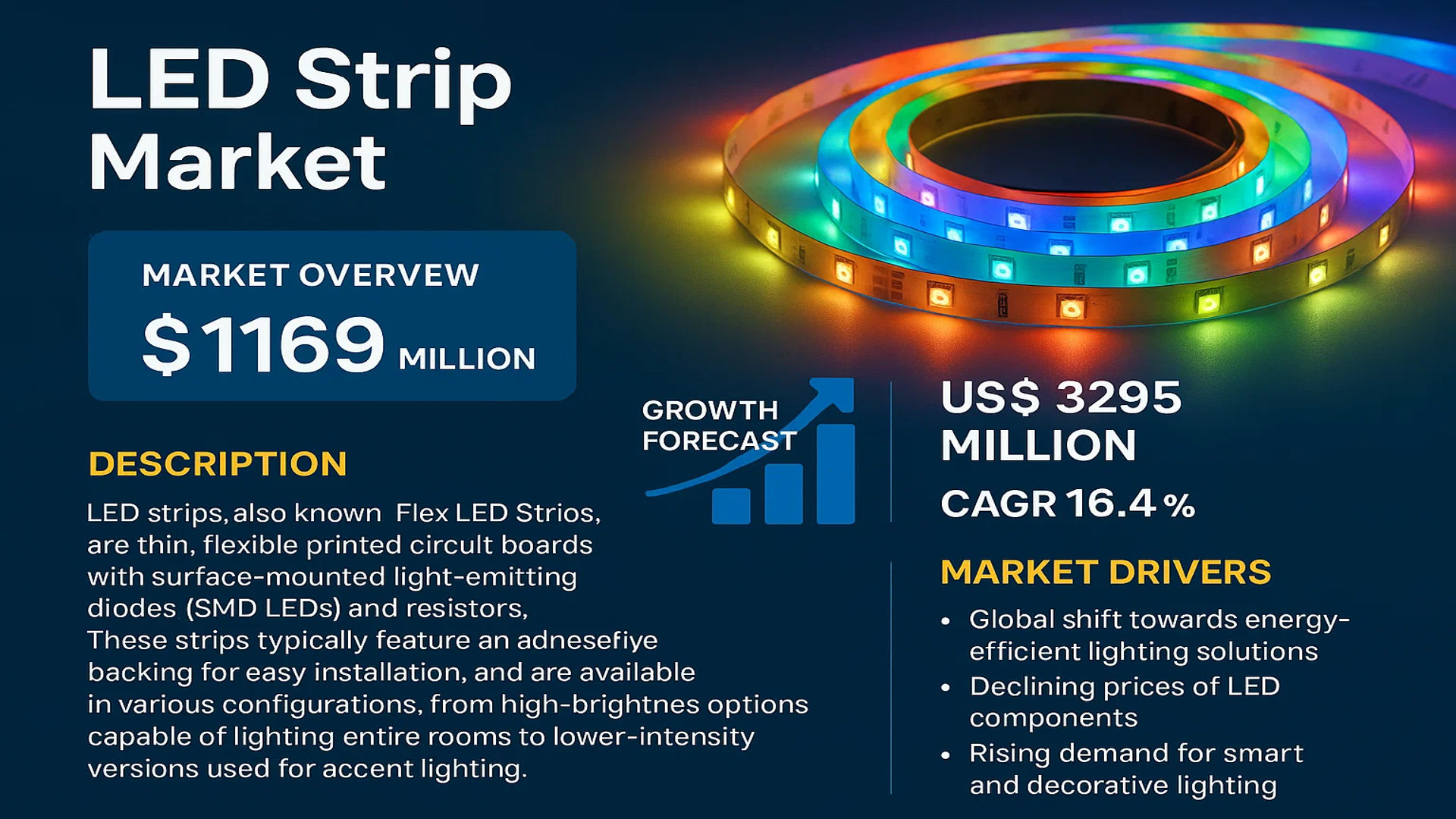
The global LED Strip Market was valued at 1169 million in 2024 and is projected to reach US$ 3295 million by 2032, at a CAGR of 16.4% during the forecast period.
LED Strips, also known as Flex LED Strips, are thin, flexible printed circuit boards populated with surface-mounted light-emitting diodes (SMD LEDs) and resistors. These strips typically feature an adhesive backing for easy installation and are available in various configurations, from high-brightness options capable of lighting entire rooms to lower-intensity versions used for accent lighting. A key advantage of LED flexible strips is their ability to be manufactured to emit any desired wavelength or color, making them highly versatile for both home and business projects.
The market is experiencing robust growth driven by several factors, including the global shift towards energy-efficient lighting solutions, declining prices of LED components, and rising demand for smart and decorative lighting in both residential and commercial sectors. Furthermore, technological advancements in connectivity, such as the integration with IoT and smart home systems, are significantly contributing to market expansion. The 5050 SMD type dominates the product segment, holding approximately 65% of the market share in 2024, due to its superior brightness and widespread application. Asia-Pacific is the largest regional market, accounting for about 40% of global revenue, followed by Europe at 30%, because of strong manufacturing bases and high adoption rates.
MARKET DYNAMICS
MARKET DRIVERS
Rising Demand for Energy-Efficient Lighting Solutions to Drive Market Expansion
The global push toward energy efficiency and sustainability is significantly accelerating the adoption of LED strip lighting. LED strips consume up to 80% less energy than traditional incandescent or fluorescent lighting, translating into substantial cost savings for both residential and commercial users. Governments worldwide are implementing stringent energy regulations and offering incentives for energy-efficient products, further propelling market growth. For instance, numerous countries have phased out inefficient lighting technologies, creating a favorable environment for LED adoption. The commercial sector, which accounts for over 50% of global LED strip consumption, is increasingly retrofitting existing lighting systems with LED strips to reduce operational costs and meet corporate sustainability targets.
Expansion of Smart Home and Building Automation to Boost Market Growth
The integration of LED strips with smart home systems and IoT-enabled devices is revolutionizing the lighting industry. These strips offer customizable lighting solutions that can be controlled via smartphones, voice assistants, or automated schedules, enhancing user convenience and energy management. The smart lighting market is projected to grow at a compound annual growth rate of over 20%, driven by increasing consumer preference for connected and automated environments. Features such as color tuning, dimming capabilities, and synchronization with other smart devices make LED strips a central component in modern home and office designs. This trend is particularly prominent in urban areas where smart infrastructure investments are rising rapidly.
Growing Applications in Architectural and Decorative Lighting to Fuel Demand
LED strips are increasingly being used in architectural lighting to highlight building facades, landscapes, and interior designs, creating visually appealing environments. The flexibility and variety of colors offered by LED strips allow designers to implement creative lighting solutions that were previously difficult to achieve. The hospitality and retail sectors are major adopters, using LED strips to enhance ambiance and attract customers. Additionally, the rise of social media has fueled demand for aesthetically pleasing lighting in residential spaces, with homeowners investing in LED strips for accent lighting, under-cabinet illumination, and decorative purposes. This broadening application spectrum is a key factor driving market growth.
MARKET RESTRAINTS
High Initial Costs and Price Sensitivity to Hinder Market Penetration
Despite the long-term cost benefits, the high initial investment required for quality LED strip lighting systems remains a significant barrier to adoption, especially in price-sensitive markets. Premium LED strips with advanced features such as high color rendering index (CRI), tunable white light, and smart connectivity command a price premium that can be prohibitive for budget-conscious consumers. In developing regions, where cost is a primary consideration, cheaper and often lower-quality alternatives may be preferred, impacting the market share of established brands. Furthermore, the need for additional components such as controllers, drivers, and connectors adds to the overall system cost, making the initial outlay more substantial than traditional lighting options.
Technical Challenges and Performance Consistency to Limit Growth
While LED technology has advanced significantly, issues such as color consistency, heat management, and longevity under continuous operation can affect performance and user satisfaction. Variations in color temperature and brightness across different batches or brands may lead to inconsistent lighting effects, particularly in large-scale installations. Heat dissipation remains a critical concern, as excessive heat can reduce the lifespan of LEDs and alter color output. Moreover, the market is flooded with products of varying quality, and consumers may face difficulties in identifying reliable options. These technical challenges necessitate stricter quality control and industry standards to ensure product reliability and performance.
Intense Market Competition and Fragmentation to Suppress Profit Margins
The LED strip market is highly competitive, with numerous players ranging from global giants to small regional manufacturers. This fragmentation often leads to price wars, eroding profit margins and discouraging investments in innovation. Smaller manufacturers may compromise on quality to offer lower prices, which can tarnish the reputation of LED technology as a whole. Additionally, the ease of entry into the market has resulted in a proliferation of brands, making it challenging for consumers to distinguish between high-quality and substandard products. This competitive landscape pressures established companies to continuously innovate while maintaining cost-effectiveness, which can strain resources and slow down market expansion.
MARKET CHALLENGES
Supply Chain Disruptions and Raw Material Shortages to Impede Market Stability
The LED strip market is susceptible to supply chain disruptions, as seen during global events that affect the availability of key components such as semiconductors, diodes, and printed circuit boards. Shortages in raw materials can lead to production delays, increased costs, and unmet demand, creating volatility in the market. For example, fluctuations in the prices of rare earth elements used in LED manufacturing can directly impact production costs and final product pricing. Additionally, geopolitical tensions and trade restrictions may further complicate sourcing strategies for manufacturers, requiring them to diversify their supply chains to mitigate risks.
Other Challenges
Regulatory Compliance and Standardization
Navigating diverse regional regulations and standards for electrical safety, energy efficiency, and environmental compliance poses significant challenges for manufacturers. Products must meet specific requirements in different markets, which can involve costly certifications and adaptations. The lack of global standardization often forces companies to develop region-specific products, increasing complexity and production costs.
Rapid Technological Obsolescence
The fast pace of innovation in LED technology means that products can become outdated quickly, leading to inventory write-offs and reduced consumer confidence in making long-term investments. Manufacturers must balance introducing cutting-edge features with ensuring backward compatibility and longevity, which requires careful planning and significant R&D investment.
MARKET OPPORTUNITIES
Emerging Applications in Horticulture and Healthcare to Open New Revenue Streams
LED strips are finding innovative applications beyond traditional lighting, such as in horticulture for optimized plant growth and in healthcare for therapeutic lighting solutions. In horticulture, specialized LED strips provide specific light spectra that enhance photosynthesis and improve crop yields, supporting the growing trend of urban farming and controlled environment agriculture. In healthcare, LED strips with adjustable color temperatures are used to create healing environments, regulate circadian rhythms, and reduce patient stress. These niche applications represent significant growth opportunities, as they cater to markets with specific needs and willingness to invest in advanced lighting solutions.
Advancements in Flexible and Organic LEDs to Revolutionize Product Design
Technological innovations such as flexible OLEDs and improved form factors are expanding the design possibilities for LED strips, enabling their use in curved surfaces, wearable technology, and unconventional spaces. These advancements allow for seamless integration into furniture, vehicles, and clothing, creating new markets and applications. The development of thinner, more efficient, and more durable LED strips is likely to attract industries such as automotive, fashion, and entertainment, where lighting is increasingly used as a design element rather than merely a functional component.
Growing Investments in Infrastructure and Urbanization to Drive Demand
Rapid urbanization and infrastructure development in emerging economies are creating substantial opportunities for LED strip applications in public spaces, transportation systems, and commercial complexes. Governments are investing in smart city projects that incorporate energy-efficient lighting for streets, parks, and buildings, driving demand for durable and versatile LED solutions. The tourism and entertainment sectors also contribute to this growth, using LED strips for decorative and safety purposes in hotels, restaurants, and event venues. These trends are expected to persist as cities worldwide prioritize sustainability and aesthetic improvements.
LED STRIP MARKET TRENDS
Smart Home Integration and IoT Connectivity Driving Market Evolution
The proliferation of smart home ecosystems is fundamentally reshaping the LED strip market, with a significant shift towards IoT-enabled and voice-controlled lighting solutions. These advanced strips now seamlessly integrate with platforms like Amazon Alexa, Google Assistant, and Apple HomeKit, allowing users to control lighting ambiance, color temperature, and schedules through simple voice commands or smartphone applications. This trend is further accelerated by the growing adoption of RGBIC (Red Green Blue Independent Control) technology, which enables individual control of LED segments on a single strip, creating dynamic lighting effects and patterns previously unattainable. The demand for these intelligent lighting solutions is a primary driver behind the market’s projected growth from its 2024 valuation to over 3295 million by 2032. Furthermore, the development of matter-compatible LED strips ensures future-proof interoperability across different smart home brands, a critical factor for consumers building integrated smart environments.
Other Trends
Energy Efficiency and Sustainability Mandates
Global regulatory pressures and rising energy costs are compelling both consumers and businesses to prioritize energy-efficient lighting. LED strips consume up to 75% less energy than traditional incandescent or halogen lighting solutions, making them a cornerstone of sustainable building practices. This is particularly impactful in the commercial segment, which holds the largest application share, where reducing operational overhead is a key concern. Government initiatives, such as the European Union’s Ecodesign Directive, continue to phase out less efficient lighting technologies, creating a regulatory tailwind for LED adoption. The inherent longevity of LED technology, with many strips rated for 50,000 hours or more of operation, also aligns with circular economy principles by reducing electronic waste, a factor increasingly influencing procurement decisions in both residential and commercial projects.
Miniaturization and Enhanced Flexibility in Product Design
Manufacturers are relentlessly pursuing miniaturization of SMD (Surface-Mounted Device) LEDs to create slimmer, more flexible, and less obtrusive lighting solutions. While the 5050 LED type currently dominates the market with approximately a 65% share, there is growing traction for smaller form factors like 3528 and even more compact variants such as 2835 and 2020. This trend is driven by demand from architectural and interior design applications where discreet, seamless integration is paramount. These smaller LEDs allow for tighter bend radii and installation in constrained spaces, unlocking new applications in furniture, coves, and automotive lighting. Concurrently, advancements in flexible printed circuit board (PCB) materials have improved the durability and reliability of these strips, ensuring consistent performance even when bent or shaped around complex geometries. This evolution in product design is expanding the addressable market beyond traditional accent lighting into functional and architectural illumination.
COMPETITIVE LANDSCAPE
Key Industry Players
Companies Strive to Strengthen their Product Portfolio to Sustain Competition
The global LED Strip market exhibits a semi-consolidated competitive structure, characterized by the presence of numerous international giants, regional specialists, and agile smaller manufacturers. This dynamic is particularly evident in the Asia-Pacific region, which commands approximately 40% of the global market share, making it the epicenter of both production and consumption. While the top five manufacturers collectively hold a significant portion of the market—estimated at around 25%—the landscape remains fiercely competitive due to low barriers to entry in certain segments and continuous technological innovation.
OML Technology and Jiasheng Lighting are prominent players, leveraging their strong manufacturing bases in Asia to achieve cost efficiencies and scale. Their growth is heavily driven by the massive domestic demand and their role as key exporters to global markets. Conversely, established lighting giants like Signify (Philips) and LEDVANCE (a successor to parts of OSRAM’s business) maintain leadership through brand reputation, extensive distribution networks, and a focus on high-value, smart, and connected lighting solutions. These companies compete not just on product quality but also on the strength of their ecosystem integrations and warranty offerings.
Furthermore, the competitive intensity is escalating as companies aggressively expand their portfolios. This includes launching strips with higher lumen outputs, improved color rendering indices (CRI >90), and advanced features such as addressable LEDs (e.g., WS2812B), weatherproofing (IP67/IP68 ratings for outdoor use), and compatibility with smart home platforms like Google Home, Amazon Alexa, and Apple HomeKit. Strategic mergers, acquisitions, and partnerships are common tactics to quickly acquire new technology and gain access to fresh sales channels.
Meanwhile, companies like Forge Europa and Ledridge Lighting are strengthening their positions by focusing on niche applications and professional installers, offering tailored solutions and superior technical support. Their strategy involves deep vertical integration and significant investments in R&D to differentiate their products in a crowded marketplace, ensuring sustained growth and relevance.
List of Key LED Strip Companies Profiled
- Signify (Philips) (Netherlands)
- LEDVANCE (Germany)
- OML Technology (China)
- Jiasheng Lighting (China)
- Forge Europa (UK)
- Ledridge Lighting (UK)
- Digital Advanced Lighting (U.S.)
- Lighting Ever (U.S.)
- LEDMY (China)
Segment Analysis:
By Type
5050 LED Strip Segment Dominates the Market Due to Superior Brightness and Versatility
The market is segmented based on type into:
- 5050
- Characteristics: Contains three 5.0mm x 5.0mm LEDs per segment, offering high lumen output and vibrant RGB color mixing capabilities.
- 3528
- Characteristics: Features smaller 3.5mm x 2.8mm LEDs, providing a lower profile and more energy-efficient option suitable for subtle accent lighting.
- Others
- Subtypes: Includes 2835, 3014, and high-density variants like 5054 and 5060, catering to specialized applications requiring specific lumen packages or form factors.
By Application
Commercial Application Segment Leads Due to Extensive Use in Retail, Hospitality, and Architectural Lighting
The market is segmented based on application into:
- Home Application
- Commercial Application
By End User
Retail and Hospitality Sectors Drive Demand for Enhanced Ambiance and Visual Merchandising
The market is segmented based on end user into:
- Residential
- Retail
- Hospitality
- Corporate Offices
- Others
By Installation Type
Indoor Installation Holds Majority Share Owing to Widespread Use in Interior Design and Architectural Features
The market is segmented based on installation type into:
- Indoor
- Outdoor
Regional Analysis: LED Strip Market
Asia-Pacific
As the dominant global market, Asia-Pacific holds approximately 40% of the total LED strip market share, driven by massive manufacturing capabilities and robust domestic consumption. China is the undisputed leader, serving as both the primary production hub and the largest consumer market. The region benefits from extensive supply chain integration, with key manufacturers like OML Technology and Jiasheng Lighting headquartered here. High-volume, cost-effective production of popular SMD types, particularly the 5050 variant which commands about 65% of the product segment, fuels both local demand and global exports. Rapid urbanization, rising disposable incomes, and extensive commercial infrastructure development, especially in China, India, and Southeast Asia, are primary growth drivers. The commercial application segment is the largest, utilizing LED strips for retail lighting, architectural accents, and hospitality settings. While the market is highly competitive and price-sensitive, there is a growing trend toward higher-quality, smart, and energy-efficient solutions.
Europe
Europe represents the second-largest market, accounting for roughly 30% of global LED strip consumption. The region is characterized by stringent energy efficiency and environmental regulations, such as the EU’s Ecodesign Directive, which drive demand for high-quality, durable, and sustainable lighting solutions. Countries like Germany, the UK, and France are at the forefront, with strong emphasis on innovation and smart home integration. The market is less price-driven than Asia-Pacific, with a higher preference for premium brands, advanced features like tunable white and RGBIC, and robust technical support. Commercial applications remain significant, but the home application segment is growing rapidly due to increased consumer interest in ambient and decorative lighting. Leading companies such as LEDVANCE and Forge Europa have a strong presence here, focusing on product reliability, compliance, and aesthetic integration into modern architectural designs.
North America
The North American market is a significant and mature region, characterized by high consumer spending power and a strong focus on technological innovation and energy savings. Strict energy codes, including Title 24 in California and Energy Star specifications, push adoption of high-efficiency LED lighting solutions. The United States is the largest national market within the region, driven by robust demand from both the residential and commercial sectors. Home applications are particularly strong, with DIY enthusiasts and smart home integrators utilizing LED strips for under-cabinet lighting, entertainment setups, and accent lighting. The market shows a pronounced trend toward smart, Wi-Fi and Bluetooth-enabled strips that integrate with popular ecosystems like Amazon Alexa and Google Home. While competition from lower-cost imports exists, there is solid brand loyalty toward companies offering superior warranties, local customer support, and innovative features.
South America
The South American market for LED strips is emerging and presents a mixed landscape of opportunities and challenges. Economic volatility in key countries like Brazil and Argentina often impacts consumer purchasing power and large-scale commercial projects, leading to a higher sensitivity to price over advanced features. However, the region is experiencing gradual growth driven by urbanization, infrastructure development, and the increasing replacement of traditional lighting with more efficient LED solutions. The market is currently dominated by more basic, cost-effective products, often imported from Asia. The commercial application segment, including retail and hospitality, shows the most consistent demand. While adoption of smart and high-end LED strips is limited, the long-term potential is significant as economic conditions stabilize and awareness of energy savings increases.
Middle East & Africa
This region represents an emerging market with strong future growth potential, though it currently accounts for a smaller share of global consumption. Development is largely concentrated in more affluent and urbanized nations such as the UAE, Saudi Arabia, Israel, and Turkey. These countries are investing heavily in modern infrastructure, luxury hospitality, and large-scale retail developments, which drives demand for architectural and commercial LED lighting solutions. The market is characterized by a preference for durable and high-brightness products suitable for harsh environmental conditions. However, growth is sometimes constrained by reliance on imports, complex supply chains, and limited local manufacturing. While the adoption of advanced smart lighting is in its early stages, the region’s focus on grandiose architectural projects and tourism infrastructure provides a solid foundation for increased LED strip integration in the coming years.
Report Scope
This market research report provides a comprehensive analysis of the global LED Strip market, covering the forecast period 2025–2032. It offers detailed insights into market dynamics, technological advancements, competitive landscape, and key trends shaping the industry.
Key focus areas of the report include:
- Market Size & Forecast: Historical data and future projections for revenue, unit shipments, and market value across major regions and segments.
- Segmentation Analysis: Detailed breakdown by product type, technology, application, and end-user industry to identify high-growth segments and investment opportunities.
- Regional Outlook: Insights into market performance across North America, Europe, Asia-Pacific, Latin America, and the Middle East & Africa, including country-level analysis where relevant.
- Competitive Landscape: Profiles of leading market participants, including their product offerings, R&D focus, manufacturing capacity, pricing strategies, and recent developments such as mergers, acquisitions, and partnerships.
- Technology Trends & Innovation: Assessment of emerging technologies, integration of AI/IoT, semiconductor design trends, fabrication techniques, and evolving industry standards.
- Market Drivers & Restraints: Evaluation of factors driving market growth along with challenges, supply chain constraints, regulatory issues, and market-entry barriers.
- Stakeholder Analysis: Insights for component suppliers, OEMs, system integrators, investors, and policymakers regarding the evolving ecosystem and strategic opportunities.
Primary and secondary research methods are employed, including interviews with industry experts, data from verified sources, and real-time market intelligence to ensure the accuracy and reliability of the insights presented.
FREQUENTLY ASKED QUESTIONS:
What is the current market size of Global LED Strip Market?
-> LED Strip Market was valued at 1169 million in 2024 and is projected to reach US$ 3295 million by 2032, at a CAGR of 16.4% during the forecast period.
Which key companies operate in Global LED Strip Market?
-> Key players include OML Technology, Jiasheng Lighting, LEDVANCE, Philips, Forge Europa, Ledridge Lighting, Digital Advanced Lighting, Lighting Ever, and LEDMY, among others.
What are the key growth drivers?
-> Key growth drivers include rising demand for energy-efficient lighting, smart home integration, architectural lighting applications, and declining manufacturing costs of LEDs.
Which region dominates the market?
-> Asia-Pacific is the largest market, holding a share of approximately 40%, followed by Europe with a share of about 30%.
What are the emerging trends?
-> Emerging trends include the integration of IoT for smart lighting control, the development of higher-density RGB strips, increased adoption of tunable white lighting, and the use of sustainable materials in manufacturing.

Get Sample Report PDF for Exclusive Insights
Report Sample Includes
- Table of Contents
- List of Tables & Figures
- Charts, Research Methodology, and more...
 Download Sample Report PDF



