
LED Grille Downlights Market Insights
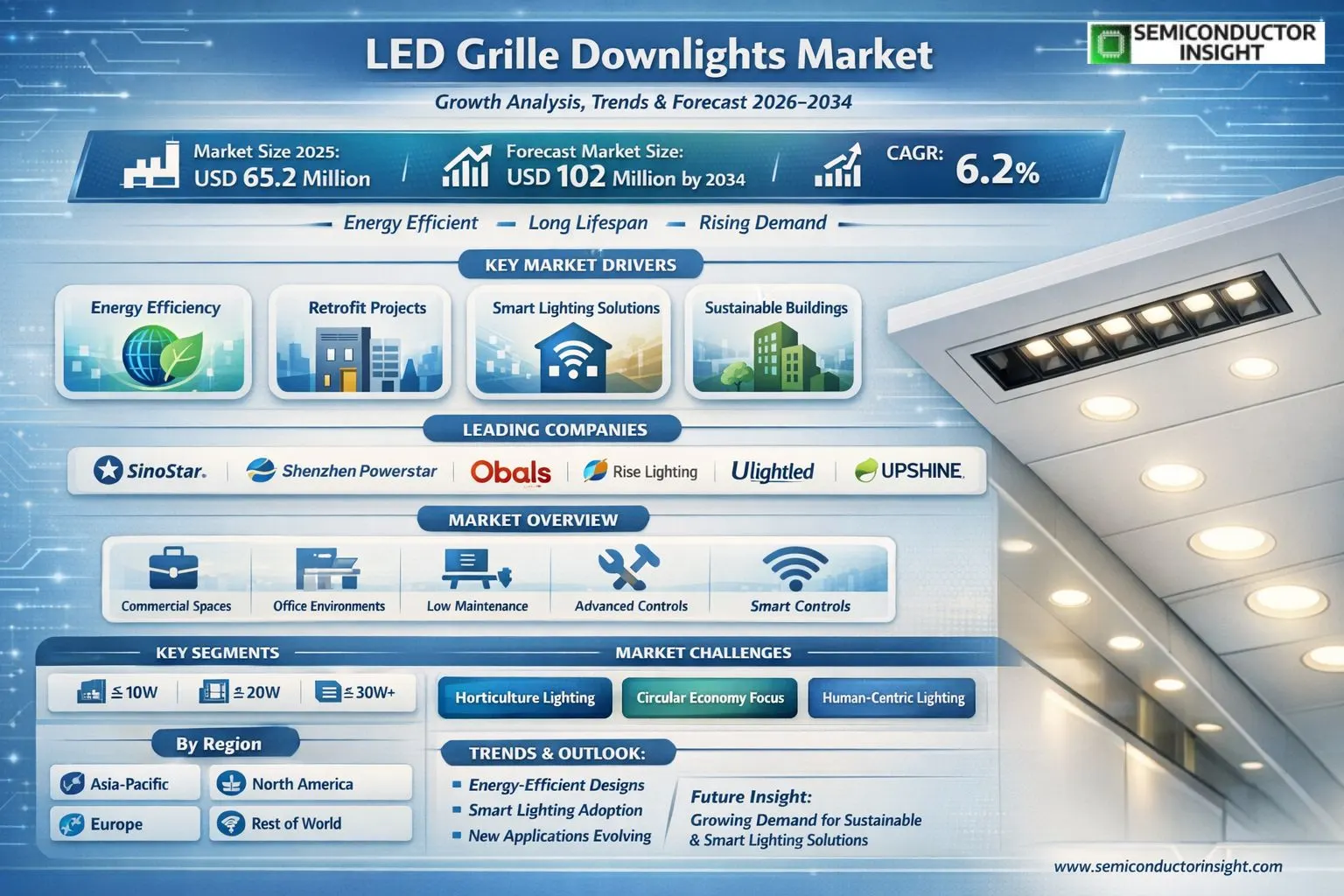
Global LED grille downlights market size was valued at USD 65.2 million in 2025. The market is projected to grow from USD 69.1 million in 2026 to USD 102 million by 2034, exhibiting a CAGR of 6.2% during the forecast period.
LED grille downlights are recessed lighting fixtures that feature a grid-like or grille design, often used for focused, efficient, and uniform illumination. They use LED technology as the light source, offering advantages like energy efficiency, long lifespan exceeding 50,000 hours, and low maintenance. The grille design helps in directing light precisely and reducing glare significantly compared to open fixtures, making them ideal for creating well-lit environments with a modern aesthetic in commercial and office settings.
The market is experiencing steady growth due to several factors, including stringent global energy efficiency regulations like the EU’s Ecodesign Directive and rising demand for sustainable building solutions under certifications such as LEED and BREEAM. Furthermore, the ongoing retrofit of traditional halogen and fluorescent lighting in existing commercial infrastructure presents a substantial opportunity. Initiatives by key players focusing on smart lighting integration with IoT controls and human-centric lighting designs are also expected to fuel market growth. For instance, manufacturers are increasingly incorporating tunable white technology and wireless dimming capabilities into their grille downlight portfolios to cater to advanced architectural projects.
MARKET DRIVERS
Stringent Global Energy Efficiency Mandates
Global shift towards energy conservation is a primary driver for LED Grille Downlights Market. Governments and regulatory bodies worldwide are implementing strict building codes and phasing out inefficient lighting. LED grille downlights, offering exceptional luminous efficacy and significantly lower power consumption than traditional halogen or fluorescent downlights, are becoming the mandated choice for new constructions and retrofits. This regulatory push creates consistent, long-term demand across commercial, industrial, and residential segments, with the retrofit market showing particularly strong growth momentum as older systems are upgraded.
Advancements in Smart Building Integration
The rise of smart homes and intelligent commercial buildings is accelerating the adoption of sophisticated lighting solutions. Modern LED Grille Downlights Market products are increasingly designed with embedded sensors and compatibility with IoT platforms and lighting control systems like DALI and Zigbee. This allows for features such as daylight harvesting, occupancy sensing, personalized dimming, and integration into broader building management systems. The value proposition extends beyond illumination to include energy data analytics and enhanced user experience, making them a critical component in premium and intelligent building projects.
➤ The operational cost savings are substantial. High-quality LED grille downlights can reduce lighting energy consumption by over 50% and have a lifespan exceeding 50,000 hours, dramatically cutting maintenance and replacement costs.
Furthermore, architectural and interior design trends favoring minimalist aesthetics and cleaner ceiling lines bolster the market. The sleek, unobtrusive design of grille downlights provides high-quality, glare-controlled illumination without visual clutter, making them a preferred specification for architects and designers in retail, hospitality, and corporate environments where ambiance and visual appeal are paramount.
MARKET CHALLENGES
Intense Price Competition and Margin Pressure
LED Grille Downlights Market is characterized by high fragmentation, particularly in the mid-to-low-tier segments. The presence of numerous regional and local manufacturers, coupled with the commoditization of basic LED components, leads to intense price competition. This pressure squeezes profit margins for manufacturers and can incentivize cost-cutting that may compromise product quality, thermal management, or driver reliability, potentially tarnishing the product category’s reputation if substandard fixtures fail prematurely.
Other Challenges
Technical Complexity in System Integration
Successfully integrating dimmable or smart LED grille downlights into existing electrical infrastructure can be challenging. Incompatibilities between LED drivers, dimmer switches, and control systems can lead to performance issues like flickering, buzzing, or limited dimming range, requiring specialist knowledge for troubleshooting and installation, which can deter some contractors and end-users.
Supply Chain Volatility for Critical Components
The market remains susceptible to disruptions in the supply of key raw materials and electronic components, such as semiconductors used in LED drivers and control chips. Geopolitical tensions, trade policies, and global demand fluctuations can cause price volatility and lead times for these components, impacting manufacturing schedules and final product cost stability for LED Grille Downlights Market.
MARKET RESTRAINTS
High Initial Investment and Perceived Value
While the total cost of ownership for LED grille downlights is favorable, the higher upfront cost compared to conventional fixtures remains a significant restraint, especially in price-sensitive markets and for small-to-medium contractors. Decision-makers often focus on the initial purchase price rather than the long-term savings on energy and maintenance. This necessitates extensive education and clear ROI calculations from suppliers and specifiers to overcome budget-driven purchasing decisions that can slow adoption rates in certain segments.
MARKET OPPORTUNITIES
Expansion in Horticulture and Specialized Lighting
Beyond general illumination, a significant opportunity lies in adapting LED grille downlight technology for specialized applications. In horticulture lighting, fixtures with specific spectral outputs for plant growth are in high demand for vertical farms and greenhouses. Similarly, there is growing potential in human-centric lighting, where tunable white LED grille downlights can adjust color temperature to support circadian rhythms in healthcare, education, and office environments, creating high-value, specialized market niches.
Growth of Sustainable and Circular Economy Models
The increasing focus on sustainability and circular economy principles presents a forward-looking opportunity. Manufacturers in LED Grille Downlights Market can differentiate by designing products for easier disassembly, using recycled materials, and establishing take-back programs for end-of-life fixtures to recover valuable components. Offering lighting-as-a-service (LaaS) models, where customers pay for light rather than hardware, aligns with this trend and can make advanced, efficient lighting solutions more accessible while ensuring proper product lifecycle management.
LED Grille Downlights Market Trends
Energy Efficiency as a Core Architectural Design Imperative
The primary trend shaping LED Grille Downlights Market is the deep integration of energy-efficient lighting into modern architectural planning. These fixtures, which provide focused illumination using an efficient grille design, are now a standard specification in new commercial and office buildings due to stringent energy codes and corporate sustainability goals. The transition from conventional downlights to LED-based solutions is largely complete in developed economies, shifting the driver from replacement to performance optimization. This demand for high-quality, low-maintenance lighting that delivers precise light distribution with minimal glare ensures continuous market evolution towards more sophisticated and integrated LED grille downlight systems.
Other Trends
Smart and Connected Lighting Integration
There is a significant trend towards integrating LED grille downlights with building management and IoT systems. Modern fixtures are increasingly designed to be compatible with sensors and controls, enabling features like daylight harvesting, occupancy-based dimming, and centralized energy monitoring. This transforms them from static light sources into dynamic components of a smart building’s infrastructure, delivering further operational savings and enhanced user experiences in commercial spaces.
Advancements in Product Segmentation by Power and Application
The market exhibits clear segmentation, with distinct trends for different power ratings such as below 10W, 20W, and 30W models, each catering to specific lighting requirements for ambient, task, or accent illumination. Concurrently, application-specific design is prominent, with fixtures being tailored for high-ceiling commercial atriums, office workstations, or retail environments, focusing on optimal color rendering and thermal management to ensure longevity and consistent performance.
Consolidation and Innovation in a Competitive Vendor Landscape
A trend of competitive consolidation is observed alongside continuous product innovation. Leading manufacturers are focusing on enhancing luminous efficacy, improving thermal dissipation designs, and offering modular systems for easier installation and maintenance. Global vendor landscape includes established players and specialized manufacturers, all competing on the basis of product reliability, efficiency certifications, and the ability to provide comprehensive lighting solutions for large-scale projects.
Regional Market Development and Standardization
Market development is progressing at different rates globally, with mature regions focusing on upgrades and retrofits, while emerging economies are adopting LED grille downlights in new construction. This has led to a trend towards greater product standardization to meet international safety and performance norms, facilitating global supply chains. Simultaneously, regional preferences for specific color temperatures and form factors continue to influence product offerings, requiring manufacturers to balance global efficiency standards with localized aesthetic and application demands.
COMPETITIVE LANDSCAPE
Key Industry Players
A Consolidated Market with Strong Specialization
Global LED Grille Downlights market exhibits a moderately consolidated structure, dominated by a core group of established manufacturers with significant technical expertise and global distribution networks. Among these, SinoStar Lighting stands out as a leading player, frequently capturing a notable share of market revenue. The competitive landscape is driven by factors such as energy efficiency, product longevity, and the ability to provide focused, glare-reducing illumination for commercial and office environments. Innovation in areas like higher power segments (e.g., 30W models) and smart lighting integration is becoming a key differentiator as the market grows from an estimated $65.2 million in 2025 towards a projected $102 million by 2034.
Beyond the top-tier leaders, the market is diversified by a range of significant niche players. Companies such as Shenzhen Powerstar Technology Co. Ltd., Obals Lighting, and Ulightled compete intensely on value, product reliability, and regional market penetration. Other prominent manufacturers include UPSHINE Lighting and VELLNICE, which have carved out strong positions through specialized offerings for commercial building applications. The competitive dynamics are further shaped by numerous other established firms focusing on cost-optimized manufacturing and supply chain efficiency, particularly from key production regions in Asia.
List of Key LED Grille Downlights Companies Profiled
- SinoStar Lighting
- Shenzhen Powerstar Technology Co. Ltd.
- Obals Lighting
- Rise Lighting
- Ulightled
- UPSHINE Lighting
- VELLNICE
- Zhongshan Fromlux Photoelectric Co Limited
- Allway Lighting Electric Co.,ltd
- SHENZHEN CREP OPTOELECTRONICS CO.,LTD
- MaxLite
- LEDVANCE GmbH
- SLS Lighting
- Foshan Lighting (FSL)
- NVC Lighting Technology
Segment Analysis:
| Segment Category | Sub-Segments | Key Insights |
| By Type |
|
Power ≤ 20W segment typically demonstrates leading traction due to its optimal balance between illumination output and energy efficiency, making it a versatile choice. This segment appeals to a broad range of projects as it provides sufficient brightness for general commercial and office applications without excessive power draw. The growth is further underpinned by its alignment with mainstream building codes and sustainability standards, which favor efficient yet effective lighting solutions. |
| By Application |
|
Commercial Building segment represents the primary and most dynamic application area for LED grille downlights. The grille design is particularly valued in retail spaces, hotels, and lobbies for its ability to provide focused, uniform illumination while minimizing glare, which enhances visual merchandising and customer experience. Persistent demand is driven by commercial retrofit projects and new constructions prioritizing modern aesthetics coupled with long-term operational cost savings from LED technology. |
| By End User |
|
Facility Management & Contractors segment is a leading and influential end-user group due to their role in specifying and implementing lighting systems during construction, renovation, and maintenance. Their preference for LED grille downlights is shaped by the product’s durability, ease of maintenance, and energy efficiency, which directly translate to lower total cost of ownership for the buildings they manage. This group’s decisions are heavily influenced by lifecycle cost analysis and vendor reliability. |
| By Mounting & Integration |
|
Retrofit & Renovation segment is experiencing significant growth as a leading market driver. The transition from traditional lighting to LED grille downlights in existing buildings is a major trend, fueled by the compelling need for energy savings and modern lighting quality. Products designed for easy retrofit installations, which minimize structural changes and downtime, are in high demand. This segment’s expansion is closely tied to corporate sustainability initiatives and regulatory incentives for energy-efficient upgrades. |
| By Sales Channel |
|
Direct Sales / Project Bidding segment remains the dominant channel for high-volume and specification-grade projects. This channel allows manufacturers like SinoStar Lighting and Obals Lighting to work closely with contractors, architects, and large end-users, providing tailored solutions and technical support. The complexity of commercial lighting projects, which require precise specifications, compliance assurance, and after-sales service, naturally favors this direct engagement model over fragmented retail approaches. |
Regional Analysis: LED Grille Downlights Market
Asia-Pacific
The region’s dense network of component suppliers and finished goods manufacturers creates a highly competitive and cost-effective supply chain for LED grille downlights, enabling rapid response to global market trends and customization requests from international buyers.
Government-led phase-outs of inefficient lighting and green building certification programs mandate the use of advanced LED lighting, directly propelling the adoption of energy-saving LED grille downlights in both new constructions and retrofit projects.
Booming commercial real estate, hospitality, and retail infrastructure demand minimalist and high-performance lighting solutions, making the sleek design and superior light output of modern LED grille downlights a preferred specification for architects and designers.
Local companies are aggressively integrating smart lighting features, such as wireless dimming and color tuning, into their LED grille downlight product lines, catering to the growing premium segment and the connected home and office markets.
North America
North America represents a sophisticated and high-value segment of LED Grille Downlights Market, characterized by stringent performance standards and a strong inclination toward premium, smart-enabled products. The United States and Canada see robust demand driven by commercial retrofits aimed at achieving significant energy savings and obtaining LEED or WELL building certifications. The market is highly influenced by professional specifiers,architects, lighting designers, and electrical contractors,who prioritize quality, durability, and seamless integration with building management systems. A noticeable trend is the convergence of lighting with IoT, where grille downlights are specified as part of broader smart office and home automation ecosystems. High consumer awareness regarding energy costs and light quality ensures steady replacement demand, supporting a mature yet innovative regional market for advanced LED downlighting solutions.
Europe
Europe’s LED Grille Downlights Market is propelled by some of the world’s most rigorous environmental directives and a deep-seated culture of architectural design excellence. The EU’s Ecodesign and energy labeling regulations continuously push the boundaries for luminaire efficiency, directly benefiting the adoption of advanced LED downlights. Markets like Germany, the UK, and the Nordic countries demonstrate high demand in both high-end commercial projects and residential renovations, with a focus on design aesthetics, light quality (CRI and TM-30), and product longevity. The region is also a leader in human-centric lighting, influencing product development for grille downlights that offer tunable white light and circadian support. The competitive landscape features strong local brands competing on quality and design, alongside strict enforcement of safety and performance standards.
Middle East & Africa
The region’s market expansion is tied to large-scale infrastructure and tourism development, particularly in the GCC nations. Iconic commercial projects, luxury hotels, and sprawling retail malls specify LED grille downlights for their ability to provide consistent, glare-free illumination in high-ceiling applications, aligning with opulent architectural themes. There is a growing focus on sustainability and reducing the immense cooling loads in buildings, making energy-efficient LED lighting a key consideration. While the market in Africa is more nascent, urban development in key economic centers is beginning to drive demand for modern lighting solutions. The overall market dynamic is project-driven, with specifications often favoring brands that offer robust after-sales support and products capable of withstanding harsh climatic conditions.
South America
South America’s market is emerging, with growth primarily concentrated in major urban centers undergoing commercial modernization. Countries like Brazil and Chile are seeing increased adoption of LED grille downlights in corporate offices, retail chains, and hospitality venues, motivated by rising electricity costs and a gradual shift toward more sustainable building practices. The market is price-sensitive but shows growing appreciation for higher-quality products that offer better reliability and longevity. Economic fluctuations can impact the pace of new construction, but the retrofit sector presents a consistent opportunity as businesses seek to modernize existing spaces. Distribution through electrical wholesalers and relationships with local contractors are critical for success in this developing region of Global LED Grille Downlights Market.
Report Scope
This market research report provides a comprehensive analysis of the LED Grille Downlights Market , covering the forecast period 2026–2034. It offers detailed insights into market dynamics, technological advancements, competitive landscape, and key trends shaping the industry.
Key focus areas of the report include:
- Market Overview: The report begins with an overview outlining its current market scenario, key growth indicators, and industry transformation drivers. It discusses macroeconomic factors, demand–supply balance, regulatory landscape, and the strategic role of semiconductors in powering advancements across industries such as automotive, telecommunications, consumer electronics, and industrial automation.
- Market Size & Forecast: Historical data and future projections for revenue, unit shipments, and market value across major regions and segments.
- Segmentation Analysis: Detailed breakdown by product type, technology, application, and end-user industry to identify high-growth segments and investment opportunities.
- Regional Insights: Insights into market performance across North America, Europe, Asia-Pacific, Latin America, and the Middle East & Africa, including country-level analysis where relevant.
- Competitive Landscape: Profiles of leading market participants, including their product offerings, R&D focus, manufacturing capacity, pricing strategies, and recent developments such as mergers, acquisitions, and partnerships.
- Technology Trends & Innovation: Assessment of emerging technologies, integration of AI/IoT, semiconductor design trends, fabrication techniques, and evolving industry standards.
- Market Drivers & Restraints: Evaluation of factors driving market growth along with challenges, supply chain constraints, regulatory issues, and market-entry barriers.
- Stakeholder Insights: Insights for component suppliers, OEMs, system integrators, investors, and policymakers regarding the evolving ecosystem and strategic opportunities.
Primary and secondary research methods are employed, including interviews with industry experts, data from verified sources, and real-time market intelligence to ensure the accuracy and reliability of the insights presented.
FREQUENTLY ASKED QUESTIONS:
What is the current market size of LED Grille Downlights Market?
-> Global LED Grille Downlights Market was valued at USD 65.2 million in 2025 and is projected to reach USD 102 million by 2034, growing at a CAGR of 6.2% during the forecast period.
Which key companies operate in LED Grille Downlights Market?
-> Key players include SinoStar Lighting, Shenzhen Powerstar Technology Co. Ltd., Obals Lighting, Rise Lighting, Ulightled, UPSHINE Lighting, VELLNICE, Zhongshan Fromlux Photoelectric Co Limited, Allway Lighting Electric Co.,ltd, and SHENZHEN CREP OPTOELECTRONICS CO.,LTD, among others.
What are the key growth drivers?
-> Key growth drivers include demand for energy-efficient lighting, long lifespan and low maintenance advantages of LED technology, and the need for focused, uniform illumination with reduced glare in modern commercial and office spaces.
Which region dominates the market?
-> The U.S. holds a significant market size, while China is a key growing market. Regional analysis covers North America, Europe, Asia, South America, and the Middle East & Africa.
What are the emerging trends?
-> Emerging trends include advancements in LED technology for greater efficiency, the adoption of smart lighting controls, and the integration of downlights in sustainable building designs for commercial and office applications.

Get Sample Report PDF for Exclusive Insights
Report Sample Includes
- Table of Contents
- List of Tables & Figures
- Charts, Research Methodology, and more...
 Download Sample Report PDF


