MARKET INSIGHTS
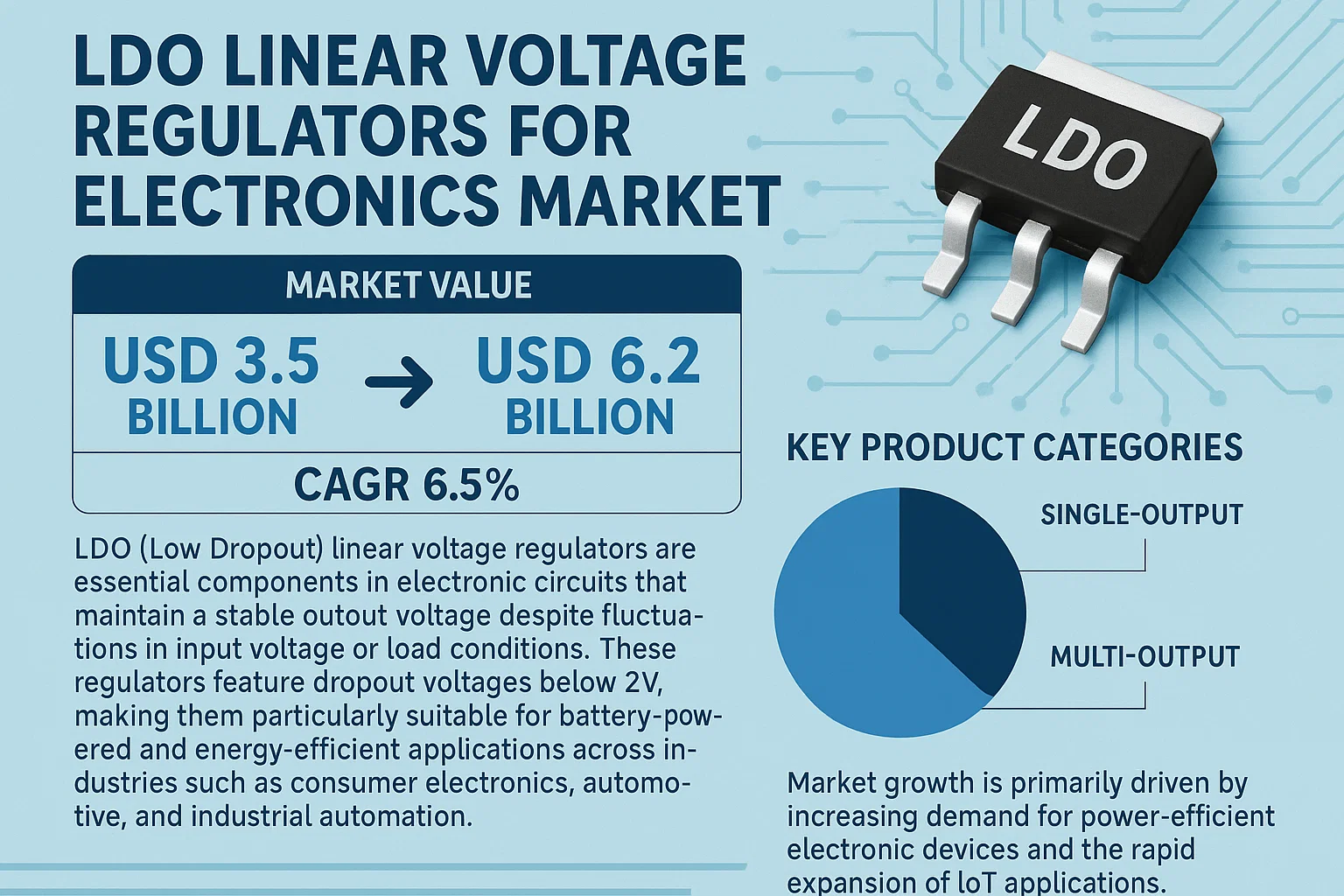
Global LDO Linear Voltage Regulators for Electronics market was valued at USD 3.5 billion in 2024 to USD 6.2 billion by 2032, exhibiting a CAGR of 6.5% during the forecast period.
LDO (Low Dropout) linear voltage regulators are essential components in electronic circuits that maintain a stable output voltage despite fluctuations in input voltage or load conditions. These regulators feature dropout voltages below 2V, making them particularly suitable for battery-powered and energy-efficient applications across industries such as consumer electronics, automotive, and industrial automation. Key product categories include single-output and multi-output LDO regulators, which cater to diverse voltage regulation needs.
The market growth is primarily driven by increasing demand for power-efficient electronic devices and the rapid expansion of IoT applications. However, the industry faces challenges from the growing adoption of switching regulators in high-current applications. Major players like Texas Instruments, STMicroelectronics, and Analog Devices continue to innovate, with recent developments focusing on ultra-low-noise LDOs for sensitive audio applications and high-PSRR regulators for 5G infrastructure.
MARKET DYNAMICS
MARKET DRIVERS
Proliferation of Portable and Battery-Powered Electronics to Drive Market Growth
The exponential growth in portable and battery-powered electronic devices, including smartphones, wearables, IoT sensors, and medical devices, is a primary driver for the LDO linear voltage regulator market. These regulators are essential for providing stable, low-noise power to sensitive components, especially in applications where space and power efficiency are critical. With the global smartphone market projected to exceed 1.5 billion units annually and the wearable technology segment growing at over 15% CAGR, the demand for efficient power management solutions like LDOs is surging. Their ability to operate with very low dropout voltages—often below 200mV in advanced models—makes them ideal for extending battery life in energy-conscious designs.
Advancements in Automotive Electronics to Boost Market Expansion
The automotive industry’s rapid transition toward electrification, advanced driver-assistance systems (ADAS), and in-vehicle infotainment (IVI) systems is significantly boosting the adoption of LDO linear voltage regulators. These components are critical for powering sensors, microcontrollers, and communication modules that require clean and stable voltage rails amidst the electrically noisy environment of a vehicle. With the global automotive electronics market expected to surpass $400 billion by 2030, the integration of multiple LDOs per vehicle is becoming standard. Furthermore, the rise of electric vehicles, which utilize extensive electronic control units, is creating additional demand for reliable voltage regulation solutions that can operate efficiently across varying temperature and load conditions.
Growing Demand for High-Performance Computing and Data Centers
High-performance computing (HPC) applications and data centers are increasingly relying on LDO regulators for point-of-load (POL) voltage regulation to ensure signal integrity and reduce noise in high-speed digital circuits. As data traffic continues to grow—with global IP traffic estimated to exceed 4.8 zettabytes by 2024—server manufacturers are incorporating more sophisticated power management architectures. LDOs are valued for their simplicity, accuracy, and excellent transient response in powering FPGAs, ASICs, and memory interfaces. The ongoing expansion of cloud infrastructure and edge computing facilities is further propelling the need for robust, efficient voltage regulation, supporting market growth.
Moreover, the trend toward miniaturization and higher integration in electronic systems is encouraging the development of multi-output LDO regulators, which consolidate several power rails into a single package, saving board space and simplifying design.
➤ For instance, leading semiconductor companies are introducing LDOs with ultra-low quiescent current, often below 1µA, enabling always-on applications in IoT and portable devices without significantly draining the battery.
Furthermore, the increasing investment in 5G infrastructure and the deployment of small cells are creating new opportunities for LDO usage in RF power amplifiers and baseband units, where stable voltage is crucial for performance.
MARKET CHALLENGES
Thermal Management and Efficiency Limitations in High-Current Applications
One of the significant challenges facing the LDO linear voltage regulator market is thermal dissipation, particularly in applications requiring higher output currents. Since LDOs operate in a linear mode, they dissipate power equal to the voltage difference between input and output multiplied by the load current. This can lead to substantial heat generation, necessitating larger packages or external heat sinks, which increase system size and cost. In high-current scenarios—such as powering modern processors or RF amplifiers—this inefficiency becomes a critical design constraint. For example, a 3A LDO with a 1V dropout can dissipate up to 3W of power, pushing junction temperatures beyond safe limits without adequate cooling solutions.
Other Challenges
Competition from Switching Regulators
The increasing efficiency and decreasing cost of switching regulators pose a substantial challenge to LDO adoption in many applications. Switching converters can achieve efficiencies above 90%, whereas LDOs are inherently less efficient, especially when the input-output voltage differential is large. In power-sensitive designs, such as battery-operated devices, this efficiency gap often leads designers to choose switching regulators despite their higher noise and more complex layout requirements.
Noise and Power Supply Rejection Ratio (PSRR) Constraints
While LDOs are valued for low output noise, achieving high PSRR at higher frequencies remains challenging. As digital circuits operate at increasingly higher speeds, noise from the power supply can significantly impact performance. Advanced LDOs must provide excellent noise rejection across a broad frequency spectrum, which requires sophisticated design and often higher quiescent current, trading off power efficiency for performance.
MARKET RESTRAINTS
Design Complexity and Cost Sensitivity in Consumer Electronics to Deter Market Growth
While LDO linear voltage regulators offer simplicity and reliability, their adoption in highly cost-sensitive consumer electronics segments is restrained by the availability of alternative integrated power management solutions. Many system-on-chip (SoC) and power management integrated circuits (PMICs) now incorporate multiple LDOs alongside switching regulators and other functions, reducing the need for discrete LDO components. This integration trend challenges standalone LDO sales, particularly in high-volume applications like smartphones and tablets, where every component cost and millimeter of board space is scrutinized.
Additionally, the design complexity associated with achieving very low dropout voltages—often requiring specialized process technologies like CMOS or bipolar-CMOS-DMOS (BCD)—increases manufacturing costs. These cost pressures are particularly acute in emerging markets, where price competition is intense.
Furthermore, the global semiconductor supply chain disruptions and fluctuations in raw material availability have occasionally led to increased lead times and pricing volatility, making it challenging for manufacturers to maintain consistent supply and cost structures.
MARKET OPPORTUNITIES
Expansion of IoT and Edge Devices to Provide Lucrative Growth Opportunities
The rapid proliferation of Internet of Things (IoT) devices and edge computing nodes is opening substantial opportunities for LDO linear voltage regulators. These applications often require ultra-low-power operation, minimal noise, and small form factors—attributes where LDOs excel. With billions of IoT devices expected to be deployed globally, spanning smart home systems, industrial sensors, and healthcare monitors, the demand for efficient, reliable voltage regulation is set to increase significantly. LDOs with nanoamp-level quiescent current are particularly well-suited for always-on applications, enabling extended battery life without compromising performance.
Moreover, the growing emphasis on energy harvesting in IoT devices—using sources such as light, heat, or vibration—creates additional opportunities for LDOs capable of operating with very low input voltages and providing stable output under varying conditions.
Additionally, the integration of advanced features such as programmability, fault protection, and digital interfaces in modern LDOs allows designers to implement more sophisticated power management schemes, further driving adoption in next-generation electronic systems.
LDO LINEAR VOLTAGE REGULATORS FOR ELECTRONICS MARKET TRENDS
Advancements in Low-Dropout (LDO) Voltage Regulators Drive Market Expansion
The global LDO Linear Voltage Regulators market is experiencing significant growth, driven by advancements in ultra-low-power semiconductor technologies and increasing demand for energy-efficient solutions. The market was valued at $X million in 2024 and is projected to reach $Y million by 2032, growing at a CAGR of Z% during the forecast period. A key driver is the adoption of LDO regulators with dropout voltages below 2V, which are increasingly preferred for battery-powered applications. These regulators offer improved efficiency and thermal performance, making them ideal for smartphones, wearables, and IoT devices that require stable power supplies with minimal noise.
Other Trends
Automotive Electronics Fueling Demand
The automotive sector is emerging as a major growth area for LDO regulators, particularly in electric vehicles (EVs) and advanced driver-assistance systems (ADAS). With automotive electronics requiring precise voltage regulation under varying load conditions, LDOs are increasingly being integrated into infotainment systems, sensors, and telematics units. The U.S. market alone accounts for $A million in 2024, while China is projected to reach $B million due to its rapidly expanding EV production capacity.
Single-Output LDO Regulators Dominate Market Share
The single-output LDO segment is expected to reach $C million by 2032, growing at a steady CAGR, due to their simplicity and widespread use in consumer electronics. Meanwhile, multi-output LDOs are gaining traction in complex PCB designs where space constraints demand integrated solutions. Leading manufacturers such as TI, Infineon, and STMicroelectronics collectively hold over XX% of the market share, leveraging their expertise in semiconductor innovation to develop low-noise, high-PSRR regulators for next-generation applications. Recent product launches also highlight a shift toward smaller form factors, such as wafer-level chip-scale packaging (WLCSP), enhancing their adoption in compact electronic devices.
COMPETITIVE LANDSCAPE
Key Industry Players
Semiconductor Giants Compete for Dominance in LDO Voltage Regulator Market
The global LDO (Low Dropout) Linear Voltage Regulators market features intense competition among established semiconductor companies, with the top five players holding approximately 60-65% market share in 2024. Texas Instruments (TI) emerges as the market leader, leveraging its extensive analog IC expertise and broad product portfolio spanning ultra-low-power to high-current LDO regulators. TI’s dominance stems from its robust R&D investments, which accounted for nearly 15% of its revenue in 2023, and strategic partnerships with automotive and consumer electronics manufacturers.
Analog Devices and STMicroelectronics follow closely, with both companies increasingly focusing on automotive-grade LDO solutions to capitalize on the growing electric vehicle market. Analog Devices recently launched its ADP176x series featuring ultra-low noise performance, while STMicroelectronics expanded its LD390xx portfolio with devices offering 300mA output current and 1% accuracy – critical specifications for IoT applications.
Emerging competition comes from ROHM Semiconductor and Microchip Technology, who are gaining traction through specialized low-quiescent-current regulators for battery-powered devices. ROHM’s BD7xxLx series, for instance, achieved market recognition for their 1µA standby current consumption, making them ideal for wearables and portable medical devices.
The competitive intensity continues to rise as companies pursue technological differentiation through:
- Advanced packaging techniques (e.g., wafer-level chip-scale packages)
- Integration of power management functions (voltage supervisors, load switches)
- Development of radiation-hardened variants for aerospace applications
List of Key LDO Voltage Regulator Manufacturers Profiled
- Texas Instruments (TI) (U.S.)
- Analog Devices, Inc. (U.S.)
- STMicroelectronics (Switzerland)
- Infineon Technologies AG (Germany)
- NXP Semiconductors (Netherlands)
- ON Semiconductor (U.S.)
- Microchip Technology (U.S.)
- ROHM Semiconductor (Japan)
- Renesas Electronics (Japan)
Segment Analysis:
By Type
Single-Output LDO Regulators Dominate the Market Due to Widespread Adoption in Portable Electronics
The market is segmented based on type into:
- Single-Output LDO Regulators
- Multi-Output LDO Regulators
By Application
Smartphones Segment Leads Due to Growing Demand for Power Efficiency in Mobile Devices
The market is segmented based on application into:
- Smartphones
- Computers
- Subtypes: Laptops, Desktops, and Servers
- Automotive Electronics
- Subtypes: Infotainment systems, ADAS, and Powertrain
- Industrial Equipment
- Others
By Dropout Voltage
Below 2V Segment Leads Market for High Efficiency Requirements
The market is segmented based on dropout voltage into:
- Below 2V
- 2V – 5V
- Above 5V
By Package Type
SMD Packages Dominate for Space-Constrained Applications
The market is segmented based on package type into:
- SMD Packages
- Subtypes: DFN, QFN, and SOT
- Through-Hole Packages
- Subtypes: TO-220 and TO-263
Regional Analysis: LDO Linear Voltage Regulators for Electronics Market
Asia-Pacific
The Asia-Pacific region is the dominant force in the global LDO linear voltage regulator market, driven by its immense electronics manufacturing ecosystem. China, in particular, is the world’s largest producer and consumer of consumer electronics, including smartphones, computers, and IoT devices, creating massive, sustained demand for power management ICs like LDOs. This is further amplified by aggressive government initiatives like “Made in China 2025,” which prioritizes semiconductor self-sufficiency and advanced manufacturing. While the region is a high-volume, cost-sensitive market, there is a clear and accelerating trend toward the adoption of more advanced, high-performance LDOs. This shift is fueled by the burgeoning automotive electronics sector, where requirements for low noise and high precision in infotainment and ADAS systems are paramount, and by the proliferation of 5G infrastructure. Japan and South Korea remain critical hubs for innovation, hosting leading semiconductor fabrication plants and demanding high-reliability components for their automotive and industrial sectors.
North America
North America, particularly the United States, is a leading region for innovation and high-value applications of LDO regulators. The market is characterized by a strong demand for ultra-low-noise, high-PSRR (Power Supply Rejection Ratio) regulators, primarily driven by the telecommunications, data center, and aerospace and defense industries. The push for more efficient power management in next-generation computing hardware, AI servers, and advanced networking equipment necessitates LDOs with exceptional performance metrics. Furthermore, the robust automotive sector, with its increasing electronic content for electric and autonomous vehicles, is a significant growth driver. The presence of major semiconductor companies like Texas Instruments (TI), Analog Devices, and Microchip Technology within the region fosters a competitive landscape focused on R&D and product differentiation through features like low quiescent current for battery-powered applications and integrated protection circuits.
Europe
The European market for LDO regulators is strongly influenced by the region’s stringent automotive industry standards and a well-established industrial automation sector. German automotive manufacturers, in particular, demand highly reliable and precise voltage regulation components for a wide array of in-vehicle systems, from engine control units to advanced driver-assistance systems (ADAS), adhering to strict AEC-Q100 qualifications. This focus on quality and reliability over pure cost positions the region as a key market for premium LDO products. Additionally, the industrial automation sector across Germany, Italy, and France requires robust components capable of operating in harsh environments, supporting steady demand. The region’s strong environmental regulations also encourage the development and adoption of energy-efficient LDOs with lower power consumption, aligning with broader EU sustainability goals for electronic products.
South America
The South American market for LDO regulators is emerging and is primarily driven by consumer electronics adoption and gradual industrial modernization. Countries like Brazil and Argentina represent the largest markets within the region. Demand is largely fueled by the smartphone and computer segments, with a strong preference for cost-effective, single-output LDO solutions from established global suppliers. However, economic volatility and currency fluctuations can sometimes hinder market growth and investment in local manufacturing. The automotive industry presents a potential growth avenue as global car manufacturers establish production facilities in the region, gradually increasing the need for automotive-grade electronic components. While the adoption of advanced multi-output or highly specialized LDOs is slower compared to more developed regions, long-term growth is anticipated as infrastructure and industrial capabilities continue to develop.
Middle East & Africa
The LDO regulator market in the Middle East and Africa is nascent but shows promising potential, primarily centered around specific developing nations and economic hubs. The United Arab Emirates, Saudi Arabia, Turkey, and South Africa are key markets where demand is growing. This growth is largely tied to infrastructure development, increasing telecommunications penetration, and the expansion of consumer electronics retail. The market is currently characterized by a focus on standard, cost-competitive components for consumer goods and basic industrial applications. While the demand for high-reliability components for sectors like oil and gas exploration exists, it represents a niche segment. The overall market progression is often linked to economic diversification plans and foreign investment in technology and manufacturing within these countries, indicating a positive, albeit gradual, long-term growth trajectory.
Report Scope
This market research report provides a comprehensive analysis of the Global LDO Linear Voltage Regulators for Electronics Market, covering the forecast period 2025–2032. It offers detailed insights into market dynamics, technological advancements, competitive landscape, and key trends shaping the industry.
Key focus areas of the report include:
- Market Size & Forecast: Historical data and future projections for revenue, unit shipments, and market value across major regions and segments. The Global LDO Linear Voltage Regulators market was valued at USD million in 2024 and is projected to reach USD million by 2032, growing at a CAGR of % during the forecast period.
- Segmentation Analysis: Detailed breakdown by product type (Single-Output and Multi-Output LDO Regulators), application (Smartphones, Computers, Automotive Electronics, Others), and end-user industries to identify high-growth segments.
- Regional Outlook: Insights into market performance across North America, Europe, Asia-Pacific, Latin America, and Middle East & Africa, including country-level analysis. The U.S. market size is estimated at USD million in 2024, while China is projected to reach USD million by 2032.
- Competitive Landscape: Profiles of leading market participants including TI, Infineon Technologies AG, NXP Semiconductors, STMicroelectronics, and Analog Devices, covering their product portfolios, market share, and strategic developments.
- Technology Trends & Innovation: Assessment of emerging semiconductor design trends, integration with IoT devices, and advancements in low-dropout voltage regulation technology.
- Market Drivers & Restraints: Evaluation of factors driving market growth such as increasing electronics miniaturization and demand for power-efficient components, along with supply chain challenges.
- Stakeholder Analysis: Strategic insights for semiconductor manufacturers, OEMs, suppliers, and investors regarding market opportunities and competitive positioning.
The research employs both primary and secondary methodologies, including interviews with industry experts and analysis of verified market data to ensure accuracy and reliability.
FREQUENTLY ASKED QUESTIONS:
What is the current market size of Global LDO Linear Voltage Regulators for Electronics Market?
-> LDO Linear Voltage Regulators for Electronics market was valued at USD 3.5 billion in 2024 to USD 6.2 billion by 2032, exhibiting a CAGR of 6.5% during the forecast period.
Which key companies operate in this market?
-> Major players include TI, Infineon Technologies AG, NXP Semiconductors, STMicroelectronics, On Semiconductor, and Analog Devices, among others.
What are the key growth drivers?
-> Growth is driven by increasing demand for power-efficient electronics, proliferation of IoT devices, and automotive electronics expansion.
Which region dominates the market?
-> Asia-Pacific leads in market share due to strong electronics manufacturing, while North America shows significant growth in advanced applications.
What are the emerging trends?
-> Emerging trends include ultra-low-power LDO designs, integration with power management ICs, and automotive-grade voltage regulators.

Get Sample Report PDF for Exclusive Insights
Report Sample Includes
- Table of Contents
- List of Tables & Figures
- Charts, Research Methodology, and more...
 Download Sample Report PDF