MARKET INSIGHTS
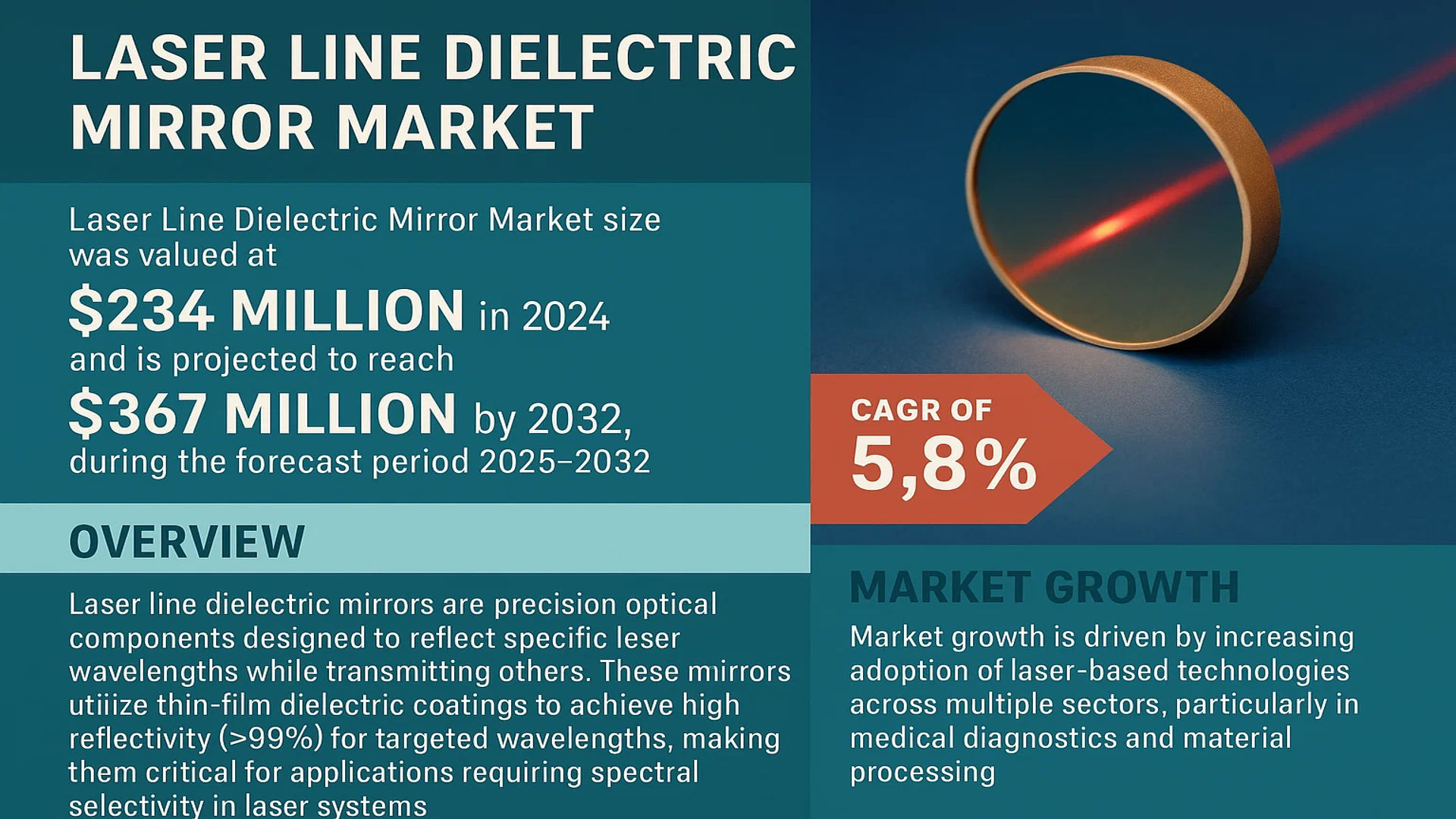
The global Laser Line Dielectric Mirror Market size was valued at US$ 234 million in 2024 and is projected to reach US$ 367 million by 2032, at a CAGR of 5.8% during the forecast period 2025-2032.
Laser line dielectric mirrors are precision optical components designed to reflect specific laser wavelengths while transmitting others. These mirrors utilize thin-film dielectric coatings to achieve high reflectivity (>99%) for targeted wavelengths, making them critical for applications requiring spectral selectivity in laser systems. They are widely used in industries such as medical devices, scientific research, industrial manufacturing, and defense.
Market growth is driven by increasing adoption of laser-based technologies across multiple sectors, particularly in medical diagnostics and material processing. The U.S. currently holds the largest market share at approximately 32%, followed by China at 25%. The Nd:YAG laser mirror segment dominates with 43% revenue share in 2024, owing to widespread use in medical and industrial lasers. Key players including Edmund Optics, Thorlabs, and Newport Corporation are expanding production capacities to meet growing demand, with recent investments in advanced coating technologies to improve mirror performance.
MARKET DYNAMICS
MARKET DRIVERS
Increased Adoption in Medical and Industrial Laser Applications to Drive Market Growth
The laser line dielectric mirror market is experiencing significant growth due to its expanding applications in medical and industrial laser systems. These mirrors play a crucial role in directing and shaping laser beams for precision cutting, welding, and medical procedures. High-reflectivity dielectric coatings are increasingly preferred over conventional metallic mirrors due to their superior performance at specific wavelengths, lower absorption losses, and higher damage thresholds. In medical applications, their use in laser surgery and ophthalmic procedures has grown substantially, with the market for medical lasers projected to expand significantly by 2030.
Technological Advancements in Optics Manufacturing to Boost Demand
Recent advancements in thin-film deposition techniques and coating technologies have enhanced the performance characteristics of laser line dielectric mirrors. Innovations in ion-assisted deposition (IAD) and plasma-assisted deposition have enabled manufacturers to produce mirrors with reflectivity exceeding 99.9% at specific wavelengths. These technological improvements are driving adoption across multiple industries where precision laser beam control is critical. The market has seen a marked increase in demand for customized solutions as manufacturers develop mirrors optimized for emerging laser types and wavelengths.
Furthermore, the growing integration of laser systems in semiconductor manufacturing equipment is creating additional demand. The semiconductor industry’s continuous expansion, particularly in Asia-Pacific regions, presents significant growth opportunities for manufacturers of high-precision optical components.
MARKET CHALLENGES
High Production Costs and Technical Complexity Pose Manufacturing Challenges
While the laser line dielectric mirror market shows promising growth potential, manufacturers face significant challenges in maintaining product consistency and managing production costs. The precision coating processes require specialized equipment and controlled environments, resulting in high capital expenditures. The complex multilayer dielectric coatings often involve 20-100 alternating layers of materials like SiO₂ and Ta₂O₅, demanding micron-level precision in deposition.
Other Challenges
Thermal Management Issues
High-power laser applications create challenges in managing thermal loading on mirror substrates. Even with careful design, prolonged exposure to intense laser beams can lead to coating degradation and thermal distortion, potentially affecting the mirror’s performance characteristics and lifespan.
Material Selection Constraints
Designing dielectric mirrors for new laser wavelengths often requires extensive materials research to identify suitable coating materials with the necessary refractive index contrast and laser damage resistance. This development process can be time-consuming and costly, creating barriers to rapid product innovation.
MARKET RESTRAINTS
Supply Chain Disruptions and Raw Material Volatility to Limit Market Expansion
The laser line dielectric mirror market faces significant constraints due to ongoing supply chain challenges affecting the availability of high-purity coating materials. Many specialized optical materials required for dielectric coatings have limited global suppliers, creating potential bottlenecks in production. The market has experienced periodic shortages of key materials like titanium dioxide and hafnium oxide, which are essential for high-performance coatings.
Additionally, the increasing cost of rare earth elements and other specialized materials has put pressure on profit margins. Manufacturers are exploring alternative materials and coating designs to mitigate these supply chain risks, but these alternatives often require extensive testing and validation before commercial implementation.
MARKET OPPORTUNITIES
Emerging Applications in Quantum Technology and Photonics to Create New Growth Avenues
The laser line dielectric mirror market stands to benefit significantly from the rapid development of quantum technologies and advanced photonic systems. The emerging field of quantum computing requires precisely tuned optical components for qubit manipulation and photon detection systems. Similarly, next-generation optical communication networks employing space-division multiplexing require high-performance mirrors for beam control and routing.
Moreover, the defense sector’s increasing investment in directed energy weapons and laser-based defense systems presents substantial opportunities. These applications demand mirrors with exceptional power handling capabilities and environmental stability, driving innovation in coating technologies and substrate materials.
LASER LINE DIELECTRIC MIRROR MARKET TRENDS
Precision Optics Demand Drives Market Growth
The global laser line dielectric mirror market is experiencing robust growth due to increasing demand for high-precision optical components in scientific and industrial applications. This market, valued at $ million in 2024, is projected to maintain steady expansion through 2032. The primary driver is the growing adoption of lasers across diverse sectors, from medical devices to industrial manufacturing. As precision requirements tighten across these applications, manufacturers are investing in advanced dielectric mirrors with ultra-high reflectivity (often exceeding 99.9%) at specific wavelengths. While the Nd:YAG segment currently dominates with applications in material processing, emerging CO2 laser applications are showing faster growth rates in certain regional markets.
Other Trends
Advancements in Coating Technology
The market is witnessing significant innovation in thin-film coating techniques, enabling mirrors to handle increasingly higher laser power densities while maintaining optical performance. Recent developments include novel deposition methods that improve environmental durability and reduce thermal distortion. This is particularly crucial for applications like industrial laser cutting, where mirrors must withstand kilowatt-level continuous wave power. Additionally, manufacturers are developing broadband dielectric mirrors that maintain high reflectivity across wider wavelength ranges, addressing the needs of tunable laser systems and multi-wavelength applications.
Integration with Next-Generation Laser Systems
The rapid development of fiber lasers and ultrafast laser systems is creating new opportunities for dielectric mirror manufacturers. Fiber lasers now account for over 40% of industrial laser sales, driving demand for mirrors optimized for these wavelengths. Furthermore, the growing adoption of picosecond and femtosecond lasers in precision manufacturing and medical applications requires mirrors with exceptional surface quality and damage thresholds. This has led to increased R&D investments in substrate materials and coating processes that can withstand the high peak powers characteristic of ultrafast lasers without compromising optical performance.
COMPETITIVE LANDSCAPE
Key Industry Players
Innovation and Precision Drive Market Leadership in Laser Line Dielectric Mirrors
The global Laser Line Dielectric Mirror market features a mix of established optical component manufacturers and specialized technology firms vying for market share. With the market projected to grow significantly through 2032, companies are actively expanding their technical capabilities and geographical reach to capitalize on increasing demand from laser systems manufacturers.
Edmund Optics maintains a dominant position with approximately 18% market share in 2024, attributed to its comprehensive product range covering wavelengths from UV to IR. The company’s ability to provide customized solutions for specific laser applications gives it an edge in research and industrial segments. Their recent acquisition of a thin-film coating specialist in 2023 has further strengthened their technical portfolio.
Thorlabs follows closely with around 15% market share, leveraging its vertically integrated manufacturing capabilities and strong distribution network. The company’s investment in automated coating facilities has enabled rapid prototyping and production of high-performance dielectric mirrors, particularly for ultrafast laser applications.
Japanese firm Optosigma Corporation (Sigma Koki Co) leads the Asian market with innovative mirror designs that achieve reflectivities exceeding 99.9% at critical laser wavelengths. Their strategic partnerships with laser manufacturers in China and South Korea position them well for growth in these rapidly expanding markets.
Emerging Trends in Market Competition
The competitive landscape is evolving with several notable trends. First, companies are increasingly focusing on ultra-low loss coatings to meet the demands of high-power laser systems. Second, the integration of AI-driven design tools has enabled faster development cycles for proprietary mirror configurations. Third, mergers and acquisitions are accelerating as larger firms seek to acquire specialized coating technologies.
Smaller specialized players like EKSMA Optics and Altechna compete through technological differentiation, offering mirrors with unique spectral characteristics for niche applications in scientific instrumentation. These companies typically focus on high-value, low-volume segments where technical specifications outweigh price considerations.
List of Key Laser Line Dielectric Mirror Companies Profiled
- Edmund Optics (U.S.)
- Optosigma Corporation (Sigma Koki Co) (Japan)
- Thorlabs (U.S.)
- EKSMA Optics (Lithuania)
- Altechna (Lithuania)
- INNOWIT Co (Japan)
- Newport Corporation (U.S.)
- CVI Laser Optics (U.S.)
The competitive intensity is expected to increase as laser technologies continue advancing across medical, industrial, and scientific applications. Companies that can combine technical excellence with scalable manufacturing processes and strong customer support will likely emerge as long-term leaders in this specialized optical components market.
Segment Analysis:
By Type
Nd:YAG Type Segment Dominates Market Due to High Demand in Industrial and Medical Laser Applications
The laser line dielectric mirror market is segmented based on type into:
- Nd:YAG Type
- Subtypes: 1064nm, 532nm, and others
- Argon-Ion Type
- Subtypes: 488nm, 514nm, and others
- Others
- Subtypes: CO2 laser mirrors, excimer laser mirrors, etc.
By Application
Projectors Segment Leads Market Owing to Increasing Adoption in High-End Display Systems
The market is segmented based on application into:
- Projectors
- Microscopes
- Laser cutting and engraving systems
- Medical laser equipment
- Scientific research instruments
- Others
By Material
Multilayer Dielectric Coatings Witness High Growth Due to Superior Optical Performance
The market is segmented based on material into:
- Multilayer dielectric coatings
- Metallic coatings
- Subtypes: Gold, silver, and aluminum coatings
- Hybrid coatings
By Wavelength Range
UV-Visible Range Segment Shows Significant Growth Potential
The market is segmented based on wavelength range into:
- UV-Visible (190-700nm)
- Near Infrared (700-2000nm)
- Mid to Far Infrared (2000nm-30µm)
Regional Analysis: Laser Line Dielectric Mirror Market
North America
The North American laser line dielectric mirror market is driven by strong demand from advanced research institutions, medical laser applications, and defense-related projects. With the U.S. accounting for over 75% of the region’s market share, major companies like Edmund Optics and Newport Corporation dominate production. The region benefits from substantial R&D investments in photonics, including a projected $3.2 billion federal allocation for optics research in 2024. While the medical sector shows steady growth in laser imaging applications, defense contracts for precision targeting systems present high-margin opportunities. However, strict ITAR regulations on advanced optical components create export challenges for manufacturers.
Europe
Europe maintains a strong position in high-precision optics manufacturing, with Germany and France leading in laser mirror production. The market is characterized by increasing adoption in industrial laser cutting systems, where dielectric mirrors offer superior durability compared to conventional alternatives. EU-funded photonics initiatives like Horizon Europe’s €100 million annual budget for optical technologies support innovation. Environmental regulations on coating materials have pushed manufacturers toward eco-friendly deposition processes. Notably, the region is witnessing growing demand from automotive laser welding applications as electric vehicle production expands.
Asia-Pacific
Asia-Pacific emerges as the fastest-growing market, projected to capture 38% of global demand by 2026. China’s extensive manufacturing ecosystem for laser equipment, coupled with India’s expanding research infrastructure, drives consumption. Japanese manufacturers like OptoSigma Corporation maintain technological leadership in precision mirrors for semiconductor lithography. The region benefits from cost-competitive production and growing adoption in consumer electronics manufacturing. However, intellectual property protection remains a challenge, with local producers frequently accused of reverse-engineering patented designs. Emerging applications in laser display technologies present new growth avenues across the region.
South America
The South American market remains underdeveloped but shows potential in mining and medical sectors. Brazil accounts for nearly 60% of regional demand, primarily for industrial laser marking systems. Economic instability has limited capital investments in advanced optics, forcing most users to rely on imports. Some local universities are establishing photonics research centers, which may stimulate domestic capability development. The lack of specialized coating facilities remains a key bottleneck, with most high-performance mirrors sourced from North American or European suppliers.
Middle East & Africa
This region represents a niche market focused primarily on oilfield applications and medical equipment. The UAE and Saudi Arabia show moderate growth in laser processing for automotive and aerospace sectors. Limited local manufacturing capability means dependence on imports, particularly from European suppliers. Some research institutions in Israel have developed specialized capabilities in laser optics, but commercial scale remains small. The market is anticipated to grow gradually as regional industrialization policies gain momentum, with particular focus on laser-based manufacturing technologies.
Report Scope
This market research report provides a comprehensive analysis of the Global Laser Line Dielectric Mirror market, covering the forecast period 2024–2032. It offers detailed insights into market dynamics, technological advancements, competitive landscape, and key trends shaping the industry.
Key focus areas of the report include:
- Market Size & Forecast: Historical data and future projections for revenue, unit shipments, and market value across major regions and segments. The Global Laser Line Dielectric Mirror market was valued at US$ 234 million in 2024 and is projected to reach US$ 367 million by 2032.
- Segmentation Analysis: Detailed breakdown by product type (Nd:YAG Type, Argon-Ion Type, Others), application (Projectors, Microscopes, Others), and end-user industry to identify high-growth segments.
- Regional Outlook: Insights into market performance across North America (U.S., Canada, Mexico), Europe (Germany, France, U.K.), Asia-Pacific (China, Japan, South Korea), and other key regions.
- Competitive Landscape: Profiles of leading market participants including Edmund Optics, Thorlabs, Newport Corporation, and others, with analysis of their market share, product portfolios, and strategic initiatives.
- Technology Trends & Innovation: Assessment of emerging optical coating technologies, precision manufacturing techniques, and wavelength-specific mirror developments.
- Market Drivers & Restraints: Evaluation of factors driving market growth including laser technology advancements and industrial automation, along with challenges such as high manufacturing costs.
- Stakeholder Analysis: Strategic insights for optical component manufacturers, laser system integrators, and research institutions regarding market opportunities.
The research employs both primary and secondary methods, including expert interviews and analysis of verified market data, to ensure accuracy and reliability.
FREQUENTLY ASKED QUESTIONS:
What is the current market size of Global Laser Line Dielectric Mirror Market?
->Laser Line Dielectric Mirror Market size was valued at US$ 234 million in 2024 and is projected to reach US$ 367 million by 2032, at a CAGR of 5.8% during the forecast period 2025-2032.
Which key companies operate in Global Laser Line Dielectric Mirror Market?
-> Key players include Edmund Optics, Thorlabs, Newport Corporation, EKSMA Optics, Optosigma Corporation, and Altechna, among others.
What are the key growth drivers?
-> Key growth drivers include increasing demand for precision laser systems, growth in medical laser applications, and advancements in optical coating technologies.
Which region dominates the market?
-> North America currently leads in market share, while Asia-Pacific is expected to show the highest growth rate during the forecast period.
What are the emerging trends?
-> Emerging trends include development of ultra-low-loss dielectric coatings, integration with fiber laser systems, and miniaturization of optical components.

Get Sample Report PDF for Exclusive Insights
Report Sample Includes
- Table of Contents
- List of Tables & Figures
- Charts, Research Methodology, and more...
 Download Sample Report PDF