L2 Corner Millimeter Wave Radar Market Insights
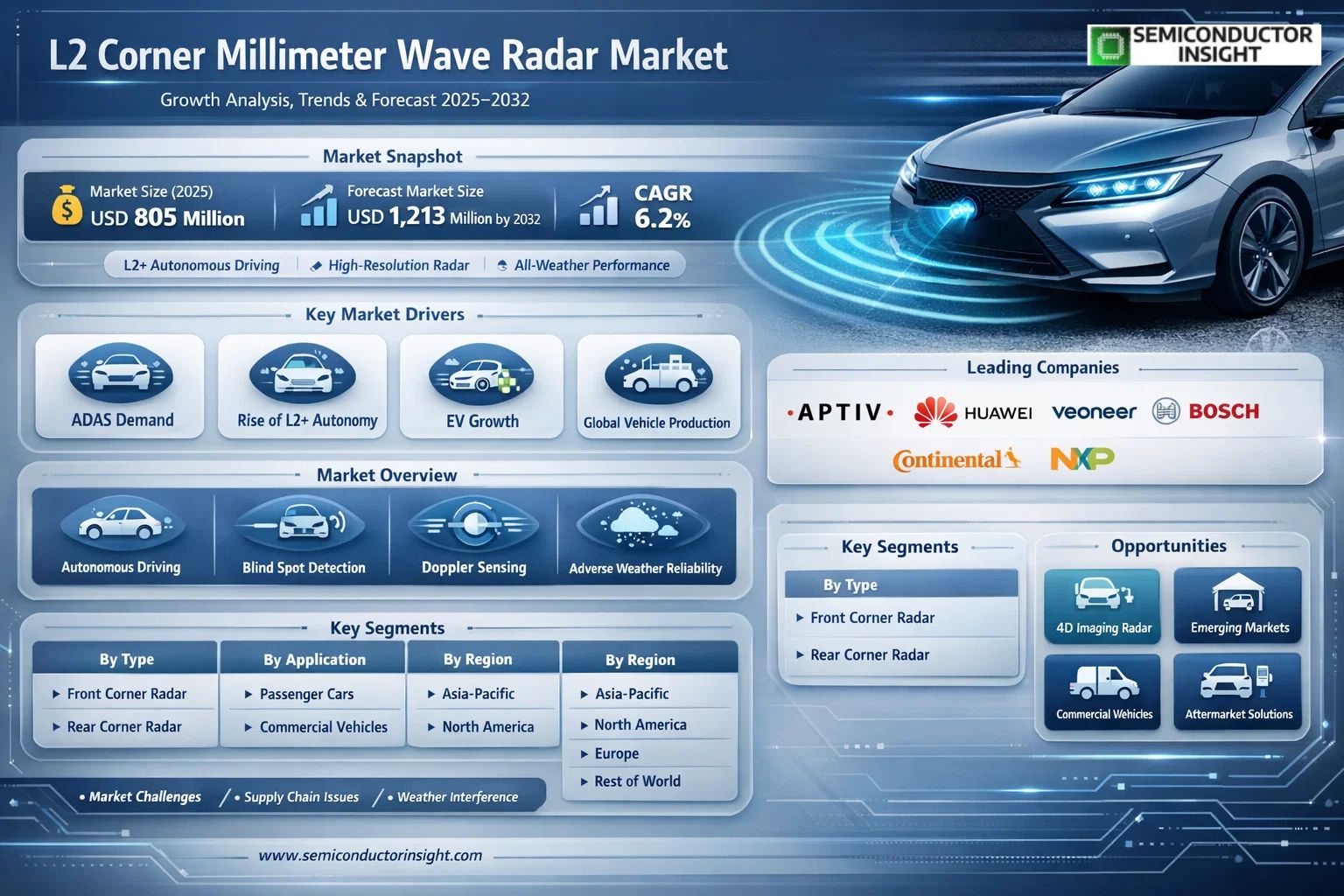
Global L2 Corner Millimeter Wave Radar market size was valued at USD 805 million in 2025. The market is projected to reach USD 1,213 million by 2032, exhibiting a CAGR of 6.2% during the forecast period.
L2 Corner Millimeter Wave Radar supports L2+ autonomous driving, an advanced iteration of L2-level technology that significantly improves safety and comfort with features like highway autonomous driving assistance. Millimeter-wave radar utilizes millimeter waves for precise wireless detection and ranging, boasting high resolution, strong directivity, robust anti-interference capabilities, and reliable performance in diverse weather conditions including strong light, fog, rain, and darkness. It delivers accurate distance and Doppler measurements. These radars are strategically installed at the four corners of the vehicle body.
The market is experiencing robust growth driven by surging demand for advanced driver-assistance systems (ADAS), rapid adoption of L2+ autonomous driving technologies, and expanding vehicle production globally. Furthermore, millimeter wave radar’s all-weather reliability addresses key limitations of camera and LiDAR sensors, accelerating its integration. Key players propelling this expansion include Aptiv, Huawei, Veoneer, Bosch, Freetech, TESTech, Continental, FinDreams Technology, and NXP, which collectively command substantial revenue shares through innovative portfolios and strategic developments.
MARKET DRIVERS
Rising Demand for ADAS in L2 Corner Millimeter Wave Radar Market
The primary driver in L2 Corner Millimeter Wave Radar Market is the accelerating adoption of Level 2 advanced driver assistance systems (ADAS) in passenger vehicles. Automakers are integrating corner radars to enable features like blind-spot monitoring and rear cross-traffic alert, enhancing vehicle safety. Global mandates for advanced safety technologies, such as the EU’s General Safety Regulation, are compelling OEMs to equip new models with these sensors, projecting a market growth rate exceeding 18% CAGR through 2030.
Electrification and Autonomous Trends
Electric vehicle (EV) proliferation further fuels demand, as manufacturers prioritize compact, high-resolution mmWave radars for corner placement to support 360-degree perception. The shift toward software-defined vehicles amplifies this, with over 70% of new EVs expected to feature L2 capabilities by 2028. Integration with camera and LiDAR fusion creates robust sensing suites, driving economies of scale in production.
➤ Key regulatory pushes and OEM commitments position L2 corner radars as essential for next-gen mobility.
Supply chain maturation, with leading suppliers scaling 77GHz and 79GHz chipsets, reduces costs and boosts reliability, solidifying market momentum in premium and mass-market segments alike.
MARKET CHALLENGES
Integration and Cost Pressures in L2 Corner Millimeter Wave Radar Market
High development and integration costs pose significant hurdles, as embedding corner radars requires precise calibration with vehicle architectures. Initial outlays can exceed $200 per unit, straining mid-tier OEM budgets amid inflationary pressures. Achieving seamless fusion with other sensors demands advanced algorithms, complicating timelines for mass deployment.
Other Challenges
Supply Chain Disruption
Semiconductor shortages and geopolitical tensions disrupt mmWave component availability, delaying L2 system rollouts. Validation in diverse environments adds testing burdens, with failure rates impacting scalability.Performance variability in adverse weather, like heavy rain attenuating signals, challenges reliability claims, eroding consumer trust in ADAS efficacy.
MARKET RESTRAINTS
Technical Limitations Hindering Growth
Signal interference and limited angular resolution restrain L2 Corner Millimeter Wave Radar Market, particularly in urban clutter where multipath effects degrade detection accuracy. Corner radars typically cover up to 60-80 meters with narrow fields of view, insufficient for some L2 maneuvers without augmentation.Regulatory spectrum allocation varies globally, with 76-81GHz bands facing contention from telecom 5G deployments, potentially capping radar performance and innovation pace.High power consumption in compact designs strains EV battery efficiency, while packaging constraints for corner mounting limit antenna array sizes, compromising resolution.
MARKET OPPORTUNITIES
Technological Advancements and Emerging Markets
Advancements in 4D imaging radars open avenues for higher-resolution L2 corner solutions in L2 Corner Millimeter Wave Radar Market, enabling velocity profiling and better obstacle classification. Partnerships between Tier 1s and chipmakers promise 20-30% cost reductions via silicon integration by 2027.Expansion into Asia-Pacific, driven by China’s NCAP safety ratings and India’s EV incentives, targets a burgeoning middle-class vehicle market projected to add 15 million units annually.Aftermarket retrofits for legacy fleets and fleet management applications in logistics present untapped potential, with V2X integration enhancing corner radar utility for cooperative ADAS.
L2 Corner Millimeter Wave Radar Market Trends
Rising Integration in L2+ Autonomous Driving Systems
L2 Corner Millimeter Wave Radar Market is experiencing significant momentum driven by the evolution of L2+ autonomous driving technologies. These systems build upon traditional L2 capabilities, offering enhanced safety and comfort features such as highway autonomous driving assistance. Corner millimeter-wave radars, positioned at the vehicle’s four corners, play a pivotal role by providing high-precision distance and Doppler measurements. Their ability to operate reliably in adverse conditions like fog, rain, and darkness underscores their value in advanced driver assistance systems (ADAS), fostering broader adoption across global automotive manufacturers.
Other Trends
Technological Advancements in Radar Performance
Key developments in L2 Corner Millimeter Wave Radar Market highlight improvements in resolution, directivity, and anti-interference capabilities. Manufacturers are focusing on refining radar sensors to deliver superior detection performance, which supports more accurate environmental perception. This trend is evident in the progression from front corner to rear corner radar segments, enabling 360-degree coverage essential for partial automation.
Expansion Across Vehicle Applications
Demand in L2 Corner Millimeter Wave Radar Market is shifting towards diverse applications, with passenger cars leading due to consumer preferences for safety features. Commercial vehicles are also seeing uptake for fleet management and logistics enhancements, where robust sensing in varied conditions proves advantageous. This diversification reflects a maturing market responsive to both personal and professional mobility needs.
Regional Market Dynamics and Competitive Landscape
In L2 Corner Millimeter Wave Radar Market, Asia-Pacific regions, particularly China and Japan, are at the forefront, propelled by strong domestic manufacturing and regulatory pushes for intelligent vehicles. Europe follows with emphasis on stringent safety standards, while North America benefits from innovation hubs. Leading players such as Aptiv, Huawei, Bosch, Continental, and Veoneer dominate through strategic mergers, product launches, and supply chain optimizations. Their focus on R&D addresses industry challenges like integration complexities and cost pressures, shaping a competitive environment that prioritizes reliability and scalability. Overall, these trends indicate a market poised for sustained growth through innovation and global collaboration.
COMPETITIVE LANDSCAPE
Key Industry Players
L2 Corner Millimeter Wave Radar Market Leaders and Dynamics
L2 Corner Millimeter Wave Radar Market exhibits an oligopolistic structure dominated by established automotive tier-1 suppliers with proven expertise in advanced driver assistance systems (ADAS). Key leaders including Bosch, Continental, and Aptiv hold substantial market positions, leveraging their global manufacturing scale, robust supply chains, and integrations with OEMs for L2+ autonomous driving features. Valued at $805 million in 2025 and forecasted to reach $1,213 million by 2032 at a 6.2% CAGR, the sector benefits from rising demand for corner radars that deliver high-resolution detection in fog, rain, and darkness, enhancing safety via precise distance and velocity measurements for blind-spot monitoring and collision avoidance in passenger cars.
Emerging Asian innovators like Huawei, FinDreams Technology, and NXP are intensifying competition through cost-efficient, high-performance 77GHz/79GHz radar modules tailored for front and rear corner installations in both passenger and commercial vehicles. Niche players such as Freetech, TESTech, and Veoneer contribute specialized Doppler and angle-resolution technologies, driving segment growth amid strategic partnerships and acquisitions. The top five players collectively command a significant revenue share, navigating challenges like supply chain disruptions and regulatory standards while capitalizing on L2+ highway assist trends across North America, China, and Europe.
List of Key L2 Corner Millimeter Wave Radar Companies Profiled
- Aptiv
- Huawei
- Veoneer (Magna)
- Bosch
- Freetech
- TESTech
- Continental
- FinDreams Technology
- NXP
- Denso
- ZF Friedrichshafen
- Valeo
- Infineon Technologies
- Arbe Robotics
Segment Analysis:
| Segment Category | Sub-Segments | Key Insights |
| By Type |
|
Front Corner Radar
|
| By Application |
|
Passenger Car
|
| By End User |
|
OEM
|
| By Frequency Band |
|
77 GHz
|
| By Detection Range |
|
Short Range
|
Regional Analysis: L2 Corner Millimeter Wave Radar Market
Asia-Pacific
Asia-Pacific leads in mmWave radar refinements, with dual-band designs improving detection in dense traffic. OEM partnerships accelerate deployment of 4D imaging radars for precise corner monitoring.
Domestic giants and international firms establish joint ventures, bolstering L2 Corner Millimeter Wave Radar Market share through customized solutions for regional vehicle architectures.
Stringent safety norms drive mandatory adoption, creating a fertile ecosystem for radar integration in mass-market segments.
Strategies pivot toward scalable production for autonomous fleets, ensuring sustained leadership amid evolving L2 standards.
North America
North America exhibits robust growth in L2 Corner Millimeter Wave Radar Market, fueled by premium automaker commitments to ADAS enhancements. Focus on highway safety and pedestrian detection underscores radar utility in diverse climates. Business strategies revolve around vertical integration, with sensor makers aligning closely with vehicle platforms for seamless fusion with cameras and lidars. Innovation hubs drive software-defined radar capabilities, adapting to over-the-air updates. Regional emphasis on consumer safety awareness accelerates aftermarket retrofits, while trade dynamics encourage diversified sourcing. Through 2034, emphasis on interoperability standards will solidify market maturity, balancing high development costs with expansive premium vehicle penetration.
Europe
Europe advances steadily in L2 Corner Millimeter Wave Radar Market, propelled by rigorous Euro NCAP ratings demanding advanced corner sensing. Luxury and mid-range segments prioritize radars for urban maneuvering and cyclist protection. Collaborative ecosystems among tier-1 suppliers and OEMs refine calibration for mixed driving conditions. Strategies highlight sustainability, integrating eco-friendly materials in radar modules. Regulatory push for Level 2+ features fosters innovation in multi-sensor architectures. Challenges from supply disruptions spur resilient local manufacturing. Projections to 2034 anticipate deeper market penetration via fleet electrification, positioning Europe as a precision engineering leader.
South America
South America emerges as a promising arena in L2 Corner Millimeter Wave Radar Market, with rising middle-class vehicle ownership spurring ADAS adoption. Cost-sensitive strategies favor modular radar designs for broad applicability. Local assemblers partner with global experts to localize production, addressing import duties. Urban congestion heightens demand for reliable blind-spot radars. Infrastructure investments support testing for varied terrains. Business focus on affordability drives value-engineered solutions. By 2034, expanding premium imports and domestic tech transfer will elevate regional dynamics.
Middle East & Africa
Middle East & Africa witness gradual uptake in L2 Corner Millimeter Wave Radar Market, driven by luxury imports and fleet modernization. Harsh environments necessitate ruggedized radars for sandstorm resilience. Strategies emphasize aftermarket enhancements for high-end SUVs. Government visions for smart cities integrate ADAS in public transport. Partnerships bridge tech gaps, customizing for regional driving patterns. Growth hinges on economic diversification and safety campaigns. To 2034, urbanization will amplify opportunities in emerging markets.
Report Scope
This market research report provides a comprehensive analysis of L2 Corner Millimeter Wave Radar Market, covering the forecast period 2025–2032. It offers detailed insights into market dynamics, technological advancements, competitive landscape, and key trends shaping the industry.
Key focus areas of the report include:
- Market Overview: The report begins with an overview outlining its current market scenario, key growth indicators, and industry transformation drivers. It discusses macroeconomic factors, demand–supply balance, regulatory landscape, and the strategic role of L2 Corner Millimeter Wave Radars in powering advancements across industries such as automotive.
- Market Size & Forecast: Historical data and future projections for revenue, unit shipments, and market value across major regions and segments.
- Segmentation Analysis: Detailed breakdown by product type, technology, application, and end-user industry to identify high-growth segments and investment opportunities.
- Regional Insights: Insights into market performance across North America, Europe, Asia-Pacific, Latin America, and the Middle East & Africa, including country-level analysis where relevant.
- Competitive Landscape: Profiles of leading market participants, including their product offerings, R&D focus, manufacturing capacity, pricing strategies, and recent developments such as mergers, acquisitions, and partnerships.
- Technology Trends & Innovation: Assessment of emerging technologies, integration of AI/IoT, radar design trends, fabrication techniques, and evolving industry standards.
- Market Drivers & Restraints: Evaluation of factors driving market growth along with challenges, supply chain constraints, regulatory issues, and market-entry barriers.
- Stakeholder Insights: Insights for component suppliers, OEMs, system integrators, investors, and policymakers regarding the evolving ecosystem and strategic opportunities.
Primary and secondary research methods are employed, including interviews with industry experts, data from verified sources, and real-time market intelligence to ensure the accuracy and reliability of the insights presented.
FREQUENTLY ASKED QUESTIONS:
What is the current market size of L2 Corner Millimeter Wave Radar Market?
-> Global L2 Corner Millimeter Wave Radar market was valued at USD 805 million in 2025 and is projected to reach USD 1213 million by 2032, at a CAGR of 6.2% during the forecast period.
Which key companies operate in L2 Corner Millimeter Wave Radar Market?
-> Key players include Aptiv, Huawei, Veoneer, Bosch, Freetech, TESTech, Continental, FinDreams Technology, NXP, among others.
What are the key growth drivers?
-> Key growth drivers include L2+ autonomous driving advancements, enhanced safety and comfort features, highway autonomous driving assistance, and millimeter-wave radar’s all-weather performance with high resolution and anti-interference capabilities.
Which region dominates the market?
-> Asia is a key region with major markets like China and Japan, while North America (U.S.) holds significant presence.
What are the emerging trends?
-> Emerging trends include integration into corner positions for four-corner detection, progress in L2+ ADAS functions, stable operation in adverse weather, and high-precision distance and speed measurements.

Get Sample Report PDF for Exclusive Insights
Report Sample Includes
- Table of Contents
- List of Tables & Figures
- Charts, Research Methodology, and more...
 Download Sample Report PDF