Market Insights
Global KNX Home Automation Products Market size was valued at USD 8.89 billion in 2025. The market is projected to grow from USD 9.76 billion in 2026 to USD 16.42 billion by 2034, exhibiting a CAGR of 10.8% during the forecast period.
KNX home automation products are intelligent control systems based on the standardized KNX protocol, enabling seamless integration of lighting, HVAC, security, and energy management in residential and commercial buildings. These devices offer interoperability across brands, ensuring scalable and reliable automation solutions through wired (KNX TP), wireless (KNX RF), or IP-based communication.
The market growth is driven by increasing demand for energy-efficient buildings, smart city initiatives, and the rising adoption of IoT-enabled infrastructure. Europe dominates the market due to stringent energy regulations, while Asia-Pacific shows rapid growth with urbanization and smart home investments. Key players like Schneider Electric, Siemens, and ABB continue to innovate with AI-driven automation features.
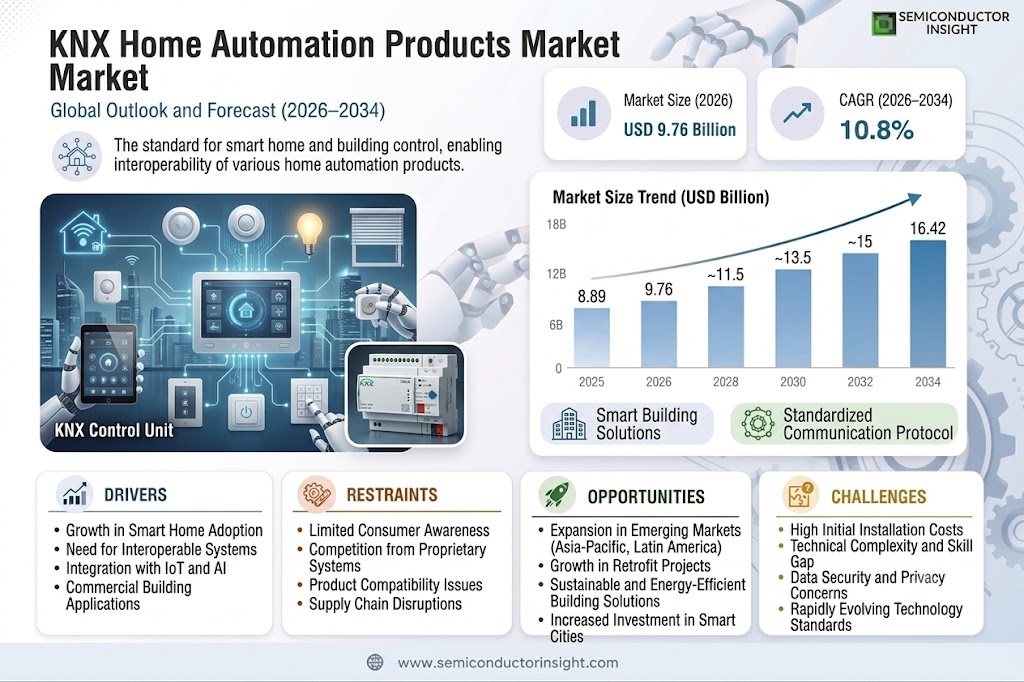
MARKET DRIVERS
Growing Demand for Energy-Efficient Solutions
KNX Home Automation Products Market is experiencing significant growth due to increasing awareness about energy conservation. KNX systems enable precise control over lighting, heating, and cooling, reducing energy consumption by up to 30% in smart homes. Governments worldwide are implementing strict energy regulations, further driving adoption.
Rise of Smart Home Integration
KNX home automation products are becoming the standard for seamless integration with other smart home ecosystems. Their interoperability with IoT devices and voice assistants like Amazon Alexa and Google Home is accelerating market penetration. The KNX protocol’s open standard ensures compatibility across 500+ manufacturers.
Commercial applications are also contributing to growth, with KNX systems being widely adopted in offices, hotels, and retail spaces for centralized control and energy management.
MARKET CHALLENGES
High Initial Installation Costs
The upfront investment required for KNX home automation products remains a barrier for many consumers. Professional installation and specialized components can increase costs by 20-30% compared to basic smart home systems, limiting adoption in price-sensitive markets.
Other Challenges
Technical Complexity
KNX systems require certified professionals for installation and maintenance, creating a skills gap in some regions. The complexity of system design and programming can deter non-technical homeowners from adoption.
MARKET RESTRAINTS
Limited Consumer Awareness
Despite its advantages, many potential customers remain unaware of KNX technology’s benefits compared to proprietary home automation solutions. This lack of awareness is particularly evident in developing markets where smart home penetration is still low.
MARKET OPPORTUNITIES
Expansion in Emerging Markets
Rapid urbanization in Asia-Pacific and Latin America presents significant growth potential for KNX home automation products. Rising disposable incomes and increasing smart city initiatives are creating favorable conditions for market expansion in these regions.
KNX Home Automation Products Market Trends
Growing Adoption in Residential and Commercial Applications
KNX Home Automation Products Market is witnessing increased adoption across both residential and commercial sectors. In residential applications, demand is driven by the need for energy-efficient solutions and enhanced living comfort, particularly in high-end homes and apartments. Commercial buildings are integrating KNX systems for centralized control of lighting, HVAC, and security, complying with stricter energy regulations and green building standards.
Other Trends
Technological Integration with IoT Platforms
KNX systems are increasingly being integrated with IoT platforms, allowing homeowners and facility managers to control and monitor devices remotely through smartphones or voice assistants. This interoperability between KNX and emerging smart technologies is opening new opportunities in the connected home ecosystem.
Rising Demand for Energy Management Solutions
With growing emphasis on sustainability, KNX-based energy management systems are gaining traction. These solutions enable precise monitoring and control of electricity consumption, automated lighting based on occupancy, and optimized HVAC operation, contributing to significant energy savings in both residential and commercial buildings.
Market Expansion in Emerging Economies
While Europe remains the dominant market for KNX Home Automation Products, rapid urbanization and increasing disposable incomes in Asia-Pacific regions are creating new growth opportunities. Countries like China and India are witnessing growing adoption of KNX systems in luxury residential projects and commercial buildings.
Other Trends
Increased Focus on Cybersecurity
As KNX systems become more connected, manufacturers are prioritizing cybersecurity features to protect against potential vulnerabilities. New product developments incorporate advanced encryption protocols and secure authentication methods to maintain system integrity.
Standardization Across Product Categories
The KNX standard continues to evolve with enhanced specifications across input devices, actuators, and system devices. This standardization ensures compatibility between products from different manufacturers while allowing for innovation within the technical framework.
COMPETITIVE LANDSCAPE
Key Industry Players
Global KNX Home Automation Products Market Dominated by Established Automation Giants
KNX Home Automation Products Market is led by multinational electrical equipment manufacturers like Schneider Electric, Siemens, and ABB, which collectively hold over 40% of the market share. These companies leverage their extensive distribution networks, brand recognition, and engineering expertise to dominate both residential and commercial KNX projects. Schneider Electric’s KNX product portfolio includes more than 500 certified devices with premium ecosystem integrations, while ABB focuses on intelligent building solutions with i-bus KNX system. Siemens has gained traction through its GAMMA instabus KNX line targeting mid-range residential applications.
Beyond the major players, specialized KNX manufacturers like GIRA, JUNG, and Theben AG hold significant positions in the European premium residential segment where design aesthetics and system reliability are prioritized. Asian manufacturers such as HDL, Tiansu, and Rishun Technology are gaining market share with cost-competitive KNX solutions while maintaining full protocol compliance. Emerging smart home players like Basalte and Zennio differentiate through advanced user interfaces and IoT integration capabilities for KNX systems.
List of Key KNX Home Automation Companies Profiled
- Schneider Electric
- ABB
- SIEMENS
- Hager (Berker)
- Legrand
- Somfy
- JUNG
- GIRA
- HDL
- STEINEL
- Urmet
- Theben AG
- Basalte
- Zennio
- Rishun Technology
Segment Analysis:
| Segment Category | Sub-Segments | Key Insights |
| By Type |
|
System-Level Devices
|
| By Application |
|
Commercial Buildings
|
| By End User |
|
System Integrators
|
| By Functionality |
|
Energy Management
|
| By Installation Type |
|
New Construction
|
Regional Analysis: KNX Home Automation Products Market
Europe
European construction regulations increasingly mandate smart building standards where KNX excels, with retrofit projects accounting for 40% of installations. The region sees particularly strong adoption in luxury residential and commercial office spaces.
Germany’s KNX Association drives protocol development while Italian and French manufacturers lead in aesthetic integration. The region produces 60% of global KNX-compatible devices with continuous advancements in IoT convergence.
Europe hosts the world’s densest network of KNX-certified training centers, with standardized curricula ensuring installer competency. This creates a self-reinforcing ecosystem where skilled professionals drive further market penetration.
EU directives on energy efficiency directly benefit KNX adoption, with the technology recognized in 80% of member states’ building codes. Tax incentives for smart home installations further accelerate market growth.
North America
The North American KNX market demonstrates accelerating growth as awareness increases about the protocol’s interoperability advantages. While lagging behind Europe in adoption, the region shows particular strength in high-end residential applications and commercial retrofits. The U.S. luxury housing market drives demand for premium KNX installations, with growing interest in whole-home automation systems. Canada’s stringent energy codes create opportunities for KNX-based efficiency solutions. Market education remains key as North American consumers traditionally favor proprietary systems.
Asia-Pacific
Asia-Pacific emerges as the fastest-growing KNX market, with China and South Korea leading expansion. Rapid urbanization and smart city initiatives fuel demand for KNX solutions in commercial buildings. Japan shows strong adoption in the premium residential segment, while Australia’s KNX market benefits from Europe-style regulations. The region faces challenges from local automation standards but benefits from increasing KNX manufacturer localization and training programs.
Middle East & Africa
The Middle East demonstrates robust KNX adoption in luxury developments and hospitality projects, particularly in UAE and Saudi Arabia. Africa shows nascent growth with KNX applications concentrated in commercial buildings and high-security installations. Both regions benefit from EuropeanKNX expertise through project consultations, though cost sensitivity remains a market barrier outside premium segments.
South America
South America’s KNX market remains concentrated in Brazil and Argentina, primarily serving luxury residential and corporate headquarters. The region shows potential with increasing awareness of energy management benefits, though economic volatility impacts market expansion. Local KNX associations are strengthening training infrastructure to support regional growth through 2034.
Report Scope
This market research report provides a comprehensive analysis of the KNX Home Automation Products Market , covering the forecast period 2025–2032. It offers detailed insights into market dynamics, technological advancements, competitive landscape, and key trends shaping the industry.
Key focus areas of the report include:
- Market Overview: The report begins with an overview outlining its current market scenario, key growth indicators, and industry transformation drivers. It discusses macroeconomic factors, demand–supply balance, regulatory landscape, and the strategic role of semiconductors in powering advancements across industries such as automotive, telecommunications, consumer electronics, and industrial automation.
- Market Size & Forecast: Historical data and future projections for revenue, unit shipments, and market value across major regions and segments.
- Segmentation Analysis: Detailed breakdown by product type, technology, application, and end-user industry to identify high-growth segments and investment opportunities.
- Regional Insights: Insights into market performance across North America, Europe, Asia-Pacific, Latin America, and the Middle East & Africa, including country-level analysis where relevant.
- Competitive Landscape: Profiles of leading market participants, including their product offerings, R&D focus, manufacturing capacity, pricing strategies, and recent developments such as mergers, acquisitions, and partnerships.
- Technology Trends & Innovation: Assessment of emerging technologies, integration of AI/IoT, semiconductor design trends, fabrication techniques, and evolving industry standards.
- Market Drivers & Restraints: Evaluation of factors driving market growth along with challenges, supply chain constraints, regulatory issues, and market-entry barriers.
- Stakeholder Insights: Insights for component suppliers, OEMs, system integrators, investors, and policymakers regarding the evolving ecosystem and strategic opportunities.
Primary and secondary research methods are employed, including interviews with industry experts, data from verified sources, and real-time market intelligence to ensure the accuracy and reliability of the insights presented.
FREQUENTLY ASKED QUESTIONS:
What is the current market size of KNX Home Automation Products Market?
-> KNX Home Automation Products Market size was valued at USD 8.89 billion in 2025. The market is projected to grow from USD 9.76 billion in 2026 to USD 16.42 billion by 2034, exhibiting a CAGR of 10.8% during the forecast period.
Which key companies operate in KNX Home Automation Products Market?
-> Key players include Schneider Electric, ABB, Siemens, Hager (Berker), Legrand, Somfy, JUNG, GIRA, HDL, and STEINEL, among others.
What are the key growth drivers?
-> Key growth drivers include green building initiatives, energy efficiency regulations, intelligent upgrading of high-end residences, and demand for interoperable systems.
Which region dominates the market?
-> Europe remains a dominant market due to early KNX adoption, while Asia shows fastest growth with increasing smart home penetration.
What are the emerging trends?
-> Emerging trends include integration of AI/IoT with KNX systems, mid-range residential adoption, and development of advanced energy management solutions.

Get Sample Report PDF for Exclusive Insights
Report Sample Includes
- Table of Contents
- List of Tables & Figures
- Charts, Research Methodology, and more...
 Download Sample Report PDF