Joint communication and localization for 5G NR positioning Market Insights
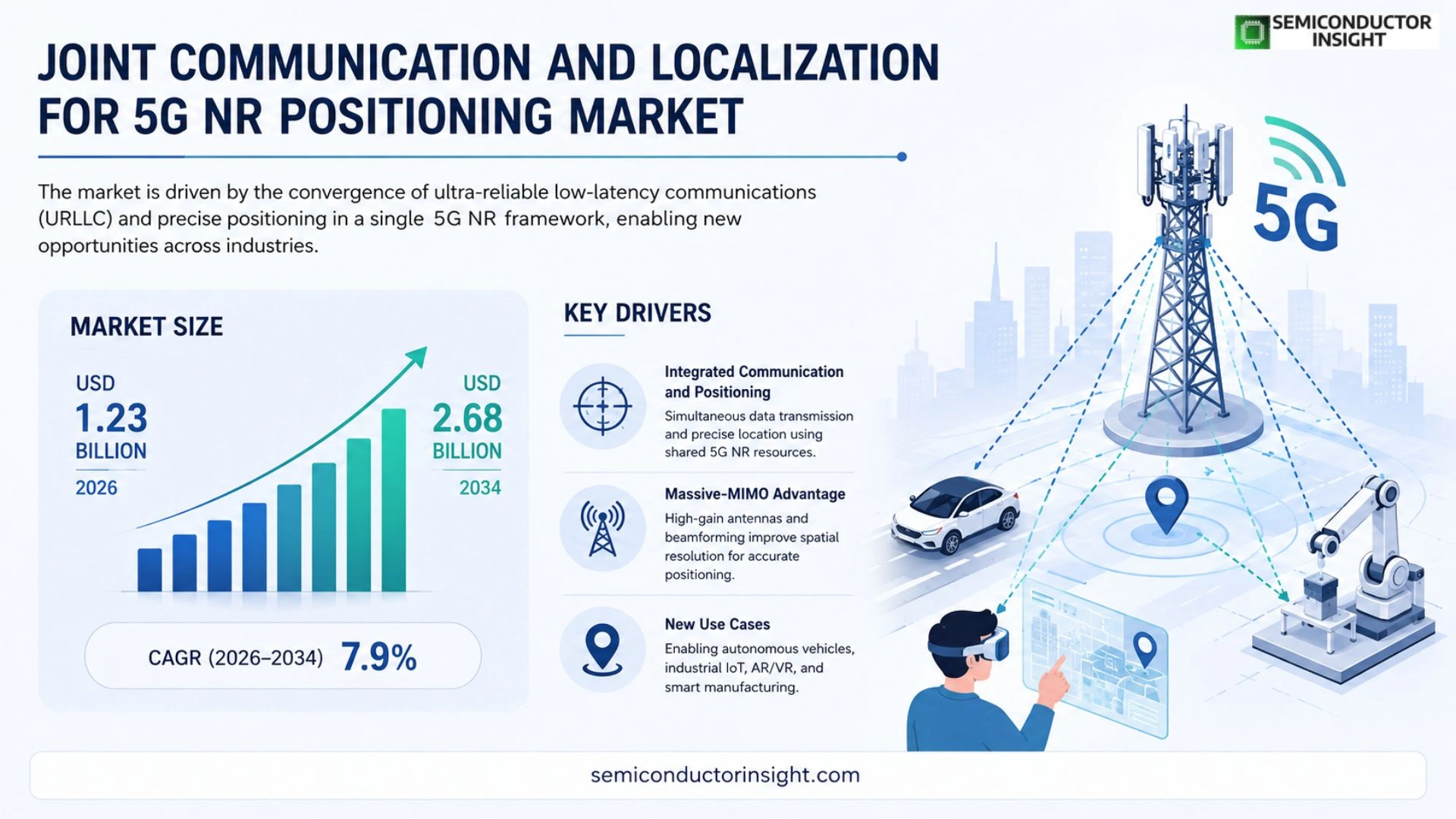
Global Joint Communication and localization for 5G NR positioning market size was valued at USD 1.15 billion in 2025. The market is projected to grow from USD 1.23 billion in 2026 to USD 2.68 billion by 2034, exhibiting a CAGR of 7.9% during the forecast period.
Joint communication and localization integrate data transmission and precise device location within the same radio resources of the 5G New Radio (NR) framework. This convergence enables services such as ultra‑reliable low‑latency communications (URLLC) combined with centimeter‑level positioning, supporting applications ranging from autonomous vehicles to industrial IoT.
The market is accelerating because telecom operators are expanding massive‑MIMO deployments, while manufacturers demand tighter location accuracy for smart factories and augmented reality experiences. Furthermore, regulatory pushes for spectrum efficiency are encouraging integrated solutions.
Key players, including Nokia, Ericsson, Qualcomm, Huawei, and Samsung, are forging partnerships; for example, Nokia announced a collaboration with Qualcomm in March 2024 to deliver end‑to‑end positioning chips optimized for 5G NR networks.
MARKET DRIVERS
Integration of Communication and Positioning Functions
Joint communication and localization for 5G NR positioning Market is propelled by the convergence of high‑throughput data links and precise location services within a single radio access network. Mobile operators can monetize spectrum more efficiently by delivering both services, leading to higher ARPU and lower CAPEX per subscriber.
Demand from Autonomous and Industrial Applications
Industries such as autonomous vehicles, robotics, and smart factories require sub‑meter accuracy combined with ultra‑reliable low‑latency communication. The ability of 5G NR to provide joint communication and localization meets these stringent requirements, accelerating adoption across verticals.
➤ “Deploying joint communication‑localization enables a 30% reduction in infrastructure cost while delivering centimeter‑level accuracy for mission‑critical use cases.”
Regulatory momentum, especially in regions prioritizing digital transformation, further fuels market growth by encouraging the rollout of network architectures that support integrated positioning services.
MARKET CHALLENGES
Complexity of Network Planning
Designing networks that simultaneously optimize for data throughput and positioning accuracy introduces layered engineering challenges. Operators must balance beamforming strategies with time‑difference‑of‑arrival measurements, which can increase deployment timelines.
Other Challenges
Standardization Fragmentation
Multiple regional standards for 5G NR positioning create interoperability issues, making it harder for equipment vendors to offer universally compatible solutions.
MARKET RESTRAINTS
High Capital Expenditure
Upgrading existing base stations to support joint communication and localization functions requires substantial investment in new antenna arrays and signal processing hardware, which can deter early adopters in price‑sensitive markets.
Limited Skilled Workforce
Qualified engineers with expertise in both RF communication and advanced positioning algorithms are scarce, slowing the pace of large‑scale rollouts and increasing reliance on specialized consultancy services.
MARKET OPPORTUNITIES
Emerging Smart‑City Infrastructures
Municipalities are investing in smart‑city platforms that leverage precise indoor and outdoor positioning for traffic management, public safety, and asset tracking. Joint communication and localization solutions can be bundled with existing 5G deployments to create revenue‑generating public‑private partnerships.
Growth of Augmented Reality Services
The rise of AR/VR experiences in retail, education, and entertainment demands real‑time location awareness coupled with high‑capacity data streams. Joint communication and localization for 5G NR positioning Market is well‑positioned to capture this emerging demand.
Joint communication and localization for 5G NR positioning Market Trends
Convergence of Communication and Positioning
Joint communication and localization for 5G NR positioning Market is witnessing a decisive shift as network operators and equipment vendors blend ultra‑reliable low‑latency communications (URLLC) with centimeter‑level device location within the same radio resources. This integration reduces latency, improves spectrum efficiency, and unlocks new service models for autonomous vehicles, industrial IoT, and immersive augmented‑reality experiences. By leveraging the flexible frame structure of the 5G New Radio (NR) framework, service providers can deliver simultaneous data throughput and precise positioning without requiring separate hardware stacks, thereby lowering deployment costs and accelerating time‑to‑market for location‑aware applications.
Other Trends
Massive‑MIMO as an Enabler
Massive‑MIMO deployments are accelerating the adoption of joint communication and localization solutions. The higher antenna count and beamforming capabilities of massive‑MIMO arrays sharpen spatial resolution, which translates directly into more accurate positioning estimates. Telecom operators are upgrading base stations to support wide‑band carrier aggregation, a prerequisite for centimeter‑level accuracy in dense urban environments. Meanwhile, manufacturers of smart factories and AR platforms are demanding tighter location fidelity to synchronize robotic processes and overlay digital content with physical assets. The combined pressure from operators seeking to maximize spectrum reuse and industrial customers needing sub‑meter accuracy creates a virtuous cycle that fuels further investment in advanced antenna systems.
Emerging Partnerships and Ecosystem Development
Strategic collaborations are reshaping the competitive landscape of the Joint communication and localization for 5G NR positioning Market. Notably, Nokia announced a partnership with Qualcomm in March 2024 to co‑develop end‑to‑end positioning chips optimized for 5G NR networks, reinforcing the trend toward vertically integrated solutions. Ericsson, Huawei, and Samsung are also pursuing joint ventures with chipset manufacturers and cloud providers to create open‑interface frameworks that simplify the deployment of combined communication‑localization services. These alliances address the need for standardized APIs, ensure interoperability across multi‑vendor deployments, and provide a clear pathway for enterprises to adopt integrated positioning without extensive custom engineering.
COMPETITIVE LANDSCAPE
Key Industry Players
Joint communication and localization for 5G NR positioning – Competitive Landscape
The market is presently anchored by a handful of tier‑one vendors that combine deep radio‑access expertise with advanced chipset capabilities. Nokia, leveraging its 5G NR portfolio, has established a strategic partnership with Qualcomm to co‑develop integrated positioning chips that deliver centimeter‑level accuracy for ultra‑reliable low‑latency communications (URLLC). Ericsson and Huawei follow closely, each offering end‑to‑end solutions that embed localization functions directly into massive‑MIMO base stations, thereby meeting operator demand for spectrum‑efficient services. Samsung’s semiconductor division complements its network equipment business, creating a vertically integrated ecosystem that accelerates rollout of joint communication‑localization services across smart‑factory and autonomous‑vehicle domains. Collectively these leaders command the majority of revenue, shaping standards and influencing the projected CAGR of 7.9% through 2034.
Beyond the dominant quartet, a diverse set of niche innovators contributes specialized technologies that broaden the market’s depth. Intel and MediaTek are advancing silicon‑level positioning algorithms that enhance power efficiency for edge devices. ZTE and Thales focus on secure, mission‑critical location services for defense and public‑safety applications. Companies such as Viavi Solutions and CommScope provide measurement and antenna‑array instrumentation essential for network calibration. Microsoft’s Azure Edge platform is integrating cloud‑native location analytics, while Fujitsu, Alcatel Lucent, NEC and others are delivering customized integration services for regional telecom operators and industrial IoT players. This ecosystem of secondary players enriches the value chain, fostering competition on cost, performance and vertical‑specific features.
List of Key Joint communication and localization for 5G NR positioning Companies Profiled
- Nokia
- Qualcomm
- Ericsson
- Huawei
- Samsung
- Intel
- MediaTek
- ZTE
- Thales
- Microsoft (Azure Edge)
- Viavi Solutions
- CommScope
- Fujitsu
- Alcatel Lucent
- NEC
Segment Analysis:
| Segment Category | Sub-Segments | Key Insights |
| By Type |
|
Integrated RF Front‑End
|
| By Application |
|
Smart Factories
|
| By End User |
|
Telecom Operators
|
| By Deployment Mode |
|
Edge Computing
|
| By Technology Trend |
|
AI‑Driven Positioning
|
Regional Analysis: North America
The automotive sector in the US is a primary consumer of advanced 5G NR positioning solutions, particularly for autonomous driving and connected car services. Accurate and reliable localization is crucial for safety, navigation, and smart city integration within the automotive ecosystem.
The logistics and supply chain industry in the US is increasingly leveraging 5G NR positioning to enhance asset tracking, fleet management, and inventory visibility. Joint communication and localization technologies enable real-time monitoring and improved operational efficiency.
Public safety and emergency services in the US are adopting 5G NR positioning for enhanced situational awareness, rapid response, and accurate location tracking of personnel and resources. Reliable joint communication is vital for seamless coordination during critical incidents.
The growing adoption of Industrial IoT (IIoT) in the US creates significant demand for precise asset tracking and management solutions powered by 5G NR positioning and joint communication technologies. This enables improved operational control and predictive maintenance.
Europe
Europe is witnessing consistent growth in the joint communication and localization for 5G NR positioning market. Stringent data privacy regulations and a focus on sustainable technologies are shaping the regional dynamics. The automotive and logistics sectors are key drivers, with increasing adoption of connected vehicle services and smart supply chain solutions. Government initiatives promoting 5G infrastructure development are further accelerating market growth. The emphasis on interoperability and security in joint communication solutions is gaining prominence.
Asia-Pacific
The Asia-Pacific region, particularly China, Japan, and South Korea, represents a substantial market for joint communication and localization for 5G NR positioning. High population density, rapid urbanization, and significant investments in 5G infrastructure are fueling market expansion. The automotive industry, especially in China, is a major adopter of advanced positioning technologies. The region also exhibits strong demand from the logistics, manufacturing, and public safety sectors. Innovation in joint communication protocols and integration with existing localization systems is a key trend.
South America
South America is an emerging market for joint communication and localization for 5G NR positioning. Increasing investments in telecommunications infrastructure and a growing adoption of IoT devices are driving market growth. The logistics and mining sectors are key application areas, with demand for asset tracking and operational efficiency solutions. Government initiatives supporting digital transformation are fostering market opportunities.
Middle East & Africa
The Middle East and Africa region presents significant growth potential for joint communication and localization for 5G NR positioning. Increasing investments in 5G infrastructure, particularly in countries like Saudi Arabia and the UAE, are driving market expansion. The automotive, logistics, and public safety sectors are key application areas. The region’s focus on smart city initiatives and industrial development is further fueling market opportunities.
Report Scope
This market research report provides a comprehensive analysis of the Joint communication and localization for 5G NR positioning Market , covering the forecast period 2026–2034. It offers detailed insights into market dynamics, technological advancements, competitive landscape, and key trends shaping the industry.
Key focus areas of the report include:
- Market Overview: The report begins with an overview outlining its current market scenario, key growth indicators, and industry transformation drivers. It discusses macroeconomic factors, demand–supply balance, regulatory landscape, and the strategic role of semiconductors in powering advancements across industries such as automotive, telecommunications, consumer electronics, and industrial automation.
- Market Size & Forecast: Historical data and future projections for revenue, unit shipments, and market value across major regions and segments.
- Segmentation Analysis: Detailed breakdown by product type, technology, application, and end-user industry to identify high-growth segments and investment opportunities.
- Regional Insights: Insights into market performance across North America, Europe, Asia-Pacific, Latin America, and the Middle East & Africa, including country-level analysis where relevant.
- Competitive Landscape: Profiles of leading market participants, including their product offerings, R&D focus, manufacturing capacity, pricing strategies, and recent developments such as mergers, acquisitions, and partnerships.
- Technology Trends & Innovation: Assessment of emerging technologies, integration of AI/IoT, semiconductor design trends, fabrication techniques, and evolving industry standards.
- Market Drivers & Restraints: Evaluation of factors driving market growth along with challenges, supply chain constraints, regulatory issues, and market-entry barriers.
- Stakeholder Insights: Insights for component suppliers, OEMs, system integrators, investors, and policymakers regarding the evolving ecosystem and strategic opportunities.
Primary and secondary research methods are employed, including interviews with industry experts, data from verified sources, and real-time market intelligence to ensure the accuracy and reliability of the insights presented.
FREQUENTLY ASKED QUESTIONS:
What is the current market size of Joint communication and localization for 5G NR positioning Market?
-> Joint communication and localization for 5G NR positioning Market was valued at USD 1.15 billion in 2025 and is expected to reach USD 2.68 billion by 2034.
Which key companies operate in Joint communication and localization for 5G NR positioning Market?
-> Key players include Nokia, Ericsson, Qualcomm, Huawei, and Samsung, among others.
What are the key growth drivers?
-> Key growth drivers include massive‑MIMO deployments, smart factories, augmented reality applications, and regulatory pushes for spectrum efficiency.
Which region dominates the market?
-> The market is globally distributed, with strong activity across North America, Europe, and Asia‑Pacific.
What are the emerging trends?
-> Emerging trends include integration of URLLC with centimeter‑level positioning, AI‑driven location analytics, and advanced massive‑MIMO techniques.
Get Sample Report PDF for Exclusive Insights
Report Sample Includes
- Table of Contents
- List of Tables & Figures
- Charts, Research Methodology, and more...
 Download Sample Report PDF