Japan AI Semiconductor Equipment Market Insights
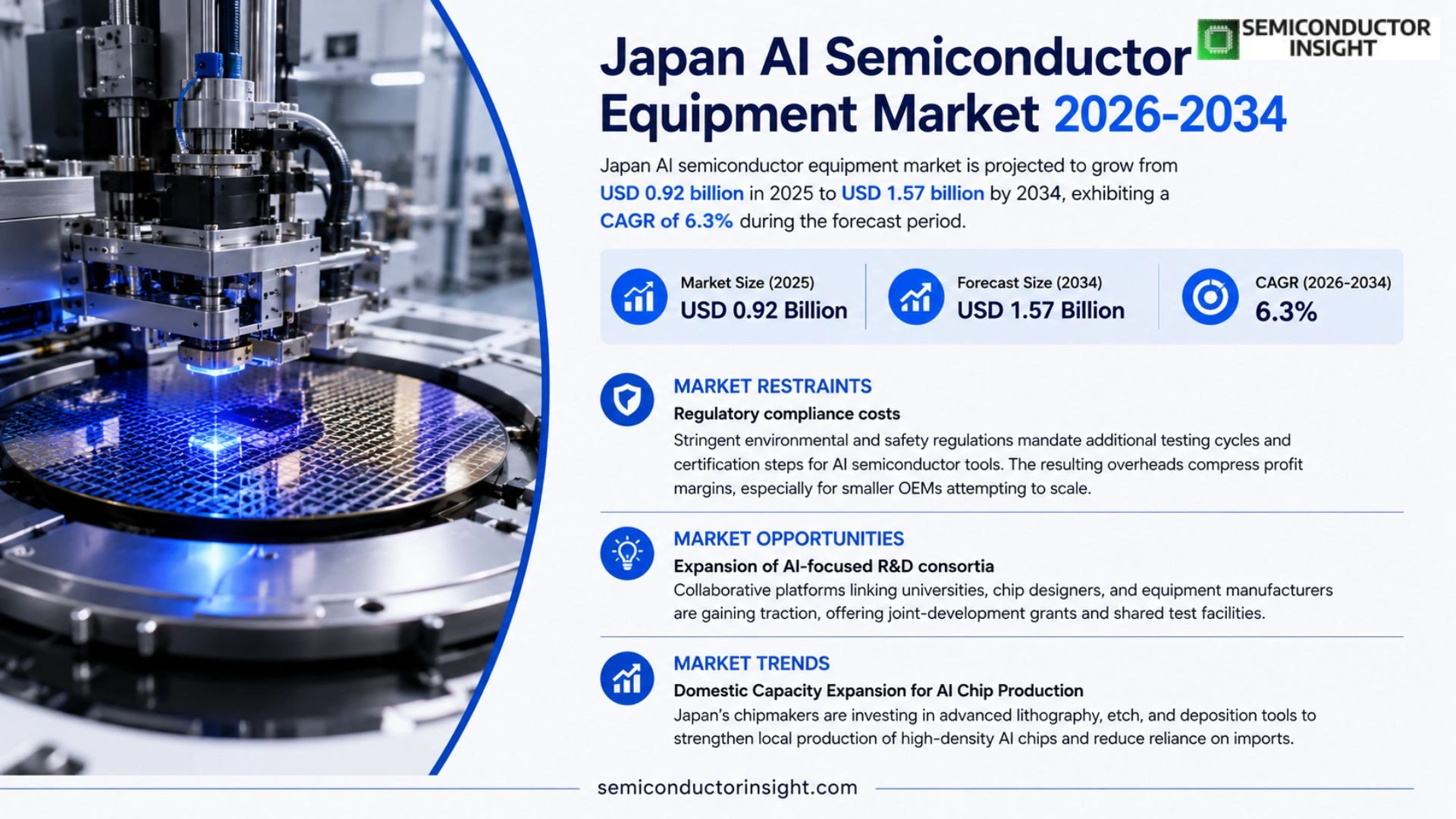
Global Japan AI semiconductor equipment market size was valued at USD 0.92 billion in 2025. The market is projected to grow from USD 0.92 billion in 2025 to USD 1.57 billion by 2034, exhibiting a CAGR of 6.3% during the forecast period.
AI semiconductor equipment comprises lithography tools, etching systems, deposition units and metrology solutions specifically designed for neural‑network accelerators and high‑density compute chips. These machines enable the precise patterning of transistors optimized for artificial‑intelligence workloads, supporting both training and inference hardware.
The market is gaining momentum because Japanese chipmakers are expanding capacity for AI‑focused designs, while government subsidies encourage domestic tool development. Moreover, rising demand from data‑center operators and automotive OEMs for edge‑AI processors fuels equipment orders. Recent moves such as Tokyo Electron’s partnership with a leading AI chip designer in March 2024 illustrate how collaboration accelerates adoption.
MARKET DRIVERS
Government policy and funding incentives
Tokyo’s strategic roadmap for AI‑enabled manufacturing earmarks billions of yen for equipment upgrades, prompting domestic suppliers to accelerate development cycles. Companies that align their product lines with the outlined standards are positioned to capture a sizable share of Japan AI Semiconductor Equipment Market as procurement budgets shift toward compliant platforms.
Escalating demand from automotive AI chips
Automakers are expanding on‑board AI functionalities, from driver‑assistance to predictive maintenance, driving a surge in wafer‑scale AI processor orders. The ripple effect compels equipment manufacturers to upscale capacity and integrate high‑throughput inspection tools, which in turn raises the overall market velocity.
➤ “The convergence of national AI agendas and auto‑industry needs creates a virtuous cycle for equipment vendors, amplifying investment returns within a three‑year horizon.”
Moreover, the rise of edge‑computing clusters in smart factories demands specialized packaging and testing suites. Vendors that can deliver modular, low‑latency solutions stand to benefit from a broadening client base across electronics, healthcare, and logistics sectors.
MARKET CHALLENGES
Talent scarcity and skill gaps
Advanced AI semiconductor production relies on engineers proficient in both AI algorithms and cutting‑edge lithography. Japan faces a demographic contraction, reducing the pool of senior specialists and forcing firms to compete for a limited number of highly skilled workers, which inflates labor costs.
Other Challenges
Supply‑chain volatility
The reliance on a narrow set of imported raw materials, such as high‑purity gases, introduces price sensitivity. Recent disruptions have highlighted the need for diversified sourcing strategies, adding a layer of operational risk for equipment producers.
MARKET RESTRAINTS
Regulatory compliance costs
Stringent environmental and safety regulations mandate additional testing cycles and certification steps for AI semiconductor tools. The resulting overheads compress profit margins, especially for smaller OEMs attempting to scale in Japan AI Semiconductor Equipment Market.
MARKET OPPORTUNITIES
Expansion of AI‑focused R&D consortia
Collaborative platforms linking universities, chip designers, and equipment manufacturers are gaining traction, offering joint‑development grants and shared test facilities. Participants can leverage collective expertise to accelerate time‑to‑market, opening revenue streams that extend beyond traditional equipment sales.
Japan AI Semiconductor Equipment Market Trends
Domestic Capacity Expansion for AI Chip Production
The current momentum in Japan AI Semiconductor Equipment Market stems from a strategic shift among domestic chipmakers toward higher‑density neural‑network accelerators. By allocating new clean‑room space and retrofitting existing lithography lines, manufacturers are shortening the cycle between design and volume production. This operational tightening reduces reliance on overseas tool importation, which historically added lead‑time and cost volatility. The practical outcome is a steadier flow of orders for deposition and etch platforms that meet the precision requirements of AI workloads. Suppliers that can align their process modules with the evolving node roadmaps gain bargaining power in contract negotiations.
Other Trends
Government Incentives Accelerate Tool Development
Recent policy measures have introduced targeted subsidies for equipment vendors that demonstrate a clear pathway to AI‑centric wafer processing. The financial aid is conditioned on meeting milestones such as a 20‑percent reduction in defect density for advanced nodes, encouraging R&D focused on metrology accuracy. As a result, a handful of Japanese firms have accelerated prototype builds, shortening the typical development horizon from three years to under eighteen months. This compression not only improves cash‑flow forecasts but also allows OEMs to align product launches with market demand for edge‑AI chips. The broader implication is a more resilient supply chain that can adapt to sudden spikes in data‑center capacity planning.
Rising Edge‑AI Demand from Automotive OEMs
The automotive sector in Japan is integrating AI capabilities directly into vehicle control units, creating a surge in orders for edge‑AI processor modules. OEMs prioritize equipment that can deliver fine‑pitch interconnects and low‑power transistor stacks, prompting a shift from traditional high‑performance computing tools to specialized deposition and patterning solutions. This trend forces equipment manufacturers to tailor their service contracts, offering on‑site optimization and rapid spare‑part turnover. For suppliers, the shift translates into a more predictable revenue stream tied to multi‑year vehicle program cycles, while also opening cross‑selling opportunities for predictive‑maintenance software. In essence, the convergence of automotive safety standards and AI functionality reshapes procurement criteria across Japan AI Semiconductor Equipment Market.
COMPETITIVE LANDSCAPE
Key Industry Players
Japan AI Semiconductor Equipment Market – Competitive Overview
Tokyo Electron dominates the domestic supply chain, leveraging its lithography and deposition platforms that have been retro‑fitted for AI‑centric wafer geometries. The firm’s deep integration with leading Japanese chip designers grants it preferential access to high‑volume orders, while its strategic partnership announced in early 2024 with a top AI accelerator developer accelerates technology transfer. Nikon and Canon Tokki sit just behind, each carving out niche segments: Nikon focuses on advanced etching solutions that meet sub‑10‑nm requirements, whereas Canon Tokki’s organic vapor‑phase deposition units cater to emerging neuromorphic devices. Collectively, these three firms control the bulk of equipment sales to data‑center and automotive OEMs, shaping pricing benchmarks and R&D road‑maps across the country.
Beyond the tier‑one tier, a constellation of specialized players injects diversity into the market. Advantest’s test‑and‑measurement rigs, now adapted for AI chip validation, complement Hitachi High‑Technologies’ metrology tools that promise tighter overlay control. Smaller outfits such as JAE, JSR, and Ricoh provide customized mask‑making and wafer‑handling subsystems, often under government‑backed development schemes. Meanwhile, conglomerates like Mitsubishi Electric and Sumitomo Heavy Industries diversify their portfolios by offering modular automation lines that integrate seamlessly with existing fab infrastructure. This breadth of capability ensures that Japan retains a full‑stack equipment ecosystem capable of responding to rapid design iterations and the escalating demand for edge‑AI processors.
List of Key AI Semiconductor Equipment Companies Profiled
- Tokyo Electron
- Nikon Corporation
- Canon Tokki
- Advantest Corporation
- Hitachi High‑Technologies
- Ricoh Co., Ltd.
- Mitsubishi Electric
- Sumitomo Heavy Industries
- JSR Corporation
- Panasonic Corporation
- SEIKO EPSON
- Fujitsu Semiconductor
- Renesas Electronics
- Hamamatsu Photonics
- Taiyo Yuden
Segment Analysis:
| Segment Category | Sub-Segments | Key Insights |
| By Type |
|
Lithography‑Centric Segment drives market momentum through several qualitative factors:
|
| By Application |
|
Data‑Center Accelerator Segment is shaping equipment demand through:
|
| By End User |
|
AI‑Fab Segment experiences strong qualitative pull:
|
| By Technology Trend |
|
3‑D Integration Trend influences equipment selection:
|
| By Value Chain Role |
|
Native Equipment Manufacturers dominate the narrative:
|
Regional Analysis: Japan AI Semiconductor Equipment Market
Japanese fabs are prioritising metrology tools that fuse real‑time image processing with predictive algorithms, allowing operators to anticipate process drift before it manifests as yield loss. Suppliers that can demonstrate closed‑loop correction gain strategic foothold.
Efforts to insulate critical equipment supply from geopolitical tensions are prompting joint‑venture manufacturing sites within Japan, ensuring faster parts availability and tighter IP protection for AI‑driven designs.
Universities in Tokyo and Osaka are feeding a pipeline of engineers versed in both semiconductor physics and AI, enabling equipment firms to co‑develop application‑specific solutions in‑house rather than relying on external software partners.
Coordination between the Ministry of Economy, Trade and Industry and standards bodies accelerates certification pathways for AI‑augmented tools, reducing time‑to‑market for innovative equipment.
North America
The United States watches Japan’s AI‑centric equipment evolution with keen interest, interpreting it as a benchmark for its own fab upgrades. While domestic fabs retain a strong legacy of high‑volume manufacturing, they are beginning to adopt similar AI‑enabled process controls to stay competitive. Partnerships between U.S. equipment OEMs and Japanese chip designers are emerging, turning knowledge exchange into a catalyst for cross‑border product development. The market dynamic encourages American suppliers to position themselves as complementary providers of software layers that enhance Japanese hardware offerings.
Europe
European semiconductor clusters, particularly in Germany and the Netherlands, view Japan as a technology frontier where AI integration is already operational. The emphasis on precision engineering in Europe aligns with Japan’s demand for ultra‑reliable AI tooling, prompting collaborative R&D programs that blend European optics expertise with Japanese AI algorithms. This synergy is reshaping procurement strategies, as European buyers seek equipment that can be seamlessly integrated into Japan‑style fab ecosystems.
South America
In South America, Japan AI Semiconductor Equipment Market acts as a reference point for emerging fabs seeking to leapfrog traditional process steps. While local production capacity remains modest, regional players are importing Japanese‑origin AI‑ready tools to establish pilot lines. The adoption curve is tempered by capital constraints, yet the perceived prestige of Japanese technology drives willingness to invest in higher‑margin, low‑volume deployments that can showcase AI‑driven productivity gains.
Middle East & Africa
The Middle East & Africa region is still nascent in semiconductor fabrication, but strategic initiatives are targeting Japan’s AI equipment paradigm as a blueprint. Government‑backed tech parks in the UAE and Saudi Arabia are negotiating technology transfer agreements that embed AI analytics into the core of their nascent manufacturing lines. The focus is less on immediate scale and more on cultivating a skilled workforce capable of operating sophisticated AI‑enabled hardware, laying groundwork for future market entry.
Report Scope
This market research report provides a comprehensive analysis of the Japan AI Semiconductor Equipment Market , covering the forecast period 2026–2034. It offers detailed insights into market dynamics, technological advancements, competitive landscape, and key trends shaping the industry.
Key focus areas of the report include:
- Market Overview: The report begins with an overview outlining its current market scenario, key growth indicators, and industry transformation drivers. It discusses macroeconomic factors, demand–supply balance, regulatory landscape, and the strategic role of semiconductors in powering advancements across industries such as automotive, telecommunications, consumer electronics, and industrial automation.
- Market Size & Forecast: Historical data and future projections for revenue, unit shipments, and market value across major regions and segments.
- Segmentation Analysis: Detailed breakdown by product type, technology, application, and end-user industry to identify high-growth segments and investment opportunities.
- Regional Insights: Insights into market performance across North America, Europe, Asia-Pacific, Latin America, and the Middle East & Africa, including country-level analysis where relevant.
- Competitive Landscape: Profiles of leading market participants, including their product offerings, R&D focus, manufacturing capacity, pricing strategies, and recent developments such as mergers, acquisitions, and partnerships.
- Technology Trends & Innovation: Assessment of emerging technologies, integration of AI/IoT, semiconductor design trends, fabrication techniques, and evolving industry standards.
- Market Drivers & Restraints: Evaluation of factors driving market growth along with challenges, supply chain constraints, regulatory issues, and market-entry barriers.
- Stakeholder Insights: Insights for component suppliers, OEMs, system integrators, investors, and policymakers regarding the evolving ecosystem and strategic opportunities.
Primary and secondary research methods are employed, including interviews with industry experts, data from verified sources, and real-time market intelligence to ensure the accuracy and reliability of the insights presented.
FREQUENTLY ASKED QUESTIONS:
What is the current market size of Japan AI Semiconductor Equipment Market?
-> Japan AI Semiconductor Equipment Market was valued at USD 0.92 billion in 2025 and is expected to reach USD 1.57 billion by 2034.
Which key companies operate in Japan AI Semiconductor Equipment Market?
-> Key players include Axalta Coating Systems, AkzoNobel, BASF SE, PPG, Sherwin-Williams, and 3M, among others.
What are the key growth drivers?
-> Key growth drivers include railway infrastructure investments, urbanization, and demand for durable coatings.
Which region dominates the market?
-> Asia-Pacific is the fastest-growing region, while Europe remains a dominant market.
What are the emerging trends?
-> Emerging trends include bio-based coatings, smart coatings, and sustainable rail solutions.
Get Sample Report PDF for Exclusive Insights
Report Sample Includes
- Table of Contents
- List of Tables & Figures
- Charts, Research Methodology, and more...
 Download Sample Report PDF