MARKET INSIGHTS
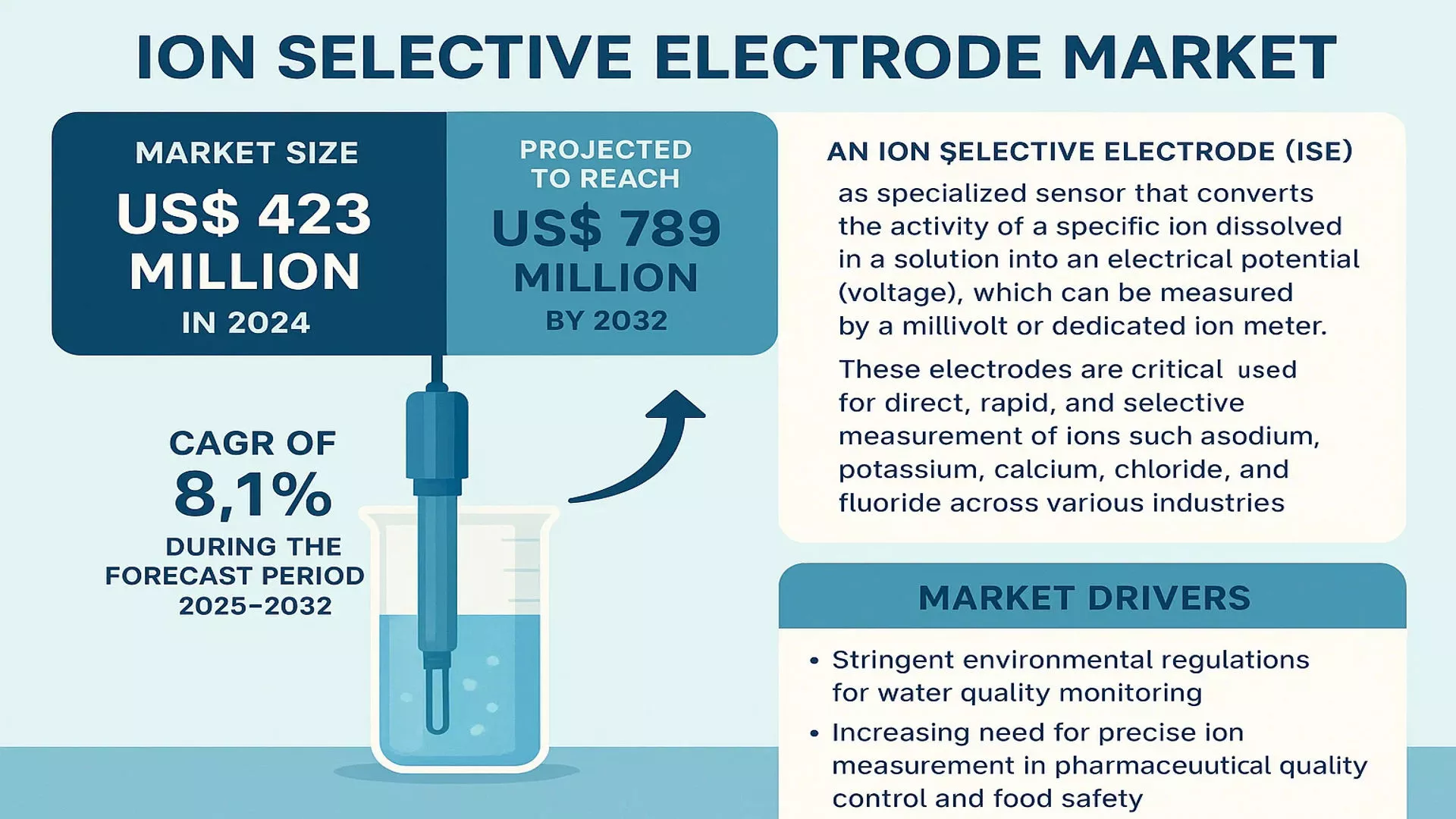
The global Ion Selective Electrode Market size was valued at US$ 423 million in 2024 and is projected to reach US$ 789 million by 2032, at a CAGR of 8.1% during the forecast period 2025-2032.
An ion selective electrode (ISE) is a specialized sensor that converts the activity of a specific ion dissolved in a solution into an electrical potential (voltage), which can be measured by a millivolt (mV) or dedicated ion meter. These electrodes are critical analytical tools used for direct, rapid, and selective measurement of ions such as sodium, potassium, calcium, chloride, and fluoride across various industries.
The market is experiencing steady growth driven by stringent environmental regulations for water quality monitoring and the increasing need for precise ion measurement in pharmaceutical quality control and food safety. Furthermore, advancements in sensor technology and the integration of ISEs into automated analytical systems are contributing to market expansion. Key players are actively engaged in product development and strategic initiatives; for instance, leading companies like Thermo Scientific, Metrohm, and Hach continue to innovate their portfolios with more robust and user-friendly electrodes to cater to the evolving demands of clinical diagnostics and industrial process control.
MARKET DYNAMICS
MARKET DRIVERS
Stringent Environmental Regulations and Water Quality Monitoring Requirements Driving Market Expansion
Global environmental protection agencies have significantly intensified water quality monitoring regulations, creating substantial demand for ion selective electrode technology. Over 85 countries have implemented stricter wastewater discharge standards since 2020, requiring continuous monitoring of specific ions in industrial and municipal water systems. The technology’s ability to provide real-time, accurate measurements of ions like fluoride, nitrate, and heavy metals makes it indispensable for compliance with environmental standards. Recent advancements in electrode design have improved detection limits to parts-per-billion levels, enabling early detection of contamination events. The global water quality monitoring market, valued at approximately $4.5 billion, continues to grow at 7% annually, with ion selective electrodes capturing a significant portion of this expansion due to their cost-effectiveness and reliability in field applications.
Growing Pharmaceutical Quality Control Applications Fueling Market Growth
The pharmaceutical industry’s increasing emphasis on quality control and process monitoring represents a major growth driver for ion selective electrodes. Regulatory requirements for drug manufacturing have become more rigorous, with over 90% of pharmaceutical companies now implementing real-time ion concentration monitoring during production processes. The technology enables precise measurement of critical ions like potassium, sodium, and calcium in drug formulations, ensuring consistency and compliance with pharmacopeia standards. The global pharmaceutical quality control market has expanded by 12% annually, with ion selective electrode adoption increasing particularly in emerging markets where cost-effective analytical solutions are prioritized. The ability to perform rapid, on-site measurements without extensive sample preparation makes these electrodes particularly valuable for pharmaceutical manufacturers seeking to optimize production efficiency while maintaining stringent quality standards.
Advancements in Sensor Technology and Miniaturization Enhancing Market Penetration
Technological innovations in electrode design and manufacturing are significantly driving market growth. Recent developments in solid-state electrodes and polymer membrane technologies have improved measurement accuracy by 35% while reducing response time to under 30 seconds. The miniaturization of electrodes has enabled their integration into portable testing devices, expanding applications in field testing and point-of-care diagnostics. Manufacturing costs have decreased by approximately 28% over the past three years due to improved production techniques and material innovations. These advancements have made ion selective electrodes more accessible to smaller laboratories and field applications, contributing to a 15% annual increase in adoption across various industrial sectors. The enhanced durability and longer shelf life of modern electrodes further reduce the total cost of ownership, making them increasingly attractive compared to traditional analytical methods.
MARKET CHALLENGES
Interference from Complex Sample Matrices Posing Significant Measurement Challenges
Ion selective electrodes face substantial challenges when analyzing complex sample matrices commonly encountered in real-world applications. The presence of interfering ions in environmental, biological, and industrial samples can cause measurement errors exceeding 25% in some cases. This interference issue becomes particularly problematic in wastewater analysis where multiple ion species coexist, and in biological fluids where protein binding affects ion availability. The need for extensive sample pretreatment and calibration procedures adds complexity to measurements and increases analysis time. Despite advancements in membrane technology, complete elimination of interference effects remains challenging, especially when measuring ions at trace concentrations in complex matrices. This limitation restricts the technology’s application in certain critical scenarios where maximum accuracy is required.
Other Challenges
Calibration and Maintenance Requirements
Frequent calibration needs and electrode maintenance present operational challenges for users. Most ion selective electrodes require daily calibration when used continuously, and membrane replacement every 3-6 months depending on usage intensity. The specialized cleaning procedures and storage requirements further complicate their use in field applications where laboratory conditions cannot be maintained. These maintenance demands increase the total cost of ownership and require trained personnel, limiting adoption in resource-constrained settings.
Competition from Alternative Technologies
Emerging analytical techniques are creating competitive pressure on ion selective electrode technology. Spectroscopic methods and chromatography techniques continue to improve in speed and sensitivity, while sensor technologies based on optical and electrochemical principles offer alternative approaches to ion detection. Although ion selective electrodes maintain advantages in cost and portability, they face increasing competition in applications requiring ultra-high sensitivity or multi-ion analysis capabilities.
MARKET RESTRAINTS
High Initial Investment and Specialized Training Requirements Limiting Market Adoption
The substantial initial investment required for comprehensive ion selective electrode systems acts as a significant market restraint. A complete analytical setup including electrodes, meters, calibration solutions, and accessories typically costs between $5,000 and $15,000, depending on application complexity. This capital expenditure represents a barrier for small laboratories and field testing operations with limited budgets. Additionally, the need for specialized operator training increases operational costs, as proper use requires understanding of electrochemical principles, calibration techniques, and interference management. The learning curve associated with obtaining accurate results deters some potential users from adopting the technology, particularly in settings where personnel turnover is high or technical expertise is limited. These factors collectively restrain market growth in price-sensitive segments and regions with limited technical infrastructure.
Limited Multiplexing Capabilities Restraining Application Scope
The inherent single-ion measurement capability of traditional ion selective electrodes presents a significant market restraint in applications requiring simultaneous multi-ion analysis. While each electrode can typically measure only one specific ion, many real-world applications require concurrent monitoring of multiple ions. This limitation necessitates either multiple electrode systems or sequential measurements, increasing analysis time and cost. The development of multi-ion sensors has progressed slowly due to technical challenges in membrane design and cross-talk between detection channels. This restraint becomes particularly relevant in clinical diagnostics and environmental monitoring where comprehensive ion profiling is often required. The inability to provide simultaneous multi-parameter analysis limits the technology’s competitiveness against alternative techniques that offer broader analytical capabilities in single instruments.
Temperature and pH Sensitivity Affecting Measurement Reliability
The performance variability of ion selective electrodes under changing environmental conditions represents a notable market restraint. Electrode response is significantly influenced by temperature fluctuations and pH variations, requiring careful environmental control or extensive compensation algorithms. In field applications where temperature can vary widely, measurement accuracy may decrease by up to 20% without proper compensation. The pH dependence of certain ion measurements necessitates additional pH monitoring and adjustment, complicating the analytical procedure. These sensitivity issues become particularly challenging in industrial process monitoring and environmental field studies where conditions cannot be easily controlled. While modern instruments incorporate temperature compensation features, complete elimination of environmental effects remains difficult, limiting application in scenarios requiring maximum reliability under variable conditions.
MARKET OPPORTUNITIES
Expanding Applications in Food Safety and Agricultural Testing Creating New Growth Avenues
The growing global focus on food safety and agricultural productivity presents substantial opportunities for ion selective electrode technology. Increasing regulations governing food quality and soil management have created demand for rapid, on-site testing of ions like nitrate, fluoride, and potassium. The technology’s portability and cost-effectiveness make it ideal for field testing in agricultural settings and food processing facilities. The global food safety testing market, projected to exceed $25 billion, increasingly incorporates ion-selective methods for routine monitoring applications. Recent developments in disposable electrode technology have further enhanced opportunities in food safety, enabling cost-effective screening at multiple points in the supply chain. The ability to perform rapid analysis without extensive laboratory facilities positions ion selective electrodes favorably for adoption in emerging markets where food safety infrastructure is developing.
Integration with IoT and Industry 4.0 Technologies Enabling Smart Monitoring Solutions
The convergence of ion selective electrode technology with Internet of Things (IoT) platforms and Industry 4.0 concepts creates significant growth opportunities. Smart sensors equipped with wireless connectivity and cloud-based data management are transforming industrial process monitoring and environmental surveillance. Ion selective electrodes integrated with IoT capabilities enable real-time remote monitoring of water quality, industrial processes, and environmental parameters. The global IoT sensor market is growing at over 20% annually, with environmental and industrial sensors representing a substantial segment. This integration allows continuous data collection from multiple locations, predictive maintenance based on electrode performance metrics, and automated calibration reminders. The development of low-power, wireless electrode systems opens new application areas in distributed monitoring networks where traditional laboratory-based approaches are impractical or cost-prohibitive.
Emerging Applications in Biomedical and Point-of-Care Diagnostics Driving Innovation
Advancements in biomedical applications represent a promising growth opportunity for ion selective electrode technology. The increasing demand for point-of-care diagnostics and wearable health monitors has stimulated development of miniaturized, disposable electrodes for medical applications. Recent innovations in solid-contact electrodes and polymer membrane technologies have improved biocompatibility and measurement stability in biological fluids. The global point-of-care diagnostics market, expanding at 9% annually, increasingly incorporates electrochemical sensors for electrolyte monitoring and disease biomarker detection. The development of wearable ion sensors for continuous health monitoring opens new market segments in personalized medicine and remote patient management. These biomedical applications require electrodes with enhanced sensitivity, stability, and miniaturization capabilities, driving research and development investments that ultimately benefit broader market applications.
ION SELECTIVE ELECTRODE MARKET TRENDS
Integration of IoT and Automation to Emerge as a Dominant Trend
The integration of Internet of Things (IoT) technology and automation into analytical instrumentation is significantly transforming the ion selective electrode market. Modern ISE systems are increasingly being equipped with wireless connectivity and cloud-based data management capabilities, enabling real-time monitoring and remote access to critical ion concentration data. This trend is particularly strong in the water quality monitoring and industrial process control sectors, where continuous, unattended operation is essential. For instance, in wastewater treatment facilities, automated ISE systems can monitor parameters like ammonium, nitrate, and fluoride concentrations around the clock, with data automatically uploaded to central control systems. This automation reduces labor costs, minimizes human error, and provides more consistent data quality. The shift toward Industry 4.0 and smart manufacturing practices is further accelerating this trend, as manufacturers seek to integrate analytical sensors into their automated production lines for quality control and regulatory compliance.
Other Trends
Expansion in Environmental Monitoring Applications
Growing global emphasis on environmental protection and regulatory compliance is driving increased adoption of ion selective electrodes for monitoring water and soil quality. Governments worldwide are implementing stricter regulations on water discharge and environmental pollutants, creating sustained demand for reliable, cost-effective monitoring solutions. ISEs offer significant advantages for field measurements due to their portability, rapid response times, and ability to provide direct measurements without complex sample preparation. The technology is particularly valuable for measuring ions like nitrate, fluoride, and heavy metals in environmental samples. The market for environmental monitoring applications is expected to grow at approximately 7.8% annually, reflecting increased investment in environmental protection infrastructure globally. This trend is further supported by rising public awareness of water pollution issues and the need for continuous monitoring of drinking water sources.
Advancements in Sensor Materials and Miniaturization
Technological innovations in sensor materials and manufacturing processes are driving significant improvements in ion selective electrode performance and application range. Recent developments include the creation of more selective and durable membrane materials that offer enhanced resistance to interfering ions and longer operational lifetimes. Researchers are developing solid-state ISEs with improved stability and reduced maintenance requirements compared to traditional liquid-filled electrodes. Simultaneously, the trend toward miniaturization is enabling the development of portable and handheld ISE devices that can perform laboratory-quality measurements in field settings. These advancements are particularly important for point-of-care medical diagnostics and food safety testing applications where rapid, on-site results are critical. The development of microarray-based ISE systems capable of simultaneously measuring multiple ions from a single sample represents another significant innovation, expanding the technology’s utility in complex analytical scenarios.
Growing Adoption in Pharmaceutical and Biomedical Sectors
The pharmaceutical and biomedical industries are increasingly incorporating ion selective electrodes into their quality control and research workflows. ISEs provide a reliable method for measuring critical ions in pharmaceutical formulations, including potassium, sodium, and lithium in various drug products. The technology’s ability to provide rapid measurements without extensive sample preparation makes it particularly valuable for quality control in manufacturing environments. In clinical settings, ISEs are essential components of blood gas analyzers and electrolyte analyzers, providing critical diagnostic information for patient care. The global aging population and increasing prevalence of chronic diseases are driving growth in clinical diagnostics, with the medical segment accounting for approximately 28% of the total ISE market revenue. Furthermore, the expansion of biopharmaceutical manufacturing and increased regulatory requirements for drug quality assurance are creating additional demand for precise ion measurement technologies throughout the pharmaceutical supply chain.
COMPETITIVE LANDSCAPE
Key Industry Players
Companies Prioritize Technological Innovation and Strategic Expansion to Maintain Market Position
The global ion selective electrode market exhibits a semi-consolidated competitive structure, characterized by the presence of established multinational corporations, specialized mid-sized firms, and emerging regional players. Thermo Fisher Scientific Inc. (operating through its brand Thermo Scientific) holds a dominant position, commanding a significant revenue share estimated at over 18% in 2024. This leadership is largely attributed to its extensive product portfolio, robust R&D capabilities, and a vast global distribution network spanning North America, Europe, and Asia-Pacific.
Metrohm AG and Hach (a subsidiary of Danaher Corporation) are also major contributors, collectively accounting for approximately 22% of the market. Their stronghold is reinforced by deep application expertise in water quality analysis and industrial process monitoring, coupled with continuous product enhancements. For instance, Metrohm’s recent launch of smart ion meters with integrated connectivity features exemplifies the industry’s shift toward digitalization and data management.
Furthermore, these leading companies are actively engaged in strategic initiatives to solidify their market standing. Investments in expanding direct sales and service capabilities in high-growth regions, particularly across Asia-Pacific, are a key focus. Additionally, partnerships with academic and research institutions for co-development of novel electrode formulations are becoming increasingly common, driving innovation in selectivity and sensor longevity.
Meanwhile, specialized players like WTW GmbH (Xylem Analytics) and Van London-pHoenix Company compete effectively by focusing on niche applications and offering customized solutions. Their growth strategies often involve targeting specific end-user segments, such as environmental monitoring or food and beverage quality control, with tailored products and technical support. This approach allows them to carve out sustainable market niches despite the scale of larger competitors.
List of Key Ion Selective Electrode Companies Profiled
- Thermo Fisher Scientific Inc. (Thermo Scientific) (U.S.)
- Metrohm AG (Switzerland)
- Hach Company (Danaher Corporation) (U.S.)
- WTW GmbH (Xylem Analytics) (Germany)
- Cole-Parmer Ltd. (U.S.)
- NT Sensors, S.L. (Spain)
- Siemens Healthcare Diagnostics Inc. (Germany)
- Van London-pHoenix Company (U.S.)
- Sensortechnik Meinsberg GmbH (Germany)
- Shanghai Leici Instrument Co., Ltd. (China)
Segment Analysis:
By Type
Glass Membrane Electrodes Dominate the Market Due to Their Robustness and Widespread Use in pH Measurement
The market is segmented based on type into:
- Glass Membranes
- Subtypes: pH electrodes, sodium ion electrodes, and others
- Crystalline Membranes
- Subtypes: Fluoride electrodes, chloride electrodes, and others
- Ion-Exchange Resin Membranes
- Subtypes: Calcium electrodes, nitrate electrodes, and others
- Enzyme Electrodes
- Subtypes: Urea electrodes, glucose electrodes, and others
- Others
By Application
Water Quality Analysis Segment Leads Due to Stringent Environmental Regulations and Global Water Safety Initiatives
The market is segmented based on application into:
- Water Quality Analysis
- Food and Beverage Processing
- Pharmaceuticals and Biotechnology
- Clinical Diagnostics
- Others
By End User
Environmental Monitoring Agencies Segment Leads Due to Increased Regulatory Compliance and Pollution Control Efforts
The market is segmented based on end user into:
- Environmental Monitoring Agencies
- Industrial Manufacturing
- Healthcare and Diagnostic Laboratories
- Academic and Research Institutions
- Others
Regional Analysis: Ion Selective Electrode Market
Asia-Pacific
The Asia-Pacific region dominates the global Ion Selective Electrode (ISE) market, accounting for over 40% of the total market share by volume as of 2024. This leadership position is driven by massive industrialization, rapid urbanization, and significant government investments in environmental monitoring and food safety infrastructure. China, in particular, is the largest consumer, fueled by its extensive manufacturing base and stringent new environmental regulations, such as the Water Ten Plan, which mandates comprehensive water quality testing. India follows closely, with its expanding pharmaceutical sector and increasing focus on water quality management under initiatives like the Jal Jeevan Mission. While cost-effective solutions remain popular, there is a marked shift towards advanced, reliable ISE technologies to ensure compliance with both domestic and international standards. The region’s growth is further accelerated by the presence of major manufacturing hubs and increasing R&D investments from global players.
North America
North America represents a mature yet steadily growing market for Ion Selective Electrodes, characterized by high regulatory standards and advanced technological adoption. The United States holds the largest share within the region, driven by strict Environmental Protection Agency (EPA) regulations for water and soil testing, as well as rigorous FDA standards in the food and pharmaceutical industries. The region’s well-established healthcare infrastructure and high spending on research and development contribute significantly to demand for precise analytical instruments. Furthermore, increasing concerns over environmental contamination, such as lead in drinking water, have spurred municipal and federal investments in advanced monitoring technologies. Key players like Thermo Scientific and Hach have a strong presence, continuously innovating to meet the demand for more accurate and user-friendly ISE systems.
Europe
Europe is a significant market for Ion Selective Electrodes, underpinned by stringent EU directives and a strong emphasis on environmental protection and public health. Regulations such as the EU Water Framework Directive and REACH (Registration, Evaluation, Authorisation and Restriction of Chemicals) drive consistent demand for high-precision ion detection in water treatment, industrial effluent monitoring, and food safety applications. Countries like Germany, France, and the UK are at the forefront, hosting leading manufacturers and research institutions that focus on technological advancements. The market here is characterized by a high adoption rate of automated and integrated ISE systems, particularly in the pharmaceutical and biotechnology sectors. While growth is stable, it is tempered by market saturation in some segments, though innovation in portable and smart sensors offers new opportunities.
South America
The Ion Selective Electrode market in South America is emerging, with growth primarily fueled by increasing environmental awareness and gradual industrialization. Brazil and Argentina are the key markets, where expanding agricultural and mining activities necessitate water and soil quality monitoring. However, the adoption of advanced ISE technologies is often hindered by economic volatility and limited regulatory enforcement. Governments are beginning to implement stricter environmental policies, but budget constraints slow down the widespread deployment of sophisticated analytical equipment. Nonetheless, the region presents long-term potential, especially in the food and beverage sector, where export quality standards drive the need for reliable ion measurement solutions.
Middle East & Africa
The Middle East & Africa region shows nascent but promising growth for the Ion Selective Electrode market. Demand is primarily driven by water scarcity issues and the resulting focus on desalination and water treatment processes, particularly in Gulf Cooperation Council (GCC) countries like Saudi Arabia and the UAE. The mining industry in Africa also contributes to demand for ion monitoring in environmental and process applications. However, the market’s development is constrained by limited technical infrastructure and lower prioritization of advanced analytical instrumentation in many areas. As economic diversification and urban development projects advance, the need for precise ion measurement in sectors like pharmaceuticals and food processing is expected to gradually increase, offering future growth avenues.
Report Scope
This market research report provides a comprehensive analysis of the global and regional Ion Selective Electrode markets, covering the forecast period 2025–2032. It offers detailed insights into market dynamics, technological advancements, competitive landscape, and key trends shaping the industry.
Key focus areas of the report include:
- Market Size & Forecast: Historical data and future projections for revenue, unit shipments, and market value across major regions and segments.
- Segmentation Analysis: Detailed breakdown by product type, technology, application, and end-user industry to identify high-growth segments and investment opportunities.
- Regional Outlook: Insights into market performance across North America, Europe, Asia-Pacific, Latin America, and the Middle East & Africa, including country-level analysis where relevant.
- Competitive Landscape: Profiles of leading market participants, including their product offerings, R&D focus, manufacturing capacity, pricing strategies, and recent developments such as mergers, acquisitions, and partnerships.
- Technology Trends & Innovation: Assessment of emerging technologies, integration of IoT and automation, sensor design trends, fabrication techniques, and evolving industry standards.
- Market Drivers & Restraints: Evaluation of factors driving market growth along with challenges, supply chain constraints, regulatory issues, and market-entry barriers.
- Stakeholder Analysis: Insights for component suppliers, OEMs, system integrators, investors, and policymakers regarding the evolving ecosystem and strategic opportunities.
Primary and secondary research methods are employed, including interviews with industry experts, data from verified sources, and real-time market intelligence to ensure the accuracy and reliability of the insights presented.
FREQUENTLY ASKED QUESTIONS:
What is the current market size of Global Ion Selective Electrode Market?
-> Ion Selective Electrode Market size was valued at US$ 423 million in 2024 and is projected to reach US$ 789 million by 2032, at a CAGR of 8.1% during the forecast period 2025-2032.
Which key companies operate in Global Ion Selective Electrode Market?
-> Key players include Thermo Scientific, Metrohm, WTW GmbH, Cole-Parmer Ltd, NT Sensors, Siemens Healthcare Diagnostics, Van London-pHoenix, and HACH, among others.
What are the key growth drivers?
-> Key growth drivers include stringent environmental regulations, increasing demand for water quality monitoring, growth in pharmaceutical and food safety testing, and technological advancements in sensor technology.
Which region dominates the market?
-> North America holds a significant market share, while Asia-Pacific is the fastest-growing region due to rapid industrialization and increasing environmental concerns.
What are the emerging trends?
-> Emerging trends include development of solid-contact ISEs, miniaturization of sensors for point-of-care testing, integration with IoT for real-time monitoring, and increased use in biomedical applications.

Get Sample Report PDF for Exclusive Insights
Report Sample Includes
- Table of Contents
- List of Tables & Figures
- Charts, Research Methodology, and more...
 Download Sample Report PDF