Market Insights
Global Intelligent Wafer Sorting Machine Market size was valued at USD 259 million in 2025. The market is projected to grow from USD 275 million in 2026 to USD 393 million by 2032, exhibiting a CAGR of 6.2% during the forecast period.
Intelligent wafer sorting machines are automated semiconductor equipment that classify wafers based on electrical characteristics, dimensional precision, surface defect inspection, crystal orientation, resistivity, and structural integrity. These systems integrate AI-based detection algorithms, high-resolution optical systems, robotic handling modules, and industrial automation controls to enhance yield and efficiency in semiconductor manufacturing.
The market growth is driven by increasing demand for advanced semiconductor packaging technologies such as 2.5D/3D ICs and fan-out wafer-level packaging (FOWLP). Additionally, rising investments in AI, 5G, and automotive electronics are accelerating adoption. Key players like KLA-Tencor and Cohu are focusing on innovations in high-precision motion control and real-time data processing to meet evolving industry requirements.
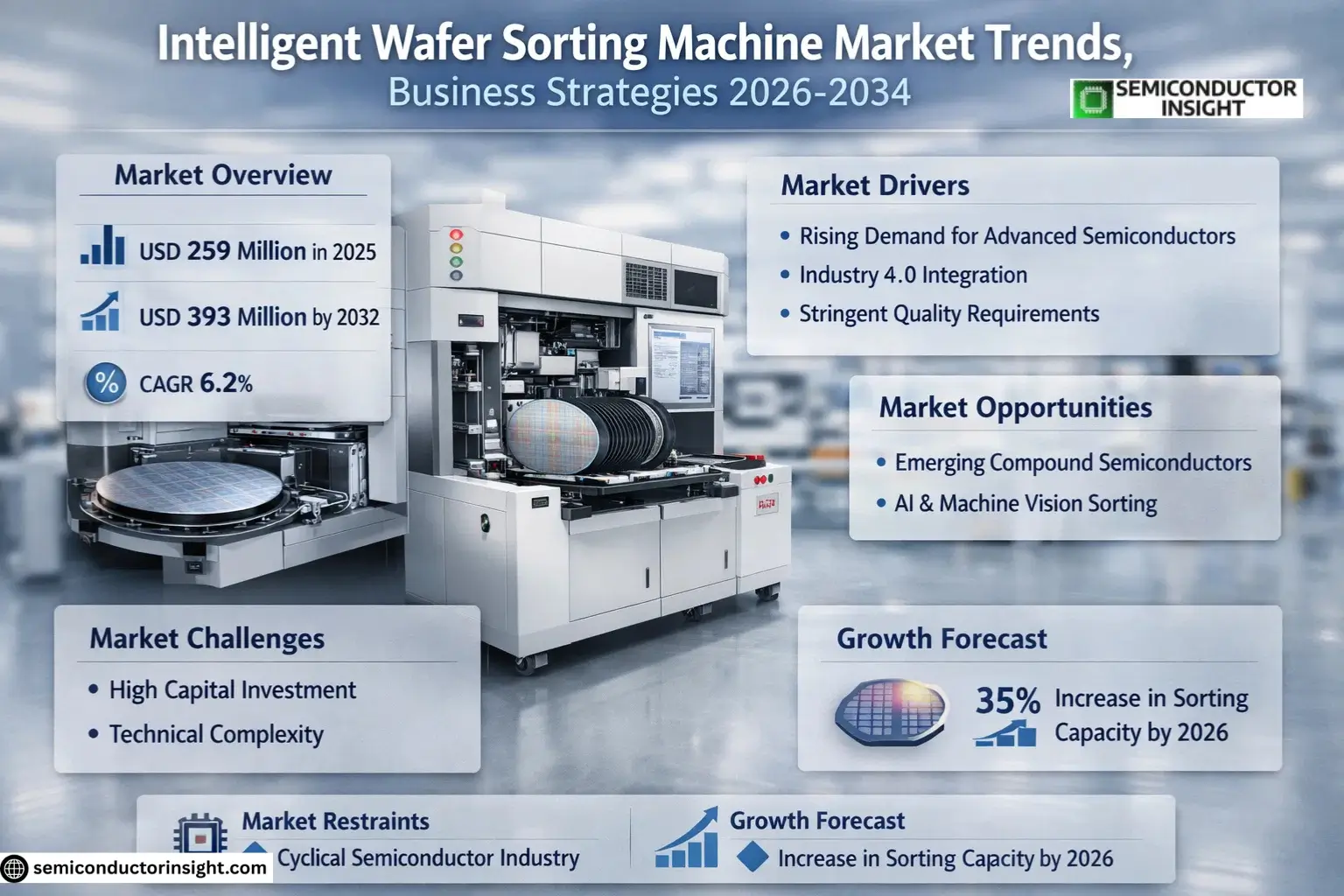
MARKET DRIVERS
Rising Demand for Advanced Semiconductor Manufacturing
Global Intelligent Wafer Sorting Machine Market is experiencing significant growth due to the increasing demand for high-performance semiconductors in consumer electronics, automotive, and industrial applications. With wafer production volumes growing at an annual rate of approximately 12%, manufacturers are adopting intelligent sorting solutions to enhance quality control and production efficiency.
Industry 4.0 Integration
Advancements in AI and machine learning have enabled intelligent wafer sorting machines to achieve defect detection accuracy rates exceeding 99.5%. This technological leap is driving adoption as manufacturers seek to reduce scrap rates and improve yield in high-volume fabrication facilities.
Stringent quality requirements in emerging applications like 5G chips and automotive power semiconductors are further accelerating market growth for precision sorting solutions.
MARKET CHALLENGES
High Capital Investment Requirements
The average price point of industrial-grade intelligent wafer sorting machines remains a significant barrier, with systems costing between USD 2-5 million depending on configuration and capability level. This limits adoption among smaller semiconductor manufacturers and startups.
Other Challenges
Technical Complexity in Integration
Deploying intelligent wafer sorting systems often requires substantial facility upgrades and staff retraining, with integration timelines averaging 6-9 months for full operational capability.
MARKET RESTRAINTS
Cyclical Nature of Semiconductor Industry
Intelligent Wafer Sorting Machine Market is affected by semiconductor industry cycles, with capital expenditure fluctuations causing periodic demand variability. During downturns, manufacturers often delay investments in new equipment, including advanced sorting solutions.
MARKET OPPORTUNITIES
Emerging Compound Semiconductor Applications
The growing adoption of GaN and SiC wafers for power electronics creates new opportunities for intelligent sorting solutions, as these materials present unique inspection challenges that conventional systems cannot address effectively. Market projections suggest compound semiconductor production will require 35% more sorting capacity by 2026.
Intelligent Wafer Sorting Machine Market Trends
AI and Machine Vision Driving Precision Sorting
Intelligent Wafer Sorting Machine Market is witnessing significant adoption of AI-driven defect detection and high-resolution machine vision systems. Leading manufacturers are integrating deep learning algorithms to identify micro-defects with sub-micron accuracy while reducing false reject rates below 0.5%. These systems now achieve 99.98% classification accuracy across complex chip architectures. The shift toward AI-powered inspection is redefining wafer sorting benchmarks in semiconductor fabs.
Other Trends
Advanced Packaging Compatibility
With the rise of 2.5D/3D IC packaging, intelligent wafer sorting machines now incorporate adaptive handling modules for chiplet architectures and through-silicon vias (TSVs). Equipment providers are developing specialized sorting solutions for fan-out wafer-level packaging (FOWLP) applications where die thickness falls below 50µm. This trend is particularly dominant among OSAT providers serving the automotive and HPC sectors.
Regional Market Developments
Asia-Pacific accounts for 78% of global intelligent wafer sorting machine deployments, primarily driven by Taiwan’s TSMC, South Korea’s Samsung, and China’s SMIC. North American IDMs are accelerating investments in next-gen sorting systems to support reshoring initiatives, with 32% increased capital expenditure projected for 2025. European equipment suppliers are focusing on niche applications in automotive-grade power semiconductors requiring sorting temperatures up to 200°C.
Throughput and Automation Innovations
High-speed intelligent wafer sorting machines now achieve 12,000 units per hour throughput through parallel processing architectures. The latest models feature fully automated wafer handling with robotic arm integration, reducing human intervention to less than 5% of operational cycles. This development is critical for maintaining profitability as wafer sizes increase to 450mm in pilot production lines.
COMPETITIVE LANDSCAPE
Key Industry Players
Market Dominated by Precision Equipment Leaders with 58% Gross Margins
Intelligent Wafer Sorting Machine Market is led by KLA-Tencor, which holds a dominant 28% revenue share globally due to its advanced AI-based defect detection systems. The competitive landscape shows moderate consolidation, with the top 5 players controlling 62% of the market. Leading suppliers differentiate through proprietary machine vision algorithms, robotic handling accuracy below 3μm, and integration with semiconductor MES systems. High barriers to entry exist due to the need for precision motion control expertise and semiconductor-grade component supply chains.
Niche players like YAC Garter and Ueno Seiki specialize in high-speed sorting solutions for advanced packaging applications. Emerging Chinese manufacturers such as Suzhou MTS Automation Equipment are gaining traction in the 12-inch wafer segment with cost-competitive alternatives. Market leaders are investing heavily in deep learning-enabled optical inspection systems to address the growing complexity of 3D IC architectures and chiplets.
List of Key Intelligent Wafer Sorting Machine Companies Profiled
- KLA-Tencor
- YAC Garter
- Ueno Seiki
- MPI Corporation
- Semiconductor Technologies & Instruments Pte Ltd
- Air-Vac Automation
- Suzhou MTS Automation Equipment
- Mühlbauer
- Canon Machinery
- Cohu
- Hangzhou Changchuan Technology
- Royce Instruments
- Syagrus Systems
- Tokyo Seimitsu
- Hirano Tecseed
Segment Analysis:
| Segment Category | Sub-Segments | Key Insights |
| By Type |
|
High Speed Intelligent Wafer Sorting Machine dominates the sector due to:
|
| By Application |
|
OSAT Providers represent the prime market segment because of:
|
| By End User |
|
Memory Chip Producers demonstrate strongest adoption driven by:
|
| By Wafer Size |
|
12-inch Wafer Sorting Machines maintain market leadership owing to:
|
| By Technology |
|
AI-Based Defect Detection technology shows greatest adoption due to:
|
Regional Analysis: Global Intelligent Wafer Sorting Machine Market
Taiwan’s dense network of foundries and OSAT providers drives intensive adoption of intelligent wafer sorting systems, with particular emphasis on AI-based defect detection for advanced nodes. The island’s semiconductor giants lead in implementing machine learning algorithms for predictive yield management.
Chinese manufacturers are rapidly upgrading to intelligent wafer sorting technologies as part of national semiconductor self-sufficiency goals. Local equipment suppliers are developing competitive sorting solutions with government R&D support, challenging established international brands in the mid-range market segment.
South Korean memory producers utilize intelligent wafer sorting machines with specialized algorithms for high-volume DRAM and NAND flash production. The country’s equipment vendors integrate proprietary vision systems optimized for memory wafer inspection and sorting at unprecedented throughput rates.
Malaysia, Singapore, and Vietnam are witnessing growing installations of intelligent wafer sorting machines as global semiconductor companies diversify manufacturing bases. New facilities in these countries prioritize automated sorting solutions to maintain quality standards across distributed production networks.
North America
North America maintains strong demand for high-performance intelligent wafer sorting machines, particularly from IDMs and advanced packaging facilities. U.S. semiconductor equipment manufacturers lead in developing next-generation sorting technologies with enhanced AI capabilities. The region sees significant R&D investment in quantum computing and compound semiconductor applications, driving specialized wafer sorting requirements. Strategic collaborations between equipment vendors and national labs accelerate innovation in defect detection algorithms for emerging materials.
Europe
European semiconductor manufacturers emphasize precision engineering in wafer sorting, with strong adoption in automotive and industrial chip production. German and Dutch equipment suppliers provide specialized sorting solutions for power semiconductors and MEMS applications. The region’s focus on sustainability influences sorting machine designs with energy-efficient operation and reduced consumable usage. Collaborative research initiatives between universities and equipment makers advance AI-based quality control methodologies.
Middle East & Africa
The Middle East is emerging as a new market for intelligent wafer sorting technologies through strategic investments in semiconductor manufacturing infrastructure. Regional initiatives aim to develop local chip production capabilities, creating demand for automated sorting solutions. Equipment vendors are establishing service hubs in the UAE and Saudi Arabia to support growing regional installations, with particular focus on photovoltaic and optoelectronics applications.
South America
South America’s Intelligent Wafer Sorting Machine Market remains nascent but shows growth potential through increasing electronics manufacturing in Brazil and Mexico. Local assembly operations are gradually adopting basic automated sorting systems, while regional trade policies encourage technology transfer partnerships. The market primarily serves automotive and consumer electronics supply chains with standardized sorting solutions.
Report Scope
This market research report provides a comprehensive analysis of the Intelligent Wafer Sorting Machine Market, covering the forecast period 2025–2032. It offers detailed insights into market dynamics, technological advancements, competitive landscape, and key trends shaping the industry.
Key focus areas of the report include:
- Market Overview: The report begins with an overview outlining its current market scenario, key growth indicators, and industry transformation drivers. It discusses macroeconomic factors, demand–supply balance, regulatory landscape, and the strategic role of semiconductors in powering advancements across industries such as automotive, telecommunications, consumer electronics, and industrial automation.
- Market Size & Forecast: Historical data and future projections for revenue, unit shipments, and market value across major regions and segments.
- Segmentation Analysis: Detailed breakdown by product type, technology, application, and end-user industry to identify high-growth segments and investment opportunities.
- Regional Insights: Insights into market performance across North America, Europe, Asia-Pacific, Latin America, and the Middle East & Africa, including country-level analysis where relevant.
- Competitive Landscape: Profiles of leading market participants, including their product offerings, R&D focus, manufacturing capacity, pricing strategies, and recent developments such as mergers, acquisitions, and partnerships.
- Technology Trends & Innovation: Assessment of emerging technologies, integration of AI/IoT, semiconductor design trends, fabrication techniques, and evolving industry standards.
- Market Drivers & Restraints: Evaluation of factors driving market growth along with challenges, supply chain constraints, regulatory issues, and market-entry barriers.
- Stakeholder Insights: Insights for component suppliers, OEMs, system integrators, investors, and policymakers regarding the evolving ecosystem and strategic opportunities.
Primary and secondary research methods are employed, including interviews with industry experts, data from verified sources, and real-time market intelligence to ensure the accuracy and reliability of the insights presented.
FREQUENTLY ASKED QUESTIONS:
What is the current market size of Intelligent Wafer Sorting Machine Market?
-> Intelligent Wafer Sorting Machine Market size was valued at USD 259 million in 2025. The market is projected to grow from USD 275 million in 2026 to USD 393 million by 2032, exhibiting a CAGR of 6.2% during the forecast period.
Which key companies operate in Intelligent Wafer Sorting Machine Market?
-> Key players include KLA-Tencor, YAC Garter, Ueno Seiki, MPI Corporation, Semiconductor Technologies & Instruments Pte Ltd, Air-Vac Automation, Suzhou MTS Automation Equipment, Mühlbauer, Canon Machinery, Cohu, Hangzhou Changchuan Technology, Royce Instruments, and Syagrus Systems.
What are the key growth drivers?
-> Key growth drivers include rising semiconductor demand across AI, 5G, high-performance computing, and automotive electronics, along with increasing adoption of advanced packaging technologies such as 2.5D/3D ICs and fan-out wafer-level packaging (FOWLP).
Which region dominates the market?
-> Asia-Pacific dominates the global Intelligent Wafer Sorting Machine Market, driven by concentration of major wafer foundries and OSAT providers in China, Taiwan, Japan, and South Korea.
What are the emerging trends?
-> Emerging trends include integration of AI-based defect detection, real-time data processing, high-precision motion control, and seamless automation integration in wafer sorting systems.

Get Sample Report PDF for Exclusive Insights
Report Sample Includes
- Table of Contents
- List of Tables & Figures
- Charts, Research Methodology, and more...
 Download Sample Report PDF