
Intelligent Phosphine Sensor Market Insights
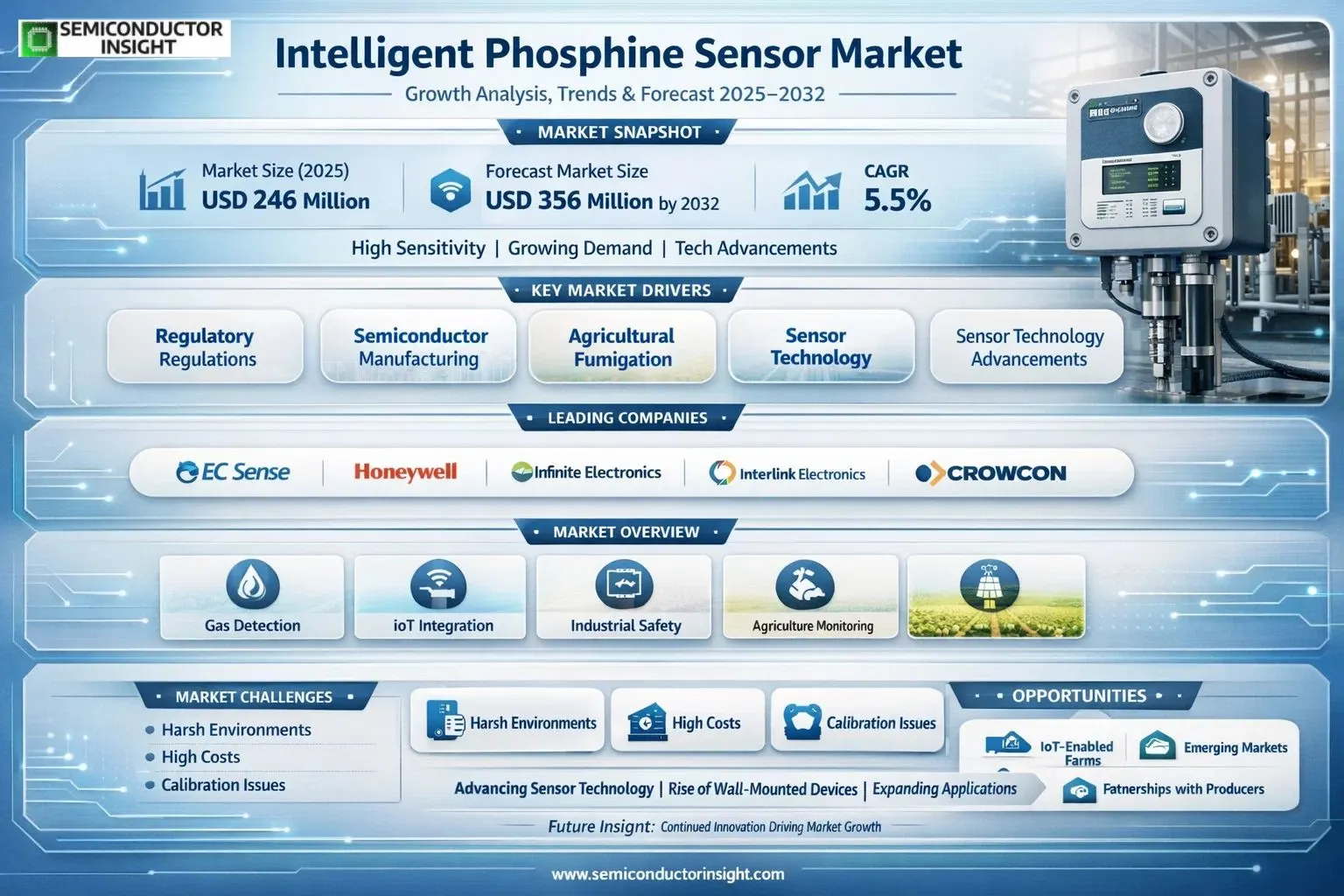
Global Intelligent Phosphine Sensor market size was valued at USD 246 million in 2025. The market is projected to reach USD 356 million by 2032, exhibiting a CAGR of 5.5% during the forecast period.
Intelligent Phosphine Sensor is a gas detection device that integrates advanced technology and intelligent algorithms. It is based on electrochemical principles and generates a current signal proportional to the concentration of phosphine through redox reactions. Phosphine sensors have the characteristics of high sensitivity, high selectivity, good stability, strong anti-interference ability, and long service life. They are widely used in petrochemical, semiconductor manufacturing, agricultural production, and other fields.
The market is experiencing steady growth due to several factors, including stringent safety regulations in high-risk industries, rising demand for precise gas monitoring in semiconductor fabrication, and expanding phosphine fumigation practices in agriculture. Additionally, advancements in electrochemical sensor designs and IoT-enabled real-time detection are contributing to market expansion. Initiatives by key players are expected to further fuel growth. Honeywell, Crowcon, and Zhengzhou Winsen Electronics Technology are some of the key players operating in the market with diverse product portfolios.
MARKET DRIVERS
Regulatory Mandates for Fumigation Safety
Intelligent Phosphine Sensor Market benefits from stringent global regulations on phosphine gas usage in agriculture and food storage. With fumigation practices essential for pest control in grains, agencies like the EPA and EU standards enforce real-time monitoring to prevent overexposure. This drives demand for smart sensors capable of precise detection at parts-per-billion levels, reducing health risks for workers.
Technological Integration in Industry 4.0
Advancements in IoT and AI are propelling the sector, enabling wireless connectivity and predictive analytics in warehouses and silos. The market sees a **projected CAGR of 8.2% through 2030**, fueled by semiconductor manufacturing where phosphine purity demands intelligent oversight. These sensors now offer remote alerts and data logging, enhancing operational efficiency.
➤ Growth in grain export volumes worldwide, with over 500 million tons annually, necessitates advanced phosphine detection to meet international quarantine rules.
Overall, rising industrial automation and worker safety priorities solidify the foundation for sustained expansion in Intelligent Phosphine Sensor Market.
MARKET CHALLENGES
Sensor Accuracy in Harsh Environments
Intelligent phosphine sensors face difficulties maintaining calibration amid humidity fluctuations and dust in grain facilities, leading to false positives that disrupt operations. Achieving reliable low-level detection remains technically demanding, with cross-sensitivity to other gases complicating deployment in Intelligent Phosphine Sensor Market.
Other Challenges
High Development and Maintenance Costs
Ongoing R&D for miniaturization and battery life pushes expenses, while frequent recalibration in field conditions adds to operational burdens for end-users in agriculture and logistics.Supply chain disruptions for rare-earth materials used in sensor components further exacerbate pricing volatility, hindering widespread adoption despite market potential.
MARKET RESTRAINTS
Regulatory Approval Delays
Stringent certification processes from bodies like ATEX and OSHA slow market entry for new intelligent phosphine sensors, as compliance testing can span 12-18 months. This restraint limits innovation pace in Intelligent Phosphine Sensor Market, particularly for startups competing with established players.Competition from traditional detection methods, such as colorimetric tubes, persists due to their lower upfront costs, capping growth in cost-sensitive sectors like small-scale farming.Additionally, limited awareness in developing regions restrains penetration, as stakeholders prioritize basic safety over intelligent systems with advanced features.
MARKET OPPORTUNITIES
IoT-Enabled Smart Agriculture Expansion
The integration of intelligent phosphine sensors with farm management platforms opens avenues in precision agriculture, where real-time data optimizes fumigation cycles and minimizes chemical use. This aligns with global sustainability goals, positioning Intelligent Phosphine Sensor Market for robust growth.Emerging economies in Asia-Pacific, handling 60% of world grain trade, present untapped demand as infrastructure modernizes for export compliance.Further, partnerships with fumigant producers for bundled solutions and AI-driven predictive maintenance could capture an additional **15% market share by 2028**.
Intelligent Phosphine Sensor Market Trends
Advancements in Intelligent Sensor Technology
Intelligent Phosphine Sensor Market is witnessing significant advancements driven by the integration of intelligent algorithms and electrochemical principles. These sensors generate precise current signals proportional to phosphine concentrations via redox reactions, offering high sensitivity, selectivity, stability, anti-interference capabilities, and extended service life. This technological evolution supports broader deployment across critical sectors, enhancing real-time gas detection for safety compliance. Industry analyses indicate that these innovations are addressing evolving safety standards in phosphine handling environments, fostering more reliable monitoring solutions.
Other Trends
Growth in Wall-Mounted Sensor Configurations
Wall-mounted Intelligent Phosphine Sensors are emerging as a preferred segment within Intelligent Phosphine Sensor Market due to their straightforward installation and suitability for fixed industrial locations. This trend reflects a shift towards user-friendly designs that minimize downtime in petrochemical plants and semiconductor facilities, where continuous phosphine monitoring is essential. Manufacturers are prioritizing these models for their adaptability in diverse operational setups, contributing to improved operational efficiency and reduced maintenance needs.
Expansion Across Key Applications and Regions
Intelligent Phosphine Sensor Market is expanding rapidly in applications such as the petrochemical industry, semiconductor manufacturing, and agricultural production, alongside other fields. Petrochemical operations benefit from robust detection to prevent hazardous exposures, while semiconductor processes leverage precise phosphine control for doping applications. Agricultural fumigation represents another growth area, with sensors aiding safe phosphine usage in grain storage. Regionally, Asia, particularly China, shows strong momentum due to surging industrial activities, complemented by steady demand in North America and Europe. Leading players like Honeywell, EC Sense, Crowcon, and Zhengzhou Winsen Electronics Technology are intensifying competition through product innovations and strategic expansions, propelling market dynamics forward. This multifaceted growth underscores the sensors’ pivotal role in enhancing workplace safety and process optimization globally.
COMPETITIVE LANDSCAPE
Key Industry Players
Intelligent Phosphine Sensor Market Leaders and Strategic Insights
Intelligent Phosphine Sensor Market exhibits a moderately concentrated structure dominated by a few leading manufacturers leveraging advanced electrochemical sensing technologies for phosphine detection. Honeywell stands out as a primary global leader, offering robust, high-sensitivity sensors integrated with intelligent algorithms for real-time monitoring in demanding environments like petrochemical and semiconductor facilities. Alongside Honeywell, the top five players—including EC Sense and Crowcon—collectively hold a substantial revenue share in 2025, capitalizing on superior selectivity, stability, and anti-interference capabilities. This oligopolistic dynamic drives innovation in wall-mounted and pipe-mounted variants, supporting the market’s projected growth from $246 million in 2025 to $356 million by 2032 at a 5.5% CAGR.
Beyond the frontrunners, a cadre of niche and regional players contributes to market diversity, particularly in Asia where demand surges from agricultural production and manufacturing sectors. Companies such as Zhengzhou Winsen Electronics Technology and Guangzhou Luftmy Intelligent Technology provide specialized, cost-competitive solutions with extended service life, challenging incumbents through agile development and localized distribution. Emerging entities like Shenzhen Singoan Electronic Technology and Skesen further fragment the landscape by targeting underserved applications in fumigation and industrial safety, fostering competitive pricing and rapid product iterations amid evolving regulatory standards.
List of Key Intelligent Phosphine Sensor Companies Profiled
- EC Sense
- Honeywell
- Infinite Electronics
- Interlink Electronics
- Innodisk Corporation
- Crowcon
- RC Systems
- Zhengzhou Winsen Electronics Technology
- Guangzhou Luftmy Intelligent Technology
- Shenzhen Singoan Electronic Technology
- Sksen
- Prsens
- Advanced Sensors Application
- Sangbay
Segment Analysis:
| Segment Category | Sub-Segments | Key Insights |
| By Type |
|
Wall-Mounted leads due to its versatility in diverse installation environments.
|
| By Application |
|
Petrochemical Industry dominates as the primary use case for phosphine detection.
|
| By End User |
|
Industrial Facilities remains the frontrunner owing to rigorous safety demands.
|
| By Technology |
|
Electrochemical technology prevails with its superior performance attributes.
|
| By Connectivity |
|
Wired connectivity holds the lead for reliable data transmission.
|
Regional Analysis: Intelligent Phosphine Sensor Market
North America
In North America, cutting-edge Intelligent Phosphine Sensor Market innovations feature AI-driven predictive analytics and remote diagnostics. These sensors provide continuous monitoring with high sensitivity, minimizing false alarms in humid silo environments. Integration with farm management software streamlines data visualization, empowering operators to make informed decisions swiftly.
Strict EPA and OSHA guidelines in North America bolster Intelligent Phosphine Sensor Market by mandating advanced gas detection in fumigation zones. Compliance drives demand for certified, reliable devices that log exposure data, supporting audits and risk assessments. This framework encourages ongoing sensor upgrades for enhanced accuracy.
Agribusiness giants across North America rapidly adopt intelligent phosphine sensors for large-scale grain handling. Portable and fixed units suit diverse applications, from warehouses to transport vessels. User-friendly interfaces lower training barriers, facilitating widespread integration into daily fumigation workflows.
North American Intelligent Phosphine Sensor Market thrives on alliances between tech firms and cooperatives. Joint ventures focus on scalable solutions, including cloud-based platforms for multi-site monitoring. These collaborations accelerate market penetration and refine sensor performance through shared field insights.
Europe
Europe exhibits steady growth in Intelligent Phosphine Sensor Market, propelled by stringent EU food safety directives and emphasis on sustainable agriculture. Countries like Germany and France lead with sophisticated grain storage infrastructures requiring precise phosphine management. Advanced sensor networks integrate seamlessly with automated ventilation systems, optimizing fumigation outcomes while curbing chemical overuse. Industry players prioritize eco-friendly designs amid green deal initiatives, incorporating low-power consumption for extended deployments. Collaborative research across member states advances multi-gas detection capabilities, addressing complex pest control needs. Rising focus on worker health drives demand for wearable and stationary monitors, enhancing compliance in high-volume export hubs. The market benefits from robust supply chains and innovation hubs, positioning Europe as a key contender despite fragmented national regulations.
Asia-Pacific
The Asia-Pacific Intelligent Phosphine Sensor Market surges with expansive rice and wheat cultivation, particularly in India and China. Massive silo networks necessitate reliable phosphine detection to safeguard food security amid population pressures. Local manufacturers develop cost-effective, rugged sensors suited to tropical climates and variable humidity. Government subsidies for modern post-harvest tech spur adoption, bridging gaps in traditional fumigation practices. Emerging IoT integrations enable remote oversight, ideal for remote rural facilities. Regional dynamics favor portable units for smallholder farmers transitioning to precision agriculture. Competitive pricing and rapid localization efforts intensify market activity, fostering innovation in battery life and sensitivity for diverse applications.
South America
South America advances in Intelligent Phosphine Sensor Market, centered on Brazil and Argentina’s soybean and corn dominance. Expansive export-oriented storage demands robust phosphine monitoring to meet international residue standards. Sensor adoption rises with mechanized farming, supporting efficient fumigation in humid conditions prone to mold. Partnerships with global tech providers introduce smart analytics, aiding grain quality preservation. Regulatory harmonization efforts enhance market confidence, promoting fixed installations in port facilities. Focus on cost-efficiency drives demand for hybrid sensor-ventilation systems, optimizing operations in vast agricultural belts.
Middle East & Africa
The Middle East & Africa Intelligent Phosphine Sensor Market gains traction amid expanding grain imports and arid storage challenges. Gulf nations invest in high-tech phosphine detection for strategic food reserves, emphasizing wireless resilience in harsh environments. African markets evolve with aid-driven modernization, targeting pest vulnerabilities in subsistence farming. Localized adaptations address dust and temperature extremes, with portable sensors prioritizing affordability. Regional cooperatives pioneer pilot programs, laying groundwork for broader digital integration in fumigation protocols.
Report Scope
This market research report provides a comprehensive analysis of Intelligent Phosphine Sensor Market, covering the forecast period 2025–2032. It offers detailed insights into market dynamics, technological advancements, competitive landscape, and key trends shaping the industry.
Key focus areas of the report include:
- Market Overview: The report begins with an overview outlining its current market scenario, key growth indicators, and industry transformation drivers. It discusses macroeconomic factors, demand–supply balance, regulatory landscape, and the strategic role of Intelligent Phosphine Sensors in powering advancements across industries such as petrochemical, semiconductor manufacturing, agricultural production, and others.
- Market Size & Forecast: Historical data and future projections for revenue, unit shipments, and market value across major regions and segments.
- Segmentation Analysis: Detailed breakdown by product type, technology, application, and end-user industry to identify high-growth segments and investment opportunities.
- Regional Insights: Insights into market performance across North America, Europe, Asia-Pacific, Latin America, and the Middle East & Africa, including country-level analysis where relevant.
- Competitive Landscape: Profiles of leading market participants, including their product offerings, R&D focus, manufacturing capacity, pricing strategies, and recent developments such as mergers, acquisitions, and partnerships.
- Technology Trends & Innovation: Assessment of emerging technologies, integration of AI/IoT, semiconductor design trends, fabrication techniques, and evolving industry standards.
- Market Drivers & Restraints: Evaluation of factors driving market growth along with challenges, supply chain constraints, regulatory issues, and market-entry barriers.
- Stakeholder Insights: Insights for component suppliers, OEMs, system integrators, investors, and policymakers regarding the evolving ecosystem and strategic opportunities.
Primary and secondary research methods are employed, including interviews with industry experts, data from verified sources, and real-time market intelligence to ensure the accuracy and reliability of the insights presented.
FREQUENTLY ASKED QUESTIONS:
What is the current market size of Intelligent Phosphine Sensor Market?
-> Global Intelligent Phosphine Sensor market was valued at USD 246 million in 2025 and is projected to reach USD 356 million by 2032, at a CAGR of 5.5% during the forecast period.
Which key companies operate in Intelligent Phosphine Sensor Market?
-> Key players include EC Sense, Honeywell, Infinite Electronics, Interlink Electronics, Innodisk Corporation, Crowcon, among others.
What are the key growth drivers?
-> Key growth drivers include demand in petrochemical industry, semiconductor manufacturing, agricultural production, and advancements in sensor technology.
Which region dominates the market?
-> North America, led by the U.S., and Asia, particularly China, are key markets.
What are the emerging trends?
-> Emerging trends include integration of intelligent algorithms, electrochemical principles for high sensitivity and selectivity, and strong anti-interference capabilities.

Get Sample Report PDF for Exclusive Insights
Report Sample Includes
- Table of Contents
- List of Tables & Figures
- Charts, Research Methodology, and more...
 Download Sample Report PDF


