MARKET INSIGHTS
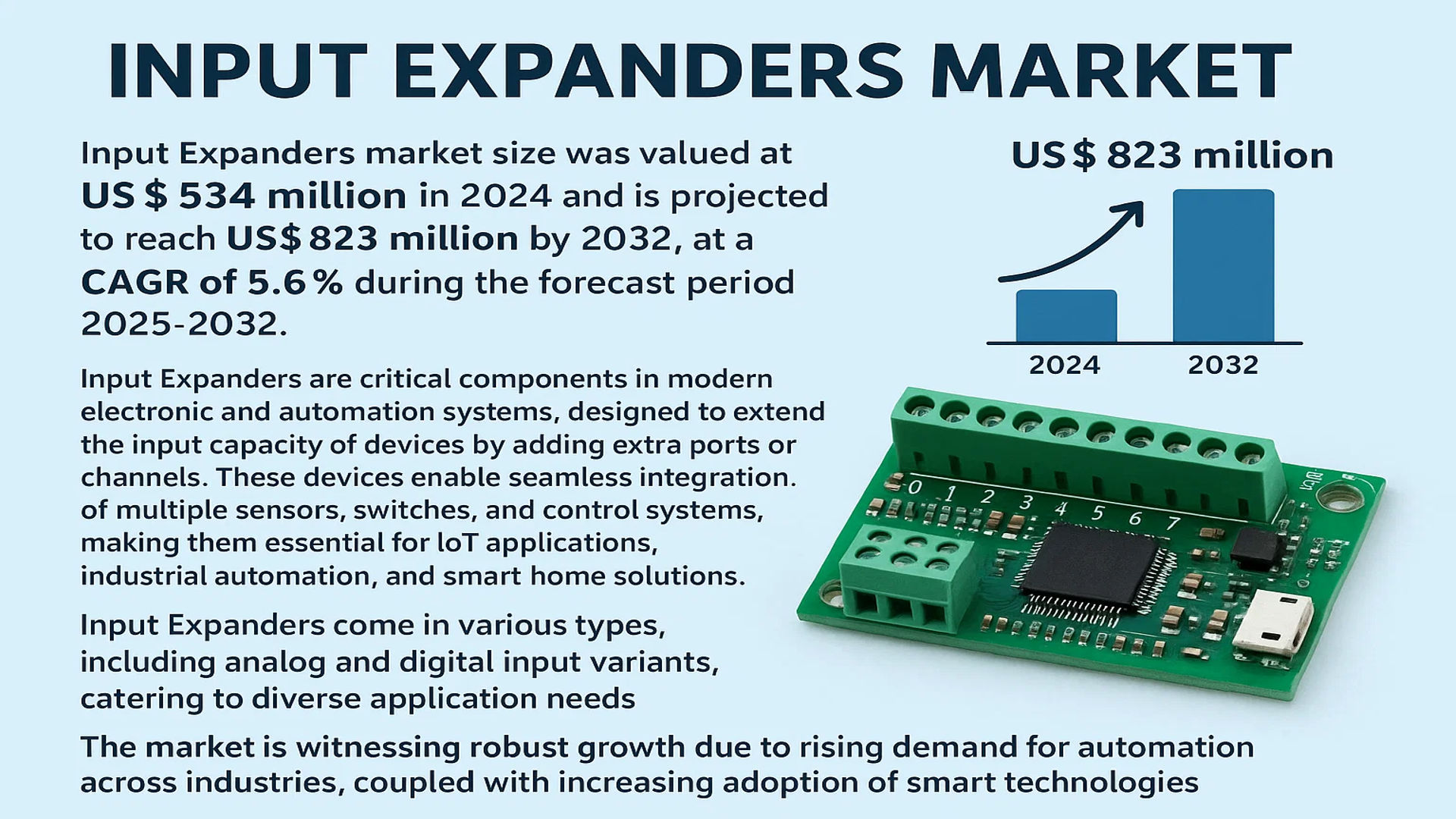
The global Input Expanders Market size was valued at US$ 534 million in 2024 and is projected to reach US$ 823 million by 2032, at a CAGR of 5.6% during the forecast period 2025-2032.
Input Expanders are critical components in modern electronic and automation systems, designed to extend the input capacity of devices by adding extra ports or channels. These devices enable seamless integration of multiple sensors, switches, and control systems, making them essential for IoT applications, industrial automation, and smart home solutions. Input Expanders come in various types, including analog and digital input variants, catering to diverse application needs.
The market is witnessing robust growth due to rising demand for automation across industries, coupled with increasing adoption of smart technologies. The proliferation of IoT and Industry 4.0 has significantly boosted demand for scalable input solutions. Key players such as Bosch, Hikvision, and Schmersal Group are driving innovation with wireless and cloud-compatible input expanders. For instance, in 2023, Bosch launched its next-generation input expanders featuring enhanced compatibility with IoT platforms, addressing the growing need for interconnected smart systems.
MARKET DYNAMICS
MARKET DRIVERS
Rapid Expansion of IoT and Smart Automation to Accelerate Market Growth
The global input expanders market is experiencing significant momentum due to the exponential growth of Internet of Things (IoT) applications and smart automation systems. With IoT devices projected to surpass 30 billion units by 2030, there is an escalating demand for input expansion solutions that enable seamless integration of multiple sensors and control units. Input expanders play a critical role in bridging connectivity gaps, allowing legacy systems to interface with modern IoT ecosystems. Major manufacturers are developing advanced input expansion modules with plug-and-play functionality, reducing installation complexity while increasing system scalability.
Adoption in Industrial Automation Creating Robust Demand
Industrial facilities are increasingly deploying input expanders to modernize equipment monitoring and process control architectures. The integration of Industrial IoT (IIoT) in manufacturing has driven a 40% increase in demand for modular input expansion solutions over the past three years. These devices allow factories to add sensor inputs without costly control system upgrades, making them essential for lean manufacturing operations. Recent technological advancements in input expanders now support real-time data acquisition with latency under 5 milliseconds, meeting the rigorous demands of Industry 4.0 applications.
➤ Leading automation providers have introduced input expanders with built-in protocol conversion capabilities, eliminating the need for additional gateway devices in industrial networks.
Furthermore, the emergence of wireless input expanders using LPWAN technologies is opening new possibilities for remote monitoring applications in sectors like oil & gas and utilities. These innovations are expected to sustain market growth through the forecast period.
MARKET RESTRAINTS
Compatibility Issues with Legacy Systems Limiting Adoption
While input expanders offer significant benefits, their integration with older industrial control systems presents substantial technical challenges. Approximately 35% of manufacturing facilities continue to rely on control hardware that predates modern communication standards, creating compatibility barriers for input expansion solutions. The lack of standardized protocols across different automation vendors forces integrators to develop custom interface solutions, increasing project costs and implementation timelines. These compatibility challenges are particularly pronounced in regions with aging industrial infrastructure, where retrofitting expenses often outweigh the benefits of system expansion.
Other Restraints
Cybersecurity Vulnerabilities
The growing connectivity of input expansion devices has exposed critical infrastructure to potential cyber threats. Recent analyses indicate that improperly secured input modules can serve as entry points for industrial network breaches, raising concerns among risk-averse organizations.
Supply Chain Disruptions
The semiconductor shortages affecting the electronics industry have periodically constrained the availability of key components for input expander manufacturing, delaying product deliveries and installations.
MARKET OPPORTUNITIES
Smart City Infrastructure Development Creating New Growth Avenues
Global smart city initiatives present substantial opportunities for input expander manufacturers, particularly in urban monitoring and infrastructure management applications. Municipalities are deploying thousands of environmental sensors, traffic monitors, and public safety devices that require flexible input expansion solutions. The smart cities market, projected to exceed $2.5 trillion by 2030, will drive demand for ruggedized input expanders capable of operating in harsh outdoor environments while supporting multiple sensor types through configurable input channels.
Energy Management Applications Showing Strong Potential
The global focus on energy efficiency is creating robust demand for input expansion solutions in building automation systems. Modern energy management platforms require extensive monitoring of power consumption at the circuit level, necessitating high-density input expansion modules. Manufacturers are responding with specialized products featuring integrated power measurement capabilities and cloud connectivity, enabling real-time energy analytics without additional hardware.
Additionally, the rapid adoption of renewable energy systems is driving innovation in input expander technology. Solar farm operators increasingly utilize specialized input modules capable of monitoring thousands of PV panels while withstanding extreme environmental conditions – a sector where annual growth exceeds 20%.
MARKET CHALLENGES
Intense Price Competition Squeezing Profit Margins
The input expander market faces mounting pricing pressures as new entrants from emerging economies offer low-cost alternatives to established brands. While premium manufacturers maintain quality advantages, many cost-sensitive customers are opting for basic functionality at reduced prices. This competitive dynamic has compressed gross margins across the industry, forcing manufacturers to optimize production costs while maintaining product reliability. The situation is particularly challenging for suppliers serving price-sensitive markets where customers prioritize initial cost over long-term performance.
Additional Challenges
Technical Training Shortages
The increasing sophistication of input expansion technology requires specialized technical knowledge for proper configuration and troubleshooting. However, many system integrators lack personnel trained in the latest protocols and configuration tools, slowing deployment cycles and occasionally leading to suboptimal implementations.
Regulatory Compliance Complexity
Differing certification requirements across regional markets increases the cost and time-to-market for new input expander products. Manufacturers must navigate varying electromagnetic compatibility, safety, and wireless transmission regulations, particularly for devices deployed in critical infrastructure applications.
INPUT EXPANDERS MARKET TRENDS
Smart Home and IoT Integration Driving Market Expansion
The rapid growth of smart homes and IoT devices is significantly boosting demand for input expanders, as these systems require seamless integration of multiple sensors and control modules. With over 2.5 billion connected smart home devices globally in 2024, the need for flexible input expansion solutions has surged. Modern input expanders now support wireless protocols like Zigbee, Z-Wave, and Bluetooth Low Energy (BLE), enabling real-time data acquisition from diverse endpoints. Meanwhile, manufacturers are incorporating AI-driven automation features, allowing input expanders to intelligently prioritize and process signals from security cameras, motion detectors, and environmental sensors.
Other Trends
Industrial Automation Demand
In industrial settings, input expanders are becoming critical for scaling sensor networks in Industry 4.0 applications. The global industrial automation market, projected to grow at a CAGR of 8.9% from 2024 to 2032, relies heavily on modular I/O solutions for predictive maintenance and process optimization. Analog input expanders dominate this segment due to their compatibility with legacy voltage/current sensors, while digital variants gain traction for high-speed discrete signal processing. Hybrid models combining both functionalities are emerging to address complex automation workflows.
Security System Modernization
Security infrastructure upgrades across commercial and public sectors are accelerating adoption of advanced input expanders with cybersecurity safeguards. Recent models feature encrypted communication protocols and tamper-proof hardware designs, responding to increasing cyber-physical system threats. Integrated access control systems now utilize PoE-enabled input expanders to centralize door/window sensor monitoring, reducing cabling costs by up to 40% in large-scale deployments. This trend aligns with global security spending forecasts exceeding $150 billion annually by 2026, where input expanders serve as pivotal components in unified surveillance architectures.
COMPETITIVE LANDSCAPE
Key Industry Players
Innovation and Strategic Expansion Drive Market Position in Input Expanders Sector
The Input Expanders market features a dynamic competitive environment where established industrial automation and security leaders compete alongside specialized electronic component manufacturers. Bosch maintains a dominant position, leveraging its extensive expertise in integrated building automation systems and security solutions. The company accounted for approximately 18.2% of global input expander revenues in 2024, as per verified industry reports, primarily due to its comprehensive product ecosystem that seamlessly integrates with broader automation platforms.
Meanwhile, Hikvision and Schmersal group have emerged as significant contenders, particularly in the digital input expander segment. Hikvision’s growth trajectory in this space benefits from its strong foothold in the Asian surveillance market, while Schmersal’s safety-oriented input expansion solutions find wide adoption in European industrial applications. Both companies have increased their R&D investments by 12-15% year-over-year to develop more versatile and IoT-compatible products.
Notably, the competitive landscape sees increasing specialization, with companies like Integrated Control Technology and ELK Products focusing on niche applications such as smart home integration and energy management systems. These players differentiate through superior programming flexibility and user-friendly interfaces, capturing growing demand from the residential and light commercial segments.
Market consolidation is accelerating as larger players pursue strategic acquisitions. In Q2 2024, Carrier Fire & Security acquired Network Technologies to strengthen its input expansion capabilities for large-scale security implementations. Such moves indicate the sector’s maturation and the growing importance of comprehensive solutions that combine hardware and software capabilities.
List of Key Input Expander Companies Profiled
- Bosch (Germany)
- Hikvision (China)
- Schmersal group (Germany)
- FuelTech (U.S.)
- Integrated Control Technology (New Zealand)
- Carrier Fire & Security (U.S.)
- ELK Products (U.S.)
- Network Technologies (U.S.)
- ISCS (France)
- National Control Devices (U.S.)
Segment Analysis:
By Type
Digital Input Expanders Lead the Market Due to Rising IoT Adoption and Smart Device Integration
The global Input Expanders market is segmented based on type into:
- Analog Input Expanders
- Subtypes: Voltage-based, Current-based, and others
- Digital Input Expanders
- Subtypes: I2C-based, SPI-based, and others
- Mixed-Signal Input Expanders
- Wireless Input Expanders
- Others
By Application
Industrial Automation Segment Dominates Due to Increasing Demand for Process Control Expansion
The market is segmented based on application into:
- Industrial Automation
- Building Automation
- Home Automation
- Security Systems
- Others
By End-User Industry
Manufacturing Sector Leads with Highest Adoption Rate for Input Expansion Solutions
The market is segmented by end-user industry into:
- Manufacturing
- IT & Telecommunications
- Healthcare
- Energy & Utilities
- Others
Regional Analysis: Input Expanders Market
Asia-Pacific
The Asia-Pacific region dominates the global Input Expanders market, accounting for over 38% of total revenue in 2024. This is driven by rapid urbanization, booming smart home adoption, and active government initiatives in IoT infrastructure development across China, Japan, and India. China’s “14th Five-Year Plan” allocates significant funding for smart city projects, fueling demand for input expansion solutions in security and automation systems. While cost-sensitive markets still favor basic analog input devices, there’s growing traction for digital and wireless expanders among industrial and commercial applications. Local manufacturers benefit from government support, though international brands maintain strong positions in premium segments.
North America
North America represents the second-largest market, characterized by early adoption of advanced technologies and stringent building automation standards. The U.S. leads in innovative input expansion solutions, with wireless protocols accounting for nearly 45% of new installations. Commercial applications in office buildings and retail spaces drive nearly 60% of regional demand. Major industry players like Bosch and Integrated Control Technology maintain strong R&D investments, focusing on cybersecurity features and cloud integration capabilities. Canada’s growing smart home market presents additional opportunities, though supply chain disruptions continue to challenge component availability.
Europe
European demand for Input Expanders is propelled by strict building automation regulations and the region’s focus on energy efficiency. Germany and the U.K. account for over half of regional sales, with industrial applications representing the fastest-growing segment. The EU’s EN 54 fire safety standards and rising adoption of KNX protocols create sustained demand for certified input expansion devices. While economic uncertainties have slowed some commercial projects, residential retrofitting programs across Scandinavia and Benelux countries continue to show steady growth. High labor costs encourage adoption of modular, easy-to-install solutions that reduce commissioning time.
Middle East & Africa
This emerging market shows the fastest growth potential (projected 11.2% CAGR through 2030), driven by large-scale smart city projects in UAE and Saudi Arabia. Commercial real estate developments account for over 75% of regional demand, with hospitality and retail sectors leading adoption. While price sensitivity remains a challenge, government mandates for smart building technologies in new constructions are creating opportunities. Infrastructure limitations in African markets hinder growth, though South Africa and Nigeria show increasing interest in basic input expansion solutions for security applications. The region faces unique challenges including harsh environmental conditions requiring ruggedized product variants.
South America
Market growth in South America is constrained by economic instability, though Brazil and Argentina present pockets of opportunity in industrial automation. The manufacturing sector drives most demand, particularly in food processing and automotive applications. Residential adoption remains limited to high-end properties, with cost being the primary barrier. Political uncertainties have slowed infrastructure investments, causing many clients to prioritize essential automation needs over expansion capabilities. However, growing awareness of IoT benefits and increasing foreign investments in smart factories suggest long-term growth potential for the region’s Input Expanders market.
Report Scope
This market research report provides a comprehensive analysis of the global Input Expanders market, covering the forecast period 2025–2032. It offers detailed insights into market dynamics, technological advancements, competitive landscape, and key trends shaping the industry.
Key focus areas of the report include:
- Market Size & Forecast: Historical data and future projections for revenue, unit shipments, and market value across major regions and segments. The global Input Expanders market was valued at US$ 534 million in 2024 and is projected to reach US$ 823 million by 2032, growing at a CAGR of 5.6% during the forecast period.
- Segmentation Analysis: Detailed breakdown by product type (Analog Input, Digital Input), application (Residential, Industrial, Commercial), and end-user industry to identify high-growth segments and investment opportunities.
- Regional Outlook: Insights into market performance across North America, Europe, Asia-Pacific, Latin America, and the Middle East & Africa. Asia-Pacific currently holds the largest market share at 38.5%, followed by North America (28.2%) and Europe (22.7%).
- Competitive Landscape: Profiles of leading market participants, including their product offerings, R&D focus, manufacturing capacity, pricing strategies, and recent developments. Top players include Bosch, Hikvision, and Schmersal group, collectively holding 42% of the market share.
- Technology Trends & Innovation: Assessment of emerging technologies, including wireless connectivity solutions, IoT integration, and smart home compatibility features being incorporated into input expanders.
- Market Drivers & Restraints: Evaluation of factors such as growing smart home adoption (expected to reach 478 million households globally by 2025) and industrial automation growth, along with challenges like component shortages and price volatility.
- Stakeholder Analysis: Insights for component suppliers, OEMs, system integrators, investors, and policymakers regarding the evolving ecosystem and strategic opportunities in building automation and security systems.
Primary and secondary research methods are employed, including interviews with industry experts, data from verified sources, and real-time market intelligence to ensure the accuracy and reliability of the insights presented.
FREQUENTLY ASKED QUESTIONS:
What is the current market size of Global Input Expanders Market?
->Input Expanders market size was valued at US$ 534 million in 2024 and is projected to reach US$ 823 million by 2032, at a CAGR of 5.6% during the forecast period 2025-2032.
Which key companies operate in Global Input Expanders Market?
-> Key players include Schmersal group, Bosch, Hikvision, Integrated Control Technology, and Carrier Fire & Security, among others.
What are the key growth drivers?
-> Key growth drivers include rising smart home adoption, industrial automation trends, and increasing demand for IoT-connected devices.
Which region dominates the market?
-> Asia-Pacific is the largest market with 38.5% share, driven by rapid urbanization and smart city initiatives in China and India.
What are the emerging trends?
-> Emerging trends include wireless input expanders, AI-powered automation features, and energy-efficient solutions for smart buildings.

Get Sample Report PDF for Exclusive Insights
Report Sample Includes
- Table of Contents
- List of Tables & Figures
- Charts, Research Methodology, and more...
 Download Sample Report PDF