MARKET INSIGHTS
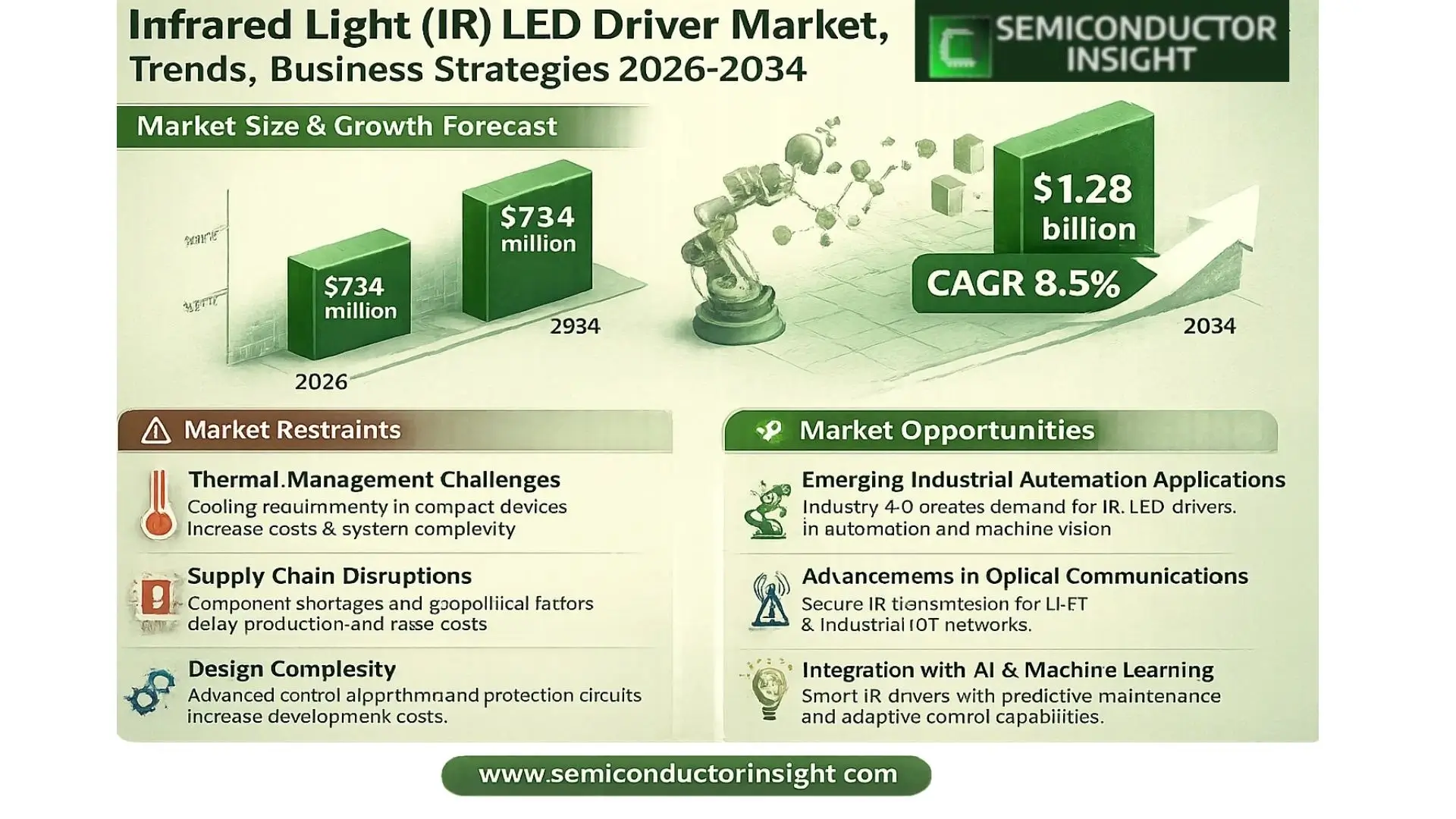
Global Infrared Light (IR) LED Driver Market size was valued at USD 734 million in 2024 and is projected to reach USD 1,280 million by 2032, at a CAGR of 8.5% during the forecast period 2025-2032. The market is witnessing steady growth, driven by increasing adoption in automotive, security, and commercial lighting applications.
Infrared Light (IR) LED drivers are critical components that regulate power to IR LEDs, ensuring optimal performance and longevity. These drivers utilize digital control to generate precise, high-current pulses for applications such as surveillance cameras, facial recognition systems, and automotive night vision. Key types include DC-powered and AC-powered drivers, with the former dominating the market due to higher efficiency in low-voltage applications.
The market growth is fueled by rising demand for smart security systems and the integration of IR LEDs in autonomous vehicles. Furthermore, advancements in driver IC technology, such as higher switching frequencies and compact designs, are enabling broader adoption. Companies like Texas Instruments and Infineon Technologies are leading innovation with energy-efficient driver solutions, catering to the expanding IoT and smart city infrastructure markets. Asia-Pacific remains the largest regional market, accounting for over 40% of global revenue, owing to robust electronics manufacturing in China and Japan.
 MARKET DYNAMICS
MARKET DRIVERS
Expanding Applications in Automotive and Security Systems Fuel Market Demand
Infrared Light (IR) LED Driver Market is experiencing significant growth due to the increasing adoption of IR-based technologies across multiple industries. The automotive sector represents one of the fastest-growing segments, where IR LEDs are essential for advanced driver assistance systems (ADAS) and night vision capabilities. With over 40% of new passenger vehicles globally now equipped with some form of IR-enabled safety features, the demand for high-performance IR LED drivers continues to rise. These components enable precise current regulation and thermal management, which are critical for reliable operation in demanding automotive environments.
Surge in Smart Home Adoption Accelerates Market Expansion
Smart home ecosystems are driving substantial demand for IR LED drivers as consumers adopt security cameras, motion sensors, and smart lighting systems. Global smart home market is projected to maintain a compound annual growth rate exceeding 13%, with IR-enabled devices playing a crucial role in this expansion. IR LED drivers facilitate efficient power management for these always-on devices while ensuring optimal performance in low-light conditions. This trend is further amplified by innovations in wireless communication protocols that enable seamless integration of IR-based security devices with home automation platforms.
Technological Advancements in Healthcare Create New Growth Avenues
The healthcare sector is emerging as a key driver for IR LED technology, particularly in non-invasive diagnostic equipment and therapeutic devices. Pulse oximeters, photodynamic therapy systems, and medical imaging devices increasingly incorporate IR LEDs, requiring sophisticated driver circuits to maintain precise wavelength control and power output. With the medical device market expanding rapidly, manufacturers are developing specialized IR LED drivers that meet stringent medical certification standards while delivering enhanced energy efficiency and reliability.
The combination of these factors, along with continued innovation in semiconductor materials and packaging technologies, positions the IR LED driver market for sustained long-term growth across diverse application segments.
MARKET RESTRAINTS
Thermal Management Challenges Impede Performance Optimization
While IR LED technology offers numerous advantages, thermal dissipation remains a significant technical hurdle for driver circuit design. High-power IR applications generate substantial heat that can degrade performance and reduce component lifespan if not properly managed. This challenge is particularly acute in compact devices where space constraints limit cooling options. Designers must balance power output requirements with thermal budget limitations, often resulting in performance compromises or increased system complexity. The need for advanced heat sinks and thermal interface materials adds cost and increases the overall footprint of IR lighting systems.
Supply Chain Disruptions Create Component Availability Issues
The semiconductor industry continues to face supply chain volatility, affecting the availability of critical components for IR LED driver manufacturing. Lead times for specialized ICs and discrete components have extended significantly, disrupting production schedules and increasing costs. These challenges are compounded by geopolitical factors and trade restrictions that affect material sourcing. Manufacturers must navigate these constraints while meeting growing demand, often requiring costly redesigns or alternative sourcing strategies that impact time-to-market and profit margins.
Design Complexity Increases Development Costs
Advanced IR LED driver applications require increasingly sophisticated control algorithms and protection circuits to ensure optimal performance. Features such as programmable current regulation, dimming control, and fault detection add design complexity that prolongs development cycles and raises engineering costs. This challenge is particularly evident in automotive and medical applications where reliability requirements demand extensive testing and certification. The resulting higher development expenses create barriers to entry for smaller manufacturers and may slow the pace of innovation in certain market segments.
MARKET OPPORTUNITIES
Emerging Industrial Automation Applications Present Growth Potential
The rapid adoption of Industry 4.0 technologies is creating new opportunities for IR LED drivers in industrial automation. Machine vision systems, product inspection equipment, and automated guided vehicles increasingly incorporate IR illumination for enhanced detection capabilities. These applications require drivers that can deliver precise pulse control and maintain consistent output despite challenging environmental conditions. The industrial automation market’s projected growth suggests significant potential for specialized IR LED driver solutions tailored to manufacturing environments.
Advancements in Optical Communications Drive Innovation
IR LED technology is gaining importance in optical wireless communication systems, particularly for secure data transmission in sensitive environments. Emerging applications in Li-Fi (light fidelity) and industrial IoT networks require high-speed modulation capabilities that place new demands on driver circuit design. This evolving application space presents opportunities for manufacturers to develop specialized drivers optimized for communication protocols rather than just illumination. The growing need for electromagnetic interference-free communication in healthcare and industrial settings further enhances this market potential.
Integration with AI and Machine Learning Creates Smart Lighting Solutions
The convergence of IR illumination with artificial intelligence is creating opportunities for intelligent driver solutions that can adapt to environmental conditions and usage patterns. Smart driver ICs with embedded machine learning capabilities enable predictive maintenance, adaptive brightness control, and real-time performance optimization. These advanced features are particularly valuable in security and surveillance applications where IR lighting conditions directly impact image quality and system effectiveness. The integration of AI promises to transform IR LED systems from simple illumination sources into intelligent sensing platforms with embedded analytics.
INFRARED LIGHT (IR) LED DRIVER MARKET TRENDS
Smart Technology Integration Reshaping IR LED Driver Demand
The rapid adoption of smart automation systems is significantly increasing demand for advanced IR LED drivers. Driven by applications in security systems, automotive night vision, and industrial sensing, the market is witnessing a shift toward intelligent driver ICs that enable precise dimming controls and energy-efficient pulsed operation. The integration of IoT connectivity in surveillance cameras, which account for nearly 38% of global IR LED applications, requires drivers capable of handling dynamic voltage regulation while maintaining thermal stability. With commercial buildings increasingly deploying sensor-based lighting controls, PWM (Pulse Width Modulation) drivers that offer 90+% efficiency are becoming the industry standard for IR illumination systems.
Other Trends
Automotive Night Vision Advancements
Automotive manufacturers are incorporating high-power IR LEDs with specialized drivers in Advanced Driver Assistance Systems (ADAS), creating new growth opportunities. The sector demands drivers that can operate in -40°C to 105°C temperature ranges while delivering consistent current to LiDAR and night vision modules. This trend is particularly prominent in Europe, where regulatory mandates for pedestrian safety are accelerating adoption rates. Recent developments include CAN bus-controlled driver circuits that synchronize multiple IR arrays with onboard cameras, a critical requirement for autonomous vehicle prototypes currently in testing phases.
Miniaturization and Thermal Management Innovations
As consumer electronics push for compact form factors, IR LED driver manufacturers are developing sub-3mm chip-scale packages with integrated thermal protection. This addresses two critical pain points: space constraints in mobile devices and heat dissipation in high-current medical applications like pulse oximeters. Stacked driver architectures, which reduce component count by 25% compared to traditional designs, are gaining traction in wearables and smart home devices. Meanwhile, ceramic substrate drivers with 150°C junction temperature ratings are solving reliability issues in industrial machine vision systems, where continuous IR illumination places extreme demands on driver components.
Energy Efficiency Regulations Driving Design Priorities
Global energy standards are compelling manufacturers to develop IR LED drivers with below 0.5W standby power consumption, particularly for always-on surveillance applications. The latest driver ICs incorporate advanced algorithms that reduce idle power by up to 70% compared to previous generations through adaptive current scaling. This aligns with the EU’s Ecodesign 2025 framework and similar initiatives in North America targeting commercial lighting systems. Furthermore, the shift from analog to digital control interfaces allows real-time power monitoring, enabling system-level optimizations that can extend battery life in portable IR devices by 30-40%.
COMPETITIVE LANDSCAPE
Key Industry Players
Technological Innovation and Strategic Partnerships Drive Market Competition
Infrared Light (IR) LED Driver Market features a dynamic competitive landscape dominated by semiconductor giants and specialized lighting solution providers. The market is moderately consolidated, with Texas Instruments and Infineon Technologies leading the pack due to their extensive product portfolios and strong foothold in the automotive and industrial sectors. Texas Instruments alone accounts for approximately 18% of Global IR LED driver revenue, leveraging its analog and power management expertise.
Meanwhile, Diodes Incorporated has emerged as a key challenger, particularly in the commercial lighting segment, with its energy-efficient solutions gaining traction in smart building applications. The company’s recent 15% year-over-year growth in IR driver sales demonstrates its increasing market influence. Similarly, On Semiconductor has strengthened its position through strategic acquisitions and development of integrated driver solutions for facial recognition and surveillance systems.
The competitive intensity is further heightened by regional players expanding globally. Macroblock, a Taiwan-based company, has significantly increased its market share in Asia Pacific through cost-competitive offerings optimized for high-power IR applications. On the innovation front, Analog Devices has been focusing on developing intelligent drivers with IoT connectivity, catering to the growing demand for smart city infrastructure.
Recent developments indicate a shift toward vertical integration, with companies like Lumileds combining LED manufacturing with driver development to offer complete illumination solutions. This trend is likely to reshape the competitive dynamics as players seek to differentiate through system-level expertise rather than component-level offerings.
List of Key Infrared Light (IR) LED Driver Companies Profiled
- Texas Instruments Incorporated (U.S.)
- Infineon Technologies AG (Germany)
- Diodes Incorporated (U.S.)
- ON Semiconductor (U.S.)
- Boston Electronics (U.S.)
- Analog Devices, Inc. (U.S.)
- Macroblock Inc. (Taiwan)
- Lumileds Holding B.V. (Netherlands)
Segment Analysis:
By Type
DC Power Segment Leads Due Its Widespread Adoption in Portable and Low-Voltage Applications
Infrared Light (IR) LED Driver Market is segmented based on power type into:
- DC Power
- Subtypes: Constant Current, Constant Voltage
- AC Power
- Subtypes: Isolated, Non-Isolated
By Application
Commercial LED Lighting Dominates Owing to Rising Demand for Smart Lighting Solutions
The market is segmented based on application into:
- Commercial LED Lighting
- Automotive
- Industrial
- Security & Surveillance
- Others
By Technology
Digital Control Technology Gaining Traction Due to Its Precise Regulation Capabilities
The market is segmented by technology into:
- Analog Drivers
- Digital Drivers
- Hybrid Drivers
By End-User
Industrial Sector Shows Strong Growth Potential Due to Increased Automation
The market is segmented by end-user into:
- Residential
- Commercial
- Industrial
- Government & Public Infrastructure
Regional Analysis: Infrared Light (IR) LED Driver Market
Asia-Pacific
The Asia-Pacific region dominates the IR LED driver market, accounting for over 45% of global revenue share in 2024. China’s massive electronics manufacturing sector and Japan’s advanced automotive industry drive significant demand for IR LED drivers, particularly for applications in security systems and smart appliances. India’s growing adoption of IoT-based solutions in commercial spaces and government-led smart city initiatives further propel market expansion. While cost-competitive solutions currently lead the market, there’s increasing emphasis on energy-efficient designs to comply with regional sustainability standards. The region benefits from strong semiconductor manufacturing capabilities and proximity to raw material suppliers.
North America
North America maintains a technology leadership position in IR LED driver development, with the U.S. contributing approximately 30% of regional demand. The market benefits from stringent automotive safety regulations that mandate advanced driver-assistance systems (ADAS) utilizing IR technology. Major tech firms in Silicon Valley continue innovating compact, high-efficiency drivers for consumer electronics and smart home applications. Industrial automation growth across manufacturing and logistics sectors also sustains steady demand. However, higher production costs compared to Asian manufacturers present ongoing challenges for domestic suppliers.
Europe
Europe’s IR LED driver market grows steadily, supported by strict EU energy efficiency directives and automotive OEM requirements. Germany leads in industrial applications, while the U.K. and France show strong adoption in commercial security systems. The region emphasizes RoHS-compliant designs with low electromagnetic interference, driving demand for specialized driver ICs. Recent EU investments in AI and machine vision applications present new opportunities for high-performance IR solutions. However, complex certification processes and competition from Asian imports restrain faster market expansion.
Middle East & Africa
This emerging market shows increasing demand for IR LED drivers in security and surveillance applications, particularly in GCC countries implementing smart city projects. The UAE leads regional adoption with investments in traffic management and building automation systems. While the market remains relatively small compared to other regions, 15% annual growth projections reflect expanding infrastructure development. Challenges include limited local manufacturing capabilities and dependence on imports, though regional assembly facilities are gradually being established.
South America
South America demonstrates moderate growth, with Brazil as the primary market for IR LED drivers used in agricultural monitoring and industrial automation. Economic constraints have slowed large-scale adoption, but increasing private sector investments in retail security and automotive night vision systems show promise. The lack of regional semiconductor fabrication necessitates complete reliance on imported components, making the market price-sensitive. Recent trade agreements may improve access to cost-effective solutions from Asian manufacturers.
Report Scope
This market research report provides a comprehensive analysis of Global and regional Infrared Light (IR) LED Driver Market, covering the forecast period 2025–2032. It offers detailed insights into market dynamics, technological advancements, competitive landscape, and key trends shaping the industry.
Key focus areas of the report include:
- Market Size & Forecast: Historical data and future projections for revenue, unit shipments, and market value across major regions and segments. Global IR LED driver market is projected to grow at a CAGR of 8.5% during 2025-2032.
- Segmentation Analysis: Detailed breakdown by product type (DC Power, AC Power), application (Commercial LED Lighting, Automotive, Others), and end-user industry to identify high-growth segments.
- Regional Outlook: Insights into market performance across North America, Europe, Asia-Pacific, Latin America, and Middle East & Africa. Asia-Pacific currently holds over 45% market share.
- Competitive Landscape: Profiles of leading market participants including Texas Instruments, Infineon Technologies, and ON Semiconductor, covering their product portfolios and strategic initiatives.
- Technology Trends & Innovation: Assessment of smart driver integration, energy efficiency improvements, and IoT connectivity in IR LED applications.
- Market Drivers & Restraints: Evaluation of factors such as increasing demand for surveillance systems and automotive night vision versus supply chain challenges.
- Stakeholder Analysis: Strategic insights for component manufacturers, system integrators, and investors in the IR LED ecosystem.
The research employs both primary and secondary methodologies, including interviews with industry leaders and analysis of verified market data to ensure accuracy.
FREQUENTLY ASKED QUESTIONS:
What is the current market size of Global Infrared Light (IR) LED Driver Market?
-> Infrared Light (IR) LED Driver Market size was valued at USD 734 million in 2024 and is projected to reach USD 1,280 million by 2032, at a CAGR of 8.5% during the forecast period 2025-2032.
Which key companies operate in Global IR LED Driver Market?
-> Key players include Texas Instruments, Infineon Technologies, ON Semiconductor, Analog Devices, and Diodes Incorporated.
What are the key growth drivers?
-> Key growth drivers include rising adoption in security systems, automotive night vision applications, and smart lighting solutions.
Which region dominates the market?
-> Asia-Pacific dominates with over 45% market share, driven by manufacturing hubs in China and increasing industrial automation.
What are the emerging trends?
-> Emerging trends include integration with IoT systems, development of high-power IR LEDs, and advanced driver ICs with digital control.
Get Sample Report PDF for Exclusive Insights
Report Sample Includes
- Table of Contents
- List of Tables & Figures
- Charts, Research Methodology, and more...
 Download Sample Report PDF