Infrared Dust PM2.5 Sensor Market Insights
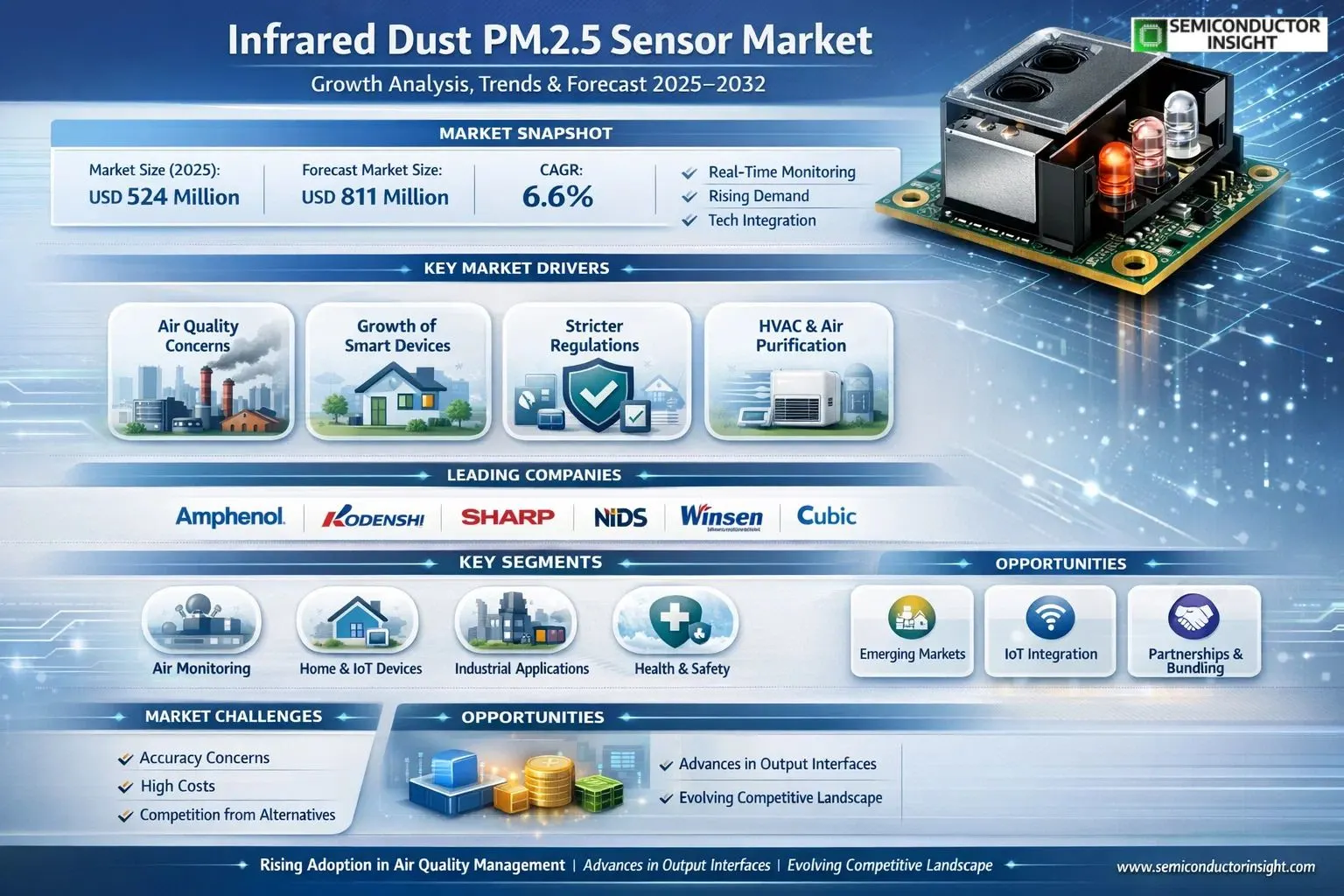
Global Infrared Dust PM2.5 Sensor market size was valued at USD 524 million in 2025. The market is projected to reach USD 811 million by 2032, exhibiting a CAGR of 6.6% during the forecast period.
Infrared dust PM2.5 sensor is a sensor used to detect the concentration of PM2.5 particles in the air. It is based on the principle of light scattering and includes infrared light-emitting diodes (LEDs), light receivers, etc. It has the characteristics of high precision, real-time, stability, and ease of use. It is widely used in air monitoring, air purification, fresh air ventilation and other fields.
The market is experiencing robust growth due to escalating concerns over air pollution, surging demand for real-time environmental monitoring, and stricter regulatory standards for indoor and outdoor air quality. Furthermore, the integration of these sensors in IoT devices, smart homes, and HVAC systems is driving expansion. Key players are investing heavily in miniaturization and accuracy improvements. Amphenol Advanced Sensors, Kodenshi, Sharp Corporation, Zhengzhou Winsen Electronics Technology, Cubic Sensor and Instrument, and Audiowell dominate with diverse product offerings tailored to various applications.
MARKET DRIVERS
Increasing Air Quality Monitoring Demand
Infrared Dust PM2.5 Sensor Market is propelled by heightened global awareness of air pollution, particularly fine particulate matter that poses severe health risks. Urbanization has intensified PM2.5 levels in megacities, driving demand for precise infrared-based detection technologies in residential, industrial, and public spaces. Governments worldwide are enforcing stricter ambient air quality standards, spurring adoption of these sensors in compliance monitoring systems.
Integration with IoT and Smart Devices
Advancements in Internet of Things (IoT) ecosystems have accelerated the deployment of infrared PM2.5 sensors in smart homes, HVAC systems, and wearable health devices. Real-time data analytics from these sensors enable proactive air purification, contributing to market expansion at a projected CAGR of 9.2% through 2030. The automotive sector is also embracing these sensors for cabin air quality enhancement in electric vehicles.
➤ Rising health consciousness post-pandemic has boosted consumer interest in personal air quality monitors, with sales surging 25% in Asia-Pacific regions.
Furthermore, corporate sustainability goals are fostering investments in workplace air monitoring, solidifying Infrared Dust PM2.5 Sensor Market’s growth trajectory amid escalating environmental concerns.
MARKET CHALLENGES
Accuracy and Reliability Issues
Infrared Dust PM2.5 Sensor Market faces hurdles from environmental interferences like high humidity and dust composition variations, which can skew readings by up to 15-20% without advanced calibration. Maintaining consistent performance across diverse conditions remains a key technical challenge for manufacturers.
Other Challenges
High Manufacturing Costs
Premium infrared components and miniaturization efforts elevate production expenses, limiting affordability in price-sensitive emerging markets and hindering widespread adoption.
Competition from Alternative Technologies
Laser-based and optical sensors offer higher precision in some applications, pressuring infrared PM2.5 sensors to innovate on cost-efficiency while matching detection accuracy.Supply chain volatilities for rare-earth materials used in infrared optics further complicate scalability and timely market delivery.
MARKET RESTRAINTS
Regulatory Compliance Burdens
Infrared Dust PM2.5 Sensor Market encounters restraints from rigorous certification processes mandated by bodies like the EPA and EU REACH, which demand extensive validation testing and delay product launches by 12-18 months. Smaller firms struggle with these compliance costs, estimated at 10-15% of R&D budgets.Market fragmentation due to varying regional standards for PM2.5 measurement creates interoperability issues, restricting cross-border scalability for sensor deployments.Additionally, limited standardization in infrared sensor calibration protocols leads to consumer skepticism regarding long-term reliability, capping penetration in consumer electronics.Finally, dependency on volatile semiconductor supply chains exacerbates pricing instability, restraining aggressive expansion in Infrared Dust PM2.5 Sensor Market.
MARKET OPPORTUNITIES
Expansion in Emerging Economies
Infrared Dust PM2.5 Sensor Market holds significant potential in rapidly industrializing regions like India and Southeast Asia, where air pollution levels exceed WHO guidelines by 5-10 times. Localized manufacturing could capture a 30% market share growth by 2028 through government-backed smart city projects.Integration opportunities with 5G-enabled IoT platforms promise enhanced remote monitoring capabilities, particularly in agriculture for dust control and in construction for worker safety.Partnerships between sensor firms and air purifier brands are emerging, driving bundled solutions that could elevate market revenues by 22% in residential segments.Moreover, advancements in AI-driven data correction algorithms present avenues to overcome traditional infrared limitations, unlocking premium applications in healthcare and precision environmental monitoring.
Infrared Dust PM2.5 Sensor Market Trends
Rising Adoption in Air Quality Management Applications
Infrared Dust PM2.5 Sensor Market continues to evolve as demand intensifies for precise air particulate detection. These sensors, leveraging infrared light scattering principles with LEDs and receivers, deliver high precision, real-time monitoring, stability, and user-friendly operation. Key applications in air monitoring, air purification, fresh air ventilation, and other fields are propelling market momentum, supported by global concerns over PM2.5 pollution levels and respiratory health risks.
Other Trends
Advancements in Output Interface Segments
In Infrared Dust PM2.5 Sensor Market, product types such as PWM Output and UART Output are witnessing tailored innovations to meet diverse integration needs. PWM Output sensors offer simple pulse-width modulation for cost-effective solutions in basic air purification units, while UART Output variants enable advanced serial communication for IoT-enabled systems. Manufacturers are focusing on enhancing signal accuracy and compatibility, addressing challenges in noisy environments to broaden applicability across consumer and industrial devices.
Competitive Dynamics and Regional Shifts
Leading players in Infrared Dust PM2.5 Sensor Market, including Amphenol Advanced Sensors, Kodenshi, Sharp Corporation, Zhengzhou Winsen Electronics Technology, and Cubic Sensor and Instrument, dominate through ongoing product developments and strategic expansions. The competitive landscape features top manufacturers holding substantial revenue shares, driven by mergers, acquisitions, and R&D investments. Regionally, Asia-Pacific, particularly China, Japan, and South Korea, emerges as a growth epicenter due to rapid urbanization, stringent air quality regulations, and surging demand in fresh air systems. North America and Europe follow, with emphasis on smart city initiatives and environmental policies. Overall, industry surveys highlight drivers like urbanization and health awareness, alongside challenges such as calibration in varying humidity and supply chain obstacles, shaping a resilient trajectory for Infrared Dust PM2.5 Sensor Market toward integrated, real-time environmental solutions.
COMPETITIVE LANDSCAPE
Key Industry Players
Dominant Leaders and Emerging Challengers in Infrared Dust PM2.5 Sensor Market
Infrared Dust PM2.5 Sensor Market, valued at US$524 million in 2025 and projected to reach US$811 million by 2032 with a CAGR of 6.6%, features a competitive landscape led by established players like Amphenol Advanced Sensors, Kodenshi, and Sharp Corporation. These top-tier manufacturers command a significant revenue share, approximately 40-50% collectively in 2025, driven by their advanced infrared light-scattering technology incorporating high-precision LEDs and receivers. The market structure is moderately concentrated, with global leaders benefiting from strong R&D capabilities, extensive supply chains, and integration into air quality monitoring and purification applications, fostering stability and real-time detection features.
Beyond the frontrunners, niche players such as Zhengzhou Winsen Electronics Technology, Cubic Sensor and Instrument, and Audiowell contribute through specialized innovations in PWM and UART output sensors tailored for fresh air ventilation and other segments. Emerging firms like Guangzhou Luftmy Intelligent Technology, MFrontier, and Henan Fosen Electronics Technology are gaining traction in Asia-Pacific regions, particularly China, by offering cost-effective, stable solutions amid rising demand for air monitoring. This diverse ecosystem reflects ongoing mergers, product developments, and regional expansions, intensifying competition while enabling market growth through technological differentiation.
List of Key Infrared Dust PM2.5 Sensor Companies Profiled
- Amphenol Advanced Sensors
- Kodenshi
- Sharp Corporation
- NIDS
- Zhengzhou Winsen Electronics Technology
- Cubic Sensor and Instrument
- Audiowell
- Guangzhou Luftmy Intelligent Technology
- MFrontier
- Henan Fosen Electronics Technology
- Shenzhen Hoto Intelligent Control Technology
Segment Analysis:
| Segment Category | Sub-Segments | Key Insights |
| By Type |
|
PWM Output
|
| By Application |
|
Air Purification
|
| By End User |
|
Commercial
|
| By Form Factor |
|
Miniature
|
| By Installation Type |
|
Fixed Installation
|
Regional Analysis: Infrared Dust PM2.5 Sensor Market
Asia-Pacific
Stringent environmental regulations in China and India compel industries to deploy infrared dust PM2.5 sensors for compliance monitoring. Urban development policies prioritize air quality, integrating sensors into traffic and construction sites for proactive pollution management.
Asia-Pacific’s electronics hubs enable scalable production of cost-effective infrared sensors. Innovations in laser diode integration improve PM2.5 detection accuracy, supporting diverse applications from smart homes to factory automation.
Seamless connectivity with cloud platforms allows real-time data analytics, aiding urban planners in mitigating haze episodes. Consumer devices leverage this for app-based insights, boosting market penetration.
Public campaigns on pollution-related ailments drive adoption in personal monitors and school environments. Portable infrared PM2.5 sensors gain traction among health-conscious urbanites seeking reliable indoor air assessment.
North America
North America exhibits strong demand for Infrared Dust PM2.5 Sensor Market, anchored by technological sophistication and environmental consciousness. Wildfire smoke and urban smog prompt integration into smart building systems and vehicle dashboards. Leading innovators focus on rugged designs for outdoor deployments, enhancing accuracy in varying climates. Regulatory emphasis on clean air acts accelerates enterprise adoption in energy sectors, while consumer preferences favor premium, app-linked devices for home wellness.
Europe
Europe’s Infrared Dust PM2.5 Sensor Market thrives on sustainability directives and green urban planning. EU-wide air quality targets drive sensor deployment in public transport and industrial zones. Precision engineering emphasizes low-energy infrared tech for extended battery life in remote monitoring. Collaborative R&D initiatives refine particle differentiation, supporting cross-border environmental data sharing and policy enforcement.
South America
In South America, Infrared Dust PM2.5 Sensor Market gains momentum amid urban expansion in Brazil and urban centers like Mexico City. Dust from deforestation and traffic fuels demand for affordable, portable sensors in residential and agricultural settings. Local adaptations address tropical humidity, with growing public-private partnerships enhancing air quality networks in megacities.
Middle East & Africa
The Middle East & Africa region sees emerging growth in Infrared Dust PM2.5 Sensor Market, propelled by desert sandstorms and oil industry emissions. Smart city projects in Gulf nations incorporate advanced infrared monitoring for infrastructure protection. Awareness campaigns tackle indoor pollution from biomass cooking, fostering adoption of compact sensors in diverse economic landscapes.
Report Scope
This market research report provides a comprehensive analysis of Infrared Dust PM2.5 Sensor Market, covering the forecast period 2025–2032. It offers detailed insights into market dynamics, technological advancements, competitive landscape, and key trends shaping the industry.
Key focus areas of the report include:
- Market Overview: The report begins with an overview outlining its current market scenario, key growth indicators, and industry transformation drivers. It discusses macroeconomic factors, demand–supply balance, regulatory landscape, and the strategic role of infrared dust PM2.5 sensors in powering advancements across industries such as air monitoring, air purification, fresh air ventilation, and others.
- Market Size & Forecast: Historical data and future projections for revenue, unit shipments, and market value across major regions and segments.
- Segmentation Analysis: Detailed breakdown by product type, technology, application, and end-user industry to identify high-growth segments and investment opportunities.
- Regional Insights: Insights into market performance across North America, Europe, Asia-Pacific, Latin America, and the Middle East & Africa, including country-level analysis where relevant.
- Competitive Landscape: Profiles of leading market participants, including their product offerings, R&D focus, manufacturing capacity, pricing strategies, and recent developments such as mergers, acquisitions, and partnerships.
- Technology Trends & Innovation: Assessment of emerging technologies, integration of AI/IoT, sensor design trends, fabrication techniques, and evolving industry standards.
- Market Drivers & Restraints: Evaluation of factors driving market growth along with challenges, supply chain constraints, regulatory issues, and market-entry barriers.
- Stakeholder Insights: Insights for component suppliers, OEMs, system integrators, investors, and policymakers regarding the evolving ecosystem and strategic opportunities.
Primary and secondary research methods are employed, including interviews with industry experts, data from verified sources, and real-time market intelligence to ensure the accuracy and reliability of the insights presented.
FREQUENTLY ASKED QUESTIONS:
What is the current market size of Infrared Dust PM2.5 Sensor Market?
-> Infrared Dust PM2.5 Sensor Market was valued at USD 524 million in 2025 and is expected to reach USD 811 million by 2032, at a CAGR of 6.6% during the forecast period.
Which key companies operate in Infrared Dust PM2.5 Sensor Market?
-> Key players include Amphenol Advanced Sensors, Kodenshi, Sharp Corporation, NIDS, Zhengzhou Winsen Electronics Technology, Cubic Sensor and Instrument, among others.
What are the key growth drivers?
-> Key growth drivers include demand for air quality monitoring, air purification systems, fresh air ventilation, and rising environmental awareness.
Which region dominates the market?
-> Asia is the fastest-growing region, while North America remains a dominant market.
What are the emerging trends?
-> Emerging trends include PWM and UART output types, high precision light scattering technology, and IoT integration for real-time monitoring.
Get Sample Report PDF for Exclusive Insights
Report Sample Includes
- Table of Contents
- List of Tables & Figures
- Charts, Research Methodology, and more...
 Download Sample Report PDF