Inertial Sensors for Integrated Navigations Systems (INS) and Inertial Measurement Units (IMU) Market, Trends, Business Strategies 2025-2032

Inertial Sensors for Integrated Navigations Systems (INS) and Inertial Measurement Units (IMU) Market was valued at USD 4.21 billion in 2024 to USD 8.74 billion by 2032, exhibiting a CAGR of 9.3% during the forecast period

PDF Icon Download Sample Report PDF
  • Quick Dispatch

    All Orders

  • Secure Payment

    100% Secure Payment

Price range: $1,500.00 through $4,250.00

Clear

MARKET INSIGHTS

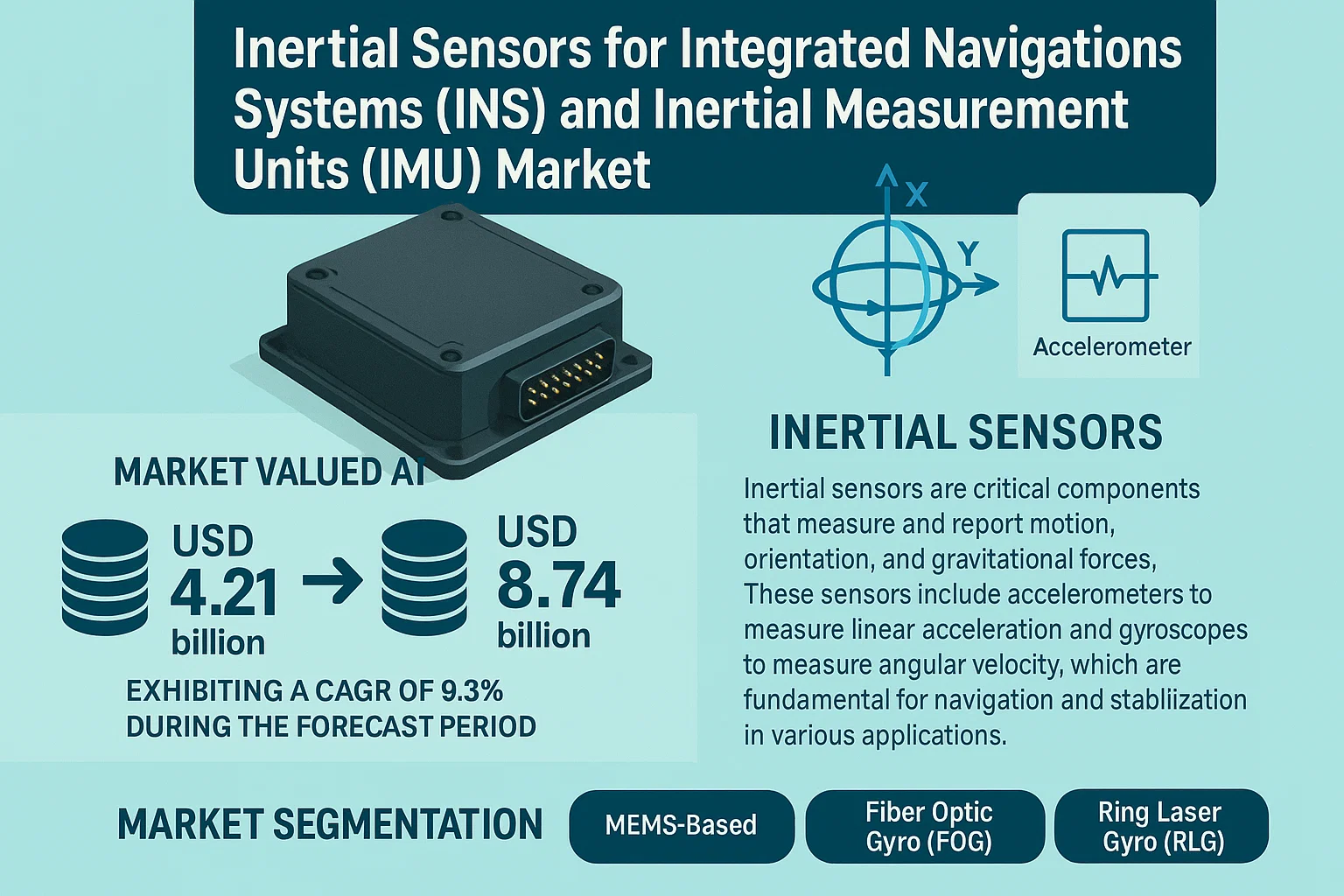
Global Inertial Sensors for Integrated Navigations Systems (INS) and Inertial Measurement Units (IMU) Market was valued at USD 4.21 billion in 2024 to USD 8.74 billion by 2032, exhibiting a CAGR of 9.3% during the forecast period.

Inertial sensors are critical components that measure and report motion, orientation, and gravitational forces. These sensors include accelerometers to measure linear acceleration and gyroscopes to measure angular velocity, which are fundamental for navigation and stabilization in various applications. The market segmentation includes MEMS-based, fiber optic gyro (FOG), and ring laser gyro (RLG) technologies, each catering to different precision and cost requirements.

The market growth is driven by increasing demand for autonomous vehicles, unmanned aerial vehicles (UAVs), and defense applications requiring precise navigation. While North America currently dominates due to high defense spending, Asia-Pacific is emerging as the fastest-growing region because of expanding aerospace and automotive sectors. Key players like Honeywell, Safran, and Northrop Grumman continue to innovate, with recent developments including miniaturized MEMS-based sensors for commercial drones and AI-enhanced navigation solutions.
Inertial Sensors for Integrated Navigations Systems (INS) and Inertial Measurement Units (IMU) Market

MARKET DYNAMICS

MARKET DRIVERS

Rising Demand for Autonomous Vehicles and Advanced Driver Assistance Systems to Propel Market Growth

The global inertial sensors market is experiencing significant growth driven by the increasing adoption of autonomous vehicles and advanced driver assistance systems (ADAS). These systems rely heavily on inertial sensors for precise navigation, stability control, and real-time positioning data. The automotive industry’s shift toward autonomous driving has created substantial demand for high-performance inertial measurement units that can provide accurate orientation and motion data under various driving conditions. Major automotive manufacturers are integrating sophisticated INS and IMU systems to enhance vehicle safety features and enable fully autonomous operations. This trend is particularly evident in North America and Europe, where regulatory support and technological advancements are accelerating the deployment of autonomous vehicle technologies.

Expanding Aerospace and Defense Applications to Accelerate Market Expansion

The aerospace and defense sector represents a crucial driver for inertial sensors, with increasing investments in modern navigation systems for military aircraft, unmanned aerial vehicles, and missile guidance systems. Inertial navigation systems provide critical positioning information where GPS signals may be unavailable or compromised, making them essential for national security applications. The growing global defense expenditure, particularly in regions experiencing geopolitical tensions, has led to increased procurement of advanced navigation systems. Military modernization programs worldwide are incorporating next-generation inertial sensors that offer improved accuracy, reliability, and resistance to electronic warfare environments, thereby driving market growth across both developed and emerging economies.

Growth in Industrial Automation and Robotics to Fuel Market Development

Industrial automation and robotics represent another significant growth driver for inertial sensors. Manufacturing facilities worldwide are increasingly adopting automated guided vehicles, robotic arms, and precision machinery that require accurate motion sensing and positioning capabilities. Inertial sensors enable these systems to maintain precise orientation, navigate complex environments, and perform delicate operations with minimal human intervention. The ongoing Industry 4.0 revolution has accelerated the integration of smart manufacturing technologies, creating substantial demand for high-performance inertial measurement units. This trend is particularly strong in manufacturing hubs where labor costs are rising and precision requirements are increasing across various industrial sectors.

MARKET CHALLENGES

High Development and Manufacturing Costs to Constrain Market Penetration

The inertial sensors market faces significant challenges related to the high costs associated with research, development, and manufacturing of precision navigation components. Developing advanced inertial measurement units requires substantial investment in specialized equipment, skilled engineering talent, and rigorous testing procedures to meet industry standards. These costs are particularly pronounced for high-accuracy systems used in aerospace and defense applications, where performance requirements are exceptionally stringent. The complex manufacturing processes involved in producing MEMS-based gyroscopes and accelerometers contribute to elevated production expenses, making it challenging for manufacturers to achieve economies of scale while maintaining quality standards.

Other Challenges

Technical Complexity and Integration Issues
The integration of inertial sensors into various applications presents substantial technical challenges. Achieving optimal performance requires sophisticated calibration procedures, advanced signal processing algorithms, and seamless integration with other navigation systems. The complexity increases when combining multiple sensor types or implementing sensor fusion techniques to enhance accuracy. These technical hurdles can delay product development cycles and increase implementation costs, particularly for applications requiring high reliability and precision under demanding environmental conditions.

Performance Limitations in Extreme Conditions
Inertial sensors face performance challenges in extreme environmental conditions, including temperature variations, vibration, and electromagnetic interference. Maintaining accuracy and reliability under such conditions requires additional engineering solutions and protective measures, which can increase system complexity and cost. These limitations are particularly problematic for applications in harsh environments such as aerospace, military operations, and industrial settings where consistent performance is critical for safety and operational effectiveness.

MARKET RESTRAINTS

Supply Chain Vulnerabilities and Component Shortages to Limit Market Growth

The inertial sensors market is experiencing constraints due to ongoing supply chain vulnerabilities and component shortages affecting the electronics manufacturing sector. The production of high-quality inertial measurement units depends on specialized materials, precision components, and advanced manufacturing equipment that are subject to global supply chain disruptions. These challenges have been exacerbated by geopolitical tensions, trade restrictions, and pandemic-related manufacturing interruptions. The limited availability of critical components has led to extended lead times, increased production costs, and delayed product deliveries across the industry.

Intense Competition and Price Pressure to Impact Profit Margins

The market faces significant restraint from intense competition among manufacturers, leading to substantial price pressure and shrinking profit margins. The presence of numerous established players and emerging competitors has created a highly competitive landscape where price becomes a primary differentiator. This competition is particularly intense in consumer electronics and automotive applications, where cost sensitivity is high. Manufacturers are compelled to reduce prices while maintaining performance standards, creating challenges for sustaining research and development investments and potentially affecting long-term innovation capabilities.

Regulatory Compliance and Certification Requirements to Slow Market Adoption

Stringent regulatory compliance and certification requirements represent another significant restraint for the inertial sensors market. Products intended for aerospace, defense, and automotive applications must undergo rigorous testing and certification processes that can be time-consuming and costly. These requirements vary across different regions and applications, creating additional complexity for manufacturers operating in global markets. The need to comply with multiple regulatory standards and obtain necessary certifications can delay product launches and increase development expenses, particularly for small and medium-sized enterprises with limited resources.

MARKET OPPORTUNITIES

Emerging Applications in Healthcare and Medical Devices to Create New Growth Avenues

The healthcare sector presents substantial growth opportunities for inertial sensors, particularly in medical devices, surgical navigation systems, and patient monitoring equipment. Advanced medical applications require precise motion tracking and orientation sensing for procedures such as minimally invasive surgery, rehabilitation therapy, and diagnostic imaging. The increasing adoption of telemedicine and remote patient monitoring technologies further expands the potential applications for inertial sensors in healthcare settings. These developments are driving innovation in sensor design and functionality, creating new market segments and revenue streams for manufacturers capable of meeting medical-grade performance and reliability standards.

Advancements in MEMS Technology to Enable New Market Applications

Technological advancements in micro-electromechanical systems (MEMS) are creating significant opportunities for inertial sensor manufacturers. Improvements in MEMS fabrication techniques, materials science, and packaging technologies are enabling the development of smaller, more accurate, and cost-effective inertial measurement units. These advancements are opening new application areas in consumer electronics, wearable devices, and Internet of Things (IoT) applications where size, power consumption, and cost are critical factors. The continuous innovation in MEMS technology allows manufacturers to address previously inaccessible market segments and develop solutions for emerging applications that require sophisticated motion sensing capabilities.

Growing Demand for Precision Agriculture and Environmental Monitoring to Drive Market Expansion

The agriculture and environmental monitoring sectors offer promising growth opportunities for inertial sensors. Precision agriculture applications increasingly rely on advanced navigation systems for automated farming equipment, drone-based crop monitoring, and soil analysis. Inertial sensors provide essential positioning and orientation data for these applications, enabling more efficient and sustainable agricultural practices. Similarly, environmental monitoring systems use inertial sensors for climate research, natural disaster prediction, and ecological studies. The growing emphasis on sustainable practices and environmental conservation is driving investment in these application areas, creating new demand for high-performance inertial measurement units tailored to specific environmental conditions and operational requirements.

INERTIAL SENSORS FOR INTEGRATED NAVIGATION SYSTEMS (INS) AND INERTIAL MEASUREMENT UNITS (IMU) MARKET TRENDS

Miniaturization and Enhanced Precision Technologies Drive Market Evolution

The relentless pursuit of miniaturization coupled with significant advancements in precision technology stands as a primary trend shaping the global inertial sensors market. The development of Micro-Electro-Mechanical Systems (MEMS) technology has been revolutionary, enabling the production of sensors that are not only smaller and lighter but also more power-efficient and cost-effective. This has unlocked their integration into a vast array of commercial applications previously dominated by larger, more expensive fiber-optic or ring laser gyroscopes. Recent innovations focus on improving the performance of these MEMS-based sensors to achieve navigation-grade accuracy, a domain traditionally reserved for higher-grade systems. Furthermore, the integration of Artificial Intelligence (AI) and machine learning algorithms with inertial data is significantly enhancing sensor fusion techniques. These algorithms can predict and compensate for inherent sensor errors like bias drift, thereby dramatically improving the overall accuracy and reliability of INS and IMU outputs, especially in GPS-denied environments.

Other Trends

Proliferation in Autonomous and Electric Vehicles

The rapid expansion of the autonomous and electric vehicle sectors is creating substantial demand for high-performance inertial sensors. These systems are fundamental for advanced driver-assistance systems (ADAS) and full autonomy, providing critical data for vehicle positioning, stability control, and navigation when satellite signals are obstructed. The level of autonomy directly correlates with the required performance grade of the inertial sensor; higher levels of automation necessitate sensors with lower drift rates and higher reliability. This surge is supported by increased investments in autonomous technology, with the global autonomous vehicle market itself projected for exponential growth, thereby pulling the inertial sensor market along with it.

Growing Demand in Unmanned Systems and Industrial Automation

There is a robust and growing demand for inertial sensors from the unmanned systems sector, encompassing Unmanned Aerial Vehicles (UAVs), autonomous underwater vehicles (AUVs), and ground robots. These platforms rely entirely on INS and IMU for navigation, guidance, and stabilization in environments where external references are unavailable or unreliable. Concurrently, the wave of Industry 4.0 is accelerating the adoption of industrial automation, where inertial sensors are crucial for the navigation of autonomous mobile robots (AMRs) within smart factories and warehouses. They ensure precise movement, payload handling, and operational safety without the need for fixed external infrastructure like magnetic tapes or reflectors. This dual thrust from both defense/commercial drones and modern industrial applications is a significant and sustained driver for market growth, encouraging continuous R&D for more robust and application-specific solutions.

COMPETITIVE LANDSCAPE

Key Industry Players

Technological Innovation and Strategic Expansion Define Market Leadership

The global inertial sensors market for INS and IMU applications exhibits a fragmented yet dynamic competitive structure, characterized by a mix of established defense contractors, specialized technology firms, and emerging manufacturers. While the market has numerous participants, a core group of companies maintains significant influence through technological superiority, extensive patent portfolios, and long-standing government and defense contracts. Norinco Group and AVIC (Aviation Industry Corporation of China) are dominant forces, particularly in the Asia-Pacific region, leveraging their deep integration within national defense supply chains and substantial R&D investments in advanced MEMS and fiber-optic gyroscope technologies.

Meanwhile, Western-based players like SDI (System Donner Inertial) and newer entrants such as StarNeto compete by focusing on high-precision, commercial-grade sensors for autonomous vehicles and unmanned systems. The competitive intensity is further amplified by companies like HY Technology and Right M&C, which have carved out significant niches in cost-effective solutions for consumer electronics and industrial automation, thereby expanding the market’s reach beyond traditional aerospace and defense sectors.

Growth strategies are predominantly centered on technological differentiation and strategic partnerships. Companies are aggressively investing in miniaturization, power efficiency, and sensor fusion algorithms to enhance performance in GPS-denied environments. Recent developments include several key players announcing next-generation IMUs with integrated AI capabilities for real-time data processing. Furthermore, mergers, acquisitions, and collaborations with software companies specializing in navigation algorithms are becoming increasingly common as the industry moves towards providing complete positioning solutions rather than just hardware components.

The landscape is also witnessing increased competition from semiconductor giants entering the space, putting pressure on specialized manufacturers to continuously innovate. However, established players maintain an edge through rigorous certification processes required for military and aerospace applications, creating significant barriers to entry and ensuring that technological expertise and reliability remain the ultimate determinants of market leadership.

List of Key Companies Profiled

  • Norinco Group (China)
  • AVIC (Avic-gyro) (China)
  • SDI (System Donner Inertial) (U.S.)
  • HY Technology (China)
  • Baocheng (China)
  • Right M&C (South Korea)
  • Chinastar (China)
  • Chenxi (China)
  • FACRI (China)
  • StarNeto (U.S.)
  • Navgnss (Global)

Segment Analysis:

By Type

Gyroscopes Segment Dominates the Market Due to Critical Role in Determining Angular Velocity and Orientation

The market is segmented based on type into:

  • Gyroscopes
    • Subtypes: Fiber Optic Gyroscopes (FOGs), Ring Laser Gyroscopes (RLGs), MEMS Gyroscopes, and others
  • Accelerometers
    • Subtypes: MEMS Accelerometers, Piezoelectric Accelerometers, and others
  • Magnetometers
  • Inertial Measurement Units (IMUs)
  • Others

By Application

Integrated Navigation Systems (INS) Segment Leads Due to High Demand in Aerospace, Defense, and Autonomous Vehicles

The market is segmented based on application into:

  • Integrated Navigation Systems (INS)
  • Inertial Measurement Units (IMU)
  • Unmanned Aerial Vehicles (UAVs)
  • Marine Navigation
  • Industrial Automation
  • Others

By End User

Aerospace and Defense Sector Holds Largest Share Owing to Extensive Use in Guidance and Navigation Systems

The market is segmented based on end user into:

  • Aerospace and Defense
  • Automotive
  • Marine
  • Industrial
  • Consumer Electronics
  • Others

By Technology

MEMS Technology Exhibits Highest Growth Driven by Miniaturization and Cost-Effectiveness

The market is segmented based on technology into:

  • MEMS (Micro-Electro-Mechanical Systems)
  • FOG (Fiber Optic Gyroscope)
  • RLG (Ring Laser Gyroscope)
  • Mechanical
  • Others

Regional Analysis: Inertial Sensors for Integrated Navigation Systems (INS) and Inertial Measurement Units (IMU) Market

Asia-Pacific
The Asia-Pacific region dominates the global INS and IMU market, accounting for the highest revenue share due to rapid industrialization, military modernization programs, and a booming commercial aerospace sector. China leads regional demand with significant investments in defense technologies and accelerated adoption of autonomous systems. India follows closely, driven by government initiatives like ‘Make in India’ and increasing aerospace testing capabilities. Japan and South Korea contribute through high-precision industrial applications, particularly in robotics and automotive navigation systems. Cost-effective manufacturing and local players like Navgnss and HY Technology enhance regional competitiveness. However, intellectual property rights concerns and geopolitical tensions pose challenges to cross-border technology transfers.

North America
North America maintains technological leadership in high-performance inertial sensors, fueled by defense contracts and advanced aerospace applications. The U.S. accounts for over 70% of regional market value, with key projects including NASA’s Artemis program and next-generation military navigation systems. Stricter export controls on dual-use technologies have reshaped supply chains, prompting domestic production expansion. Companies like SDI and FACRI are investing in MEMS-based solutions to address cost pressures from commercial drone and autonomous vehicle markets. Canada’s focus on Arctic navigation systems creates niche opportunities, while cybersecurity requirements for defense-grade IMUs drive innovation across the region.

Europe
Europe’s mature INS/IMU market emphasizes precision and reliability, particularly in aviation and marine applications. The EU’s Galileo satellite program has stimulated demand for complementary inertial navigation systems, while strict certification requirements (EN 9100, DO-254) ensure quality standards. Germany and France lead in industrial applications, with growing adoption in automated manufacturing. The UK’s defense sector remains a key consumer, albeit facing budget constraints. Emerging opportunities include offshore wind farm maintenance drones and urban air mobility platforms. However, the region faces competition from U.S. and Asian manufacturers in cost-sensitive segments, prompting strategic partnerships with local players like Chenxi and StarNeto.

Middle East & Africa
This region shows accelerating adoption of inertial technologies, primarily driven by defense modernization in Gulf states and oil/gas exploration applications. Saudi Arabia and the UAE account for over 60% of regional demand, investing in indigenous defense capabilities and smart city infrastructure. Israel maintains a specialized niche in tactical-grade MEMS for defense applications. Africa’s market remains limited but shows potential in mining automation and UAV-based delivery systems. Challenges include limited local manufacturing, reliance on imports, and economic volatility in certain markets. Recent collaborations between Norinco Group and Middle Eastern partners signal growing technology transfer initiatives.

South America
South America’s market is emerging, with Brazil dominating regional demand through its aerospace and defense programs including Embraer projects and border surveillance systems. Argentina shows potential in agricultural drone applications, while Chile’s mining sector adopts inertial sensors for autonomous heavy equipment. Economic instability and currency fluctuations hinder large-scale investments, though localized production by players like Chinastar aims to mitigate import dependence. The region’s lack of standardization and testing infrastructure presents barriers but also opportunities for turnkey solution providers. Naval applications along the Pacific coast and Amazon waterway monitoring systems represent untapped growth segments.

Report Scope

This market research report provides a comprehensive analysis of the global and regional Inertial Sensors for Integrated Navigation Systems (INS) and Inertial Measurement Units (IMU) markets, covering the forecast period 2025–2032. It offers detailed insights into market dynamics, technological advancements, competitive landscape, and key trends shaping the industry.

Key focus areas of the report include:

  • Market Size & Forecast: Historical data and future projections for revenue, unit shipments, and market value across major regions and segments.
  • Segmentation Analysis: Detailed breakdown by product type, technology, application, and end-user industry to identify high-growth segments and investment opportunities.
  • Regional Outlook: Insights into market performance across North America, Europe, Asia-Pacific, Latin America, and the Middle East & Africa, including country-level analysis where relevant.
  • Competitive Landscape: Profiles of leading market participants, including their product offerings, R&D focus, manufacturing capacity, pricing strategies, and recent developments such as mergers, acquisitions, and partnerships.
  • Technology Trends & Innovation: Assessment of emerging technologies, integration of AI/IoT, semiconductor design trends, fabrication techniques, and evolving industry standards.
  • Market Drivers & Restraints: Evaluation of factors driving market growth along with challenges, supply chain constraints, regulatory issues, and market-entry barriers.
  • Stakeholder Analysis: Insights for component suppliers, OEMs, system integrators, investors, and policymakers regarding the evolving ecosystem and strategic opportunities.

Primary and secondary research methods are employed, including interviews with industry experts, data from verified sources, and real-time market intelligence to ensure the accuracy and reliability of the insights presented.

FREQUENTLY ASKED QUESTIONS:

What is the current market size of Global Inertial Sensors for INS and IMU Market?

-> Inertial Sensors for Integrated Navigations Systems (INS) and Inertial Measurement Units (IMU) Market was valued at USD 4.21 billion in 2024 to USD 8.74 billion by 2032, exhibiting a CAGR of 9.3% during the forecast period.

Which key companies operate in Global Inertial Sensors for INS and IMU Market?

-> Key players include Navgnss, Avic-gyro, SDI, Norinco Group, HY Technology, Baocheng, Right M&C, Chinastar, Chenxi, FACRI, and StarNeto, among others.

What are the key growth drivers?

-> Key growth drivers include increasing demand for autonomous vehicles, rising defense and aerospace expenditures, growth in industrial automation, and advancements in MEMS technology.

Which region dominates the market?

-> Asia-Pacific is the fastest-growing region, driven by manufacturing hubs in China and Japan, while North America remains a dominant market due to high defense spending and technological innovation.

What are the emerging trends?

-> Emerging trends include miniaturization of sensors, integration with AI and machine learning, development of quantum inertial sensors, and increased use in consumer electronics and wearable devices.

Inertial Sensors for Integrated Navigations Systems (INS) and Inertial Measurement Units (IMU) Market, Trends, Business Strategies 2025-2032

Get Sample Report PDF for Exclusive Insights

Report Sample Includes

  • Table of Contents
  • List of Tables & Figures
  • Charts, Research Methodology, and more...

PDF Icon Download Sample Report PDF
SKU: 6baa144b9397
Category:

Download Sample Report

Table of Content

1 Introduction to Research & Analysis Reports
1.1 Inertial Sensors for Integrated Navigations Systems (INS) and Inertial Measurement Units (IMU) Market Definition
1.2 Market Segments
1.2.1 Segment by Type
1.2.2 Segment by Application
1.3 Global Inertial Sensors for Integrated Navigations Systems (INS) and Inertial Measurement Units (IMU) Market Overview
1.4 Features & Benefits of This Report
1.5 Methodology & Sources of Information
1.5.1 Research Methodology
1.5.2 Research Process
1.5.3 Base Year
1.5.4 Report Assumptions & Caveats
2 Global Inertial Sensors for Integrated Navigations Systems (INS) and Inertial Measurement Units (IMU) Overall Market Size
2.1 Global Inertial Sensors for Integrated Navigations Systems (INS) and Inertial Measurement Units (IMU) Market Size: 2024 VS 2032
2.2 Global Inertial Sensors for Integrated Navigations Systems (INS) and Inertial Measurement Units (IMU) Market Size, Prospects & Forecasts: 2020-2032
2.3 Global Inertial Sensors for Integrated Navigations Systems (INS) and Inertial Measurement Units (IMU) Sales: 2020-2032
3 Company Landscape
3.1 Top Inertial Sensors for Integrated Navigations Systems (INS) and Inertial Measurement Units (IMU) Players in Global Market
3.2 Top Global Inertial Sensors for Integrated Navigations Systems (INS) and Inertial Measurement Units (IMU) Companies Ranked by Revenue
3.3 Global Inertial Sensors for Integrated Navigations Systems (INS) and Inertial Measurement Units (IMU) Revenue by Companies
3.4 Global Inertial Sensors for Integrated Navigations Systems (INS) and Inertial Measurement Units (IMU) Sales by Companies
3.5 Global Inertial Sensors for Integrated Navigations Systems (INS) and Inertial Measurement Units (IMU) Price by Manufacturer (2020-2025)
3.6 Top 3 and Top 5 Inertial Sensors for Integrated Navigations Systems (INS) and Inertial Measurement Units (IMU) Companies in Global Market, by Revenue in 2024
3.7 Global Manufacturers Inertial Sensors for Integrated Navigations Systems (INS) and Inertial Measurement Units (IMU) Product Type
3.8 Tier 1, Tier 2, and Tier 3 Inertial Sensors for Integrated Navigations Systems (INS) and Inertial Measurement Units (IMU) Players in Global Market
3.8.1 List of Global Tier 1 Inertial Sensors for Integrated Navigations Systems (INS) and Inertial Measurement Units (IMU) Companies
3.8.2 List of Global Tier 2 and Tier 3 Inertial Sensors for Integrated Navigations Systems (INS) and Inertial Measurement Units (IMU) Companies
4 Sights by Product
4.1 Overview
4.1.1 Segment by Type – Global Inertial Sensors for Integrated Navigations Systems (INS) and Inertial Measurement Units (IMU) Market Size Markets, 2024 & 2032
4.1.2 Gyroscopes
4.1.3 Accelerometers
4.1.4 Others
4.2 Segment by Type – Global Inertial Sensors for Integrated Navigations Systems (INS) and Inertial Measurement Units (IMU) Revenue & Forecasts
4.2.1 Segment by Type – Global Inertial Sensors for Integrated Navigations Systems (INS) and Inertial Measurement Units (IMU) Revenue, 2020-2025
4.2.2 Segment by Type – Global Inertial Sensors for Integrated Navigations Systems (INS) and Inertial Measurement Units (IMU) Revenue, 2026-2032
4.2.3 Segment by Type – Global Inertial Sensors for Integrated Navigations Systems (INS) and Inertial Measurement Units (IMU) Revenue Market Share, 2020-2032
4.3 Segment by Type – Global Inertial Sensors for Integrated Navigations Systems (INS) and Inertial Measurement Units (IMU) Sales & Forecasts
4.3.1 Segment by Type – Global Inertial Sensors for Integrated Navigations Systems (INS) and Inertial Measurement Units (IMU) Sales, 2020-2025
4.3.2 Segment by Type – Global Inertial Sensors for Integrated Navigations Systems (INS) and Inertial Measurement Units (IMU) Sales, 2026-2032
4.3.3 Segment by Type – Global Inertial Sensors for Integrated Navigations Systems (INS) and Inertial Measurement Units (IMU) Sales Market Share, 2020-2032
4.4 Segment by Type – Global Inertial Sensors for Integrated Navigations Systems (INS) and Inertial Measurement Units (IMU) Price (Manufacturers Selling Prices), 2020-2032
5 Sights by Application
5.1 Overview
5.1.1 Segment by Application – Global Inertial Sensors for Integrated Navigations Systems (INS) and Inertial Measurement Units (IMU) Market Size, 2024 & 2032
5.1.2 Integrated Navigations Systems (INS)
5.1.3 Inertial Measurement Units (IMU)
5.2 Segment by Application – Global Inertial Sensors for Integrated Navigations Systems (INS) and Inertial Measurement Units (IMU) Revenue & Forecasts
5.2.1 Segment by Application – Global Inertial Sensors for Integrated Navigations Systems (INS) and Inertial Measurement Units (IMU) Revenue, 2020-2025
5.2.2 Segment by Application – Global Inertial Sensors for Integrated Navigations Systems (INS) and Inertial Measurement Units (IMU) Revenue, 2026-2032
5.2.3 Segment by Application – Global Inertial Sensors for Integrated Navigations Systems (INS) and Inertial Measurement Units (IMU) Revenue Market Share, 2020-2032
5.3 Segment by Application – Global Inertial Sensors for Integrated Navigations Systems (INS) and Inertial Measurement Units (IMU) Sales & Forecasts
5.3.1 Segment by Application – Global Inertial Sensors for Integrated Navigations Systems (INS) and Inertial Measurement Units (IMU) Sales, 2020-2025
5.3.2 Segment by Application – Global Inertial Sensors for Integrated Navigations Systems (INS) and Inertial Measurement Units (IMU) Sales, 2026-2032
5.3.3 Segment by Application – Global Inertial Sensors for Integrated Navigations Systems (INS) and Inertial Measurement Units (IMU) Sales Market Share, 2020-2032
5.4 Segment by Application – Global Inertial Sensors for Integrated Navigations Systems (INS) and Inertial Measurement Units (IMU) Price (Manufacturers Selling Prices), 2020-2032
6 Sights by Region
6.1 By Region – Global Inertial Sensors for Integrated Navigations Systems (INS) and Inertial Measurement Units (IMU) Market Size, 2024 & 2032
6.2 By Region – Global Inertial Sensors for Integrated Navigations Systems (INS) and Inertial Measurement Units (IMU) Revenue & Forecasts
6.2.1 By Region – Global Inertial Sensors for Integrated Navigations Systems (INS) and Inertial Measurement Units (IMU) Revenue, 2020-2025
6.2.2 By Region – Global Inertial Sensors for Integrated Navigations Systems (INS) and Inertial Measurement Units (IMU) Revenue, 2026-2032
6.2.3 By Region – Global Inertial Sensors for Integrated Navigations Systems (INS) and Inertial Measurement Units (IMU) Revenue Market Share, 2020-2032
6.3 By Region – Global Inertial Sensors for Integrated Navigations Systems (INS) and Inertial Measurement Units (IMU) Sales & Forecasts
6.3.1 By Region – Global Inertial Sensors for Integrated Navigations Systems (INS) and Inertial Measurement Units (IMU) Sales, 2020-2025
6.3.2 By Region – Global Inertial Sensors for Integrated Navigations Systems (INS) and Inertial Measurement Units (IMU) Sales, 2026-2032
6.3.3 By Region – Global Inertial Sensors for Integrated Navigations Systems (INS) and Inertial Measurement Units (IMU) Sales Market Share, 2020-2032
6.4 North America
6.4.1 By Country – North America Inertial Sensors for Integrated Navigations Systems (INS) and Inertial Measurement Units (IMU) Revenue, 2020-2032
6.4.2 By Country – North America Inertial Sensors for Integrated Navigations Systems (INS) and Inertial Measurement Units (IMU) Sales, 2020-2032
6.4.3 United States Inertial Sensors for Integrated Navigations Systems (INS) and Inertial Measurement Units (IMU) Market Size, 2020-2032
6.4.4 Canada Inertial Sensors for Integrated Navigations Systems (INS) and Inertial Measurement Units (IMU) Market Size, 2020-2032
6.4.5 Mexico Inertial Sensors for Integrated Navigations Systems (INS) and Inertial Measurement Units (IMU) Market Size, 2020-2032
6.5 Europe
6.5.1 By Country – Europe Inertial Sensors for Integrated Navigations Systems (INS) and Inertial Measurement Units (IMU) Revenue, 2020-2032
6.5.2 By Country – Europe Inertial Sensors for Integrated Navigations Systems (INS) and Inertial Measurement Units (IMU) Sales, 2020-2032
6.5.3 Germany Inertial Sensors for Integrated Navigations Systems (INS) and Inertial Measurement Units (IMU) Market Size, 2020-2032
6.5.4 France Inertial Sensors for Integrated Navigations Systems (INS) and Inertial Measurement Units (IMU) Market Size, 2020-2032
6.5.5 U.K. Inertial Sensors for Integrated Navigations Systems (INS) and Inertial Measurement Units (IMU) Market Size, 2020-2032
6.5.6 Italy Inertial Sensors for Integrated Navigations Systems (INS) and Inertial Measurement Units (IMU) Market Size, 2020-2032
6.5.7 Russia Inertial Sensors for Integrated Navigations Systems (INS) and Inertial Measurement Units (IMU) Market Size, 2020-2032
6.5.8 Nordic Countries Inertial Sensors for Integrated Navigations Systems (INS) and Inertial Measurement Units (IMU) Market Size, 2020-2032
6.5.9 Benelux Inertial Sensors for Integrated Navigations Systems (INS) and Inertial Measurement Units (IMU) Market Size, 2020-2032
6.6 Asia
6.6.1 By Region – Asia Inertial Sensors for Integrated Navigations Systems (INS) and Inertial Measurement Units (IMU) Revenue, 2020-2032
6.6.2 By Region – Asia Inertial Sensors for Integrated Navigations Systems (INS) and Inertial Measurement Units (IMU) Sales, 2020-2032
6.6.3 China Inertial Sensors for Integrated Navigations Systems (INS) and Inertial Measurement Units (IMU) Market Size, 2020-2032
6.6.4 Japan Inertial Sensors for Integrated Navigations Systems (INS) and Inertial Measurement Units (IMU) Market Size, 2020-2032
6.6.5 South Korea Inertial Sensors for Integrated Navigations Systems (INS) and Inertial Measurement Units (IMU) Market Size, 2020-2032
6.6.6 Southeast Asia Inertial Sensors for Integrated Navigations Systems (INS) and Inertial Measurement Units (IMU) Market Size, 2020-2032
6.6.7 India Inertial Sensors for Integrated Navigations Systems (INS) and Inertial Measurement Units (IMU) Market Size, 2020-2032
6.7 South America
6.7.1 By Country – South America Inertial Sensors for Integrated Navigations Systems (INS) and Inertial Measurement Units (IMU) Revenue, 2020-2032
6.7.2 By Country – South America Inertial Sensors for Integrated Navigations Systems (INS) and Inertial Measurement Units (IMU) Sales, 2020-2032
6.7.3 Brazil Inertial Sensors for Integrated Navigations Systems (INS) and Inertial Measurement Units (IMU) Market Size, 2020-2032
6.7.4 Argentina Inertial Sensors for Integrated Navigations Systems (INS) and Inertial Measurement Units (IMU) Market Size, 2020-2032
6.8 Middle East & Africa
6.8.1 By Country – Middle East & Africa Inertial Sensors for Integrated Navigations Systems (INS) and Inertial Measurement Units (IMU) Revenue, 2020-2032
6.8.2 By Country – Middle East & Africa Inertial Sensors for Integrated Navigations Systems (INS) and Inertial Measurement Units (IMU) Sales, 2020-2032
6.8.3 Turkey Inertial Sensors for Integrated Navigations Systems (INS) and Inertial Measurement Units (IMU) Market Size, 2020-2032
6.8.4 Israel Inertial Sensors for Integrated Navigations Systems (INS) and Inertial Measurement Units (IMU) Market Size, 2020-2032
6.8.5 Saudi Arabia Inertial Sensors for Integrated Navigations Systems (INS) and Inertial Measurement Units (IMU) Market Size, 2020-2032
6.8.6 UAE Inertial Sensors for Integrated Navigations Systems (INS) and Inertial Measurement Units (IMU) Market Size, 2020-2032
7 Manufacturers & Brands Profiles
7.1 Navgnss
7.1.1 Navgnss Company Summary
7.1.2 Navgnss Business Overview
7.1.3 Navgnss Inertial Sensors for Integrated Navigations Systems (INS) and Inertial Measurement Units (IMU) Major Product Offerings
7.1.4 Navgnss Inertial Sensors for Integrated Navigations Systems (INS) and Inertial Measurement Units (IMU) Sales and Revenue in Global (2020-2025)
7.1.5 Navgnss Key News & Latest Developments
7.2 Avic-gyro
7.2.1 Avic-gyro Company Summary
7.2.2 Avic-gyro Business Overview
7.2.3 Avic-gyro Inertial Sensors for Integrated Navigations Systems (INS) and Inertial Measurement Units (IMU) Major Product Offerings
7.2.4 Avic-gyro Inertial Sensors for Integrated Navigations Systems (INS) and Inertial Measurement Units (IMU) Sales and Revenue in Global (2020-2025)
7.2.5 Avic-gyro Key News & Latest Developments
7.3 SDI
7.3.1 SDI Company Summary
7.3.2 SDI Business Overview
7.3.3 SDI Inertial Sensors for Integrated Navigations Systems (INS) and Inertial Measurement Units (IMU) Major Product Offerings
7.3.4 SDI Inertial Sensors for Integrated Navigations Systems (INS) and Inertial Measurement Units (IMU) Sales and Revenue in Global (2020-2025)
7.3.5 SDI Key News & Latest Developments
7.4 Norinco Group
7.4.1 Norinco Group Company Summary
7.4.2 Norinco Group Business Overview
7.4.3 Norinco Group Inertial Sensors for Integrated Navigations Systems (INS) and Inertial Measurement Units (IMU) Major Product Offerings
7.4.4 Norinco Group Inertial Sensors for Integrated Navigations Systems (INS) and Inertial Measurement Units (IMU) Sales and Revenue in Global (2020-2025)
7.4.5 Norinco Group Key News & Latest Developments
7.5 HY Technology
7.5.1 HY Technology Company Summary
7.5.2 HY Technology Business Overview
7.5.3 HY Technology Inertial Sensors for Integrated Navigations Systems (INS) and Inertial Measurement Units (IMU) Major Product Offerings
7.5.4 HY Technology Inertial Sensors for Integrated Navigations Systems (INS) and Inertial Measurement Units (IMU) Sales and Revenue in Global (2020-2025)
7.5.5 HY Technology Key News & Latest Developments
7.6 Baocheng
7.6.1 Baocheng Company Summary
7.6.2 Baocheng Business Overview
7.6.3 Baocheng Inertial Sensors for Integrated Navigations Systems (INS) and Inertial Measurement Units (IMU) Major Product Offerings
7.6.4 Baocheng Inertial Sensors for Integrated Navigations Systems (INS) and Inertial Measurement Units (IMU) Sales and Revenue in Global (2020-2025)
7.6.5 Baocheng Key News & Latest Developments
7.7 Right M&C
7.7.1 Right M&C Company Summary
7.7.2 Right M&C Business Overview
7.7.3 Right M&C Inertial Sensors for Integrated Navigations Systems (INS) and Inertial Measurement Units (IMU) Major Product Offerings
7.7.4 Right M&C Inertial Sensors for Integrated Navigations Systems (INS) and Inertial Measurement Units (IMU) Sales and Revenue in Global (2020-2025)
7.7.5 Right M&C Key News & Latest Developments
7.8 Chinastar
7.8.1 Chinastar Company Summary
7.8.2 Chinastar Business Overview
7.8.3 Chinastar Inertial Sensors for Integrated Navigations Systems (INS) and Inertial Measurement Units (IMU) Major Product Offerings
7.8.4 Chinastar Inertial Sensors for Integrated Navigations Systems (INS) and Inertial Measurement Units (IMU) Sales and Revenue in Global (2020-2025)
7.8.5 Chinastar Key News & Latest Developments
7.9 Chenxi
7.9.1 Chenxi Company Summary
7.9.2 Chenxi Business Overview
7.9.3 Chenxi Inertial Sensors for Integrated Navigations Systems (INS) and Inertial Measurement Units (IMU) Major Product Offerings
7.9.4 Chenxi Inertial Sensors for Integrated Navigations Systems (INS) and Inertial Measurement Units (IMU) Sales and Revenue in Global (2020-2025)
7.9.5 Chenxi Key News & Latest Developments
7.10 FACRI
7.10.1 FACRI Company Summary
7.10.2 FACRI Business Overview
7.10.3 FACRI Inertial Sensors for Integrated Navigations Systems (INS) and Inertial Measurement Units (IMU) Major Product Offerings
7.10.4 FACRI Inertial Sensors for Integrated Navigations Systems (INS) and Inertial Measurement Units (IMU) Sales and Revenue in Global (2020-2025)
7.10.5 FACRI Key News & Latest Developments
7.11 StarNeto
7.11.1 StarNeto Company Summary
7.11.2 StarNeto Business Overview
7.11.3 StarNeto Inertial Sensors for Integrated Navigations Systems (INS) and Inertial Measurement Units (IMU) Major Product Offerings
7.11.4 StarNeto Inertial Sensors for Integrated Navigations Systems (INS) and Inertial Measurement Units (IMU) Sales and Revenue in Global (2020-2025)
7.11.5 StarNeto Key News & Latest Developments
8 Global Inertial Sensors for Integrated Navigations Systems (INS) and Inertial Measurement Units (IMU) Production Capacity, Analysis
8.1 Global Inertial Sensors for Integrated Navigations Systems (INS) and Inertial Measurement Units (IMU) Production Capacity, 2020-2032
8.2 Inertial Sensors for Integrated Navigations Systems (INS) and Inertial Measurement Units (IMU) Production Capacity of Key Manufacturers in Global Market
8.3 Global Inertial Sensors for Integrated Navigations Systems (INS) and Inertial Measurement Units (IMU) Production by Region
9 Key Market Trends, Opportunity, Drivers and Restraints
9.1 Market Opportunities & Trends
9.2 Market Drivers
9.3 Market Restraints
10 Inertial Sensors for Integrated Navigations Systems (INS) and Inertial Measurement Units (IMU) Supply Chain Analysis
10.1 Inertial Sensors for Integrated Navigations Systems (INS) and Inertial Measurement Units (IMU) Industry Value Chain
10.2 Inertial Sensors for Integrated Navigations Systems (INS) and Inertial Measurement Units (IMU) Upstream Market
10.3 Inertial Sensors for Integrated Navigations Systems (INS) and Inertial Measurement Units (IMU) Downstream and Clients
10.4 Marketing Channels Analysis
10.4.1 Marketing Channels
10.4.2 Inertial Sensors for Integrated Navigations Systems (INS) and Inertial Measurement Units (IMU) Distributors and Sales Agents in Global
11 Conclusion
12 Appendix
12.1 Note
12.2 Examples of Clients
12.3 DisclaimerList of Tables
Table 1. Key Players of Inertial Sensors for Integrated Navigations Systems (INS) and Inertial Measurement Units (IMU) in Global Market
Table 2. Top Inertial Sensors for Integrated Navigations Systems (INS) and Inertial Measurement Units (IMU) Players in Global Market, Ranking by Revenue (2024)
Table 3. Global Inertial Sensors for Integrated Navigations Systems (INS) and Inertial Measurement Units (IMU) Revenue by Companies, (US$, Mn), 2020-2025
Table 4. Global Inertial Sensors for Integrated Navigations Systems (INS) and Inertial Measurement Units (IMU) Revenue Share by Companies, 2020-2025
Table 5. Global Inertial Sensors for Integrated Navigations Systems (INS) and Inertial Measurement Units (IMU) Sales by Companies, (K Units), 2020-2025
Table 6. Global Inertial Sensors for Integrated Navigations Systems (INS) and Inertial Measurement Units (IMU) Sales Share by Companies, 2020-2025
Table 7. Key Manufacturers Inertial Sensors for Integrated Navigations Systems (INS) and Inertial Measurement Units (IMU) Price (2020-2025) & (US$/Unit)
Table 8. Global Manufacturers Inertial Sensors for Integrated Navigations Systems (INS) and Inertial Measurement Units (IMU) Product Type
Table 9. List of Global Tier 1 Inertial Sensors for Integrated Navigations Systems (INS) and Inertial Measurement Units (IMU) Companies, Revenue (US$, Mn) in 2024 and Market Share
Table 10. List of Global Tier 2 and Tier 3 Inertial Sensors for Integrated Navigations Systems (INS) and Inertial Measurement Units (IMU) Companies, Revenue (US$, Mn) in 2024 and Market Share
Table 11. Segment by Type – Global Inertial Sensors for Integrated Navigations Systems (INS) and Inertial Measurement Units (IMU) Revenue, (US$, Mn), 2024 & 2032
Table 12. Segment by Type – Global Inertial Sensors for Integrated Navigations Systems (INS) and Inertial Measurement Units (IMU) Revenue (US$, Mn), 2020-2025
Table 13. Segment by Type – Global Inertial Sensors for Integrated Navigations Systems (INS) and Inertial Measurement Units (IMU) Revenue (US$, Mn), 2026-2032
Table 14. Segment by Type – Global Inertial Sensors for Integrated Navigations Systems (INS) and Inertial Measurement Units (IMU) Sales (K Units), 2020-2025
Table 15. Segment by Type – Global Inertial Sensors for Integrated Navigations Systems (INS) and Inertial Measurement Units (IMU) Sales (K Units), 2026-2032
Table 16. Segment by Application – Global Inertial Sensors for Integrated Navigations Systems (INS) and Inertial Measurement Units (IMU) Revenue, (US$, Mn), 2024 & 2032
Table 17. Segment by Application – Global Inertial Sensors for Integrated Navigations Systems (INS) and Inertial Measurement Units (IMU) Revenue, (US$, Mn), 2020-2025
Table 18. Segment by Application – Global Inertial Sensors for Integrated Navigations Systems (INS) and Inertial Measurement Units (IMU) Revenue, (US$, Mn), 2026-2032
Table 19. Segment by Application – Global Inertial Sensors for Integrated Navigations Systems (INS) and Inertial Measurement Units (IMU) Sales, (K Units), 2020-2025
Table 20. Segment by Application – Global Inertial Sensors for Integrated Navigations Systems (INS) and Inertial Measurement Units (IMU) Sales, (K Units), 2026-2032
Table 21. By Region – Global Inertial Sensors for Integrated Navigations Systems (INS) and Inertial Measurement Units (IMU) Revenue, (US$, Mn), 2025-2032
Table 22. By Region – Global Inertial Sensors for Integrated Navigations Systems (INS) and Inertial Measurement Units (IMU) Revenue, (US$, Mn), 2020-2025
Table 23. By Region – Global Inertial Sensors for Integrated Navigations Systems (INS) and Inertial Measurement Units (IMU) Revenue, (US$, Mn), 2026-2032
Table 24. By Region – Global Inertial Sensors for Integrated Navigations Systems (INS) and Inertial Measurement Units (IMU) Sales, (K Units), 2020-2025
Table 25. By Region – Global Inertial Sensors for Integrated Navigations Systems (INS) and Inertial Measurement Units (IMU) Sales, (K Units), 2026-2032
Table 26. By Country – North America Inertial Sensors for Integrated Navigations Systems (INS) and Inertial Measurement Units (IMU) Revenue, (US$, Mn), 2020-2025
Table 27. By Country – North America Inertial Sensors for Integrated Navigations Systems (INS) and Inertial Measurement Units (IMU) Revenue, (US$, Mn), 2026-2032
Table 28. By Country – North America Inertial Sensors for Integrated Navigations Systems (INS) and Inertial Measurement Units (IMU) Sales, (K Units), 2020-2025
Table 29. By Country – North America Inertial Sensors for Integrated Navigations Systems (INS) and Inertial Measurement Units (IMU) Sales, (K Units), 2026-2032
Table 30. By Country – Europe Inertial Sensors for Integrated Navigations Systems (INS) and Inertial Measurement Units (IMU) Revenue, (US$, Mn), 2020-2025
Table 31. By Country – Europe Inertial Sensors for Integrated Navigations Systems (INS) and Inertial Measurement Units (IMU) Revenue, (US$, Mn), 2026-2032
Table 32. By Country – Europe Inertial Sensors for Integrated Navigations Systems (INS) and Inertial Measurement Units (IMU) Sales, (K Units), 2020-2025
Table 33. By Country – Europe Inertial Sensors for Integrated Navigations Systems (INS) and Inertial Measurement Units (IMU) Sales, (K Units), 2026-2032
Table 34. By Region – Asia Inertial Sensors for Integrated Navigations Systems (INS) and Inertial Measurement Units (IMU) Revenue, (US$, Mn), 2020-2025
Table 35. By Region – Asia Inertial Sensors for Integrated Navigations Systems (INS) and Inertial Measurement Units (IMU) Revenue, (US$, Mn), 2026-2032
Table 36. By Region – Asia Inertial Sensors for Integrated Navigations Systems (INS) and Inertial Measurement Units (IMU) Sales, (K Units), 2020-2025
Table 37. By Region – Asia Inertial Sensors for Integrated Navigations Systems (INS) and Inertial Measurement Units (IMU) Sales, (K Units), 2026-2032
Table 38. By Country – South America Inertial Sensors for Integrated Navigations Systems (INS) and Inertial Measurement Units (IMU) Revenue, (US$, Mn), 2020-2025
Table 39. By Country – South America Inertial Sensors for Integrated Navigations Systems (INS) and Inertial Measurement Units (IMU) Revenue, (US$, Mn), 2026-2032
Table 40. By Country – South America Inertial Sensors for Integrated Navigations Systems (INS) and Inertial Measurement Units (IMU) Sales, (K Units), 2020-2025
Table 41. By Country – South America Inertial Sensors for Integrated Navigations Systems (INS) and Inertial Measurement Units (IMU) Sales, (K Units), 2026-2032
Table 42. By Country – Middle East & Africa Inertial Sensors for Integrated Navigations Systems (INS) and Inertial Measurement Units (IMU) Revenue, (US$, Mn), 2020-2025
Table 43. By Country – Middle East & Africa Inertial Sensors for Integrated Navigations Systems (INS) and Inertial Measurement Units (IMU) Revenue, (US$, Mn), 2026-2032
Table 44. By Country – Middle East & Africa Inertial Sensors for Integrated Navigations Systems (INS) and Inertial Measurement Units (IMU) Sales, (K Units), 2020-2025
Table 45. By Country – Middle East & Africa Inertial Sensors for Integrated Navigations Systems (INS) and Inertial Measurement Units (IMU) Sales, (K Units), 2026-2032
Table 46. Navgnss Company Summary
Table 47. Navgnss Inertial Sensors for Integrated Navigations Systems (INS) and Inertial Measurement Units (IMU) Product Offerings
Table 48. Navgnss Inertial Sensors for Integrated Navigations Systems (INS) and Inertial Measurement Units (IMU) Sales (K Units), Revenue (US$, Mn) and Average Price (US$/Unit) & (2020-2025)
Table 49. Navgnss Key News & Latest Developments
Table 50. Avic-gyro Company Summary
Table 51. Avic-gyro Inertial Sensors for Integrated Navigations Systems (INS) and Inertial Measurement Units (IMU) Product Offerings
Table 52. Avic-gyro Inertial Sensors for Integrated Navigations Systems (INS) and Inertial Measurement Units (IMU) Sales (K Units), Revenue (US$, Mn) and Average Price (US$/Unit) & (2020-2025)
Table 53. Avic-gyro Key News & Latest Developments
Table 54. SDI Company Summary
Table 55. SDI Inertial Sensors for Integrated Navigations Systems (INS) and Inertial Measurement Units (IMU) Product Offerings
Table 56. SDI Inertial Sensors for Integrated Navigations Systems (INS) and Inertial Measurement Units (IMU) Sales (K Units), Revenue (US$, Mn) and Average Price (US$/Unit) & (2020-2025)
Table 57. SDI Key News & Latest Developments
Table 58. Norinco Group Company Summary
Table 59. Norinco Group Inertial Sensors for Integrated Navigations Systems (INS) and Inertial Measurement Units (IMU) Product Offerings
Table 60. Norinco Group Inertial Sensors for Integrated Navigations Systems (INS) and Inertial Measurement Units (IMU) Sales (K Units), Revenue (US$, Mn) and Average Price (US$/Unit) & (2020-2025)
Table 61. Norinco Group Key News & Latest Developments
Table 62. HY Technology Company Summary
Table 63. HY Technology Inertial Sensors for Integrated Navigations Systems (INS) and Inertial Measurement Units (IMU) Product Offerings
Table 64. HY Technology Inertial Sensors for Integrated Navigations Systems (INS) and Inertial Measurement Units (IMU) Sales (K Units), Revenue (US$, Mn) and Average Price (US$/Unit) & (2020-2025)
Table 65. HY Technology Key News & Latest Developments
Table 66. Baocheng Company Summary
Table 67. Baocheng Inertial Sensors for Integrated Navigations Systems (INS) and Inertial Measurement Units (IMU) Product Offerings
Table 68. Baocheng Inertial Sensors for Integrated Navigations Systems (INS) and Inertial Measurement Units (IMU) Sales (K Units), Revenue (US$, Mn) and Average Price (US$/Unit) & (2020-2025)
Table 69. Baocheng Key News & Latest Developments
Table 70. Right M&C Company Summary
Table 71. Right M&C Inertial Sensors for Integrated Navigations Systems (INS) and Inertial Measurement Units (IMU) Product Offerings
Table 72. Right M&C Inertial Sensors for Integrated Navigations Systems (INS) and Inertial Measurement Units (IMU) Sales (K Units), Revenue (US$, Mn) and Average Price (US$/Unit) & (2020-2025)
Table 73. Right M&C Key News & Latest Developments
Table 74. Chinastar Company Summary
Table 75. Chinastar Inertial Sensors for Integrated Navigations Systems (INS) and Inertial Measurement Units (IMU) Product Offerings
Table 76. Chinastar Inertial Sensors for Integrated Navigations Systems (INS) and Inertial Measurement Units (IMU) Sales (K Units), Revenue (US$, Mn) and Average Price (US$/Unit) & (2020-2025)
Table 77. Chinastar Key News & Latest Developments
Table 78. Chenxi Company Summary
Table 79. Chenxi Inertial Sensors for Integrated Navigations Systems (INS) and Inertial Measurement Units (IMU) Product Offerings
Table 80. Chenxi Inertial Sensors for Integrated Navigations Systems (INS) and Inertial Measurement Units (IMU) Sales (K Units), Revenue (US$, Mn) and Average Price (US$/Unit) & (2020-2025)
Table 81. Chenxi Key News & Latest Developments
Table 82. FACRI Company Summary
Table 83. FACRI Inertial Sensors for Integrated Navigations Systems (INS) and Inertial Measurement Units (IMU) Product Offerings
Table 84. FACRI Inertial Sensors for Integrated Navigations Systems (INS) and Inertial Measurement Units (IMU) Sales (K Units), Revenue (US$, Mn) and Average Price (US$/Unit) & (2020-2025)
Table 85. FACRI Key News & Latest Developments
Table 86. StarNeto Company Summary
Table 87. StarNeto Inertial Sensors for Integrated Navigations Systems (INS) and Inertial Measurement Units (IMU) Product Offerings
Table 88. StarNeto Inertial Sensors for Integrated Navigations Systems (INS) and Inertial Measurement Units (IMU) Sales (K Units), Revenue (US$, Mn) and Average Price (US$/Unit) & (2020-2025)
Table 89. StarNeto Key News & Latest Developments
Table 90. Inertial Sensors for Integrated Navigations Systems (INS) and Inertial Measurement Units (IMU) Capacity of Key Manufacturers in Global Market, 2023-2025 (K Units)
Table 91. Global Inertial Sensors for Integrated Navigations Systems (INS) and Inertial Measurement Units (IMU) Capacity Market Share of Key Manufacturers, 2023-2025
Table 92. Global Inertial Sensors for Integrated Navigations Systems (INS) and Inertial Measurement Units (IMU) Production by Region, 2020-2025 (K Units)
Table 93. Global Inertial Sensors for Integrated Navigations Systems (INS) and Inertial Measurement Units (IMU) Production by Region, 2026-2032 (K Units)
Table 94. Inertial Sensors for Integrated Navigations Systems (INS) and Inertial Measurement Units (IMU) Market Opportunities & Trends in Global Market
Table 95. Inertial Sensors for Integrated Navigations Systems (INS) and Inertial Measurement Units (IMU) Market Drivers in Global Market
Table 96. Inertial Sensors for Integrated Navigations Systems (INS) and Inertial Measurement Units (IMU) Market Restraints in Global Market
Table 97. Inertial Sensors for Integrated Navigations Systems (INS) and Inertial Measurement Units (IMU) Raw Materials
Table 98. Inertial Sensors for Integrated Navigations Systems (INS) and Inertial Measurement Units (IMU) Raw Materials Suppliers in Global Market
Table 99. Typical Inertial Sensors for Integrated Navigations Systems (INS) and Inertial Measurement Units (IMU) Downstream
Table 100. Inertial Sensors for Integrated Navigations Systems (INS) and Inertial Measurement Units (IMU) Downstream Clients in Global Market
Table 101. Inertial Sensors for Integrated Navigations Systems (INS) and Inertial Measurement Units (IMU) Distributors and Sales Agents in Global Market

List of Figures
Figure 1. Inertial Sensors for Integrated Navigations Systems (INS) and Inertial Measurement Units (IMU) Product Picture
Figure 2. Inertial Sensors for Integrated Navigations Systems (INS) and Inertial Measurement Units (IMU) Segment by Type in 2024
Figure 3. Inertial Sensors for Integrated Navigations Systems (INS) and Inertial Measurement Units (IMU) Segment by Application in 2024
Figure 4. Global Inertial Sensors for Integrated Navigations Systems (INS) and Inertial Measurement Units (IMU) Market Overview: 2024
Figure 5. Key Caveats
Figure 6. Global Inertial Sensors for Integrated Navigations Systems (INS) and Inertial Measurement Units (IMU) Market Size: 2024 VS 2032 (US$, Mn)
Figure 7. Global Inertial Sensors for Integrated Navigations Systems (INS) and Inertial Measurement Units (IMU) Revenue: 2020-2032 (US$, Mn)
Figure 8. Inertial Sensors for Integrated Navigations Systems (INS) and Inertial Measurement Units (IMU) Sales in Global Market: 2020-2032 (K Units)
Figure 9. The Top 3 and 5 Players Market Share by Inertial Sensors for Integrated Navigations Systems (INS) and Inertial Measurement Units (IMU) Revenue in 2024
Figure 10. Segment by Type – Global Inertial Sensors for Integrated Navigations Systems (INS) and Inertial Measurement Units (IMU) Revenue, (US$, Mn), 2024 & 2032
Figure 11. Segment by Type – Global Inertial Sensors for Integrated Navigations Systems (INS) and Inertial Measurement Units (IMU) Revenue Market Share, 2020-2032
Figure 12. Segment by Type – Global Inertial Sensors for Integrated Navigations Systems (INS) and Inertial Measurement Units (IMU) Sales Market Share, 2020-2032
Figure 13. Segment by Type – Global Inertial Sensors for Integrated Navigations Systems (INS) and Inertial Measurement Units (IMU) Price (US$/Unit), 2020-2032
Figure 14. Segment by Application – Global Inertial Sensors for Integrated Navigations Systems (INS) and Inertial Measurement Units (IMU) Revenue, (US$, Mn), 2024 & 2032
Figure 15. Segment by Application – Global Inertial Sensors for Integrated Navigations Systems (INS) and Inertial Measurement Units (IMU) Revenue Market Share, 2020-2032
Figure 16. Segment by Application – Global Inertial Sensors for Integrated Navigations Systems (INS) and Inertial Measurement Units (IMU) Sales Market Share, 2020-2032
Figure 17. Segment by Application -Global Inertial Sensors for Integrated Navigations Systems (INS) and Inertial Measurement Units (IMU) Price (US$/Unit), 2020-2032
Figure 18. By Region – Global Inertial Sensors for Integrated Navigations Systems (INS) and Inertial Measurement Units (IMU) Revenue, (US$, Mn), 2025 & 2032
Figure 19. By Region – Global Inertial Sensors for Integrated Navigations Systems (INS) and Inertial Measurement Units (IMU) Revenue Market Share, 2020 VS 2024 VS 2032
Figure 20. By Region – Global Inertial Sensors for Integrated Navigations Systems (INS) and Inertial Measurement Units (IMU) Revenue Market Share, 2020-2032
Figure 21. By Region – Global Inertial Sensors for Integrated Navigations Systems (INS) and Inertial Measurement Units (IMU) Sales Market Share, 2020-2032
Figure 22. By Country – North America Inertial Sensors for Integrated Navigations Systems (INS) and Inertial Measurement Units (IMU) Revenue Market Share, 2020-2032
Figure 23. By Country – North America Inertial Sensors for Integrated Navigations Systems (INS) and Inertial Measurement Units (IMU) Sales Market Share, 2020-2032
Figure 24. United States Inertial Sensors for Integrated Navigations Systems (INS) and Inertial Measurement Units (IMU) Revenue, (US$, Mn), 2020-2032
Figure 25. Canada Inertial Sensors for Integrated Navigations Systems (INS) and Inertial Measurement Units (IMU) Revenue, (US$, Mn), 2020-2032
Figure 26. Mexico Inertial Sensors for Integrated Navigations Systems (INS) and Inertial Measurement Units (IMU) Revenue, (US$, Mn), 2020-2032
Figure 27. By Country – Europe Inertial Sensors for Integrated Navigations Systems (INS) and Inertial Measurement Units (IMU) Revenue Market Share, 2020-2032
Figure 28. By Country – Europe Inertial Sensors for Integrated Navigations Systems (INS) and Inertial Measurement Units (IMU) Sales Market Share, 2020-2032
Figure 29. Germany Inertial Sensors for Integrated Navigations Systems (INS) and Inertial Measurement Units (IMU) Revenue, (US$, Mn), 2020-2032
Figure 30. France Inertial Sensors for Integrated Navigations Systems (INS) and Inertial Measurement Units (IMU) Revenue, (US$, Mn), 2020-2032
Figure 31. U.K. Inertial Sensors for Integrated Navigations Systems (INS) and Inertial Measurement Units (IMU) Revenue, (US$, Mn), 2020-2032
Figure 32. Italy Inertial Sensors for Integrated Navigations Systems (INS) and Inertial Measurement Units (IMU) Revenue, (US$, Mn), 2020-2032
Figure 33. Russia Inertial Sensors for Integrated Navigations Systems (INS) and Inertial Measurement Units (IMU) Revenue, (US$, Mn), 2020-2032
Figure 34. Nordic Countries Inertial Sensors for Integrated Navigations Systems (INS) and Inertial Measurement Units (IMU) Revenue, (US$, Mn), 2020-2032
Figure 35. Benelux Inertial Sensors for Integrated Navigations Systems (INS) and Inertial Measurement Units (IMU) Revenue, (US$, Mn), 2020-2032
Figure 36. By Region – Asia Inertial Sensors for Integrated Navigations Systems (INS) and Inertial Measurement Units (IMU) Revenue Market Share, 2020-2032
Figure 37. By Region – Asia Inertial Sensors for Integrated Navigations Systems (INS) and Inertial Measurement Units (IMU) Sales Market Share, 2020-2032
Figure 38. China Inertial Sensors for Integrated Navigations Systems (INS) and Inertial Measurement Units (IMU) Revenue, (US$, Mn), 2020-2032
Figure 39. Japan Inertial Sensors for Integrated Navigations Systems (INS) and Inertial Measurement Units (IMU) Revenue, (US$, Mn), 2020-2032
Figure 40. South Korea Inertial Sensors for Integrated Navigations Systems (INS) and Inertial Measurement Units (IMU) Revenue, (US$, Mn), 2020-2032
Figure 41. Southeast Asia Inertial Sensors for Integrated Navigations Systems (INS) and Inertial Measurement Units (IMU) Revenue, (US$, Mn), 2020-2032
Figure 42. India Inertial Sensors for Integrated Navigations Systems (INS) and Inertial Measurement Units (IMU) Revenue, (US$, Mn), 2020-2032
Figure 43. By Country – South America Inertial Sensors for Integrated Navigations Systems (INS) and Inertial Measurement Units (IMU) Revenue Market Share, 2020-2032
Figure 44. By Country – South America Inertial Sensors for Integrated Navigations Systems (INS) and Inertial Measurement Units (IMU) Sales, Market Share, 2020-2032
Figure 45. Brazil Inertial Sensors for Integrated Navigations Systems (INS) and Inertial Measurement Units (IMU) Revenue, (US$, Mn), 2020-2032
Figure 46. Argentina Inertial Sensors for Integrated Navigations Systems (INS) and Inertial Measurement Units (IMU) Revenue, (US$, Mn), 2020-2032
Figure 47. By Country – Middle East & Africa Inertial Sensors for Integrated Navigations Systems (INS) and Inertial Measurement Units (IMU) Revenue, Market Share, 2020-2032
Figure 48. By Country – Middle East & Africa Inertial Sensors for Integrated Navigations Systems (INS) and Inertial Measurement Units (IMU) Sales, Market Share, 2020-2032
Figure 49. Turkey Inertial Sensors for Integrated Navigations Systems (INS) and Inertial Measurement Units (IMU) Revenue, (US$, Mn), 2020-2032
Figure 50. Israel Inertial Sensors for Integrated Navigations Systems (INS) and Inertial Measurement Units (IMU) Revenue, (US$, Mn), 2020-2032
Figure 51. Saudi Arabia Inertial Sensors for Integrated Navigations Systems (INS) and Inertial Measurement Units (IMU) Revenue, (US$, Mn), 2020-2032
Figure 52. UAE Inertial Sensors for Integrated Navigations Systems (INS) and Inertial Measurement Units (IMU) Revenue, (US$, Mn), 2020-2032
Figure 53. Global Inertial Sensors for Integrated Navigations Systems (INS) and Inertial Measurement Units (IMU) Production Capacity (K Units), 2020-2032
Figure 54. The Percentage of Production Inertial Sensors for Integrated Navigations Systems (INS) and Inertial Measurement Units (IMU) by Region, 2024 VS 2032
Figure 55. Inertial Sensors for Integrated Navigations Systems (INS) and Inertial Measurement Units (IMU) Industry Value Chain
Figure 56. Marketing Channels