Industrial Edge AI Processor Market Insights
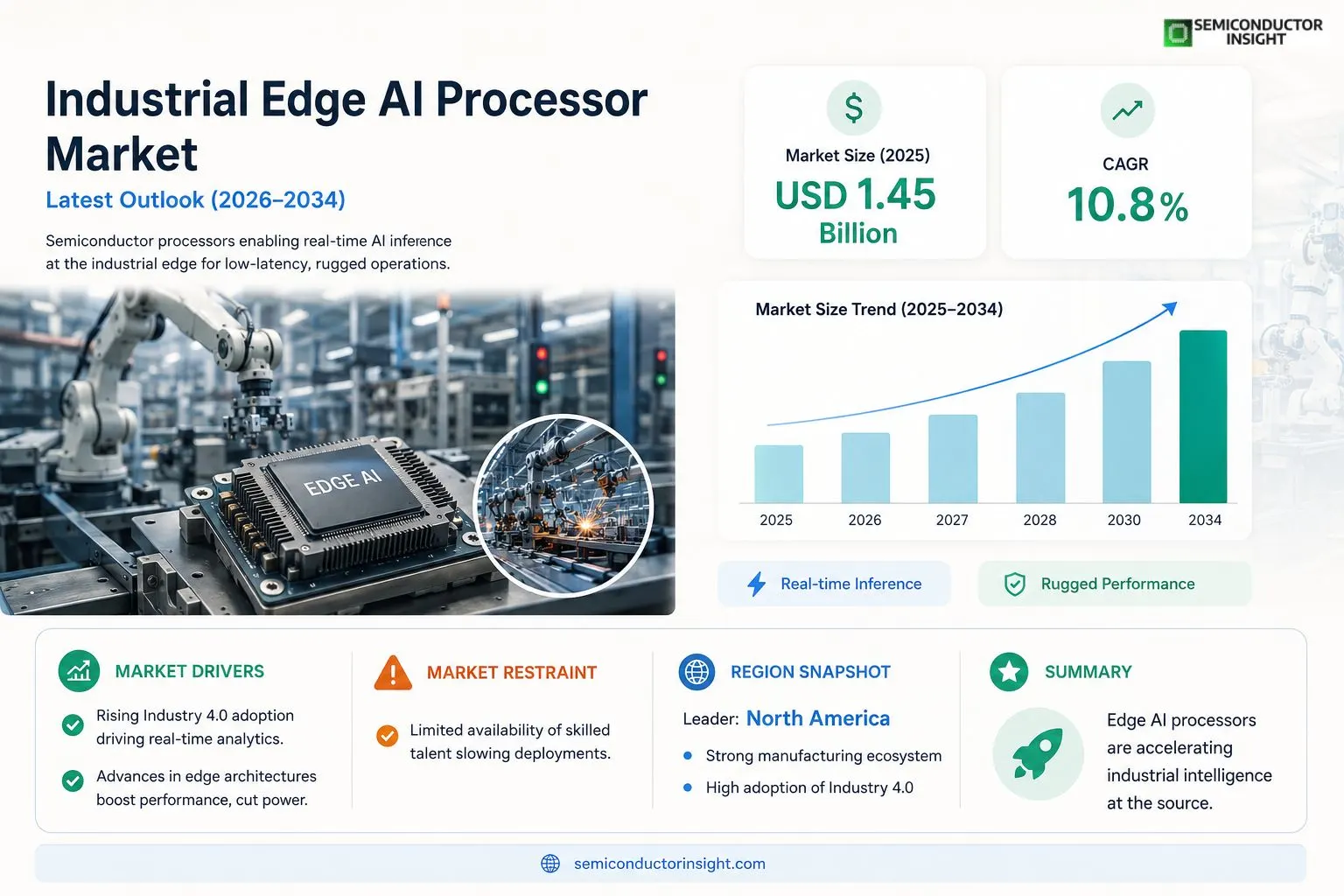
Global Industrial Edge AI Processor market size was valued at USD 1.45 billion in 2025. The market is projected to grow from USD 1.58 billion in 2026 to USD 3.92 billion by 2034, exhibiting a CAGR of 10.8% during the forecast period.
Industrial Edge AI processors are purpose‑built semiconductor devices that enable real‑time inference and analytics within factories, energy plants, and logistics hubs. These processors combine low‑latency compute cores with ruggedized packaging to withstand harsh industrial conditions while supporting frameworks such as TensorFlow Lite and ONNX.The market is experiencing rapid growth because manufacturers are accelerating digital transformation, investing heavily in predictive maintenance, and seeking to reduce reliance on cloud connectivity. Furthermore, advancements in heterogeneous integration and power‑efficient architectures are driving adoption across automotive factories, smart grids, and robotics firms.
MARKET DRIVERS
Rising Demand for Real‑Time Analytics
The surge in Industry 4.0 initiatives is driving manufacturers to adopt Industrial Edge AI Processor Market solutions that deliver sub‑second decision making on the shop floor. Real‑time analytics enable predictive maintenance, quality control, and energy optimization without relying on cloud latency.
Advances in Edge Computing Architecture
New heterogeneous architectures combining CPUs, GPUs, and dedicated AI accelerators are reducing power consumption while boosting inference throughput. These technical gains empower edge devices to run sophisticated deep‑learning models locally, offering a competitive edge to early adopters.
➤ Edge AI processors can cut latency by up to 70 % and lower energy use by 45 % compared with traditional PLC‑based control loops.
Regulatory incentives in Europe and North America are further accelerating deployments, as governments promote smart manufacturing ecosystems that rely on secure, low‑latency processing at the edge.
MARKET CHALLENGES
High Development Costs
Designing custom silicon for industrial environments involves extensive validation cycles, driving up R&D expenditures. Companies must invest heavily in ruggedization, safety certification, and long‑term support, which can deter small‑to‑mid‑size enterprises.
Other Challenges
Supply Chain Bottlenecks
Global semiconductor shortages have limited the availability of high‑performance AI cores, extending lead times and increasing price pressure for edge deployments.Integration complexity with legacy SCADA and PLC systems adds another layer of difficulty, requiring specialized engineering resources to ensure seamless data flow and compliance with IEC 62443 security standards.
MARKET RESTRAINTS
Limited Availability of Skilled Talent
There is a shortage of engineers proficient in both AI model optimization and industrial automation standards, slowing the rollout of edge AI solutions across factories.
Stringent Certification Requirements
Obtaining functional safety certifications (e.g., SIL 2/3) for AI‑enabled processors is a lengthy process that can postpone time‑to‑market, especially for startups.
Power and Thermal Constraints
Industrial environments often impose strict power budgets and harsh temperature ranges, limiting the selection of high‑performance AI chips that can operate reliably without extensive cooling.
MARKET OPPORTUNITIES
Growth in Predictive Maintenance Solutions
Predictive maintenance platforms are leveraging edge AI processors to analyze vibration, temperature, and acoustic signals in real time, reducing unplanned downtime by up to 30 % and creating a sizable revenue stream for vendors.
Expansion into Automotive Edge AI
Automakers are integrating rugged edge AI processors into assembly lines for quality inspection and autonomous logistics, opening new OEM partnerships for industrial chip manufacturers.
Strategic Partnerships with Cloud Providers
Collaborations that blend edge inference with cloud analytics enable hybrid architectures, allowing manufacturers to retain critical decision‑making on‑premise while benefiting from scalable cloud insights.
Industrial Edge AI Processor Market Trends
Rise of On‑Device Inference for Real‑Time Control
Manufacturers are increasingly embedding AI capabilities directly inside equipment to achieve sub‑second response times. Purpose‑built processors combine low‑latency compute cores with ruggedized packaging, allowing continuous analytics in environments where temperature spikes and vibration are common. By executing models locally, factories reduce dependence on cloud bandwidth, improve data privacy, and maintain deterministic control loops for robotics and high‑speed assembly lines. The ability to run frameworks such as TensorFlow Lite and ONNX at the edge empowers production teams to deploy predictive maintenance algorithms without disrupting existing network architecture, driving measurable efficiency gains across the sector.
Other Trends
Heterogeneous Integration Boosts Power Efficiency
Advances in heterogeneous integration enable the stacking of specialized accelerators alongside general‑purpose cores within a single silicon footprint. This architecture delivers higher performance per watt, a critical factor for installations that operate continuously or rely on limited power budgets, such as remote energy substations and autonomous mobile robots. Designers are leveraging chip‑let concepts to mix digital signal processors, neural processing units, and memory modules, resulting in processors that can sustain intensive inferencing while maintaining thermal stability. The shift toward modular, power‑efficient designs is accelerating adoption in automotive factories, where environmental compliance and operational cost control are top priorities.
Edge AI Expansion in Energy Management and Logistics
Beyond traditional manufacturing floors, Industrial Edge AI Processor market is seeing rapid penetration in smart grid monitoring and logistics hub automation. In energy plants, on‑site AI analyzes sensor streams to detect anomalies in turbine performance, enabling pre‑emptive interventions that avoid costly downtime. Similarly, logistics centers deploy edge processors to orchestrate autonomous guided vehicles, optimizing routing based on real‑time load data. These applications illustrate a broader trend: enterprises are leveraging localized intelligence to close the loop between data capture and actionable insight, eliminating latency associated with centralized cloud processing and reinforcing resilience against network interruptions.
COMPETITIVE LANDSCAPEKey Industry Players
Industrial Edge AI Processors: Powering Real‑Time Intelligence at the Factory Floor
Industrial Edge AI Processor market is currently led by a handful of semiconductor powerhouses that combine high‑performance compute cores with ruggedized, low‑latency packaging suitable for harsh factory environments. NVIDIA’s Jetson family dominates the segment through its mature software ecosystem and extensive partner network, while Intel leverages its Xeon‑based and Movidius VPU portfolios to address both legacy and emerging edge workloads. Qualcomm’s Snapdragon series and Google’s Coral Edge TPU bring energy‑efficient, mobile‑originated architectures that appeal to distributed sensor networks and predictive‑maintenance applications. The market structure is increasingly tiered: Tier‑1 giants provide broad platform support and large‑scale volume, whereas a growing cohort of specialist AI accelerator firms target niche workloads such as robotics, smart grids, and high‑throughput vision. This dichotomy fuels both price competition and rapid innovation in heterogeneous integration, resulting in a CAGR projected at double‑digit levels through 2034.Beyond the established leaders, a vibrant ecosystem of niche innovators is shaping the competitive landscape. Companies such as Hailo, Mythic, and Graphcore offer highly optimized inference engines that excel in ultra‑low‑power or ultra‑low‑latency scenarios, attracting OEMs seeking differentiated performance. Regional players like NXP, Renesas, and Texas Instruments provide automotive‑grade edge solutions that integrate safety‑critical functions. Emerging entrants from China and Israel, including Horizon Robotics and Syntiant, are expanding their footprint with AI‑centric silicon tailored for smart manufacturing and logistics. These specialized firms complement the broader market by delivering application‑specific accelerators, fostering a diversified supplier base that mitigates risk and accelerates adoption across multiple industrial verticals.
List of Key Industrial Edge AI Processor Companies Profiled
- NVIDIA
- Intel
- Qualcomm
- Google Coral
- AMD
- Texas Instruments
- NXP Semiconductors
- Renesas Electronics
- Hailo
- Mythic
- Graphcore
- Horizon Robotics
- Syntiant
- MediaTek
- Samsung Electronics
Segment Analysis:
| Segment Category | Sub-Segments | Key Insights |
| By Type |
|
General‑purpose Edge AI processors
|
| By Application |
|
Predictive maintenance
|
| By End User |
|
Automotive manufacturers
|
| By Architecture |
|
Heterogeneous multi‑core designs
|
| By Industry Vertical |
|
Manufacturing
|
Regional Analysis: North America
North America
The automotive sector in North America is a significant driver of Industrial Edge AI Processor market. Advancements in autonomous driving, advanced driver-assistance systems (ADAS), and connected car technologies are fueling the need for powerful edge computing capabilities within vehicles and manufacturing plants.
North American manufacturers are leveraging industrial edge AI processors to optimize production processes, improve quality control, and reduce downtime. Real-time analytics and predictive maintenance are key applications driving adoption in this segment.
The logistics and supply chain industry in North America is utilizing edge AI processors for enhanced route optimization, warehouse automation, and real-time tracking of goods, leading to greater efficiency and cost savings.
Retail businesses and smart city initiatives across North America are increasingly deploying edge AI processors for applications like customer analytics, inventory management, and smart infrastructure management.
Europe
Europe represents another significant market for Industrial Edge AI Processor market, characterized by a strong emphasis on sustainable industrial practices and technological advancement. The region’s diverse industrial base, including automotive, manufacturing, and pharmaceuticals, presents substantial opportunities for edge AI adoption. Government initiatives promoting Industry 4.0 and the digital transformation are further accelerating market growth. European companies are focusing on developing energy-efficient edge AI solutions and prioritizing data privacy and security in their deployments. The automotive sector in Germany and the UK is particularly active in adopting edge AI for autonomous driving and connected vehicle technologies. The pharmaceutical industry in Europe is leveraging edge AI for drug discovery, manufacturing process optimization, and quality control.
Asia-Pacific
Asia-Pacific is poised for the fastest growth in Industrial Edge AI Processor market, driven by rapid industrialization and increasing investments in automation across countries like China, Japan, and South Korea. The region’s large manufacturing base and growing adoption of smart factory concepts are creating substantial demand for edge AI solutions. China, in particular, is a major market for edge AI processors, with significant investments in AI infrastructure and a supportive government policy environment. The automotive industry in Asia-Pacific is also a key driver, with increasing demand for advanced driver-assistance systems and autonomous driving technologies. The manufacturing sector in Japan and South Korea is adopting edge AI for precision manufacturing, quality control, and predictive maintenance.
South America
South America presents a growing, albeit less mature, market for Industrial Edge AI Processors. The region’s industrial sector is expanding, particularly in areas like mining, agriculture, and manufacturing. Increasing connectivity and the adoption of digital technologies are driving demand for edge AI solutions. The mining industry in Chile and Brazil is exploring applications of edge AI for optimizing operations, improving safety, and enhancing resource management. The agricultural sector is utilizing edge AI for precision farming, crop monitoring, and yield optimization. Investment in infrastructure and technology is expected to further accelerate market growth in the coming years.
Middle East & Africa
The Middle East & Africa region is an emerging market for Industrial Edge AI Processors, with significant potential for growth driven by government initiatives focused on industrial diversification and technological advancements. Countries like Saudi Arabia, the UAE, and South Africa are investing in smart city initiatives, industrial automation, and infrastructure development. The oil and gas sector in the Middle East is exploring applications of edge AI for predictive maintenance, operational optimization, and safety enhancement. The manufacturing sector in South Africa is adopting edge AI for improving production efficiency and quality control. The region’s growing focus on renewable energy is also creating opportunities for edge AI in smart grids and energy management systems.
Report Scope
This market research report provides a comprehensive analysis of the Industrial Edge AI Processor Market , covering the forecast period 2026–2034. It offers detailed insights into market dynamics, technological advancements, competitive landscape, and key trends shaping the industry.
Key focus areas of the report include:
- Market Overview: The report begins with an overview outlining its current market scenario, key growth indicators, and industry transformation drivers. It discusses macroeconomic factors, demand–supply balance, regulatory landscape, and the strategic role of semiconductors in powering advancements across industries such as automotive, telecommunications, consumer electronics, and industrial automation.
- Market Size & Forecast: Historical data and future projections for revenue, unit shipments, and market value across major regions and segments.
- Segmentation Analysis: Detailed breakdown by product type, technology, application, and end-user industry to identify high-growth segments and investment opportunities.
- Regional Insights: Insights into market performance across North America, Europe, Asia-Pacific, Latin America, and the Middle East & Africa, including country-level analysis where relevant.
- Competitive Landscape: Profiles of leading market participants, including their product offerings, R&D focus, manufacturing capacity, pricing strategies, and recent developments such as mergers, acquisitions, and partnerships.
- Technology Trends & Innovation: Assessment of emerging technologies, integration of AI/IoT, semiconductor design trends, fabrication techniques, and evolving industry standards.
- Market Drivers & Restraints: Evaluation of factors driving market growth along with challenges, supply chain constraints, regulatory issues, and market-entry barriers.
- Stakeholder Insights: Insights for component suppliers, OEMs, system integrators, investors, and policymakers regarding the evolving ecosystem and strategic opportunities.
Primary and secondary research methods are employed, including interviews with industry experts, data from verified sources, and real-time market intelligence to ensure the accuracy and reliability of the insights presented.
FREQUENTLY ASKED QUESTIONS:
What is the current market size of Industrial Edge AI Processor Market?
-> Industrial Edge AI Processor market was valued at USD 1.45 billion in 2025 and is expected to reach USD 3.92 billion by 2034.
Which key companies operate in Industrial Edge AI Processor Market?
-> Key players include Axalta Coating Systems, AkzoNobel, BASF SE, PPG, Sherwin-Williams, and 3M, among others.
What are the key growth drivers?
-> Key growth drivers include railway infrastructure investments, urbanization, and demand for durable coatings.
Which region dominates the market?
-> Asia-Pacific is the fastest-growing region, while Europe remains a dominant market.
What are the emerging trends?
-> Emerging trends include bio-based coatings, smart coatings, and sustainable rail solutions.

Get Sample Report PDF for Exclusive Insights
Report Sample Includes
- Table of Contents
- List of Tables & Figures
- Charts, Research Methodology, and more...
 Download Sample Report PDF