Industrial CAN Transceiver Market Insights
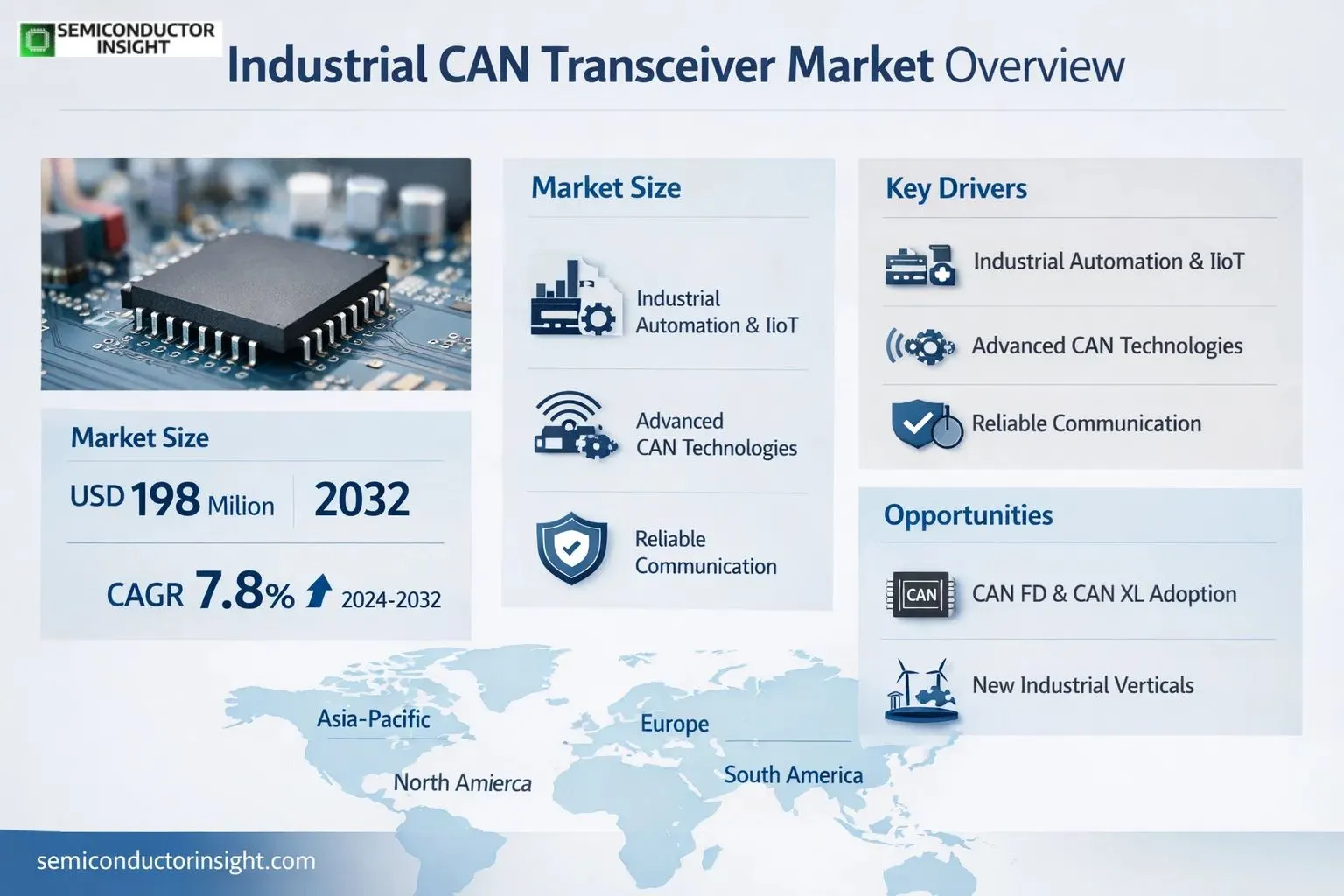
Global Industrial CAN Transceiver market size was valued at USD 198 million in 2024. The market is projected to grow from USD 213 million in 2025 to USD 326 million by 2032, exhibiting a CAGR of 7.8% during the forecast period.
Industrial CAN (Controller Area Network) transceivers serve as critical components in industrial automation, automotive, and aerospace applications. These devices act as a bridge between the CAN controller and the physical bus, converting logical signals into differential signals for transmission over the CAN bus while also receiving and translating incoming signals for the controller.
The market is expanding due to increasing adoption of Industrial Internet of Things (IIoT) and smart manufacturing technologies. The high reliability, real-time performance, and cost-effectiveness of CAN protocols have solidified their position as a standard in industrial communication. Key players are focusing on integrated designs, enhanced performance, and low-power solutions to meet evolving industry demands.
MARKET DRIVERS
Rising Demand for Industrial Automation and IIoT
The expansion of Industry 4.0 and the Industrial Internet of Things (IIoT) is a primary driver for the Industrial CAN Transceiver Market. These systems require robust, real-time communication networks for machinery control and data acquisition, making the reliable Controller Area Network (CAN) protocol essential. The demand for higher efficiency and predictive maintenance in manufacturing is accelerating the adoption of CAN-based sensor networks and control units.
Superior Performance in Harsh Environments
Industrial CAN transceivers are specifically engineered to perform reliably in demanding conditions characterized by extreme temperatures, high electromagnetic interference (EMI), and significant voltage fluctuations. This resilience is critical for applications in factory automation, process control, and heavy machinery, where network integrity is non-negotiable for safety and operational continuity.
➤ The integration of advanced features like selective wake-up and low-power modes is enabling new applications in battery-operated industrial IoT devices, further propelling market growth.
Furthermore, the inherent simplicity and cost-effectiveness of CAN bus architecture compared to more complex networking solutions make it a preferred choice for a wide range of industrial applications, supporting steady market expansion.
MARKET CHALLENGES
Increasing Network Complexity and Bandwidth Limitations
A significant challenge facing the Industrial CAN Transceiver Market is the escalating complexity of industrial networks. As systems incorporate more nodes and generate larger volumes of data, the traditional CAN (CAN 2.0) protocol’s limited bandwidth of 1 Mbit/s can become a bottleneck for high-speed data-intensive applications, potentially limiting its use in next-generation automation.
Other Challenges
Competition from Alternative Protocols
The market faces stiff competition from other industrial communication protocols like Ethernet/IP, PROFINET, and Time-Sensitive Networking (TSN), which offer higher data rates and seamless IT/OT convergence, challenging CAN’s dominance in certain high-performance segments.
Ensuring Electromagnetic Compatibility
As industrial environments become more electrically noisy, designing CAN transceivers that consistently meet stringent electromagnetic compatibility (EMC) standards without significantly increasing cost or power consumption remains a persistent technical challenge for manufacturers.
MARKET RESTRAINTS
High Initial Investment and System Integration Costs
The adoption of new or upgraded industrial automation systems incorporating CAN transceivers often requires substantial capital investment. For many small and medium-sized enterprises, the costs associated with retrofitting existing machinery or purchasing new CAN-based equipment can be prohibitive, acting as a restraint on market growth.
Long Lifecycle of Existing Industrial Equipment
The industrial sector is characterized by long equipment lifecycles, often exceeding 10 to 15 years. Many facilities continue to operate with legacy systems that do not utilize modern CAN networks, slowing the replacement rate and the subsequent demand for new Industrial CAN Transceiver components.
MARKET OPPORTUNITIES
Advent of CAN FD and CAN XL Protocols
The introduction and growing adoption of CAN with Flexible Data-Rate (CAN FD) and the newer CAN XL protocol present substantial opportunities. These evolutions offer significantly higher data payloads and speeds—up to 10 Mbit/s and beyond—making the Industrial CAN Transceiver Market viable for a broader range of advanced applications, including complex motion control and high-resolution machine vision systems.
Expansion into New Industrial Verticals
There is significant potential for growth in non-traditional sectors such as renewable energy, agricultural automation, and smart grid infrastructure. These areas require reliable, low-latency communication for distributed control, creating new avenues for the deployment of Industrial CAN Transceiver solutions beyond conventional factory settings.
Development of Functional Safety Compliant Transceivers
The increasing focus on functional safety standards like ISO 13849 and IEC 61508 in industrial equipment opens opportunities for transceivers certified for Safety Integrity Levels (SIL). Products designed for safety-critical applications, such as emergency stop systems and robotic safety controllers, represent a high-value, growing segment within the market.
Industrial CAN Transceiver Market Trends
Accelerated Growth Driven by Industrial Automation and IIoT
Global Industrial CAN Transceiver market is demonstrating robust expansion, with a valuation of $198 million in 2024 projected to reach $326 million by 2032, representing a compound annual growth rate of 7.8%. This significant growth is primarily fueled by the rapid proliferation of the Industrial Internet of Things (IIoT) and Global push towards smart manufacturing. As the essential bridge between a CAN controller and the physical bus, the transceiver’s role in converting logical signals to differential signals is critical for system stability. The inherent reliability, real-time performance, and cost-effectiveness of the CAN protocol solidify its position as a leading standard in industrial communications, directly increasing demand for high-performance industrial CAN transceivers.
Other Trends
Evolution Towards High-Performance and Low-Power Designs
The market is witnessing a clear trend towards integrated, high-performance, and low-power designs. Integrated designs allow for more compact embedding into complex industrial systems, reducing both cost and spatial requirements while enhancing overall reliability. High-performance designs focus on increasing data transmission rates and bolstering anti-interference capabilities to handle demanding industrial environments. Concurrently, low-power consumption has become a critical design parameter, especially for IIoT applications where extended battery life is essential for reducing operational and maintenance costs.
Intelligent Functionality and CAN FD Adoption
Beyond basic communication, industrial CAN transceivers are increasingly incorporating intelligent features such as diagnostics, fault detection, and status monitoring. This evolution supports the need for predictive maintenance and operational efficiency in automated systems. Looking forward, the adoption of CAN FD (Flexible Data-Rate) technology is a key trend, enabling higher data throughput to meet the demands of large-scale data acquisition in Industry 4.0 applications. The market is poised for further advancements towards even higher speeds and larger bandwidth capabilities, ensuring the Industrial CAN Transceiver market remains at the forefront of industrial communication technology.
COMPETITIVE LANDSCAPEKey Industry Players
A Market Characterized by Established Semiconductor Giants and Specialized Innovators
Global Industrial CAN Transceiver market is dominated by leading semiconductor manufacturers with extensive portfolios and significant research and development capabilities. Companies like NXP Semiconductors, Texas Instruments (TI), and Infineon Technologies hold substantial market shares, leveraging their expertise in automotive and industrial semiconductors. The competitive landscape is characterized by a focus on developing high-reliability, low-power solutions that meet the stringent requirements of industrial automation, including robust EMC performance and support for advanced protocols like CAN FD. These key players compete on technological innovation, product reliability, global supply chain strength, and strategic partnerships with major industrial automation equipment manufacturers.
Beyond the market leaders, a cohort of specialized and regional players contributes to a diverse competitive environment. Companies such as Renesas Electronics, STMicroelectronics, and Microchip Technology offer strong alternatives with competitive product features. Furthermore, the market sees participation from niche innovators like Novosense Microelectronics and Analog Devices, who focus on specific performance attributes such as enhanced isolation or ultra-low power consumption for IIoT applications. This multi-tiered structure ensures a healthy level of competition, driving continuous product evolution to meet the growing demands for speed, efficiency, and diagnostic capabilities in industrial networks.
List of Key Industrial CAN Transceiver Companies Profiled
- NXP Semiconductors
- Texas Instruments
- Infineon Technologies
- STMicroelectronics
- Rohm Semiconductor
- ON Semiconductor
- Microchip Technology
- Renesas Electronics
- Analog Devices
- Novosense Microelectronics
- One Chip Semiconductor (Mornsun)
Segment Analysis:
| Segment Category | Sub-Segments | Key Insights |
| By Type |
|
4-8 Mbps transceivers are emerging as the leading segment, driven by the escalating demand for higher data throughput in advanced industrial environments. This category supports more complex data exchange and real-time monitoring required by Industry 4.0 applications. Furthermore, these transceivers offer enhanced performance for integrating sophisticated diagnostics and fault detection capabilities, positioning them as a critical enabler for next-generation industrial automation and smart manufacturing systems where speed and data integrity are paramount. |
| By Application |
|
Industrial Control represents the dominant application area, as CAN transceivers are fundamental to the robust communication networks within factory automation, process control, and machine-to-machine communication. The high reliability and deterministic real-time performance of CAN protocol are essential for synchronizing machinery and ensuring operational safety. This application is further reinforced by the ongoing expansion of the Industrial Internet of Things, which demands dependable and low-latency data links for supervisory control and data acquisition systems across diverse industrial settings. |
| By End User |
|
Original Equipment Manufacturers (OEMs) are the primary end users, integrating CAN transceivers directly into new industrial machinery, automotive systems, and medical devices. Their demand is shaped by the need for components that offer long-term reliability, compact integration, and adherence to stringent industry standards. The design philosophy of OEMs increasingly favors transceivers with advanced features like integrated diagnostic functions, which help reduce system complexity and improve the overall lifecycle management of the equipment they produce, thereby strengthening their market leadership. |
| By Protocol Standard |
|
CAN FD (Flexible Data-Rate) is gaining significant traction as the leading protocol standard due to its ability to support higher data rates and larger payloads compared to Classic CAN. This evolution is critical for applications requiring extensive data exchange, such as complex sensor networks and advanced control systems. The migration towards CAN FD is accelerated by its backward compatibility, allowing for a gradual upgrade path in existing installations while offering the necessary bandwidth to support future innovations in industrial automation and intelligent device connectivity. |
| By Integration Level |
|
Integrated with Microcontroller solutions are becoming the preferred choice, driven by the industry-wide trend towards miniaturization and system optimization. This integration reduces the overall component count, saves valuable board space, and enhances system reliability by minimizing external interconnections. The consolidated design approach also simplifies the development process for engineers, leading to faster time-to-market for end products. Furthermore, integrated solutions often provide better power management and lower electromagnetic interference, which are critical factors in dense industrial electronic assemblies. |
Regional Analysis: Industrial CAN Transceiver Market
Asia-Pacific
The concentration of the world’s largest automotive manufacturers in the Asia-Pacific region creates a foundational demand for Industrial CAN Transceivers. These components are critical for in-vehicle networking and are equally vital for the automated machinery used on production lines. The synergy between the automotive sector and industrial automation solidifies the region’s dominant position in the Industrial CAN Transceiver Market.
Supportive government policies, such as “Made in China 2025” and India’s “Make in India,” actively promote advanced manufacturing and automation. These initiatives drive the adoption of sophisticated industrial communication networks, directly fueling demand for high-performance Industrial CAN Transceivers and encouraging local production of these critical semiconductor components.
A deeply integrated electronics supply chain, from semiconductor fabrication to end-product assembly, allows for efficient production and distribution of Industrial CAN Transceivers. This ecosystem enables manufacturers to quickly respond to market demands and reduces lead times, providing a significant competitive advantage in Global Industrial CAN Transceiver Market.
The region exhibits a rapid adoption rate for new industrial communication standards and technologies. As factories upgrade to smarter, more connected systems, the requirement for advanced, robust Industrial CAN Transceivers that can handle higher data rates and operate in harsh environments grows exponentially, fostering continuous market expansion.
North America
North America remains a highly significant and technologically advanced market for Industrial CAN Transceivers, characterized by a strong focus on innovation and high-value manufacturing. The region, led by the United States and Canada, has a mature industrial automation sector that demands high-reliability components for applications in aerospace, defense, and heavy machinery. The presence of leading technology firms and a strong emphasis on research and development drives the adoption of next-generation Industrial CAN Transceiver solutions that offer enhanced features like improved electromagnetic compatibility and lower power consumption. Regulatory standards and a focus on operational safety in industrial environments further shape the market demand for certified and robust communication components.
Europe
Europe holds a prominent position in the Industrial CAN Transceiver Market, underpinned by its strong automotive industry and leading manufacturing nations like Germany, which is a pioneer in Industry 4.0. The region’s market is defined by a stringent regulatory framework that emphasizes quality, safety, and energy efficiency, influencing the specifications for Industrial CAN Transceivers used in factory automation and mechanical engineering. High labor costs drive the adoption of automation, creating steady demand for reliable industrial communication components. European manufacturers are often early adopters of sophisticated CAN FD (Flexible Data-rate) transceivers to meet the data throughput requirements of modern, interconnected production systems.
South America
The Industrial CAN Transceiver Market in South America is emerging, with growth potential linked to the modernization of industrial sectors in countries like Brazil and Argentina. The market is primarily driven by investments in mining, agriculture equipment, and automotive manufacturing. While adoption rates are slower compared to leading regions, increasing awareness of the benefits of industrial automation is creating new opportunities. The market dynamics are influenced by economic fluctuations, but a gradual shift towards upgrading industrial infrastructure is expected to spur demand for reliable communication components like CAN transceivers in the long term.
Middle East & Africa
The Middle East & Africa region represents a developing market for Industrial CAN Transceivers, with growth centered around oil and gas, petrochemicals, and infrastructure development projects. Nations in the Gulf Cooperation Council (GCC) are investing in economic diversification, which includes building advanced manufacturing capabilities. The demand for Industrial CAN Transceivers is linked to the automation of heavy industrial processes and utilities. The market is characterized by project-based demand and is gradually evolving as industrial sectors modernize, though it currently remains a smaller segment of Global landscape.
Report Scope
This market research report provides a comprehensive analysis of the Industrial CAN Transceiver, covering the forecast period 2024–2032. It offers detailed insights into market dynamics, technological advancements, competitive landscape, and key trends shaping the industry.
Key focus areas of the report include:
- Market Overview: The report begins with an overview outlining its current market scenario, key growth indicators, and industry transformation drivers. It discusses macroeconomic factors, demand–supply balance, regulatory landscape, and the strategic role of Industrial CAN Transceivers in powering advancements across industries such as automotive, industrial automation, aerospace, and medical equipment.
- Market Size & Forecast: Historical data and future projections for revenue, unit shipments, and market value across major regions and segments.
- Segmentation Analysis: Detailed breakdown by product type, technology, application, and end-user industry to identify high-growth segments and investment opportunities.
- Regional Insights: Insights into market performance across North America, Europe, Asia-Pacific, Latin America, and the Middle East & Africa, including country-level analysis where relevant.
- Competitive Landscape: Profiles of leading market participants, including their product offerings, R&D focus, manufacturing capacity, pricing strategies, and recent developments such as mergers, acquisitions, and partnerships.
- Technology Trends & Innovation: Assessment of emerging technologies, integration of IIoT, semiconductor design trends, fabrication techniques, and evolving industry standards.
- Market Drivers & Restraints: Evaluation of factors driving market growth along with challenges, supply chain constraints, regulatory issues, and market-entry barriers.
- Stakeholder Insights: Insights for component suppliers, OEMs, system integrators, investors, and policymakers regarding the evolving ecosystem and strategic opportunities.
Primary and secondary research methods are employed, including interviews with industry experts, data from verified sources, and real-time market intelligence to ensure the accuracy and reliability of the insights presented.
FREQUENTLY ASKED QUESTIONS:
What is the current market size of Industrial CAN Transceiver?
-> Global Industrial CAN Transceiver market was valued at USD 198 million in 2024 and is expected to reach USD 326 million by 2032.
Which key companies operate in Industrial CAN Transceiver market?
-> Key players include Rohm Semiconductor, NXP Semiconductors, STMicroelectronics, Infineon Technologies, ON Semiconductor, TI Semiconductor, Microchip Technology, Renesas Electronics, Analog Device, One Chip Semiconductor, Novosense Microelectronics, among others.
What are the key growth drivers?
-> Key growth drivers include rapid development of Industrial Internet of Things (IIoT), increasing automation in manufacturing, demand for reliable industrial communication systems, and advancements in CAN FD technology.
What is the expected CAGR for Industrial CAN Transceiver market?
-> The market is projected to grow at a CAGR of 7.8% during 2024-2032.
What are the emerging trends?
-> Emerging trends include integration of diagnostic functions, fault detection capabilities, low-power designs for IoT applications, and higher data throughput requirements.

Get Sample Report PDF for Exclusive Insights
Report Sample Includes
- Table of Contents
- List of Tables & Figures
- Charts, Research Methodology, and more...
 Download Sample Report PDF