MARKET INSIGHTS
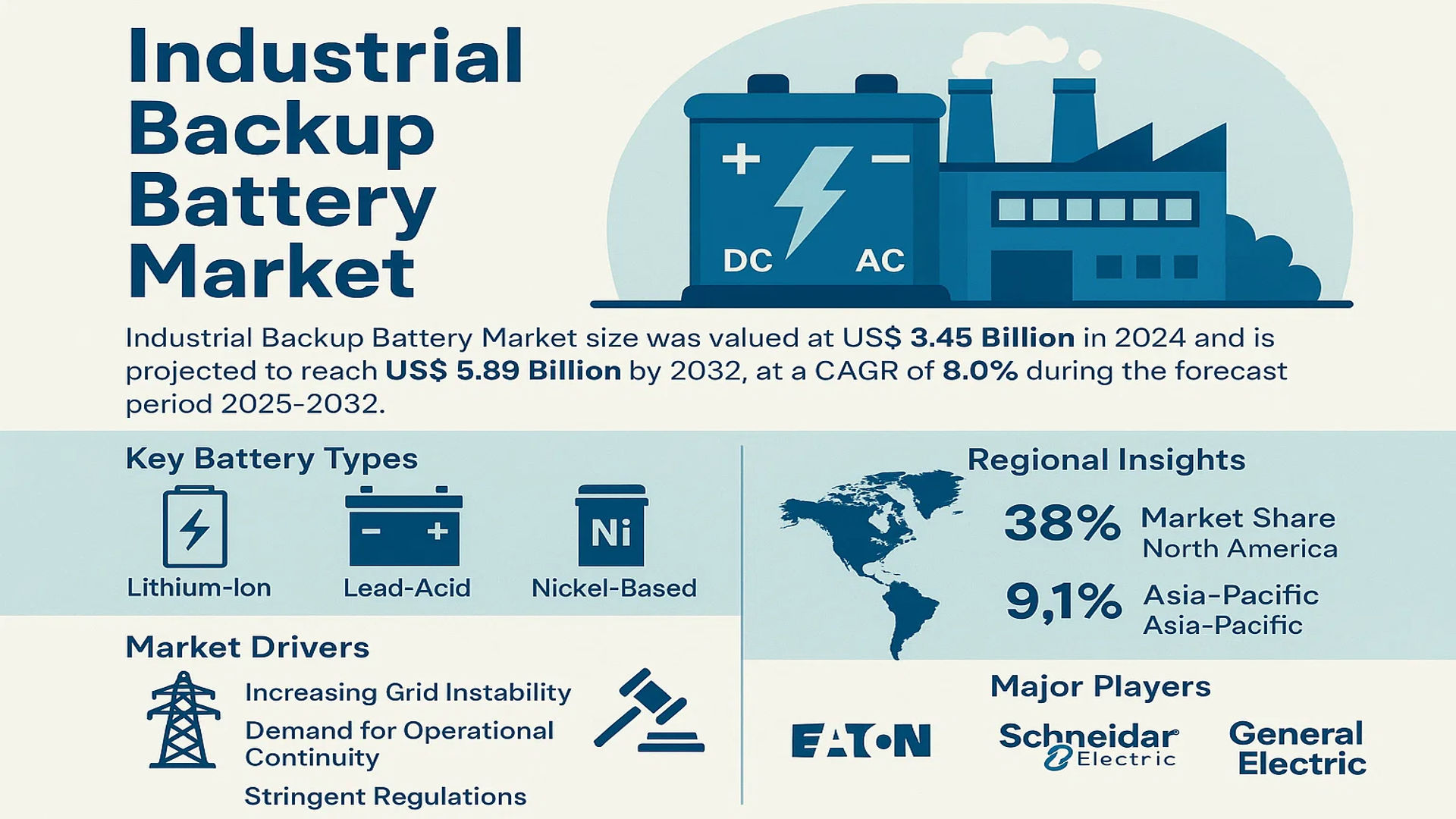
The global Industrial Backup Battery Market size was valued at US$ 3.45 billion in 2024 and is projected to reach US$ 5.89 billion by 2032, at a CAGR of 8.0% during the forecast period 2025-2032.
Industrial backup batteries are critical power storage solutions designed to ensure uninterrupted operations during electrical outages. These systems store energy in either DC (direct current) or AC (alternating current) formats and are widely deployed across industries such as petroleum, chemicals, and power generation. Key battery types include lithium-ion, lead-acid, and nickel-based solutions, each offering distinct advantages in terms of energy density, lifecycle, and maintenance requirements.
The market growth is primarily driven by increasing grid instability, rising demand for operational continuity in critical industries, and stringent regulations regarding power reliability. While North America currently dominates with 38% market share due to advanced infrastructure, Asia-Pacific is projected to witness the fastest growth at 9.1% CAGR through 2032, fueled by rapid industrialization. Major players like EATON, Schneider Electric, and General Electric are expanding their product portfolios with advanced lithium-ion solutions, reflecting the industry’s shift toward higher efficiency technologies.
MARKET DYNAMICS
MARKET DRIVERS
Increasing Industrial Automation to Fuel Adoption of Backup Battery Systems
The global push towards Industry 4.0 and smart factories is significantly driving demand for industrial backup batteries. As manufacturing facilities adopt automated systems and IoT-enabled devices, the need for uninterrupted power becomes critical to prevent costly downtime. Even brief power interruptions can lead to production losses exceeding millions of dollars in capital-intensive industries. The industrial automation market is projected to grow at an impressive rate over the next decade, directly correlating with increased backup battery installations to protect sensitive equipment and maintain operational continuity.
Stricter Data Protection Regulations Accelerate Market Growth
Modern industrial facilities generate vast amounts of critical operational data that must be preserved during power outages. Regulations in sectors like oil & gas, pharmaceuticals, and food processing now mandate data integrity protocols that require reliable backup power solutions. Industrial backup batteries have become essential compliance tools, with their adoption growing particularly in regions with stringent industrial safety and environmental protection laws. Recent updates to industrial safety standards in Europe and North America have specifically addressed power backup requirements for process control systems.
Renewable Energy Integration Creates New Demand
The transition to renewable energy sources presents both challenges and opportunities for the industrial backup battery market. While renewable power reduces carbon footprints, its intermittent nature creates demand for reliable energy storage solutions. Many industrial facilities are implementing hybrid power systems combining renewable generation with backup battery storage to ensure uninterrupted operations. This trend is particularly evident in regions with ambitious decarbonization goals, where industrial operators must maintain reliability while meeting sustainability targets.
➤ Approximately 40% of new industrial facility designs now incorporate integrated backup power solutions as part of their energy management systems.
MARKET RESTRAINTS
High Initial Costs Limit Adoption in Developing Regions
While industrial backup batteries offer significant operational benefits, their upfront costs remain prohibitive for many small and medium-sized enterprises, particularly in emerging markets. Advanced lithium-ion systems, while high-performing, require substantial capital investment that may not align with shorter-term budgeting cycles. This financial barrier slows market penetration in price-sensitive regions, where operations often prioritize immediate costs over long-term reliability investments.
Supply Chain Disruptions Impact Market Stability
The industrial backup battery market faces constraints from ongoing global supply chain challenges affecting critical raw material availability. Lithium, cobalt, and other key battery components experience periodic shortages and price volatility, making long-term planning difficult for manufacturers. These disruptions have led to extended lead times for some industrial-scale battery systems, particularly those requiring custom configurations. While the situation has improved from pandemic-era strains, the market continues to navigate materials sourcing challenges that impact both pricing and delivery timelines.
Technical Limitations in Extreme Environments
Industrial applications often involve harsh operating conditions that challenge conventional battery technologies. High-temperature environments common in manufacturing, mining, and oilfield operations can significantly reduce battery lifespan and performance. While specialized high-temperature battery solutions exist, they typically command premium pricing and may still require additional cooling infrastructure. These technical constraints limit optimal deployment scenarios for industrial backup systems in certain vertical markets.
MARKET OPPORTUNITIES
Emerging Battery Technologies Create New Market Potential
Technological advancements in battery chemistry present significant growth opportunities for the industrial sector. Solid-state batteries and advanced flow battery systems offer potential solutions to many current limitations, including improved safety, longer lifespans, and better performance in extreme conditions. As these technologies mature and scale, they are expected to open new application areas for industrial backup power, particularly in mission-critical environments where conventional batteries fall short.
Microgrid Expansion Drives Demand for Industrial Storage
The growing adoption of industrial microgrids creates substantial opportunities for backup battery integration. Modern microgrid designs increasingly incorporate energy storage as a core component rather than just a backup solution. This shift reflects the evolving role of batteries from emergency power sources to active grid management tools that provide frequency regulation and demand charge reduction. Industrial facilities with microgrid capabilities can achieve both reliability improvements and operational cost savings, making battery investments more financially attractive.
Retrofit Market Presents Untapped Potential
While new facility construction drives much backup battery demand, the retrofit market for existing industrial plants represents a significant growth opportunity. Many older facilities still rely on outdated backup solutions or lack proper power protection entirely. As plant managers recognize the risks of insufficient power backup and the potential return on investment from modernization, retrofits are becoming an increasingly important market segment. This trend is particularly strong in industries with aging infrastructure facing reliability challenges.
INDUSTRIAL BACKUP BATTERY MARKET TRENDS
Increasing Demand for Uninterrupted Power Solutions Drives Market Expansion
The global industrial backup battery market is experiencing robust growth due to rising demand for uninterrupted power supply (UPS) solutions across critical industries. With the market valued at millions in 2024, projections indicate it will reach millions by 2032, growing at a CAGR of % during the forecast period. The need for reliable energy storage has intensified as industries prioritize operational continuity, especially in sectors like petroleum, electric power, and chemical processing, where power disruptions can lead to significant financial and safety risks. The increasing frequency of grid instability and extreme weather events has further accelerated adoption, with backup batteries now viewed as essential risk mitigation tools.
Other Trends
Shift Toward Lithium-Ion Technology
While traditional lead-acid batteries still dominate due to cost-effectiveness, lithium-ion alternatives are gaining traction for their higher energy density, longer lifespan, and reduced maintenance. The DC industrial backup battery segment, in particular, is projected to grow at % CAGR over the next six years, driven by compatibility with renewable energy systems and scalable industrial applications. Increasing R&D investments in solid-state battery technology further highlight the industry’s commitment to efficiency and safety, with prototypes already demonstrating faster charging cycles and improved thermal stability.
Decentralized Energy Storage Systems Reshape Industry Needs
The expansion of microgrids and distributed energy resources (DERs) is transforming backup power requirements, with industries adopting modular battery solutions for localized energy resilience. Data centers and telecommunications sectors contribute significantly to this trend, where high-capacity lithium batteries ensure near-zero downtime during outages. Recent strategic partnerships among key players like Eaton, Schneider Electric, and General Electric focus on integrated power management systems, combining backup batteries with AI-driven predictive analytics for optimized performance. Meanwhile, regulatory pressures to reduce carbon footprints are pushing manufacturers toward recyclable battery components, aligning with global ESG (Environmental, Social, Governance) initiatives.
COMPETITIVE LANDSCAPE
Key Industry Players
Market Leaders Invest in Innovation to Secure Industrial Energy Reliability
The global Industrial Backup Battery market exhibits a semi-consolidated structure, where established multinational corporations compete with specialized regional players. EATON and Schneider Electric dominate the market, collectively holding over 25% revenue share in 2024. Their leadership stems from comprehensive product portfolios spanning lithium-ion, nickel-cadmium, and advanced lead-acid battery solutions for industrial applications.
Tadiran Batteries and Emerson have carved significant niches in ruggedized battery systems for extreme environments—particularly in oil & gas and marine applications. These companies continue to gain traction through modular battery architectures that allow flexible capacity scaling, addressing the growing demand from data centers and smart manufacturing facilities.
The market sees increasing competition from Asian manufacturers like Toshiba, which leverage cost efficiencies in lithium battery production. Recent expansions in Southeast Asian manufacturing hubs are enabling these players to compete more aggressively in price-sensitive markets while maintaining compliance with international safety standards such as UL 1973 and IEC 62619.
Strategic movements in 2024 include Schneider Electric’s acquisition of battery management software firm Zincio to enhance its EcoStruxure platform, while General Electric launched its Duration HD series with hybrid lithium-iron-phosphate chemistry, achieving 20% longer cycle life than previous models.
List of Key Industrial Backup Battery Manufacturers
- EATON Corporation (Ireland)
- Schneider Electric (France)
- Emerson Electric Co. (U.S.)
- Tadiran Batteries GmbH (Germany)
- General Electric (U.S.)
- CyberPower Systems (Taiwan)
- Alpine Power Systems (U.S.)
- Benning Power Electronics (Germany)
- Toshiba Infrastructure Systems (Japan)
- Socomec Group (France)
The competitive intensity continues to rise as companies develop battery-as-a-service models and integrated microgrid solutions. Market participants are increasingly focusing on total cost of ownership rather than upfront pricing, with warranties extending to 10 years for premium lithium systems. While North American and European firms lead in technological innovation, Asian manufacturers are rapidly closing the gap through strategic partnerships with raw material suppliers and local grid operators.
Segment Analysis:
By Type
DC Industrial Backup Battery Segment Leads Due to High Efficiency in Critical Power Applications
The market is segmented based on type into:
- DC Industrial Backup Battery
- AC Industrial Backup Battery
By Power Rating
High-Capacity Batteries Gain Traction for Industrial-Scale Power Requirements
The market is segmented based on power rating into:
- Low Capacity (<10kWh)
- Medium Capacity (10-100kWh)
- High Capacity (>100kWh)
By Application
Electric Power Industry Segment Dominates With Rising Demand for Grid Stability
The market is segmented based on application into:
- Petroleum Industry
- Chemical Industry
- Electric Power Industry
- Other Industrial Applications
By Battery Technology
Lithium-ion Technology Preferred for Its Superior Energy Density and Longevity
The market is segmented based on battery technology into:
- Lead-Acid Batteries
- Lithium-Ion Batteries
- Nickel-Cadmium Batteries
- Flow Batteries
- Other Advanced Technologies
Regional Analysis: Industrial Backup Battery Market
Asia-Pacific
The Asia-Pacific region dominates the global Industrial Backup Battery market, driven by rapid industrialization and substantial investments in critical infrastructure. Countries such as China, India, and Japan are leading contributors due to expanding manufacturing sectors, power grid modernization initiatives, and rising demand for uninterrupted power supply solutions. China alone accounts for over 35% of the regional market share, supported by government policies promoting energy resilience and smart manufacturing. While lithium-ion batteries are gaining traction, lead-acid variants remain prevalent in cost-sensitive industries. The region’s growth is further propelled by increasing data center deployments and telecom sector expansions.
North America
North America is a mature yet innovation-driven market, with the U.S. contributing over 60% of regional revenue. Stringent regulations, such as NFPA 110 for emergency power systems, and the need for grid stability amid rising extreme weather events are key demand drivers. The region favors high-efficiency lithium-ion and nickel-cadmium batteries for industrial applications, particularly in data centers, healthcare, and oil & gas sectors. Government incentives for renewable energy integration and microgrid projects are accelerating adoption. However, supply chain disruptions and raw material shortages pose short-term challenges for manufacturers.
Europe
Europe’s market is characterized by strict energy efficiency directives (e.g., EU Battery Regulation) and a strong focus on sustainability. Germany and France lead in adopting advanced battery technologies, with growing demand from the renewable energy and automotive sectors. The region is transitioning toward green backup solutions, including recycled-material batteries and second-life energy storage systems. Investments in offshore wind farms and industrial IoT are creating opportunities for decentralized backup power solutions. Nevertheless, high production costs and complex regulatory frameworks moderate growth compared to Asia-Pacific.
Middle East & Africa
This region shows nascent but accelerating growth, driven by infrastructure development in GCC countries and increasing power reliability concerns. The oil & gas industry remains the primary end-user, with investments in refinery expansions fueling demand for explosion-proof backup systems. South Africa and UAE are emerging as key markets, though adoption rates lag due to limited local manufacturing and dependence on imports. Hybrid solar-battery systems are gaining popularity as governments push for energy diversification. Market potential is high, but economic volatility and underdeveloped grid infrastructure hinder rapid expansion.
South America
South America’s market growth is uneven but promising, with Brazil and Chile as focal points. Mining operations and renewable energy projects are driving demand for rugged backup solutions capable of extreme condition operation. However, currency fluctuations, political instability, and lack of standardized regulations suppress broader adoption. The region shows increasing interest in modular battery systems that offer scalability for small-to-mid-sized industries, yet cost sensitivity remains a persistent challenge for premium product penetration.
Report Scope
This market research report provides a comprehensive analysis of the global and regional Industrial Backup Battery markets, covering the forecast period 2024–2032. It offers detailed insights into market dynamics, technological advancements, competitive landscape, and key trends shaping the industry.
Key focus areas of the report include:
- Market Size & Forecast: Historical data and future projections for revenue, unit shipments, and market value across major regions and segments. The global Industrial Backup Battery market was valued at US$ 3.45 billion in 2024 and is projected to reach US$ 5.89 billion by 2032.
- Segmentation Analysis: Detailed breakdown by product type (DC and AC Industrial Backup Batteries), application (Petroleum, Chemical, Electric Power industries), and end-user industry to identify high-growth segments and investment opportunities.
- Regional Outlook: Insights into market performance across North America, Europe, Asia-Pacific, Latin America, and the Middle East & Africa, including country-level analysis where relevant. The U.S. market size is estimated at USD million in 2024, while China is projected to reach USD million.
- Competitive Landscape: Profiles of leading market participants including Tadiran Batteries, EATON, Schneider-Electric, and General Electric, covering their product offerings, R&D focus, manufacturing capacity, and recent developments.
- Technology Trends & Innovation: Assessment of emerging battery technologies, integration with smart grid systems, and evolving industry standards for industrial power backup solutions.
- Market Drivers & Restraints: Evaluation of factors driving market growth along with challenges, including increasing demand for uninterrupted power supply in critical industries and regulatory constraints on battery disposal.
- Stakeholder Analysis: Insights for battery manufacturers, industrial equipment providers, system integrators, and investors regarding the evolving ecosystem and strategic opportunities.
Primary and secondary research methods are employed, including interviews with industry experts, data from verified sources, and real-time market intelligence to ensure the accuracy and reliability of the insights presented.
FREQUENTLY ASKED QUESTIONS:
What is the current market size of Global Industrial Backup Battery Market?
-> Industrial Backup Battery Market size was valued at US$ 3.45 billion in 2024 and is projected to reach US$ 5.89 billion by 2032, at a CAGR of 8.0% during the forecast period 2025-2032.
Which key companies operate in Global Industrial Backup Battery Market?
-> Key players include Tadiran Batteries, EATON, Schneider-Electric, General Electric, Emerson, and Toshiba, among others.
What are the key growth drivers?
-> Key growth drivers include increasing demand for uninterrupted power supply, expansion of industrial infrastructure, and stringent regulations for power backup in critical industries.
Which region dominates the market?
-> Asia-Pacific is the fastest-growing region, while North America remains a dominant market.
What are the emerging trends?
-> Emerging trends include lithium-ion battery adoption, smart grid integration, and development of sustainable battery solutions.

Get Sample Report PDF for Exclusive Insights
Report Sample Includes
- Table of Contents
- List of Tables & Figures
- Charts, Research Methodology, and more...
 Download Sample Report PDF