Industrial AI Market Insights
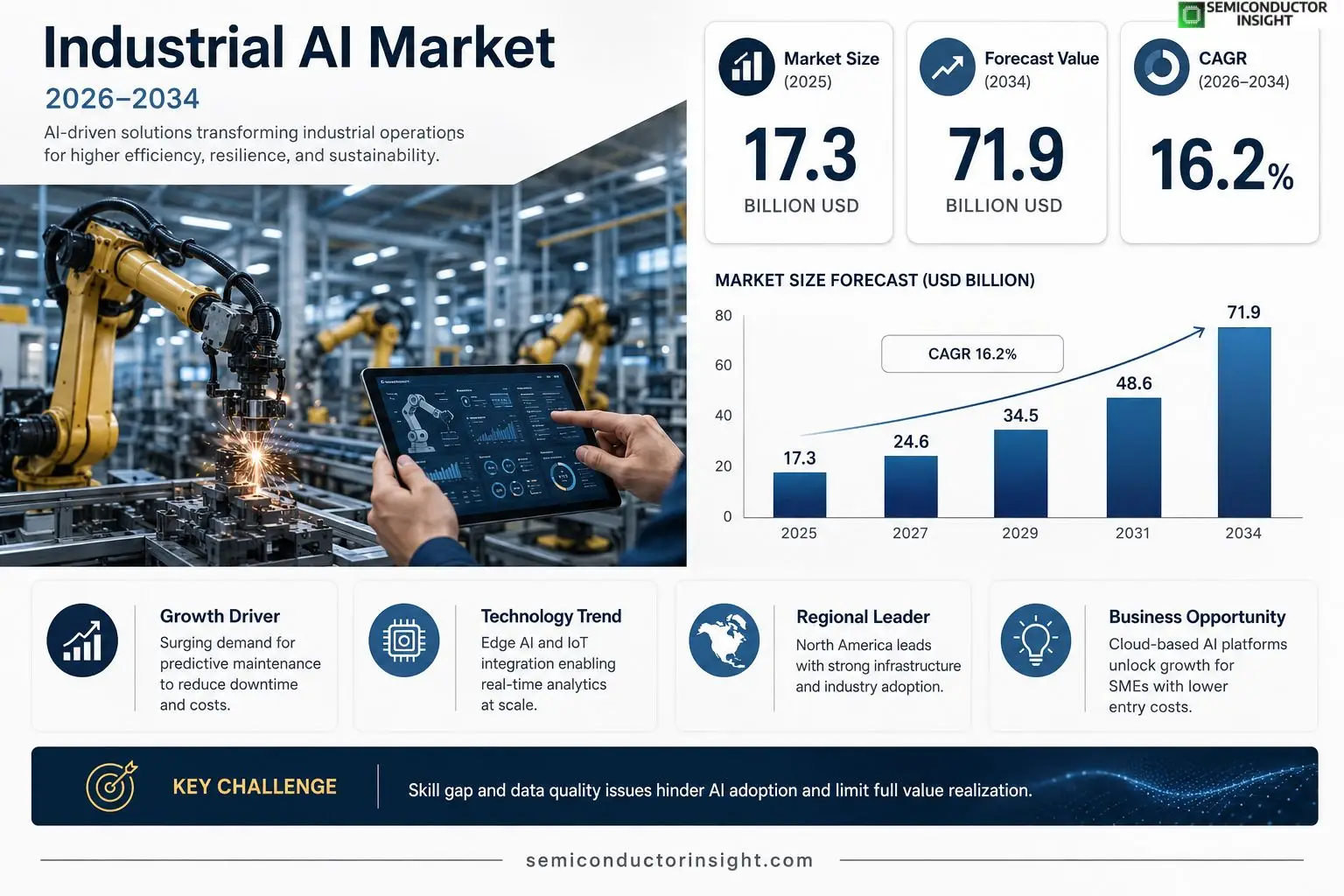
Global Industrial AI market size was valued at USD 17.3 billion in 2025. The market is projected to grow from USD 17.3 billion in 2025 to USD 71.9 billion by 2034, exhibiting a CAGR of 16.2% during the forecast period.
Industrial AI refers to the integration of artificial‑intelligence technologies,such as machine learning, computer vision, natural‑language processing and predictive analytics,into manufacturing and process‑heavy sectors. These solutions enable real‑time equipment monitoring, autonomous quality inspection, demand forecasting and energy‑optimisation across factories, refineries and supply‑chain networks.The market is experiencing rapid growth because enterprises are accelerating digital transformation initiatives while seeking higher productivity and lower carbon footprints. Moreover, expanding edge‑computing infrastructure and decreasing costs of sensor deployment are fueling adoption across traditional heavy‑industry verticals. Initiatives by leading vendors are also expected to drive expansion; for example, in March 2024 Siemens announced a strategic partnership with NVIDIA to deliver AI‑driven automation platforms for smart factories. Other key players such as ABB, GE Digital, IBM Watson IoT and Microsoft Azure Industrial IoT are continuously broadening their portfolios through acquisitions and joint ventures.
MARKET DRIVERS
Growing Adoption of Predictive Maintenance
Industrial AI Market is being propelled by manufacturers seeking to reduce unplanned downtime. Recent surveys indicate that 30% of large factories have already deployed AI‑driven predictive maintenance solutions, delivering average cost savings of 18% on maintenance budgets.
Integration with IoT and Edge Computing
Edge‑enabled AI analytics allow real‑time processing of sensor data without reliance on cloud latency. Companies that combine IoT edge devices with AI report a 25% improvement in production yield, reinforcing the momentum of Industrial AI Market.
➤ Industrial AI Market is projected to exceed $30 billion by 2030, driven by AI‑edge convergence.
Overall, the synergy between AI, IoT, and advanced robotics creates a virtuous cycle of efficiency gains, positioning Industrial AI Market for sustained growth through 2030.
MARKET CHALLENGES
Skill Gap and Workforce Readiness
Deploying AI solutions requires specialized talent. A recent industry report estimates that 45% of manufacturers lack personnel with sufficient AI expertise, leading to delayed projects and under‑utilized investments in Industrial AI Market.
Other Challenges
Data Quality Issues
Inconsistent sensor calibrations and fragmented data silos hinder model accuracy. Companies that fail to implement robust data governance see AI performance degrade by up to 15%.
MARKET RESTRAINTS
High Upfront Capital Expenditure
Initial investments for AI infrastructure, including high‑performance servers and specialized software licences, can exceed $2 million for mid‑size plants. This cost barrier slows adoption rates, particularly among capital‑constrained manufacturers, restraining the overall pace of Industrial AI Market.
MARKET OPPORTUNITIES
Emerging Opportunities in Small‑Medium Enterprises
Cloud‑based AI platforms are lowering entry costs, enabling small‑ and medium‑sized enterprises to adopt advanced analytics without large CAPEX. This democratization is expected to capture an additional 12% of the total addressable market, opening new growth avenues for Industrial AI Market through 2030.
Industrial AI Market Trends
Predictive Maintenance and Real‑Time Monitoring
Industrial AI Market is seeing a decisive shift toward predictive maintenance solutions that combine machine‑learning models with continuous sensor data streams. By analyzing vibration, temperature, and operational variables, factories can forecast equipment failures days or weeks in advance, reducing unplanned downtime by significant margins. This capability aligns with the broader digital‑transformation agenda that demands higher asset utilization while trimming operational expenditures. Vendors are integrating these models into edge gateways, allowing real‑time inference without reliance on cloud latency. As a result, manufacturers are moving from reactive break‑fix models to proactive service contracts, creating new revenue streams and improving overall equipment effectiveness across the sector.
Other Trends
Edge Computing Acceleration
Edge computing is becoming the backbone of Industrial AI Market because it addresses the latency and bandwidth challenges of processing massive industrial datasets on‑site. Modern edge nodes embed specialized AI accelerators that can execute deep‑learning inference within milliseconds, enabling immediate corrective actions on the factory floor. This architecture also enhances data security by limiting the transmission of sensitive operational information to centralized data centers. Companies are standardizing modular edge platforms that support over‑the‑air updates, ensuring that AI models remain current as new failure modes are identified. The convergence of 5G connectivity and robust edge hardware is further expanding the reach of AI into remote facilities such as oil refineries and mining sites, where traditional cloud solutions were previously impractical.
AI‑Driven Energy Optimization
Energy consumption represents a major cost driver for heavy‑industry operations, and Industrial AI Market is responding with sophisticated optimization engines that balance production schedules against real‑time energy pricing and plant constraints. By leveraging reinforcement‑learning algorithms, these systems continuously fine‑tune motor speeds, furnace temperatures, and coolant flows to achieve the lowest possible energy footprint while maintaining product quality. Integration with building‑management systems also allows factories to shift non‑critical loads to off‑peak periods, further reducing utility expenses. The measurable impact includes double‑digit percentage reductions in electricity usage and a measurable decline in carbon emissions, reinforcing the strategic importance of AI in meeting both fiscal and sustainability objectives.
COMPETITIVE LANDSCAPEKey Industry Players
Industrial AI Market Competitive Overview
Industrial AI Market is anchored by a handful of large technology manufacturers that combine deep domain expertise with AI‑centric product platforms. Siemens leads the space, leveraging its extensive automation portfolio and a strategic partnership with NVIDIA announced in March 2024 to deliver AI‑driven smart‑factory solutions. ABB and GE Digital follow closely, offering integrated AI modules for predictive maintenance and process optimization across heavy‑industry assets. IBM Watson IoT and Microsoft Azure Industrial IoT round out the core group, providing cloud‑native AI services that enable real‑time analytics and edge compute scalability. Together these incumbents shape a market structure where platform‑based ecosystems dominate, creating high entry barriers for newcomers while fostering collaborative innovation through joint ventures and acquisitions.Beyond the primary tier, a vibrant set of niche players is expanding the functional breadth of Industrial AI. Rockwell Automation and Schneider Electric focus on factory‑floor control systems enriched with computer‑vision quality inspection. Honeywell and PTC deliver specialized AI solutions for safety compliance and digital twins. SAP, Google Cloud, Amazon Web Services, Dell Technologies, Bosch, and Hitachi contribute cloud infrastructure, data‑management tools, and IoT edge hardware that complement the larger platforms. These firms differentiate through industry‑specific use cases,such as energy‑optimisation for refineries or demand‑forecasting for supply‑chain networks,enhancing overall market depth and offering customers a broader selection of best‑in‑class capabilities.
List of Key Industrial AI Companies Profiled
- Siemens
- ABB
- GE Digital
- IBM Watson IoT
- Microsoft Azure Industrial IoT
- Rockwell Automation
- Schneider Electric
- Honeywell
- PTC
- SAP
- Google Cloud
- Amazon Web Services
- Dell Technologies
- Bosch
- Hitachi
Segment Analysis:
| Segment Category | Sub-Segments | Key Insights |
| By Type |
|
Machine Learning drives the core intelligence of industrial AI solutions, offering flexible modeling capabilities that adapt to diverse operational data. Key qualitative drivers include:
|
| By Application |
|
Predictive Maintenance is the most compelling application, reshaping asset reliability strategies. Qualitative impact highlights:
|
| By End User |
|
Manufacturing remains the primary end‑user, where AI integrates tightly with shop‑floor systems. Notable qualitative observations:
|
| By Technology Infrastructure |
|
Edge Computing is emerging as the leading infrastructure choice, bringing AI closer to the data source. Key qualitative benefits:
|
| By Deployment Mode |
|
Integrated Platforms dominate the deployment landscape, offering seamless connectivity across existing industrial IT stacks. Qualitative observations include:
|
Regional Analysis: North America
North America
The manufacturing sector in North America is witnessing a significant shift towards intelligent automation. This involves implementing AI-driven systems for tasks ranging from supply chain optimization to quality inspection. The increasing adoption of robotics and computer vision powered by Industrial AI is enhancing production efficiency and reducing operational costs.
Industrial AI is revolutionizing supply chain management by enabling predictive analytics for demand forecasting, risk mitigation, and logistics optimization. AI algorithms analyze vast datasets to identify potential disruptions and optimize inventory levels, leading to enhanced resilience and cost savings.
A key application of Industrial AI is in predictive maintenance. By analyzing sensor data from machinery, AI algorithms can detect anomalies and predict potential equipment failures, enabling proactive maintenance interventions and minimizing downtime. This approach significantly improves operational reliability and reduces maintenance expenses.
Industrial AI is enhancing quality control processes through computer vision and machine learning. AI-powered systems can automatically inspect products for defects with greater accuracy and speed than traditional methods, ensuring higher quality standards and reducing waste.
Europe
Europe presents a strong and steadily growing market for Industrial AI. While perhaps not yet at the forefront of adoption as North America, the region is experiencing increasing investment and a growing awareness of the technology’s potential. The European focus often leans towards sustainable industrial practices and regulatory compliance, influencing the development and implementation of Industrial AI solutions. Key industries driving adoption include automotive, energy, and pharmaceuticals. The availability of skilled talent and supportive government initiatives are fostering innovation and market expansion.
Asia-Pacific
Asia-Pacific is emerging as a dynamic and rapidly expanding market for Industrial AI. Driven by large-scale manufacturing operations, a growing emphasis on automation, and significant government support for technological advancements, the region is witnessing substantial investment in Industrial AI. Countries like China, Japan, and South Korea are leading the charge, with a particular focus on smart manufacturing and industrial digitalization. The availability of cost-effective talent and a large domestic market further contribute to the region’s growth potential.
South America
South America represents a developing market with considerable potential for Industrial AI adoption. While currently at an earlier stage of development compared to North America and Europe, the region is witnessing increasing interest from manufacturers seeking to improve efficiency and competitiveness. Key drivers include the need to modernize aging infrastructure and enhance productivity across various industries, including agriculture, mining, and manufacturing. Government initiatives promoting technological innovation and the availability of a growing pool of skilled professionals are expected to fuel future growth.
Middle East & Africa
The Middle East and Africa offer a promising, albeit less mature, market for Industrial AI. The region’s focus on diversifying economies and embracing digital transformation is driving adoption across sectors such as oil and gas, construction, and logistics. Investments in smart infrastructure and a growing awareness of the benefits of automation are creating opportunities for Industrial AI solutions. While challenges remain in terms of infrastructure development and talent availability, the long-term growth potential is significant.
Report Scope
This market research report provides a comprehensive analysis of the Industrial AI Market , covering the forecast period 2026–2034. It offers detailed insights into market dynamics, technological advancements, competitive landscape, and key trends shaping the industry.
Key focus areas of the report include:
- Market Overview: The report begins with an overview outlining its current market scenario, key growth indicators, and industry transformation drivers. It discusses macroeconomic factors, demand–supply balance, regulatory landscape, and the strategic role of semiconductors in powering advancements across industries such as automotive, telecommunications, consumer electronics, and industrial automation.
- Market Size & Forecast: Historical data and future projections for revenue, unit shipments, and market value across major regions and segments.
- Segmentation Analysis: Detailed breakdown by product type, technology, application, and end-user industry to identify high-growth segments and investment opportunities.
- Regional Insights: Insights into market performance across North America, Europe, Asia-Pacific, Latin America, and the Middle East & Africa, including country-level analysis where relevant.
- Competitive Landscape: Profiles of leading market participants, including their product offerings, R&D focus, manufacturing capacity, pricing strategies, and recent developments such as mergers, acquisitions, and partnerships.
- Technology Trends & Innovation: Assessment of emerging technologies, integration of AI/IoT, semiconductor design trends, fabrication techniques, and evolving industry standards.
- Market Drivers & Restraints: Evaluation of factors driving market growth along with challenges, supply chain constraints, regulatory issues, and market-entry barriers.
- Stakeholder Insights: Insights for component suppliers, OEMs, system integrators, investors, and policymakers regarding the evolving ecosystem and strategic opportunities.
Primary and secondary research methods are employed, including interviews with industry experts, data from verified sources, and real-time market intelligence to ensure the accuracy and reliability of the insights presented.
FREQUENTLY ASKED QUESTIONS:
What is the current market size of Industrial AI Market?
-> Industrial AI Market was valued at USD 17.3 billion in 2025 and is expected to reach USD 71.9 billion by 2034, reflecting a CAGR of 16.2% over the forecast period.
Which key companies operate in Industrial AI Market?
-> Key players include Siemens, NVIDIA, ABB, GE Digital, IBM Watson IoT, and Microsoft Azure Industrial IoT, among others.
What are the key growth drivers?
-> Key growth drivers include accelerated digital transformation initiatives, the pursuit of higher productivity and lower carbon footprints, expanding edge‑computing infrastructure, and decreasing costs of sensor deployment.
Which region dominates the market?
-> Regional dominance data is not specified in the provided reference material.
What are the emerging trends?
-> Emerging trends comprise AI‑driven automation platforms, increased integration of AI with edge computing, and broader adoption of predictive analytics in manufacturing and process‑heavy sectors.

Get Sample Report PDF for Exclusive Insights
Report Sample Includes
- Table of Contents
- List of Tables & Figures
- Charts, Research Methodology, and more...
 Download Sample Report PDF