Key Statistics
Key Takeaways
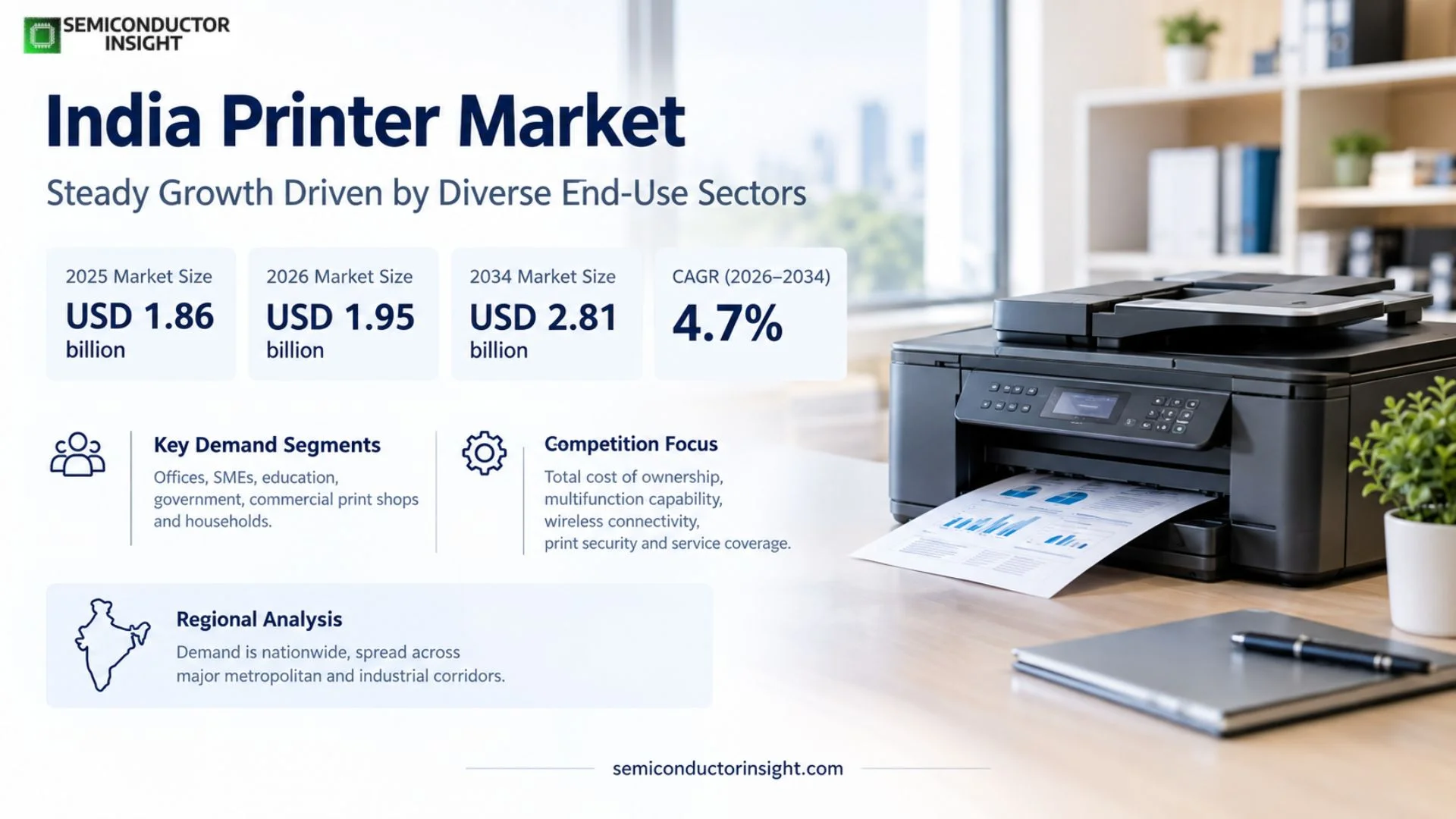
- Market size: The market stands at USD 1.86 billion in 2025 and is projected to reach USD 2.81 billion by 2034, representing a 4.7% CAGR across 2026–2034.
- Laser printers lead office-oriented demand because speed, duty cycle and cost per page remain decisive for enterprises, government offices and institutional users.
- Multifunction printers are gaining share as businesses consolidate printing, scanning and copying into a single networked device with mobile and cloud connectivity.
- Ink-tank and inkjet products remain important in home and small-business use, where lower upfront cost, color output and page-yield economics shape purchasing decisions.
- Price sensitivity remains the main restraint, making total cost of ownership, cartridge or ink yield and service reach central competitive factors.
India Printer Market Overview
India Printer Market is valued at USD 1.86 billion in 2025 and is projected to reach USD 2.81 billion by 2034, expanding at a 4.7% CAGR during 2026–2034. The 2026 market level is USD 1.95 billion. Demand is nationwide and spans offices, SMEs, education, government, commercial print shops and households. Product competition is increasingly based on total cost of ownership, multifunction capability, wireless connectivity, print security and service coverage rather than print speed alone.
The India printer market covers laser, inkjet and dot-matrix hardware sold for document, graphics and transactional printing across commercial and consumer settings. Office demand is concentrated in multifunction and monochrome laser systems, while ink-tank and inkjet products serve homes, education, small businesses and color-intensive workflows. Dot-matrix printers retain niche relevance in logistics, manufacturing and multi-part-form applications where impact printing remains useful.
Technology development is focused on connectivity, lower running cost and device consolidation. Wi-Fi, mobile printing, cloud integration and managed print features make printers part of wider document workflows rather than isolated peripherals. Vendors also compete through high-yield ink systems, toner-box designs, automatic duplexing, scanning, security and fleet-management tools. These features matter because buyers increasingly evaluate lifetime consumable cost and ease of support alongside hardware price.
India’s distribution environment is becoming more digital and geographically broad. Canon stated in January 2025 that its official e-shop could serve more than 89,000 PIN codes through authorized partners, illustrating the reach of online and hybrid channels. At the same time, enterprise and production-print sales still rely on dealers, service networks and direct account relationships because uptime, installation and consumables support are crucial to customer retention.
Segment Analysis: By Type
By type, the market is segmented into laser, inkjet and dot-matrix printers. Laser printers hold the strongest position in office and institutional environments because they combine high speed, low cost per page and robust duty cycles. Inkjet products are important for home, education, photo and small-business use, while dot-matrix printers remain specialized for continuous forms and multi-part documents.
| Type | Technical / commercial role | Market position |
|---|---|---|
| Laser Printer | Toner-based printing for offices, institutions and higher-volume document workflows. | Largest office-oriented segment; valued for speed, text quality, duty cycle and cost per page. |
| Inkjet Printer | Ink-based color printing, increasingly led by refillable ink-tank systems. | Strong in home, education, photo and SME use where color output and acquisition cost matter. |
| Dot Matrix Printer | Impact printing for multipart forms, invoices, receipts and continuous stationery. | Niche but resilient in logistics, manufacturing and legacy transactional workflows. |
Additional Segmentation: By Function
Functionality divides the market into single-function and multifunction devices. Single-function printers remain appropriate where print volume is concentrated and scanning or copying is handled elsewhere, including some production and large-format use cases. Multifunction printers combine printing, scanning and copying, reducing device count and simplifying network management. This architecture is particularly attractive for SMEs and offices seeking lower space, maintenance and procurement complexity.
| Function | Demand characteristics |
|---|---|
| Single-Function | Focused print workflows, large-format output and environments where scanning or copying is handled by separate systems. |
| Multifunction | Integrated print, scan and copy workflows; increasingly preferred in offices, SMEs and home-office environments. |
Segment Analysis: By Application
By application, office use represents the largest demand pool because corporate, government and institutional environments require regular document output, scanning and copying. Home demand is smaller but supported by education, remote work and household documentation. Commercial printing spans copy shops, photo studios, design, engineering and production-print environments where throughput, media handling and color consistency carry more weight.
| Application | Demand characteristics |
|---|---|
| Office | High-volume documents, reports, administrative output and distributed workgroup printing; laser and multifunction systems dominate. |
| Home | Education, remote work, personal documents and photo output; ink-tank and compact multifunction products are common. |
| Commercial Printing | Copy shops, graphics, production color, architecture and engineering; buyers prioritize throughput, media size and image quality. |
Additional Segmentation: By End User
End users include corporate offices, SMEs, education, government and households. Large enterprises tend to buy managed fleets and secure networked devices, while SMEs focus on acquisition cost and total page economics. Education users need affordable color and document output, government buyers emphasize procurement compliance and service reach, and home users favor compact devices with wireless printing and simple consumable management.
| End User | Commercial relevance |
|---|---|
| Corporate Offices | Managed fleets, secure printing, high duty cycles and centralized service. |
| SMEs | Cost-sensitive multifunction demand with strong focus on page yield and maintenance. |
| Education | Assignments, teaching material and administrative printing, often favoring affordable color output. |
| Government | Large installed base, tender-led procurement and emphasis on service coverage. |
| Home Users | Compact ink-tank or inkjet devices with Wi-Fi, mobile printing and simple operation. |
Regional Analysis
Because this is an India-only market, the national market is the relevant geographic unit. Demand is distributed across major metropolitan and industrial corridors rather than concentrated in one verified regional share. Western and southern business centers contribute strongly to enterprise and technology-sector demand, while northern metros and tier-2/3 cities support education, government and SME demand through expanding dealer and e-commerce coverage.
How does printer demand vary across India without relying on unsupported regional share estimates?
The market varies by customer mix. Major metros support enterprise fleets, production printing and premium devices; industrial centers retain transactional and label workflows; tier-2 and tier-3 cities are important for SMEs, education and retail-led ink-tank demand. Nationwide online access is reducing geographic constraints, but local service capability still matters for business customers that cannot tolerate printer downtime.
| Region | Position | Growth outlook | Demand profile | Supplier selection |
|---|---|---|---|---|
| West India | Major demand center | Steady | Corporate, industrial, commercial print | Dealer reach and enterprise service |
| South India | Major demand center | Steady-high | IT, education, SMEs | Connectivity, service and channel depth |
| North India | Major demand center | Steady | Government, corporate, education | Tender access and metro distribution |
| East India | Developing | Moderate | Education, government, SMEs | Affordability and service availability |
| Central / Tier-2 India | Growth corridor | Moderate-high | SMEs, education, home office | E-commerce reach and local support |
Competitive Landscape
Competition is led by global printer vendors with broad product portfolios and established Indian service networks. HP, Canon, Epson and Brother are strong across office and consumer categories, while Xerox, Ricoh, Konica Minolta, Kyocera and Toshiba are relevant in enterprise and production environments. Vendor strength is built on installed base, consumable economics, service coverage, dealer relationships and the ability to offer both single-function and multifunction systems.
Hardware pricing alone does not determine profitability. Ink, toner, drums, maintenance kits and managed-print contracts create recurring revenue over the device life. This makes page yield, cartridge availability and service quality important parts of the competitive proposition. Ink-tank systems have changed consumer and SME economics by reducing page cost, while toner-box and high-yield laser designs target similar total-cost concerns in office printing.
Digital channels are becoming more important alongside traditional dealers. Canon’s 2025 e-shop expansion and Brother’s product launches show that vendors are combining online discovery with authorized partner fulfillment. Enterprise accounts still require direct or dealer-led service, so the strongest competitive model is omnichannel: online reach for discovery and purchase, backed by local installation, consumables and technical support.
| Competitive tier | Representative companies | Primary differentiation |
|---|---|---|
| Broad consumer and office leaders | HP India, Canon India, Epson India, Brother India | Wide portfolio, brand recognition, ink/toner ecosystem and national service. |
| Enterprise and production print | Xerox, Ricoh, Konica Minolta, Kyocera, Toshiba | Managed print, production systems, document workflow and service contracts. |
| Niche / legacy workflows | Dot-matrix and specialized vendors | Transactional forms, industrial documentation and specialized output requirements. |
Key companies profiled
HP India, Canon India, Epson India, Brother International (India), Samsung India Electronics, Ricoh India, Xerox India, Konica Minolta Business Solutions India, Toshiba India and Kyocera Document Solutions India are included in the competitive scope. Product strength differs across home ink-tank, office laser, multifunction, large-format and production-print categories.
Production Capacity Analysis
Printer supply for India is a combination of imported finished units, regional assembly, consumables production and local distribution. Manufacturing capacity is less concentrated in a single domestic printer cluster than semiconductor fabrication, so effective supply depends on global component sourcing, shipping, channel inventory and local service parts. Vendors with strong forecasting and authorized partner networks can maintain availability through product refresh cycles and seasonal demand.
Consumables capacity is commercially important because ink, toner and maintenance parts determine device uptime and total cost of ownership. A hardware sale without dependable supplies can damage brand retention, especially among SMEs and enterprise customers. This makes warehouse placement, dealer stocking and e-commerce fulfillment as important to effective capacity as the number of printers a factory can assemble.
Market Dynamics
India’s printer market grows through a balance of office modernization, SME digitization, education, home use and production printing. Multifunction devices, refillable ink systems and mobile connectivity improve the value proposition, while paperless workflows and price sensitivity limit faster expansion. Competition therefore centers on total cost of ownership and service reach rather than unit specifications alone.
Market Drivers
| Driver | Impact | Commercial mechanism |
|---|---|---|
| Multifunction adoption | High | Combining print, scan and copy reduces device count and simplifies workflows. |
| SME and education demand | Medium-High | Distributed businesses and institutions need affordable color and document output. |
| Mobile and cloud printing | Medium | Wireless workflows make printers easier to integrate with laptops and smartphones. |
| Channel digitization | Medium | E-commerce extends product availability beyond large metro dealer networks. |
Multifunction devices improve office economics
Multifunction printers consolidate printing, scanning and copying into one networked device, lowering hardware count and simplifying maintenance. This is particularly attractive to SMEs and branch offices that need broad capability without dedicated print rooms. Automatic duplexing, wireless connectivity and document scanning also help devices fit modern mixed digital-paper workflows.
SMEs and education sustain distributed demand
India’s large SME and education base creates demand outside enterprise headquarters. These buyers often need reliable document output but operate under tighter budgets, so page yield and consumable cost matter as much as device price. Ink-tank systems and compact multifunction printers are well suited to this segment because they combine versatility with relatively low running cost.
Wireless and mobile workflows reduce friction
Wi-Fi, mobile apps and cloud printing let users print from laptops, smartphones and shared networks without dedicated cabling. The feature is particularly relevant for home offices, small businesses and education environments where users move between devices. Connectivity also supports remote administration and can improve printer utilization across workgroups.
Online distribution broadens national reach
Authorized e-commerce allows vendors to serve customers outside the largest cities while maintaining control over genuine products and warranty channels. Canon’s 2025 e-shop announcement cited reach across more than 89,000 PIN codes. The commercial opportunity is strongest when online ordering is paired with local service and readily available consumables.
Market Restraints
| Restraint | Impact | Commercial consequence |
|---|---|---|
| Price sensitivity | High | Budget-conscious buyers may defer upgrades or choose entry-level devices. |
| Digitization / paperless workflows | Medium-High | Electronic documents reduce routine office print volumes. |
| Consumable cost | Medium-High | High ink or toner costs can suppress usage and encourage third-party supplies. |
| Service gaps | Medium | Poor local maintenance coverage can reduce adoption outside major cities. |
Price sensitivity limits premium adoption
Many households and small businesses prioritize purchase price, creating resistance to premium enterprise features or faster devices. Vendors must demonstrate lower total cost through page yield, durability and bundled functionality. Without that value case, buyers may choose lower-specification devices even when productivity would improve with a higher-end model.
Digital workflows reduce some document printing
Electronic signatures, cloud collaboration, digital billing and document-management systems reduce the need for routine office printing. This does not eliminate printers, but it changes usage toward fewer, more capable shared devices. Vendors must therefore sell workflow value, scanning and security rather than relying on historical page volumes.
Consumables can undermine the hardware value proposition
Customers often judge printers by ink or toner expense after purchase. Expensive cartridges can reduce usage, encourage third-party alternatives and weaken brand loyalty. High-yield ink tanks, toner-box designs and subscription or managed-print models respond to this issue by making operating cost more predictable.
Service quality matters outside metropolitan areas
Printers are mechanical devices that require cleaning, replacement parts and occasional repair. Outside major cities, long service times can push customers toward brands with stronger dealer coverage even if another model has better specifications. Expanding e-commerce therefore needs to be matched by after-sales support and parts availability.
Market Opportunities
High-yield ink-tank systems
Refillable ink-tank products address price-sensitive home, education and SME customers by reducing running cost without sacrificing color capability. Vendors can build recurring revenue through genuine ink while using page-yield economics as the main sales message.
Managed print for SMEs
Managed print has historically focused on large enterprises, but cloud fleet tools and standardized multifunction devices make smaller managed-service packages viable. Dealers can bundle hardware, toner, maintenance and usage monitoring into predictable monthly costs for SMEs.
Large-format and production printing
Architecture, engineering, construction, graphics and commercial print shops need larger media sizes, high throughput and color consistency. Canon’s 2025 large-format launches illustrate ongoing product investment in these professional segments.
Tier-2 and tier-3 channel expansion
Online purchasing and better logistics create a route to customers beyond the largest metros. Brands that combine digital reach with authorized local service can grow installed base without relying exclusively on traditional high-cost retail footprints.
Supply Chain Analysis
Components. Printers depend on printheads or laser engines, motors, controllers, sensors, displays and networking components. Supply continuity matters because product platforms may remain in the market for several years, and shortages in electronics or printhead components can affect availability across multiple models.
Assembly and consumables. Finished printers combine mechanical assemblies with ink or toner systems and embedded software. Consumables are strategically important because they generate recurring revenue and shape customer perception of total cost. High-yield tanks and cartridges therefore influence both product design and channel economics.
Distribution. National distributors, authorized dealers, corporate resellers and e-commerce platforms all participate in India. Consumer and SME demand can move online, while enterprise and production-print customers still require consultation, installation and service. Inventory placement near major demand centers reduces lead times and protects sales during peak periods.
End users. Offices, SMEs, educational institutions, government buyers, commercial print shops and households buy printers for different workloads. Vendors that map device duty cycle, color needs, media size and connectivity to each use case can reduce mis-selling and improve long-term consumable and service revenue.
Recent Developments in the India Printer Market
Developments tracked through September 2026. Entries are limited to events that materially affect product capability, manufacturing capacity, customer adoption, channel access or the competitive structure of the market.
- 10 September 2025
Brother International India launched six high-efficiency ink-tank printers aimed at home users, office professionals and small businesses, emphasizing affordability, connectivity and compact use. The launch strengthens competition in the high-page-yield consumer and SME segment. Source - 22 January 2025
Canon India launched seven large-format imagePROGRAF printers for graphic design, architecture, engineering, construction and other professional output environments. The range includes single-function and multifunction configurations and targets higher productivity. Source - 20 January 2025
Canon India launched its official e-shop with authorized partners and stated that it could serve customers across more than 89,000 PIN codes. The channel expansion improves national access to printers, accessories and genuine supplies. Source
Report Scope & Segmentation
| Attribute | Scope |
|---|---|
| Base year | 2025 |
| Estimated year | 2026 |
| Forecast period | 2026–2034 |
| 2025 market size | USD 1.86 billion |
| 2026 estimated size | USD 1.95 billion |
| 2034 projected size | USD 2.81 billion |
| CAGR (2026–2034) | 4.7% |
| Largest market in 2025 | India (National Market) |
| By Type | Laser Printer; Inkjet Printer; Dot Matrix Printer |
| By Application | Office; Home; Commercial Printing |
| By Function | Single-Function; Multifunction |
| By End User | Corporate Offices; SMEs; Education; Government; Home Users |
| Companies profiled | HP India; Canon India; Epson India; Brother India; Samsung India Electronics; Ricoh India; Xerox India; Konica Minolta India; Toshiba India; Kyocera Document Solutions India |
Frequently Asked Questions
What is the India printer market size in 2025?
The India printer market is valued at USD 1.86 billion in 2025. Demand covers laser, inkjet and dot-matrix printers used by offices, households, commercial print providers, educational institutions, government organizations and small businesses.
What is the India printer market forecast for 2034?
The market is projected to reach USD 2.81 billion by 2034, representing a 4.7% CAGR during 2026–2034. The corresponding 2026 market level is USD 1.95 billion.
Which printer type leads in India?
Laser printers lead office-oriented demand because they provide fast output, strong text quality, higher duty cycles and competitive cost per page. Ink-tank and inkjet systems remain important for homes, education, color output and smaller businesses.
What is driving multifunction printer demand?
Multifunction devices combine printing, scanning and copying, reducing device count and simplifying office workflows. Wi-Fi, mobile printing and automatic duplexing further increase their value for SMEs, branch offices and home users.
How important are ink-tank printers?
Ink-tank printers are important in price-sensitive markets because refillable systems can lower running cost for frequent color printing. They are well suited to households, education and SMEs that want lower page costs without moving to laser technology.
What is the biggest restraint on the India printer market?
Price sensitivity is the main restraint. Buyers often focus on acquisition cost and consumable expense, which can delay upgrades or shift demand toward entry-level models. Paperless workflows also reduce routine office printing.
How is e-commerce changing printer sales in India?
Authorized e-commerce expands geographic reach beyond major cities and improves access to genuine devices and supplies. Vendors still need local service because business customers require installation, maintenance and fast resolution of downtime.
Which end users generate the most demand?
Corporate offices, SMEs, education and government create broad institutional demand, while households support ink-tank and compact multifunction sales. Commercial print shops add a separate professional segment for production and large-format equipment.
Who are the major printer companies in India?
Major companies include HP, Canon, Epson, Brother, Ricoh, Xerox, Konica Minolta, Toshiba and Kyocera, with product strengths spanning consumer ink-tank, office laser, multifunction, large-format and production printing.
What will determine market growth through 2034?
Growth will depend on multifunction adoption, SME digitization, education and home-office demand, lower consumable costs, mobile connectivity and channel expansion into tier-2 and tier-3 cities. Paperless workflows will keep overall growth moderate rather than explosive.
Research Sources & Evidence Base
View research sources used in this market overview
- Brother International India – Brother International India unveils six ink tank printers. India product launch and target-use evidence, September 2025.
- Canon India – Canon India launches Seven Large Format Printers. Large-format product and professional application evidence, January 2025.
- Canon India – Canon India Launches Its Official e-Shop. Distribution reach across more than 89,000 PIN codes, January 2025.

Get Sample Report PDF for Exclusive Insights
Report Sample Includes
- Table of Contents
- List of Tables & Figures
- Charts, Research Methodology, and more...
 Download Sample Report PDF