Monochrome LED Market Insights
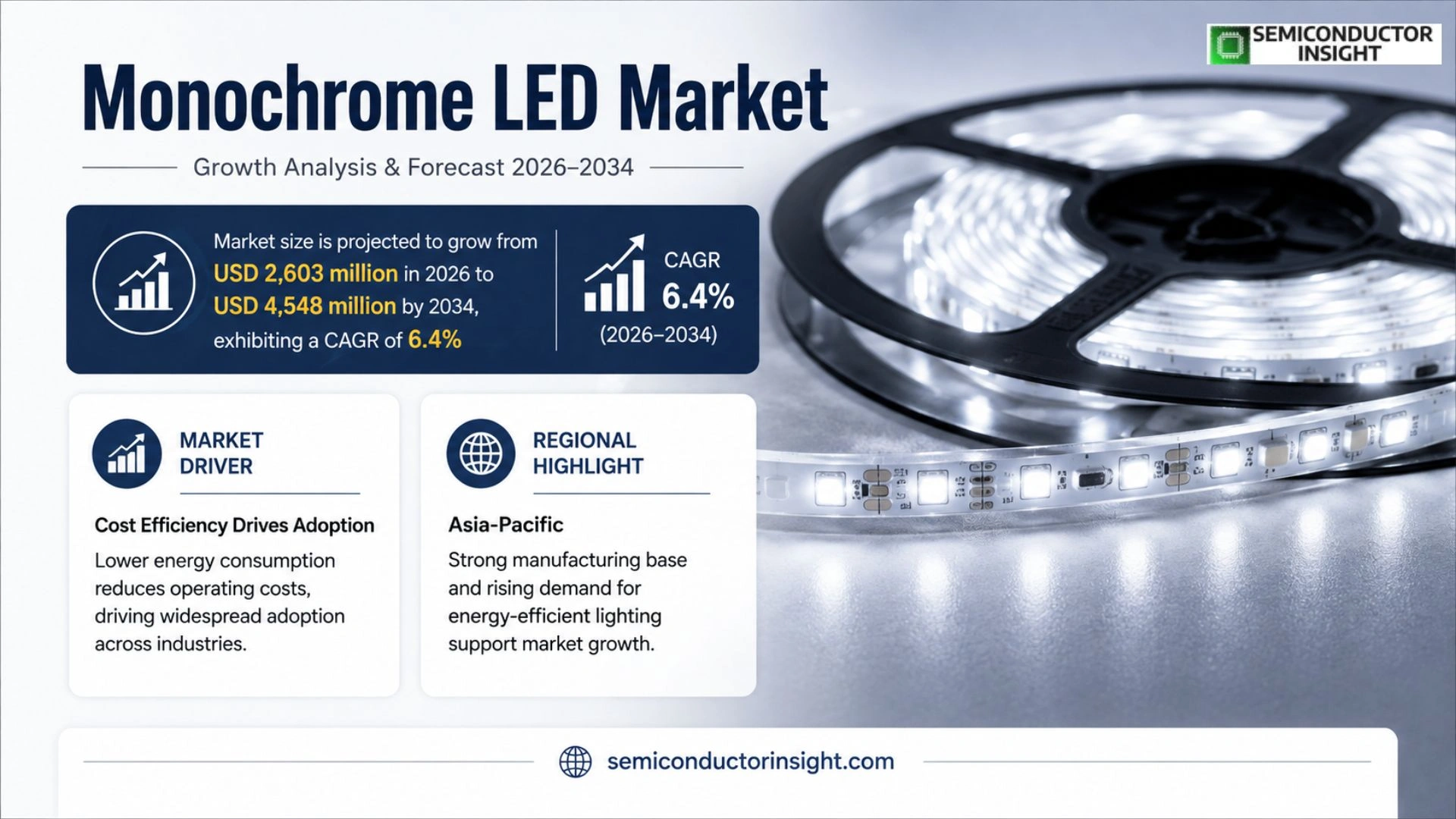
Monochrome LED market size is projected to grow from USD 2,603 million in 2026 to USD 4,548 million by 2034, exhibiting a CAGR of 6.4% during the forecast period.
Monochrome LEDs are semiconductor light‑emitting diodes that emit only one fixed wavelength (color) of light within a single device or package. Their output spectrum concentrates within a dominant wavelength range such as red, green, blue, amber or yellow, and they lack multi‑chip color mixing or white‑light conversion functions; this distinguishes them from RGB LEDs, tunable LEDs and white LEDs. In 2025 global production reached approximately 4.75 billion units and unit pricing typically spans $0.20‑$1.2020 depending on specifications.
MARKET DRIVERS
Cost Efficiency Drives Adoption
The transition from incandescent and fluorescent sources to monochrome LEDs has been accelerated by their markedly lower operating expense. Energy bills for industrial lighting contracts shrink by an average of 30 percent, providing manufacturers with a compelling financial incentive to replace legacy fixtures. In regions where utility tariffs climbed by double‑digit rates in 2023, plant managers report a clear shift toward the more economical monochrome solution.
Industrial Automation Integration
Modern production lines rely on high‑speed visual feedback; monochrome LEDs offer rapid rise times and a consistent spectral output that aligns with machine‑vision sensors. This technical harmony reduces calibration cycles, which translates into higher equipment uptime. As factories push toward 24/7 operation, the reliability of a single‑wavelength light source becomes a decisive factor.
➤ Monochrome LEDs deliver up to 30 % lower power consumption than comparable multicolor modules, a boost that directly improves bottom‑line profitability.
Collectively, these forces have nudged Monochrome LED market past the $2 billion mark in 2023, setting a solid foundation for continued expansion as cost‑sensitive sectors modernize their lighting infrastructure.
MARKET CHALLENGES
Limited Color Flexibility
Unlike RGB or full‑spectrum LEDs, monochrome devices emit a single hue, confining their use to applications where color rendering is non‑essential. This restriction curtails market penetration in retail or decorative lighting, where visual aesthetics dominate purchasing decisions.
Other Challenges
Supply‑Chain Volatility
The semiconductor components that underpin LED manufacturing have experienced periodic shortages, inflating unit costs by roughly 12 percent during the 2022‑2023 period. Firms that lack diversified sourcing strategies may encounter lead‑time extensions that erode their competitive edge.
MARKET RESTRAINTS
Regulatory Hurdles
Stringent certification requirements in the European Union demand compliance with the Ecodesign Directive, which imposes minimum efficacy thresholds. Achieving these standards often necessitates redesign of driver circuitry, adding to development overhead.
In North America, emerging state‑level lighting ordinances mandate higher lumen‑per‑watt ratios, pressuring manufacturers to invest in advanced phosphor technologies. Companies that cannot meet these benchmarks risk exclusion from key public‑sector contracts.
Furthermore, the need to document lifecycle and recyclability metrics under various environmental regulations adds administrative complexity, especially for smaller suppliers lacking dedicated compliance teams.
MARKET OPPORTUNITIES
Emerging Applications in Edge Computing
Edge‑computing nodes increasingly incorporate status indicators and low‑power visual cues. Monochrome LEDs, with their minimal heat output and precise intensity control, fit seamlessly into these compact enclosures, opening a niche that blends hardware reliability with information display.
The rise of smart‑city initiatives also creates a platform for monochrome lighting in traffic signaling and environmental monitoring stations, where durability and low maintenance outweigh the need for color variation. Early adopters are already reporting reduced service intervals and a measurable decline in municipal energy expenditures.
Finally, the ongoing miniaturization of medical diagnostic equipment presents a forward‑looking avenue. Monochrome LEDs can be integrated into point‑of‑care devices to provide consistent illumination for optical sensors, a capability that may accelerate R&D investment in Monochrome LED market over the next few years.
Monochrome LED Market Trends
Automotive Integration Accelerates Demand
Vehicle manufacturers are embedding monochrome LEDs in door‑panel buttons, ambient lighting strips, and external signal units to satisfy a growing appetite for cabin personalization and safety‑critical signaling. The shift toward electrified powertrains and advanced driver‑assistance systems creates a design environment where compact, single‑color emitters replace bulkier electromechanical components. Because the optical output is fixed, engineers can guarantee consistent luminous intensity across production runs, a prerequisite for regulatory compliance in brake‑light and turn‑signal applications. Manufacturers that secure automotive‑grade certifications benefit from higher gross margins,often above 30%,thanks to the additional testing, reliability validation, and supply‑chain safeguards demanded by OEMs. Consequently, Monochrome LED market is seeing a reallocation of capacity toward high‑reliability lines, a trend that reshapes supplier negotiations and elevates the strategic importance of automotive customers.
Other Trends
Industrial Digitization and Reliability Upsell
Factories upgrading to Industry 4.0 platforms rely heavily on status indicators, fault alarms, and equipment‑status panels, all of which are powered by monochrome LEDs. The devices’ narrow spectral output simplifies sensor integration, enabling precise feedback loops in automated assembly lines. As production lines become more data‑centric, the tolerance for erratic illumination shrinks, prompting a migration from generic, low‑margin parts to high‑reliability variants that can endure harsh thermal cycles and extended lifespans. This migration lifts margin bands for industrial‑grade products into the 28‑40% range, reflecting the added value of robust packaging, heat‑dissipation solutions, and stringent quality controls. Suppliers that can demonstrate repeatable performance under these conditions are positioning themselves as essential partners in the broader digital infrastructure overhaul.
Pricing Pressure and Value‑Added Segmentation
While the unit price of monochrome LEDs spans from $0.2 to $1.2, the market remains segmented by application‑specific profitability. Commodity‑grade indicators face transparent pricing, driving margins down to the lower end of the 18‑28% band. In contrast, segments that demand specialized wavelengths, high brightness, or certified reliability retain pricing power, allowing manufacturers to offset raw‑material volatility and exchange‑rate fluctuations. This stratification compels firms to tier their product portfolios: standard‑issue parts for volume‑driven consumer electronics and premium, tightly‑specified devices for automotive and industrial customers. The strategic implication is clear,companies that can balance cost‑efficient scale with differentiated, high‑margin offerings will capture the most resilient share of Monochrome LED market as cost‑down pressures intensify across the supply chain.
COMPETITIVE LANDSCAPE
Key Industry Players
Monochrome LED market – competitive hierarchy and strategic positioning
Nichia remains the preeminent supplier of monochrome LEDs, leveraging its deep expertise in gallium nitride epitaxy to command a sizable share of automotive‑grade and high‑reliability segments. The company’s ability to integrate rigorous certification processes and advanced heat‑dissipation packaging translates into premium pricing and margins that considerably outpace commodity‑grade producers. Meanwhile, the market exhibits a bifurcated structure: a thin‑margin tier populated by generic SMD manufacturers catering to consumer indicators, and a differentiated tier where specialized players extract value through material innovations, longer lifespans, and strict automotive compliance. This stratification forces larger entrants to balance volume‑driven cost efficiencies against the necessity of maintaining high‑quality supply chains for critical automotive customers.
Beyond the dominant tier, a constellation of niche firms enriches the competitive fabric. Seoul Semiconductor and Samsung LED have sharpened their focus on high‑brightness, single‑color devices for industrial signaling, carving out profitable niches despite intense price pressure. European and Japanese specialists such as ams OSRAM, Lumileds, and Everlight differentiate themselves through bespoke wavelength control and optical consistency, securing contracts with equipment manufacturers that demand exacting performance. Emerging regional players,including LITEON, Nationstar, ROHM, and Harvatek,tap domestic substitution trends, offering cost‑effective alternatives while gradually expanding into export markets. Their agility in adapting substrate materials and leveraging localized supply chains positions them as credible challengers to the incumbents.
List of Key Monochrome LED Companies Profiled
- Nichia
- ams OSRAM
- Seoul Semiconductor
- Samsung LED
- Lumileds
- Stanley Electric
- Everlight
- LITEON
- Nationstar
- ROHM
- Dominant
- Refond
- Harvatek
- Citizen
- Toyoda Gosei
Segment Analysis:
| Segment Category | Sub-Segments | Key Insights |
| By Type |
|
Surface Mount
Through Mount
Specialized Packages
|
| By Application |
|
Automotive Lighting
Industrial Indicators
Consumer Electronics
|
| By End User |
|
Automotive OEMs
Industrial Equipment Makers
Consumer Device Manufacturers
|
| By Reliability Tier |
|
Automotive‑Grade
Industrial‑Grade
Standard Grade
|
| By Distribution Channel |
|
Direct OEM Supply
Distributors and Authorized Resellers
Online Component Marketplaces
|
Regional Analysis: Monochrome LED Market
Asia-Pacific
The Asia‑Pacific landscape for Monochrome LED solutions reflects a confluence of cost‑driven manufacturing capacity and an accelerating shift toward energy‑efficient lighting across industrial and commercial premises. Production hubs in China, South Korea, and Taiwan are capitalising on mature supply chains, which depress component costs and enable manufacturers to offer competitive pricing without compromising reliability. Simultaneously, regulatory incentives in Japan and Singapore are nudging architects and facility managers toward monochrome models for back‑lit signage and display panels, thanks to their low power draw and long lifespan. These dynamics generate a self‑reinforcing loop: lower acquisition costs stimulate broader adoption, prompting OEMs to broaden their product portfolios, which in turn deepens market penetration. For downstream distributors, the implication is a need to align inventory with a widening array of form factors, while end users must evaluate total‑ownership savings against initial outlay.
Clustered fabs in the region benefit from economies of scale, allowing OEMs to iterate designs quickly and keep component pricing under pressure, a factor that sustains demand from cost‑sensitive sectors.
Energy‑efficiency standards in several APAC economies flag monochrome LEDs as preferred solutions for new construction, shaping procurement policies and driving volume growth.
Beyond signage, the market sees rising use in medical equipment displays and automotive instrument clusters, expanding the addressable base beyond traditional lighting.
Recent disruptions have spurred regional firms to invest in buffer inventories and local sourcing, reducing lead times and improving reliability for end customers.
North America
In the United States and Canada, the monochrome LED niche is largely driven by the retro‑fit market, where legacy signage and display panels are being replaced with more energy‑conscious alternatives. Utilities and municipal programs often provide rebates for upgrades, encouraging building owners to consider monochrome solutions for corridors, parking structures, and control rooms. The premium placed on aesthetic uniformity in commercial interiors also fuels demand for sleek, single‑color light sources that integrate seamlessly with modern décor. Suppliers must navigate a fragmented distribution network, balancing direct sales to large facilities with partnerships to reach smaller commercial tenants.
Europe
European adoption of monochrome LEDs is shaped by stringent environmental directives and a cultural emphasis on sustainable design. Countries such as Germany and the Netherlands prioritize lifecycle assessments, prompting architects to select luminaires that combine low energy consumption with recyclable materials. The market benefits from a mature design community that values precision lighting for retail environments and public transport hubs. However, higher labor costs and rigorous certification processes demand that manufacturers justify price points through demonstrable durability and compliance, prompting a focus on high‑quality, long‑lasting modules.
South America
Growth in Brazil, Argentina, and Chile is anchored in expanding urban infrastructure and a surge in commercial construction. Developers view monochrome LEDs as a cost‑effective way to meet lighting codes while delivering consistent illumination for storefronts and malls. Economic volatility leads buyers to favour solutions with predictable operating expenses, positioning monochrome LEDs as attractive alternatives to traditional fluorescent fixtures. Local distributors increasingly offer bundled services,including installation and maintenance,to alleviate concerns about technical expertise and component lifespan.
Middle East & Africa
In the Gulf Cooperation Council states, the push for smart‑city projects injects demand for monochrome LED panels used in wayfinding, airport terminals, and high‑rise exteriors. The region’s emphasis on iconic architecture amplifies the need for lighting that delivers both visual impact and energy efficiency. Conversely, in many African markets, limited grid reliability drives interest in low‑power, long‑lasting luminaires that can operate on auxiliary power sources. Suppliers who can adapt to variable voltage environments and provide robust after‑sales support stand to capture emerging opportunities.
Report Scope
This market research report provides a comprehensive analysis of the Monochrome LED Market , covering the forecast period 2026–2034. It offers detailed insights into market dynamics, technological advancements, competitive landscape, and key trends shaping the industry.
Key focus areas of the report include:
- Market Overview: The report begins with an overview outlining its current market scenario, key growth indicators, and industry transformation drivers. It discusses macroeconomic factors, demand–supply balance, regulatory landscape, and the strategic role of semiconductors in powering advancements across industries such as automotive, telecommunications, consumer electronics, and industrial automation.
- Market Size & Forecast: Historical data and future projections for revenue, unit shipments, and market value across major regions and segments.
- Segmentation Analysis: Detailed breakdown by product type, technology, application, and end-user industry to identify high-growth segments and investment opportunities.
- Regional Insights: Insights into market performance across North America, Europe, Asia-Pacific, Latin America, and the Middle East & Africa, including country-level analysis where relevant.
- Competitive Landscape: Profiles of leading market participants, including their product offerings, R&D focus, manufacturing capacity, pricing strategies, and recent developments such as mergers, acquisitions, and partnerships.
- Technology Trends & Innovation: Assessment of emerging technologies, integration of AI/IoT, semiconductor design trends, fabrication techniques, and evolving industry standards.
- Market Drivers & Restraints: Evaluation of factors driving market growth along with challenges, supply chain constraints, regulatory issues, and market-entry barriers.
- Stakeholder Insights: Insights for component suppliers, OEMs, system integrators, investors, and policymakers regarding the evolving ecosystem and strategic opportunities.
Primary and secondary research methods are employed, including interviews with industry experts, data from verified sources, and real-time market intelligence to ensure the accuracy and reliability of the insights presented.
FREQUENTLY ASKED QUESTIONS:
What is the current market size of Monochrome LED Market?
-> Monochrome LED market size is projected to grow from USD 2,603 million in 2026 to USD 4,548 million by 2034, exhibiting a CAGR of 6.4%
Which key companies operate in Monochrome LED Market?
-> Key players include Nichia, ams OSRAM, Seoul Semiconductor, Samsung LED, Lumileds, Stanley Electric, Everlight, LITEON, Nationstar, ROHM, Dominant, Refond, Harvatek, Citizen, Toyoda Gosei, HC SemiTek, Changelight.
What are the key growth drivers?
-> Key growth drivers include automotive interior lighting and signaling, industrial digitalization of status indicators and alarms, and the increasing demand for high‑reliability, automotive‑grade monochrome LEDs.
Which region dominates the market?
-> Asia-Pacific holds the largest share of production and consumption, driven by high manufacturing capacity and strong automotive demand, while Europe remains a significant market for high‑reliability applications.
What are the emerging trends?
-> Emerging trends include development of high‑brightness and special‑wavelength devices, migration toward automotive‑grade certification, and integration of monochrome LEDs in smart‑connected vehicle interiors.

Get Sample Report PDF for Exclusive Insights
Report Sample Includes
- Table of Contents
- List of Tables & Figures
- Charts, Research Methodology, and more...
 Download Sample Report PDF