Key Statistics
Key Takeaways
- LED monitors are the commercially dominant technology class within the report’s CRT, LCD and LED segmentation because modern monitor portfolios are overwhelmingly built around LED-backlit flat panels, while CRT is concentrated in legacy replacement niches.
- Business Series remains the most structurally resilient application because corporate refresh, IT services, financial trading, software development and multi-monitor productivity create repeat procurement that is less discretionary than premium gaming demand.
- Gaming Series is the strongest premiumization vector, with high refresh rates, low response times, adaptive synchronization, OLED/QD-OLED and larger screen sizes allowing vendors to expand value per unit even when overall unit growth is moderate.
- Domestic electronics manufacturing policy is changing the supply-side context; India’s PLI 2.0 for IT Hardware is supporting local production ecosystems, which can reduce dependence on fully imported finished products even though critical display panels and components remain globally sourced.
- Price competition, fast specification cycles and alternative screens remain the main restraints, forcing brands to manage inventory tightly and differentiate through panel quality, ergonomics, warranty, ports, gaming features and after-sales service rather than resolution alone.
India Computer Monitor Market Overview
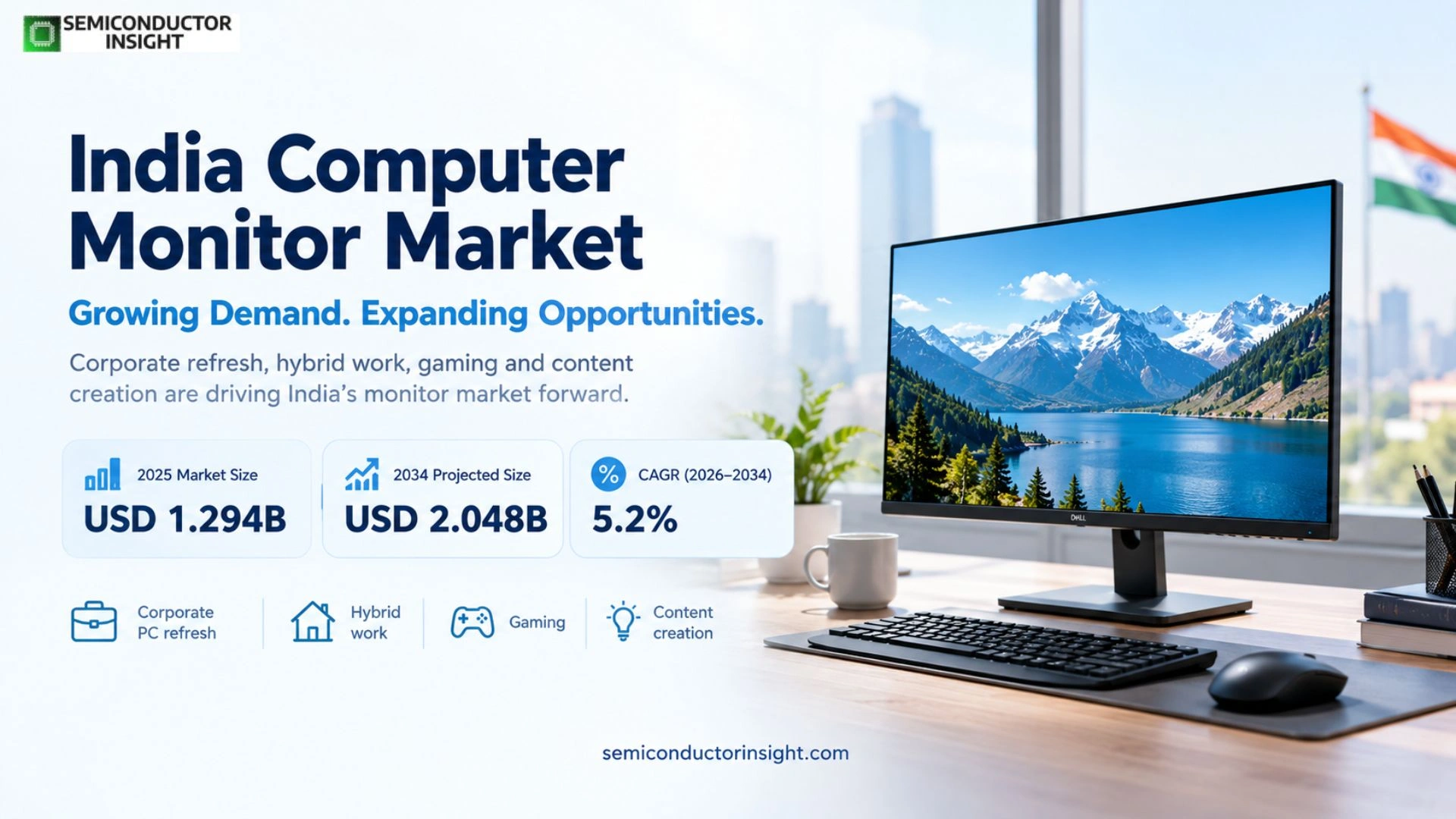
India Computer Monitor Market is rebased to USD 1.294 billion in 2025 and is projected to reach USD 2.048 billion by 2034, representing a 5.2% CAGR for 2026–2034. The market is a national India demand pool, with purchasing shaped by corporate PC refresh, hybrid work, education, gaming and content creation, while domestic IT-hardware manufacturing policy is gradually changing where final systems and related electronics are assembled.
Computer monitors are standalone visual display devices used with desktop PCs, laptops, workstations, gaming systems and specialized commercial computing environments. The report page defines the India market through CRT, LCD and LED types and through Gaming Series, Business Series and Other Series applications. Commercially, the category is no longer driven by basic screen availability alone; buyers increasingly compare panel technology, resolution, refresh rate, color performance, ergonomics, connectivity, power consumption and warranty as part of the purchase decision.
India’s demand base is broad because monitors sit across business, household, education and professional-creation environments. Corporate buyers use external displays to improve desktop productivity and to support laptop-centric hybrid-work setups. Gamers value high refresh rates and low latency, while creators and technical professionals prioritize resolution and color performance. This creates a market where unit growth can be moderate while value per unit rises through larger displays, premium panels, USB-C docking, higher refresh rates and specialized use cases.
The supply-side context is also changing. A Government of India release in February 2026 reported cumulative production of ₹16,531 crore under PLI 2.0 for IT Hardware through December 2025, with ₹856.64 crore of investment and 4,776 direct jobs. Those figures relate to the wider IT-hardware program rather than monitors alone, but they show a policy-backed expansion of domestic electronics manufacturing capability. Monitor brands can benefit through local system ecosystems, logistics and contract manufacturing even while display panels and many key components remain integrated into global supply chains.
Technology cycles remain fast. Premium monitor launches in India increasingly feature OLED or QD-OLED panels, 4K resolution, AI-enhanced smart functions and very high refresh rates. Samsung’s 2025 India launches, for example, included Odyssey gaming monitors and the M9 smart monitor, illustrating how vendors are merging monitor, entertainment and connected-device functions. The commercial implication is that category boundaries are widening: a premium monitor can compete not only on PC display performance but also on streaming, smart-home integration and console use.
Segment Analysis: By Type
By type, the report page segments the India computer monitor market into CRT, LCD and LED. The commercial center of gravity has moved decisively toward modern flat-panel LED products, while LCD remains relevant as a broad technical description across many flat-panel architectures and CRT is primarily a legacy category. The more important purchasing distinctions now occur within flat panels: panel technology, backlight, size, resolution, refresh rate, color accuracy and connectivity.
| Type | Technical / purchasing role | Market position |
|---|---|---|
| CRT | CRT monitors use cathode-ray-tube technology and are bulky, heavy and power intensive compared with modern flat panels. Their remaining demand is tied to legacy equipment, specialized replacement situations and installed systems where changing the display interface or equipment configuration is inconvenient. The technology does not align with current office, gaming or consumer preferences for thin form factors, high resolution and low power consumption. | A residual legacy segment rather than a growth engine. Suppliers and channels must manage very limited new-product availability and replacement-driven demand. Commercial relevance persists where old industrial or institutional systems remain in service, but the category faces structural decline as equipment is replaced and as repair economics deteriorate. Inventory risk is therefore higher than in current flat-panel technologies. |
| LCD | LCD represents the broad flat-panel display foundation used across a large share of monitor products. In market terminology, the category can overlap with LED-backlit monitors because most contemporary LCD panels use LED backlights. Purchasing therefore depends less on the LCD label itself and more on panel subtype, resolution, viewing angle, response time, color gamut and the electronics driving the panel. | A broad established technology base with wide coverage from entry office displays to professional products. The segment’s commercial challenge is differentiation because core LCD capability is mature. Brands create value through better panel selection, ergonomic stands, connectivity, factory calibration, warranty and channel execution. Lower-end products are exposed to intense price competition and rapid comparison across e-commerce channels. |
| LED | LED monitors in the report segmentation refer to modern flat-panel products using LED-based backlighting or related current-generation display implementations. These products deliver thin designs, lower power consumption and broad size and resolution options. Premium portfolios increasingly extend into mini-LED, OLED and QD-OLED technologies, but the report’s published type structure remains CRT, LCD and LED and is preserved here. | Commercially dominant technology class. LED-based monitor portfolios cover mainstream office, gaming and professional demand and therefore capture most active product development and retail attention. Competition ranges from low-cost Full HD models to 4K, ultrawide and high-refresh premium devices. Vendors can defend pricing when display performance is paired with docking, USB-C power delivery, smart functions or gaming-specific features. |
Pricing and specification ladder
The Indian monitor market is best understood as a specification ladder layered on top of the report’s technology categories. Entry office models compete on screen size, Full HD resolution, reliability and price; business monitors add ergonomics, docking and warranty; gaming products add refresh rate, response time and adaptive synchronization; creator and professional displays add color accuracy, higher resolution and calibration. This ladder allows vendors to raise average selling value without relying on unit growth alone, but it also creates inventory risk because a model can become less competitive quickly when higher refresh rates, better panels or new ports migrate into lower price bands.
Segment Analysis: By Application
By application, the report page lists Gaming Series, Business Series and Other Series. Business purchasing provides the most repeatable replacement demand through offices and IT services, while Gaming Series drives premiumization through high refresh rates, low latency and advanced panels. Other Series captures household, education, creator and specialized uses where screen size, resolution, color quality or cost may matter more than either gaming or enterprise specifications.
| Application | Demand characteristics |
|---|---|
| Gaming Series | Gaming monitor demand is driven by younger consumers, esports, PC gaming and streaming, with purchasing centered on refresh rate, response time, adaptive synchronization, HDR capability and panel quality. Samsung’s April 2025 India launch included high-end Odyssey models, demonstrating that vendors see room for premium 4K and OLED products. The commercial opportunity is value growth: gamers will pay for measurable responsiveness and image quality, but specification cycles are fast and inventory can age quickly. |
| Business Series | Business monitors serve corporate offices, IT services, financial institutions, software development, trading and hybrid-work users. Demand is less about extreme display performance and more about reliability, ergonomics, text clarity, multi-monitor productivity, USB-C or docking, manageable power consumption and dependable warranty service. Organizations often standardize models across fleets, creating repeat orders and longer product-life expectations. Vendors with enterprise channels and service infrastructure can therefore defend positions even when consumer retail pricing becomes aggressive. |
| Other Series | Other Series includes home computing, education, content creation and specialized professional uses. This is a heterogeneous demand pool: students may prioritize price and screen size, creators require color accuracy and resolution, and households increasingly use monitors for mixed work, streaming and console use. Samsung’s 2025 M9 smart monitor illustrates the convergence path, adding connected entertainment and AI-oriented functions. Commercially, this segment rewards clear use-case positioning because generic displays face direct price comparison. |
Regional Analysis
India is the single national market covered by the report, but demand and supply conditions differ materially across domestic clusters. South India has a particularly important electronics-manufacturing and technology-services base; North India combines the National Capital Region with manufacturing in Uttar Pradesh; West India adds financial, corporate and technology demand; East India is more distributor-led; and Central India is a smaller but expanding demand cluster. These blocks describe commercial geography rather than assigning unsupported regional revenue shares.
How do India’s domestic monitor demand clusters differ commercially?
Monitor demand follows the geography of corporate employment, IT services, education, gaming consumers, electronics manufacturing and distribution. Government PLI 2.0 data also shows approved IT-hardware applicants spread across Tamil Nadu, Uttar Pradesh, Maharashtra, Haryana and Karnataka, indicating that manufacturing and ecosystem development are not confined to one state. For monitor brands, regional performance therefore depends on channel depth, enterprise accounts, e-commerce logistics and service coverage as much as on national marketing.
| Region | Position | Growth outlook | Demand profile | What decides supplier selection |
|---|---|---|---|---|
| South India | Leading technology/manufacturing cluster | Strong | IT services + electronics production + gaming | Enterprise accounts, manufacturing ecosystem, service and e-commerce |
| North India | Large demand/manufacturing cluster | Strong | NCR corporate + Uttar Pradesh electronics | Price tiers, institutional procurement and logistics |
| West India | Large corporate/financial cluster | Steady | Finance + business + creator demand | Enterprise channel, premium mix and after-sales |
| East India | Developing demand cluster | Moderate | Value retail + education + institutional | Distribution reach, price and service availability |
| Central India | Smaller expanding cluster | Moderate | SMB + education + household computing | Dealer network, affordability and e-commerce fulfillment |
India Computer Monitor Market Competitive Landscape
The report profiles Samsung, LG, Dell, HP, Lenovo, Acer, Asus, BenQ, ViewSonic and Philips. Competition is broad rather than winner-take-all because vendors enter from different strengths: consumer electronics, PC ecosystems, gaming, enterprise channels and display specialization. The most defensible positions combine product breadth with distribution, warranty service and the ability to refresh specifications quickly without leaving channel partners with obsolete inventory.
Samsung and LG compete from a display and consumer-electronics position, allowing them to span mainstream, gaming and premium screen technologies. Samsung’s Indian monitor launches in 2024 and 2025 demonstrate an emphasis on Odyssey gaming, ViewFinity productivity and Smart Monitor convergence. This strategy gives the brand multiple price points and use cases, but also requires a wide channel and service network because product complexity rises sharply from entry office models to premium OLED gaming displays.
Dell, HP and Lenovo compete strongly where the monitor is part of a broader enterprise PC relationship. Corporate buyers value standardized configurations, multi-year availability, docking compatibility and bundled support, so the display may be procured alongside laptops, desktops or workstations rather than as an isolated consumer purchase. This channel structure creates recurring refresh demand and can reduce exposure to pure e-commerce price competition, especially for business-series models.
Acer, Asus, BenQ and ViewSonic bring strong gaming, enthusiast or display-specialist portfolios, while Philips participates across productivity and consumer segments. These vendors can win by targeting high-refresh gaming, creator color accuracy or value office products instead of matching the full portfolio of the largest brands. The competitive risk is rapid specification convergence: once a premium feature becomes common, brands must move to panel quality, software, ergonomics, warranty or price to maintain differentiation.
| Competitive tier | Companies / participants | How competition works |
|---|---|---|
| Display / consumer-electronics leaders | Samsung; LG | These brands can leverage display technology, broad consumer recognition and premium product marketing. Their portfolios extend from general productivity to gaming and smart-monitor formats, giving them multiple routes to value growth. The competitive advantage is strongest when proprietary panel access, image processing or ecosystem functions create a visible user benefit that justifies a higher selling price than commodity office monitors. |
| Enterprise PC ecosystem vendors | Dell; HP; Lenovo | Enterprise PC vendors can bundle monitors into broader fleet procurement and support contracts. Buyers value consistent availability, standardized ports, docking compatibility and service more than rapid consumer-style feature changes. This creates a more stable replacement cycle and gives these vendors access to large corporate accounts, although they still face price pressure in public tenders and standardized office configurations. |
| Gaming / specialist challengers | Acer; Asus; BenQ; ViewSonic; Philips | Specialist and gaming-oriented vendors compete through high refresh rates, response time, panel quality, ergonomics and targeted price-performance. They can move quickly into enthusiast niches but must maintain strong e-commerce visibility and channel inventory discipline. A product that is technically strong at launch can lose competitiveness rapidly when new refresh-rate or panel standards reach mainstream price points, making fast portfolio management critical. |
Key participants profiled
The report page’s profiled company list is Samsung, LG, Dell, HP, Lenovo, Acer, Asus, BenQ, ViewSonic and Philips. These companies should be interpreted by channel and product specialization rather than only by corporate scale. A PC vendor can be strongest in business procurement, a display manufacturer can lead premium panel adoption, and a gaming specialist can command enthusiast attention without having the largest overall India unit base. The common commercial requirements are local availability, clear price-tier coverage, warranty service and frequent specification refresh.
India Computer Monitor Market Production Capacity Analysis
India’s monitor supply chain is moving toward greater local electronics manufacturing capability, but final monitor economics still depend on global panels, semiconductor components, power electronics and mechanical modules. Government PLI 2.0 figures for IT Hardware show investment and production expanding across several states, which can strengthen contract manufacturing, logistics and component ecosystems around PCs and related equipment. For monitor brands, the practical question is how much local value can be added without losing access to globally competitive display panels.
A February 2026 Government of India release reported ₹16,531 crore of cumulative production under PLI 2.0 for IT Hardware through December 2025, with ₹856.64 crore of investment and 4,776 direct jobs. The program covers the broader IT-hardware ecosystem rather than monitors specifically, so the figures should not be read as monitor production. Their relevance is structural: more domestic hardware assembly creates supplier, logistics, testing and service capabilities that monitor vendors can use when designing India-focused manufacturing and sourcing models.
State distribution of approved PLI 2.0 applicants also matters. A July 2026 government response listed six approved applicants each in Tamil Nadu and Uttar Pradesh, three in Maharashtra, two in Haryana and two in Karnataka, with additional applicants in other states. This indicates a multi-state production footprint. For monitor suppliers, domestic assembly strategy can therefore be optimized around electronics clusters, ports, customer proximity and incentives rather than relying on one national manufacturing location.
| Capacity layer | Key locations / participants | Constraint and market implication |
|---|---|---|
| Display panels | Global TFT-LCD, OLED and related panel supply centered in East Asia | The panel remains the defining cost and performance component in a monitor. India can add value through assembly, electronics, enclosures and testing, but panel economics are still tied to global capacity cycles. Changes in panel pricing or availability can therefore flow directly into Indian retail pricing, especially in large-size, gaming and premium products where substitutes may not match refresh rate, resolution or color requirements. |
| Electronics and power modules | Controller boards, power supplies, ports and cable ecosystems sourced globally with increasing local assembly potential | Controller ICs, power supplies, interface boards and connectivity determine refresh rate, port support, power delivery and smart functions. These modules are more suitable for progressive localization than the display panel itself. Suppliers that build local PCB assembly and testing capability can reduce lead times and logistics exposure, but they still need qualified global semiconductor sources and must manage frequent specification changes across model generations. |
| Final assembly and test | Indian electronics-manufacturing clusters including Tamil Nadu, Uttar Pradesh, Maharashtra, Haryana and Karnataka | Final assembly can combine imported panels with locally sourced or assembled electronics, mechanical parts, packaging and quality testing. Government PLI data shows growing IT-hardware production capacity across multiple states. The commercial benefit is shorter domestic replenishment and potential logistics savings; the constraint is that quality control, panel handling and yield must be strong enough that localization does not create warranty costs that exceed the savings. |
| Distribution and service | National e-commerce, retail, enterprise resellers and authorized service networks | Monitors are bulky relative to many electronics products, so logistics, damage control and after-sales service are material operating costs. E-commerce expands assortment nationally but increases transparent price comparison. Enterprise resellers provide access to standardized fleet purchases, while local service coverage builds trust for premium displays. A brand’s effective capacity is therefore partly constrained by its ability to stock, deliver and service products across India rather than by factory output alone. |
India Computer Monitor Market Market Dynamics: Drivers, Restraints and Opportunities
India’s monitor market grows through a combination of corporate computing, hybrid work, gaming, creator demand and gradual premiumization, while policy support is improving the domestic IT-hardware manufacturing environment. Growth is moderated by aggressive pricing, import exposure for critical components, substitution by laptops/tablets for basic users, uneven regional purchasing power and rapid specification obsolescence. The best opportunities are in use cases where a larger or better display measurably improves productivity, immersion or professional output.
MARKET DRIVERS
What is accelerating demand?
| Driver | Directional impact* | Commercial mechanism |
|---|---|---|
| Corporate and hybrid-work display upgrades | High | Laptop-centric work increases demand for larger external screens, dual-monitor setups, USB-C docking and ergonomic workplace configurations. |
| Gaming and esports premiumization | Medium–High | High refresh rates, low latency and advanced panels create higher-value demand among PC and console gamers. |
| Education and digital content consumption | Medium | Online learning and home computing sustain entry and mid-range demand beyond corporate procurement. |
| Domestic IT-hardware manufacturing ecosystem | Medium | PLI-backed production expands local electronics capabilities and can improve supply resilience and assembly economics over time. |
Hybrid work makes the external monitor a productivity accessory
As organizations standardize on laptops, the desk monitor becomes the primary way to restore screen area, ergonomics and multi-application visibility. Business buyers increasingly evaluate USB-C connectivity, height adjustment, multi-monitor support and dependable warranties alongside panel quality. The commercial response is a shift from selling a basic display to selling a workplace endpoint that can simplify laptop docking and improve employee setup. This supports recurring fleet purchases even when PC replacement cycles lengthen.
Gaming creates a premium specification cycle
Gaming monitors give vendors a route to grow value per unit through higher refresh rates, faster response, HDR, OLED or QD-OLED panels and adaptive synchronization. Samsung’s April 2025 India Odyssey launch illustrates the willingness of brands to bring advanced gaming displays to the market. Gamers can directly perceive frame-rate and latency improvements, so technical differentiation is easier to communicate than in basic office displays. The risk is rapid feature diffusion, which forces frequent portfolio refresh.
Content creation expands demand for resolution and color performance
India’s creator economy, design work, video editing and streaming support demand for monitors that deliver higher resolution, wider color gamuts and better calibration than entry office models. These buyers often use the monitor as a production tool, making display accuracy commercially meaningful rather than cosmetic. Vendors can therefore defend higher prices with verified color performance, factory calibration and professional connectivity, especially when the product is paired with creator laptops and workstations.
Electronics policy strengthens the local hardware ecosystem
PLI 2.0 for IT Hardware is expanding domestic production, investment and employment across several states. The program does not mean that display panels themselves are fully localized, but it strengthens electronics assembly, testing, supplier development and logistics capabilities around the broader computing ecosystem. Monitor brands can use that infrastructure to explore local assembly and faster replenishment, potentially reducing exposure to finished-goods imports while still sourcing specialized panels globally.
MARKET RESTRAINTS
What can slow market conversion?
| Restraint | Directional impact* | Commercial mechanism |
|---|---|---|
| Panel and component import exposure | High | Global panel prices, freight and currency movement can change local pricing quickly, particularly for larger and premium displays. |
| Alternative devices for basic users | Medium | Laptops, tablets and smart TVs can satisfy some entry-level display needs, reducing the necessity of a standalone monitor. |
| Rapid specification obsolescence | Medium–High | Refresh-rate, panel and connectivity improvements can make channel inventory less competitive within a short selling window. |
| Uneven purchasing power and rural penetration | Medium | Demand remains concentrated in urban, institutional and digitally connected users, limiting uniform national adoption. |
Global panel economics still transmit into Indian pricing
The display panel is a large share of monitor value and is sourced from global manufacturing networks. A brand can localize packaging, final assembly or electronics yet still face changes in panel prices, freight and exchange rates. This limits how fully domestic manufacturing can stabilize retail pricing. The commercial response is portfolio diversification, inventory planning and supplier negotiation, but premium panels remain harder to substitute because response time, refresh rate and color performance must match the advertised specification.
Basic computing can happen without a separate monitor
For entry-level users, a laptop, tablet or smartphone may provide sufficient computing access without purchasing an additional display. This substitution is strongest where budgets are tight or living space is limited. Monitor demand therefore needs a clear incremental benefit: larger workspace, better ergonomics, gaming performance, color accuracy or shared household use. Products that do not articulate such a benefit are more vulnerable to delayed purchases and price comparison.
Fast feature cycles create channel inventory risk
Monitor specifications can move quickly as higher refresh rates, OLED panels, USB-C docking and smarter functions migrate through price tiers. A distributor carrying too much older inventory may need discounts after a new generation launches, compressing margins for both channel and brand. Vendors must coordinate launch timing, inventory and price ladders carefully. Frequent online price visibility amplifies the problem because buyers can compare an older model against a newer specification instantly.
After-sales coverage is part of the purchase decision
A large monitor is expensive to ship and inconvenient to service, so warranty quality and local support influence brand trust. Smaller brands may offer strong specifications at lower prices but can struggle if panel replacement, pickup logistics or spare parts are weak. This creates a market restraint for new entrants and a moat for established service networks. It also increases the importance of quality control because a high return rate can erase savings from aggressive component sourcing.
MARKET OPPORTUNITIES
Where can suppliers create incremental value?
USB-C productivity and monitor-as-dock positioning
Business users increasingly want one cable to carry video, data and power between a laptop and monitor. Vendors can expand value by integrating USB hubs, Ethernet, power delivery and KVM functions into displays, turning the monitor into a desk connectivity hub. Corporate buyers benefit from simpler workstations and fewer standalone docks, while monitor suppliers gain a defensible feature set that is harder to compare purely on screen size. The opportunity is strongest in enterprise and premium home-office segments.
High-refresh and OLED gaming
Gaming offers a clear path to premium revenue because refresh rate, response time, HDR and panel technology can materially change the experience. Brands can segment products for competitive esports, immersive AAA gaming and console use, with OLED or QD-OLED positioned at the high end. The commercial challenge is to balance premium features with burn-in protection, warranty and price. Vendors that educate buyers and provide credible support can defend value better than those competing only on headline refresh rate.
Creator and professional color workflows
Designers, video editors, photographers and technical professionals need resolution, color accuracy and consistent calibration. These buyers can justify higher prices when monitor quality directly affects output. Brands can create differentiated professional lines with factory calibration, wide color coverage, 4K or higher resolution and strong ergonomic design. Bundling with creator laptops or workstations can improve channel efficiency, while certification and calibration reports make performance more credible than generic marketing claims.
Local assembly and faster India-specific replenishment
The expansion of India’s IT-hardware manufacturing ecosystem creates an opportunity to assemble more monitors domestically, source selected mechanical and electronic content locally and shorten supply cycles. This does not eliminate dependence on imported panels, but it can improve inventory responsiveness and reduce finished-goods logistics exposure. Suppliers that localize selectively can respond faster to Indian price tiers and enterprise tenders while preserving access to globally competitive panel technology.
India Computer Monitor Market Supply Chain Analysis
The monitor supply chain starts with display glass, panel fabrication, driver and scaler electronics, power components and mechanical parts, then moves through module integration, final assembly, logistics, retail or enterprise channels and after-sales service. India’s opportunity is strongest in electronics assembly, mechanical content, final integration, packaging, distribution and service, while the most advanced panel capacity remains concentrated in global manufacturing hubs.
Panel and semiconductor layer
Panel manufacturing is highly capital intensive and concentrated outside India, so local monitor pricing remains connected to global display cycles. Driver and scaler ICs also determine refresh-rate, resolution and interface capability. Brands must therefore forecast demand by specification, not only by unit volume. A shortage in a particular premium panel or controller can delay a whole model even when lower-end inventory is plentiful, making supplier diversification and platform reuse important planning tools.
Electronics and mechanical integration
Controller boards, power supplies, ports, enclosures and stands offer more room for localization and product differentiation. A business monitor may add USB-C power delivery and Ethernet, while a gaming model needs high-bandwidth interfaces and firmware tuned for low latency. Mechanical design also affects ergonomics and shipping cost. Localizing these layers can reduce lead time, but quality and certification must remain consistent because power or interface failures generate costly warranty returns.
Assembly and test
Final assembly requires careful panel handling, uniformity checks, dead-pixel policies, electrical safety testing and mechanical inspection. India’s growing electronics-manufacturing base can support this stage, particularly when production is close to major logistics corridors and customer markets. The economic benefit depends on yield and scale: local assembly that creates high rework or return rates is not competitive. Manufacturers therefore need process control and supplier quality systems as much as labor availability.
Distribution and service
Monitors move through a mix of e-commerce, large-format retail, PC channels and enterprise resellers. Online channels accelerate national reach and price transparency, while enterprise resellers influence standardized fleet purchases. Because monitors are fragile and bulky, reverse logistics and service can materially affect profitability. Brands with wide service coverage can justify a higher price and win institutional buyers who value replacement speed, making downstream execution part of the product proposition.
Recent Developments in the India Computer Monitor Market
Recent developments show India’s monitor market moving simultaneously toward premium display technology and a deeper domestic IT-hardware manufacturing ecosystem. The product side is adding OLED, AI-oriented smart functions and faster gaming panels, while government programs are expanding local production, investment and jobs across the wider computing-hardware supply chain. Together, these shifts create opportunities for higher-value products and more localized final assembly.
A Government of India response listed approved PLI 2.0 applicants across several states, including six each in Tamil Nadu and Uttar Pradesh, three in Maharashtra and two each in Haryana and Karnataka. The data matters to monitor suppliers because it shows a distributed domestic IT-hardware manufacturing ecosystem that can support assembly, component suppliers, logistics and service. The opportunity is selective localization rather than assuming every critical display component will move onshore.
The government reported cumulative production of ₹16,531 crore, investment of ₹856.64 crore and 4,776 direct jobs under PLI 2.0 for IT Hardware through December 2025. These figures cover the wider program rather than computer monitors alone, but they demonstrate rising domestic electronics manufacturing capability. Monitor vendors can benefit through local assembly partners, shorter replenishment and integration with the broader PC and IT-hardware ecosystem.
Samsung introduced its M9 smart monitor in India with 4K QD-OLED technology and AI-oriented smart features. The product illustrates category convergence: a premium monitor is increasingly positioned as a productivity, entertainment and connected-device platform rather than a passive PC peripheral. This creates higher-value opportunities for vendors but also raises software-support expectations and increases competition with smart TVs and other large-screen devices.
Samsung unveiled new Odyssey gaming monitors in India, including advanced 3D, 4K and OLED products with high refresh-rate positioning. The launch shows that gaming is being used as a premiumization engine in the Indian monitor market. Suppliers can grow value per unit through perceptible performance upgrades, but rapid technical progression also shortens the competitive life of channel inventory and increases the importance of launch timing.
A Government of India release on electronics manufacturing in Chennai reported a major state electronics production base and highlighted progress under PLI 2.0 for IT Hardware. The relevance for monitors is ecosystem development: contract manufacturing, electronics assembly, skilled labor and logistics can support more India-specific final integration even when display panels continue to be sourced from global factories.
REPORT SCOPE & SEGMENTATION
The scope preserves the report page’s published CRT, LCD and LED type categories, Gaming Series, Business Series and Other Series applications, and the full list of ten profiled companies. The market series is standardized to 2025, 2026 and 2034 using the page’s 2024 and 2030 size anchors. Domestic regional discussion is used to explain commercial demand and manufacturing clusters within India without assigning unsupported regional market-share percentages.
| Attribute | Coverage |
|---|---|
| Market | India Computer Monitor Market |
| Base year | 2025 — USD 1.294 billion |
| Estimated year | 2026 — USD 1.362 billion |
| Forecast year | 2034 — USD 2.048 billion |
| Forecast period | 2026–2034 at 5.2% CAGR |
| Geography | India national market; domestic demand discussion covers South, North, West, East and Central India commercial clusters. |
| Type segmentation | CRT; LCD; LED |
| Application segmentation | Gaming Series; Business Series; Other Series |
| Additional segmentation | The public report page also states regional analysis within India and manufacturer revenue, sales, price and concentration analysis. No separate end-user axis is enumerated on the public page. |
| Companies profiled | Samsung; LG; Dell; HP; Lenovo; Acer; Asus; BenQ; ViewSonic; Philips |
| Units | Revenue values in USD; technical and commercial metrics are stated with their original units and periods where cited. |
Frequently Asked Questions
What is the India Computer Monitor Market size in 2025 and 2034?
The report page publishes USD 1.23 billion for 2024 and USD 1.67 billion for 2030. Using those two size anchors to standardize the series, the India computer monitor market is placed at USD 1.294 billion in 2025, USD 1.362 billion in 2026 and USD 2.048 billion in 2034. The implied compound growth rate is 5.2% for 2026–2034, which is consistent with the report page’s printed 5.2% rate after rounding.
Which monitor technologies are included in the India report?
The report page segments the market by type into CRT, LCD and LED. These categories are preserved exactly in the scope. In current commercial portfolios, modern flat-panel LED and LCD products account for the active market, while CRT is largely a legacy replacement category. Within flat panels, buyers increasingly distinguish products by panel subtype, resolution, refresh rate, response time, color accuracy, backlight, connectivity and ergonomic features rather than by the broad technology label alone.
Which application segments are covered?
The report page lists Gaming Series, Business Series and Other Series. Gaming Series focuses on high refresh rates, low latency and premium panel performance; Business Series emphasizes reliability, ergonomics, docking, warranty and fleet standardization; Other Series captures home, education, creator and specialized demand. These three buckets are commercially useful because they explain why similar screen sizes can carry very different specifications, channel strategies and selling prices.
What is the largest market in this India-only report?
The report covers India as one national market, so the Key Statistics card identifies India as the market rather than inventing a regional revenue leader that is not published on the public report page. Regional sections in this overview describe domestic commercial clusters such as South, North and West India using enterprise demand, manufacturing ecosystem and channel logic, but they do not assign unsupported regional market-share percentages.
What is driving computer monitor demand in India?
Demand is driven by corporate and hybrid work, laptop-centric desk setups, gaming and esports, education, content creation and broader household computing. External monitors improve screen area and ergonomics for business users, while gaming and creator products create premium value through refresh rate, panel quality and color performance. Government support for domestic IT-hardware manufacturing also strengthens the broader supply ecosystem, although advanced display panels remain globally sourced.
How does PLI 2.0 for IT Hardware matter to monitor suppliers?
PLI 2.0 is a wider IT-hardware program and its published production figures should not be treated as monitor market size. Its relevance is ecosystem development. A February 2026 government release reported ₹16,531 crore of cumulative production, ₹856.64 crore of investment and 4,776 direct jobs through December 2025. More domestic hardware assembly can improve supplier availability, electronics integration, logistics and contract-manufacturing options for monitor brands considering selective localization.
Which companies are profiled in the India Computer Monitor Market report?
The report page profiles Samsung, LG, Dell, HP, Lenovo, Acer, Asus, BenQ, ViewSonic and Philips. They compete from different strengths: Samsung and LG have deep display and consumer-electronics positions; Dell, HP and Lenovo have strong enterprise PC relationships; and Acer, Asus, BenQ and ViewSonic have significant gaming or display-specialist portfolios. Competitive strength therefore varies by application, price tier and channel rather than following a single national ranking.
What are the main restraints on the India Computer Monitor Market?
Key restraints include exposure to global display-panel and component pricing, intense competition in entry products, rapid specification obsolescence, uneven purchasing power and substitution by laptops, tablets or smart TVs for basic users. Monitors are also bulky and fragile, so logistics and after-sales service affect real profitability. Vendors must manage inventory tightly because a channel model can lose competitiveness quickly when new refresh rates, panels or connectivity features move into lower price bands.
Where is the strongest premium opportunity?
Gaming, creator and productivity monitors provide the clearest premiumization paths. Gaming users value high refresh rates, low response time, adaptive synchronization and OLED or QD-OLED panels. Creators value color accuracy and 4K resolution, while business users can justify USB-C docking, KVM, ergonomics and multi-monitor support. These use cases allow suppliers to defend value with measurable benefits rather than relying on basic screen size, where price comparison is strongest.
What should monitor suppliers watch through 2034?
Suppliers should watch India’s local hardware-manufacturing ecosystem, panel-price cycles, USB-C and docking adoption, OLED and mini-LED penetration, gaming refresh-rate migration, smart-monitor convergence and the evolution of enterprise laptop workstations. The strongest strategies will combine India-specific inventory and service with access to global panel technology. Local assembly can improve responsiveness, but competitive advantage still depends on product quality, supply discipline, channel reach and the ability to refresh specifications without excessive markdowns.
Research Sources & Evidence Base

Get Sample Report PDF for Exclusive Insights
Report Sample Includes
- Table of Contents
- List of Tables & Figures
- Charts, Research Methodology, and more...
 Download Sample Report PDF