4K Ultra HD Set-top Box (STB) Market Insights
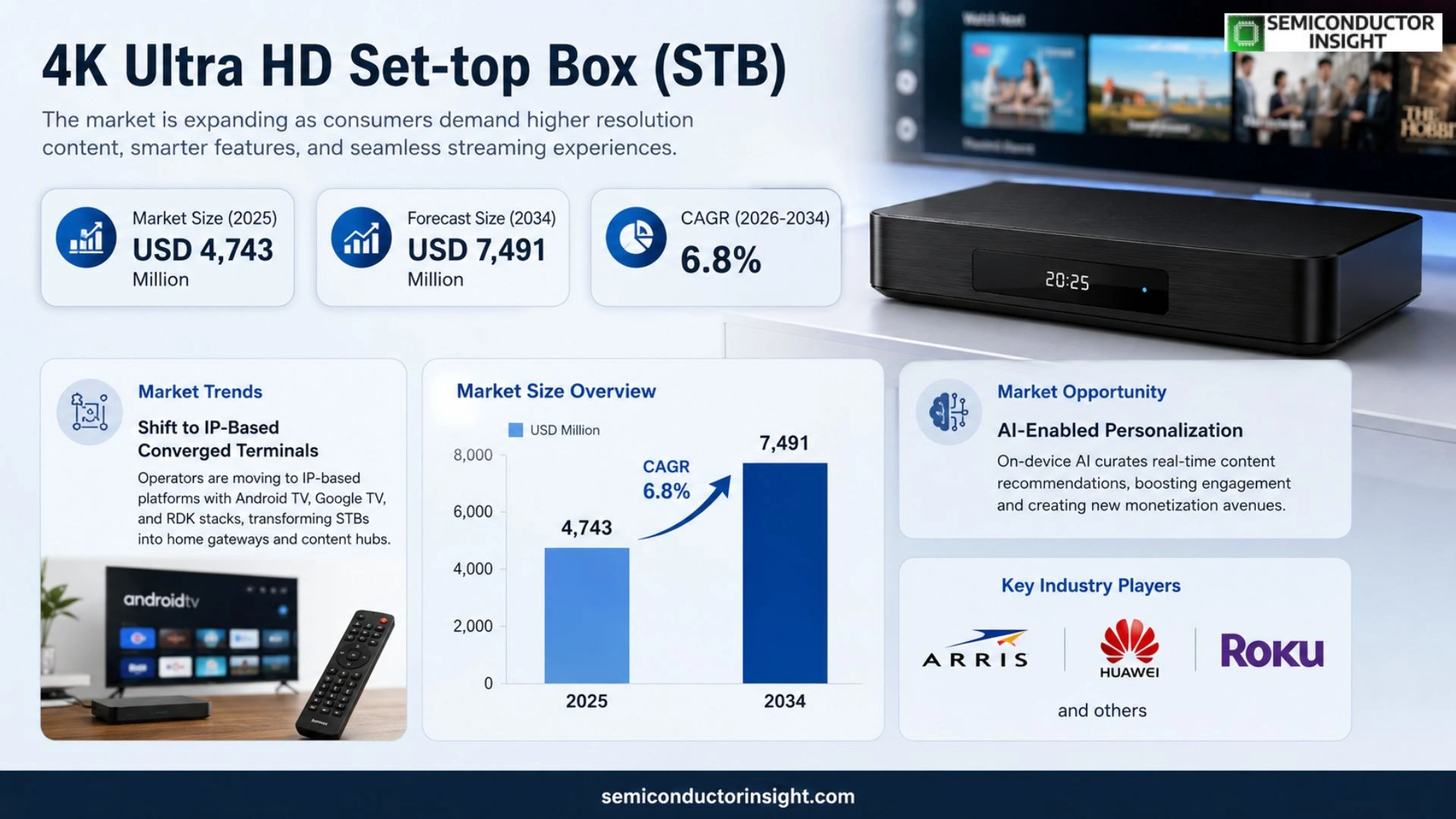
Global 4K Ultra HD Set-top Box (STB) market size was valued at USD 4743 million in 2025 and is projected to reach USD 7491 million by 2034, exhibiting a CAGR of 6.8% during the forecast period.
A 4K Ultra HD Set-Top Box (STB) is a terminal device that decodes video signals from cable, satellite, terrestrial or IP networks and outputs them as 4K (including HDR) images. It integrates a decoding chip, operating system and applications, supporting live streaming, video‑on‑demand, OTT, DRM encryption and voice remote control for ultra‑high‑definition content on large TV screens.
MARKET DRIVERS
Consumer Shift Toward 4K Streaming
Broadband providers have expanded gigabit‑level services to more than 45 % of households in North America and Western Europe, creating a fertile environment for high‑resolution content consumption. As viewers compare 1080p with ultra‑crisp 4K imagery, the appetite for devices that can decode and deliver that quality has risen sharply, prompting retailers to allocate larger shelf space for the 4K Ultra HD Set-top Box (STB) Market.
Infrastructure Upgrades by Telecom Operators
Major telcos are rolling out next‑generation broadcast standards, such as DVB‑T2 and ATSC 3.0, which are intrinsically compatible with 4K set‑top solutions. The deployment of these standards has cut latency and enhanced error correction, making the user experience smoother and encouraging subscription‑based OTT platforms to bundle premium 4K channels, further stimulating demand for advanced STBs.
➤ Industry insiders note that adoption rates for 4K boxes have outpaced 8K launches, reflecting a pragmatic balance between consumer readiness and content availability.
Content creators are investing heavily in original 4K productions, with major studios allocating upwards of 30 % of their budgets to Ultra HD projects. This surge in high‑quality programming not only justifies the purchase of a 4K decoder but also drives ancillary services,such as interactive advertising,that rely on the box’s processing power.
MARKET CHALLENGES
Cost Sensitivity and Price Pressures
While premium models offer AI‑driven recommendations and HDR support, the price gap between entry‑level HD boxes and 4K units remains sizable. Price‑conscious segments, especially in emerging economies, tend to delay upgrades until economies of scale lower unit costs, creating a choke point for rapid market penetration.
Other Challenges
Supply Chain Constraints
Semiconductor shortages have elongated lead times for key components such as video decoders and Wi‑Fi 6 modules. Manufacturers, therefore, face inventory imbalances that translate into longer order‑to‑delivery cycles for retailers and end‑users.
MARKET RESTRAINTS
Broadband Penetration Gaps
In regions where average download speeds linger below 25 Mbps, streaming 4K content becomes unreliable, dampening consumer enthusiasm for high‑definition set‑top hardware. Service providers in these markets are still prioritizing network expansion over value‑added services, which stalls demand for premium STBs.
Regulatory and Spectrum Limitations
Licensing authorities in several countries impose strict caps on the spectrum allocated for broadcast 4K signals, limiting the number of channels that can be delivered over traditional airwaves. This regulatory ceiling reduces the perceived utility of a 4K box for cord‑cutters who rely on free‑to‑air options.
Moreover, data‑privacy regulations impose additional compliance burdens on manufacturers that embed telemetry and usage analytics within the device firmware, increasing development costs and potentially slowing product refresh cycles.
MARKET OPPORTUNITIES
AI‑Enabled Personalization
Integrating on‑device artificial intelligence allows the set‑top box to curate content recommendations in real time, creating a differentiated user experience that can be monetized through targeted advertising. Early adopters of this capability have reported a 12 % uplift in average viewing duration per household.
Strategic OTT Partnerships
Collaborations between STB manufacturers and leading OTT platforms enable bundled subscription packages that include exclusive 4K titles. These alliances reduce churn for both parties and open cross‑selling avenues for ancillary services such as cloud gaming.
Edge‑Computing Integration
Embedding edge‑processing capabilities within the box can offload transcoding tasks from centralized servers, lowering latency for live events and interactive applications. Service providers that pilot this architecture anticipate a reduction in backbone bandwidth usage by up to 18 %.
4K Ultra HD Set-top Box (STB) Market Trends
Shift to IP‑Based Converged Terminals
The ecosystem is moving away from legacy broadcast hardware toward platforms that combine IP delivery with a unified user interface. Operators are standardising on Android TV, Google TV and RDK stacks, which turn the box into a de‑facto home gateway and content hub. This migration enables voice‑controlled remotes, cross‑device recommendations and a blend of subscription and ad‑supported revenue streams. In 2025 the market recorded sales of roughly 148 million units at a unit price of $35, underscoring the scale of the transition and the commercial incentive for manufacturers to embed richer software layers.
Other Trends
Encoding Efficiency and Power Management
Manufacturers are prioritising codecs that squeeze more pixels into the same bandwidth while keeping silicon draw modest. AV1 and HEVC have become the default choices for 4K delivery, and premium HDR10+ or Dolby Vision profiles are emerging in higher‑end models. Parallel advances in AI‑driven up‑scaling reduce the need for raw processing power, allowing the inclusion of Wi‑Fi 6/6E, gigabit Ethernet and expanded flash storage without a proportional rise in energy use. These technical shifts respond to consumer demand for seamless 4K streams on multiple screens simultaneously, while preserving the modest profit margins that hover around 35 %.
Emerging Market Expansion and Competitive Refinement
While established regions concentrate on unit replacement and incremental feature upgrades, broadband rollout in South‑East Asia, Africa and Latin America fuels genuine demand for first‑time adoption. The competitive set is fragmenting: hardware differentiation narrows, and vendors are investing heavily in DRM, remote diagnostics and custom operator skins to stay viable. This strategic tilt toward software ecosystems and service‑level agreements is reshaping the value chain, making post‑sale support and data analytics as important as the physical chassis. Companies that can align their product roadmaps with these ecosystem demands are likely to capture the modest but steady growth projected for the 4K Ultra HD Set-top Box (STB) Market through 2032.
COMPETITIVE LANDSCAPE
Key Industry Players
4K Ultra HD Set‑Top Box Market – Competitive Overview
Arris, Huawei, and Roku dominate the upper tier of the 4K Ultra HD STB arena, each leveraging vertically integrated designs that combine advanced SoC architectures with mature software ecosystems such as Android TV and RDK. Their scale enables bulk procurement of decoding chips and Wi‑Fi 6 modules, translating into unit costs that sit comfortably below the $35 benchmark while preserving a healthy margin. This cost advantage, coupled with deep relationships with cable operators and OTT platforms, allows them to secure long‑term service contracts and to roll out over‑the‑air firmware upgrades that keep devices compatible with emerging codecs like AV1. The concentration of market share in a handful of global vendors creates a competitive pressure for smaller players to specialize in niche firmware customization, rapid certification, or verticals such as hospitality and commercial signage.
Beyond the headline makers, a cohort of regionally strong firms adds texture to the competitive set. Companies such as Technicolor, Sagemcom, Humax, and Zinwell excel in tailoring hardware to specific regulatory environments in Europe and Asia, often bundling DRM suites that satisfy local content‑protection mandates. Emerging challengers including MatrixStream Technologies, Netgem, Skyworth Digital, and MStar Semiconductor focus on differentiating through AI‑enhanced picture processing and expanded storage options, addressing the increasing consumer demand for multi‑screen synchronization and voice‑controlled interfaces. Their agility in adopting newer interfaces,e.g., HDMI 2.1 and gigabit Ethernet,helps them capture replacement cycles in mature markets while also opening footholds in fast‑growing broadband regions.
List of Key Set‑Top Box Companies Profiled
- Arris
- Huawei
- Roku
- Technicolor
- Sagemcom
- Humax
- Zinwell
- MatrixStream Technologies
- Netgem
- Skyworth Digital
- MStar Semiconductor
- ZTE
- Inspur
- Echostar
- Hisense
Segment Analysis:
| Segment Category | Sub-Segments | Key Insights |
| By Type |
|
IPTV Set‑Top Box
|
| By Application |
|
Residential Use
|
| By End User |
|
Home Consumers
|
| By Platform |
|
Android TV
|
| By Connectivity |
|
Wi‑Fi 6/6E
|
Regional Analysis: 4K Ultra HD Set-top Box (STB) Market
North America
Operators are packaging native 4K movies and series alongside exclusive live sports, prompting subscribers to view the STB as an essential upgrade rather than a discretionary gadget.
Fiber‑to‑the‑home networks now reach over half of urban households, delivering the sustained throughput required for uninterrupted 4K streams and encouraging manufacturers to embed higher‑speed Ethernet ports.
Surveys reveal a growing expectation for HDR and Dolby Vision support, driving vendors to integrate advanced processing chips that can upscale legacy content without sacrificing detail.
Recent spectrum reallocation has opened channels for over‑the‑air 4K broadcasting, compelling traditional broadcasters to collaborate with STB makers on firmware that can decode new transmission standards.
Europe
European markets exhibit a nuanced trajectory for the 4K Ultra HD Set-top Box (STB) Market, where fragmented broadband quality coexists with strong governmental incentives for digital migration. Countries such as Germany and the United Kingdom have witnessed broadcasters committing to native 4K linear channels, prompting pay‑TV operators to subsidize set‑top hardware for premium tiers. Meanwhile, the rise of pan‑European OTT aggregators intensifies competition, forcing local manufacturers to differentiate through multilingual UI and seamless integration with legacy set‑up boxes. Energy‑efficiency standards, enforced by the EU, further influence design choices, leading to slimmer, low‑power consumption models that meet both ecological mandates and consumer demand for discreet devices.
Asia‑Pacific
In the Asia‑Pacific corridor, rapid urbanization and aggressive 5G deployments are reshaping the 4K Ultra HD Set-top Box (STB) Market landscape. Nations like South Korea and Japan already enjoy near‑ubiquitous high‑definition streaming, turning the STB into a conduit for bundled services such as gaming, cloud storage, and localized advertising. Emerging economies,India, Indonesia, Vietnam,are still grappling with bandwidth constraints; however, tier‑2 carriers are deploying hybrid broadcast broadband systems that allow low‑cost STBs to deliver 4K content over existing infrastructure. Manufacturers therefore prioritize modular designs that can be upgraded with external 5G modems, ensuring scalability as network capabilities expand.
South America
South America presents a market where price sensitivity intersects with an escalating appetite for premium visual experiences. Cable operators in Brazil and Argentina are experimenting with affordable 4K‑ready set‑top boxes that leverage built‑in Android platforms, enabling direct access to regional streaming services without the need for additional hardware. Regulatory bodies are incentivizing local content production in 4K, a move that stimulates demand for devices capable of handling higher bitrate streams. Consequently, manufacturers focus on cost‑effective component sourcing while preserving sufficient processing headroom to future‑proof against anticipated bandwidth improvements.
Middle East & Africa
The Middle East & Africa region illustrates a dual‑track evolution for the 4K Ultra HD Set-top Box (STB) Market. Wealthier Gulf Cooperation Council states invest heavily in satellite and fiber networks, delivering ultra‑high‑definition feeds to luxury residential complexes, where consumers expect seamless integration with home‑automation ecosystems. Conversely, sub‑Saharan nations contend with limited fiber penetration, prompting a reliance on satellite‑based 4K services that demand robust, weather‑resilient hardware. Vendors therefore tailor product lines: high‑end, feature‑rich boxes for affluent markets, and rugged, cost‑optimized units for emerging territories, each aligned with distinct revenue models and distribution channels.
Report Scope
This market research report provides a comprehensive analysis of the 4K Ultra HD Set-top Box (STB) Market , covering the forecast period 2026–2034. It offers detailed insights into market dynamics, technological advancements, competitive landscape, and key trends shaping the industry.
Key focus areas of the report include:
- Market Overview: The report begins with an overview outlining its current market scenario, key growth indicators, and industry transformation drivers. It discusses macroeconomic factors, demand–supply balance, regulatory landscape, and the strategic role of semiconductors in powering advancements across industries such as automotive, telecommunications, consumer electronics, and industrial automation.
- Market Size & Forecast: Historical data and future projections for revenue, unit shipments, and market value across major regions and segments.
- Segmentation Analysis: Detailed breakdown by product type, technology, application, and end-user industry to identify high-growth segments and investment opportunities.
- Regional Insights: Insights into market performance across North America, Europe, Asia-Pacific, Latin America, and the Middle East & Africa, including country-level analysis where relevant.
- Competitive Landscape: Profiles of leading market participants, including their product offerings, R&D focus, manufacturing capacity, pricing strategies, and recent developments such as mergers, acquisitions, and partnerships.
- Technology Trends & Innovation: Assessment of emerging technologies, integration of AI/IoT, semiconductor design trends, fabrication techniques, and evolving industry standards.
- Market Drivers & Restraints: Evaluation of factors driving market growth along with challenges, supply chain constraints, regulatory issues, and market-entry barriers.
- Stakeholder Insights: Insights for component suppliers, OEMs, system integrators, investors, and policymakers regarding the evolving ecosystem and strategic opportunities.
Primary and secondary research methods are employed, including interviews with industry experts, data from verified sources, and real-time market intelligence to ensure the accuracy and reliability of the insights presented.
FREQUENTLY ASKED QUESTIONS:
What is the current market size of 4K Ultra HD Set-top Box (STB) Market?
-> 4K Ultra HD Set-top Box (STB) market is projected to reach USD 7491 million by 2034, exhibiting a CAGR of 6.8%
Which key companies operate in 4K Ultra HD Set-top Box (STB) Market?
-> Key players include Arris, ZTE, Inspur, Technicolor, Echostar, Roku, Sagemcom, Humax, Zinwell, MatrixStream Technologies, Netgem, Skyworth Digital, Huawei, Hisense, and MStar Semiconductor, among others.
What are the key growth drivers?
-> Key growth drivers include the shift from traditional broadcast boxes to IP‑based converged terminals, accelerated IPTV/OTT convergence, broader adoption of Android TV/Google TV and RDK platforms, and increasing demand for higher encoding efficiency (AV1/HEVC) combined with lower power consumption and AI‑enhanced image quality.
Which region dominates the market?
-> Asia‑Pacific remains the largest and fastest‑growing region, driven by rapid broadband expansion, strong content availability, and rising consumer demand for 4K OTT services, while mature markets such as North America and Europe focus on equipment replacement and experience upgrades.
What are the emerging trends?
-> Emerging trends include the integration of 4K STBs as home gateways and content aggregators, support for HDR10+/Dolby Vision, deployment of Wi‑Fi 6/6E and gigabit Ethernet, larger local storage for multi‑terminal use, and increasing emphasis on software ecosystems, remote maintenance, and operator‑customizable functionalities.
Get Sample Report PDF for Exclusive Insights
Report Sample Includes
- Table of Contents
- List of Tables & Figures
- Charts, Research Methodology, and more...
 Download Sample Report PDF