
Market Insights
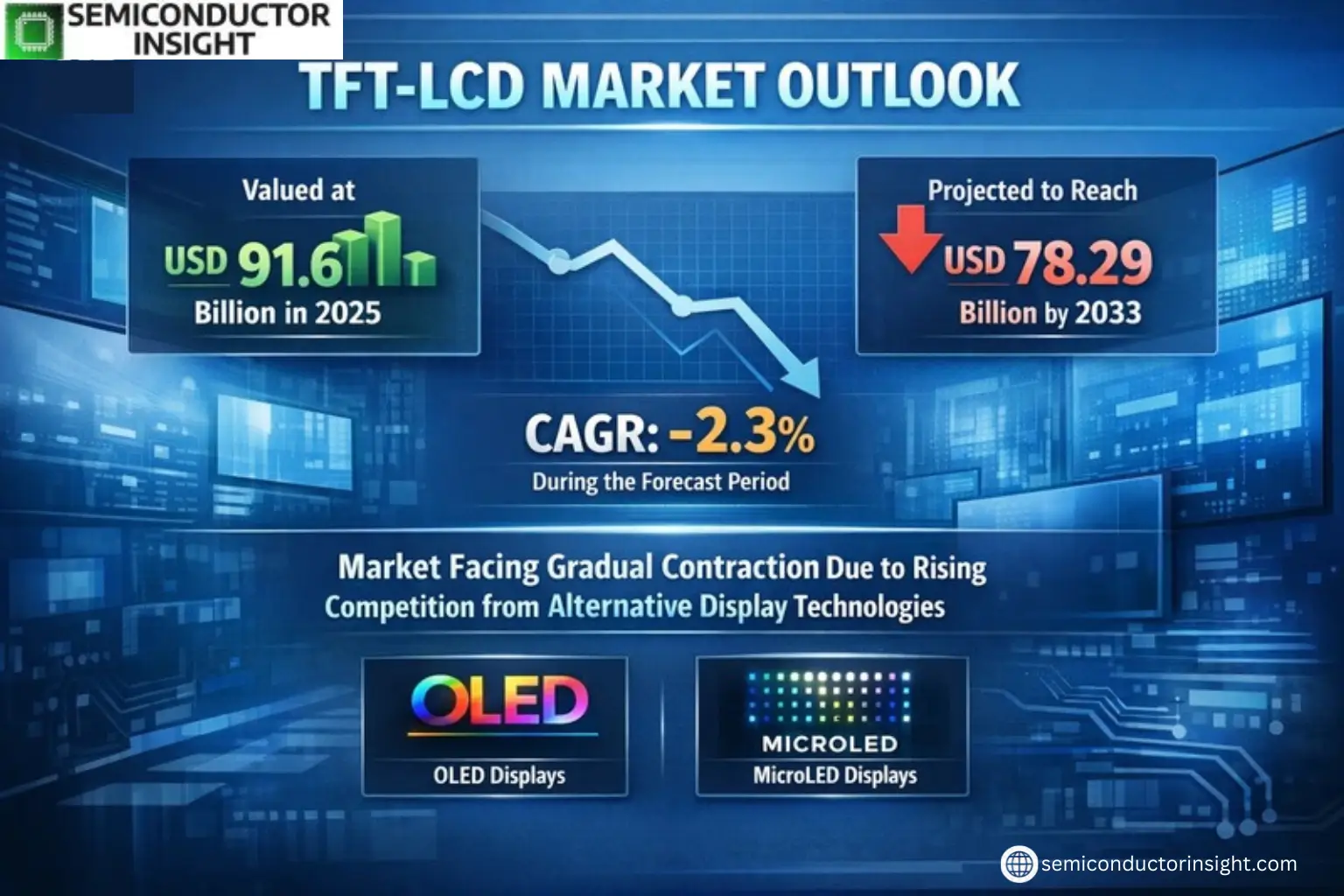
Global TFT-LCD Market was valued at USD 91.6 billion in 2025 and is projected to reach USD 78.29 billion by 2033, exhibiting a CAGR of -2.3% during the forecast period.
A thin-film-transistor liquid-crystal display (TFT-LCD) is an advanced variant of liquid-crystal display technology that utilizes thin-film transistors to enhance image quality, including improved addressability and contrast. Unlike passive-matrix LCDs, TFT-LCDs operate as active-matrix displays, offering superior performance for high-resolution applications.
The market is experiencing gradual contraction primarily due to increasing competition from alternative display technologies such as OLED and MicroLED. However, TFT-LCDs maintain dominance in large-format applications like televisions and monitors, where they account for over 95% of the market share. Key players including LG Display, Innolux, and AUO collectively control more than 55% of the global market, with China representing the largest regional market at over 30% share.
MARKET DRIVERS
Growing Demand for High-Resolution Displays
TFT-LCD Market is experiencing steady growth due to increasing consumer preference for high-resolution displays in smartphones, tablets, and televisions. Manufacturers are focusing on higher pixel density and color accuracy to meet evolving consumer expectations.
Automotive Display Advancements
The automotive sector is adopting TFT-LCD technology for infotainment systems and digital dashboards. With over 60% of new vehicles now featuring advanced displays, this segment is becoming a key driver for market expansion.
Technological advancements in flexible and foldable displays are creating new opportunities for TFT-LCD adoption in emerging product categories.
MARKET CHALLENGES
Intense Competition from OLED Technology
TFT-LCD Market faces growing competition from OLED displays, which offer superior contrast ratios and energy efficiency. Many premium device manufacturers are shifting towards OLED solutions.
Other Challenges
Production Cost Pressures
Rising costs of raw materials and complex manufacturing processes are impacting profit margins for TFT-LCD panel producers.
Supply Chain Disruptions
The semiconductor shortage has affected TFT-LCD component availability, causing production delays and inventory challenges.
MARKET RESTRAINTS
Market Saturation in Mature Segments
The consumer electronics market for TFT-LCD displays is reaching maturity in developed regions, limiting growth potential. Manufacturers must identify new application areas to sustain expansion.
MARKET OPPORTUNITIES
Industrial and Medical Applications
TFT-LCD Market is seeing growing adoption in industrial HMI panels and medical display equipment, where durability and long lifespan are prioritized over cutting-edge display technologies.
Emerging Market Expansion
Developing economies with rising disposable incomes present significant opportunities for TFT-LCD manufacturers, particularly in the mid-range smartphone and television segments.
TFT-LCD Market Trends
Declining Market Value with Shifting Applications
Global TFT-LCD Market faces a projected decline, valued at USD 91.6 billion in 2025 but expected to drop to USD 78.29 billion by 2033, reflecting a -2.3% CAGR. This contraction stems partly from OLED technology adoption in premium displays, though TFT-LCD maintains dominance in cost-sensitive segments. Manufacturers are adapting by targeting high-growth applications like automotive displays and public signage, where TFT-LCD’s reliability and affordability remain competitive.
Other Trends
Regional Market Concentration
China commands over 30% of the global TFT-LCD Market share, with South Korea and Taiwan collectively holding 45%. This Asia-centric production landscape is bolstered by established supply chains and major manufacturers like BOE, Innolux, and LG Display. However, trade policies and supply chain diversification efforts may gradually alter this concentration.
Product and Application Segments
Large TFT-LCD panels dominate with 95% market share, primarily driven by LCD TV demand. The notebook PC and monitor segments follow, though growth in these areas slows as mobile devices transition to alternative display technologies. Emerging opportunities exist in industrial and automotive applications where TFT-LCD’s durability and temperature tolerance are advantageous.
Competitive Landscape Shifts
The top five TFT-LCD manufacturers control 55% of the market, with LG Display, Samsung, and AU Optronics leading. Recent strategic moves include partnerships with automotive suppliers and investments in Gen 8.5+ fabs to improve production efficiency. Price competition remains intense, pressuring margins and accelerating consolidation among smaller players.
Technological Adaptation
While facing competition from OLED in premium segments, TFT-LCD producers are enhancing performance through innovations like mini-LED backlighting and higher refresh rates. These improvements aim to extend the technology’s relevance in gaming monitors and professional displays where color accuracy and response times are critical.
COMPETITIVE LANDSCAPE
Key Industry Players
Oligopolistic Market Dominated by Asian Display Giants
Global TFT-LCD Market remains highly concentrated, with the top five manufacturers controlling over 55% market share. LG Display maintains market leadership through its diversified product portfolio spanning large-sized TV panels to premium mobile displays. Samsung Display follows closely with advanced OLED-TFT hybrid technologies, while Innolux and AUO dominate the Taiwan region with cost-competitive production capabilities. Chinese manufacturers like BOE and CSOT are rapidly gaining share through massive capacity expansions and government-backed initiatives.
Niche players are carving specialized segments Sharp focuses on high-resolution IGZO panels for professional monitors, Japan Display supplies automotive displays, while Tianma leads in medium-small sized panels for industrial applications. Emerging Chinese suppliers CPT and CEC-Panda are disrupting mid-range markets through aggressive pricing, though technological differentiation remains limited. Hannstar maintains a strong position in entry-level monitor panels, leveraging Taiwan’s established supply chain efficiencies.
List of Key TFT-LCD Companies Profiled
- LG Display
- Innolux Corporation
- AU Optronics (AUO)
- Samsung Display
- Sharp Corporation
- BOE Technology
- Japan Display Inc. (JDI)
- China Star Optoelectronics (CSOT)
- Tianma Microelectronics
- Chunghwa Picture Tubes (CPT)
- CEC-Panda LCD Technology
- HannStar Display Corporation
- Truly International Holdings
- InfoVision Optoelectronics (IVO)
- Panasonic Liquid Crystal Display
Segment Analysis:
| Segment Category | Sub-Segments | Key Insights |
| By Type |
|
Large TFT-LCD dominates the market due to:
|
| By Application |
|
LCD TV maintains market leadership because:
|
| By End User |
|
Consumer Electronics remains the dominant segment due to:
|
| By Technology |
|
IPS Technology is preferred in the market because:
|
| By Manufacturing Process |
|
Gen 8.5 production dominates due to:
|
Regional Analysis: TFT-LCD Market
Asia-Pacific (Leading Region)
China leads in TFT-LCD production capacity expansion through massive investments in Gen 10.5/11 fabrication plants. Government initiatives like “Made in China 2025” actively support domestic display makers BOE and CSOT to challenge Korean dominance.
South Korea maintains technological advantage with QD-OLED and advanced TFT architectures. Samsung and LG continue to shift premium production while transferring mature TFT-LCD technologies to Chinese partners.
Japan specializes in high-performance materials and production equipment, with companies like JSR and Nikon providing critical components and photolithography systems essential for advanced TFT-LCD manufacturing processes.
Taiwan focuses on specialized applications, with AUO and Innolux developing custom TFT-LCD solutions for automotive and industrial markets, leveraging flexible manufacturing systems to serve diverse customer requirements.
North America
North America shows strong demand for premium TFT-LCD displays in consumer electronics and professional applications. The region benefits from close collaboration between OEMs like Apple and display technology developers, driving specifications for high-performance mobile displays. While having limited production facilities, North American companies lead in display controller ICs and interface technologies. Automotive manufacturers integrate advanced TFT-LCDs into next-generation dashboards and infotainment systems, creating specialized market segments that Asian suppliers increasingly target.
Europe
Europe emphasizes quality and energy efficiency in its TFT-LCD consumption patterns, with strict regulations shaping display specifications. German automotive brands drive adoption of high-reliability automotive displays, while the medical sector demands specialized TFT-LCD panels with extended operational lifetimes. European companies focus on display systems integration rather than panel manufacturing, developing value-added solutions that combine TFT-LCDs with custom interfaces and embedded systems.
South America
The South American TFT-LCD Market is primarily import-driven, with Brazil as the largest regional consumer. Local assembly of consumer electronics creates some demand for display modules, though most high-end panels are imported from Asia. The market shows preference for cost-effective TFT-LCD solutions in television and mobile applications, with growing interest in smart home displays. Political and economic instability periodically affects market growth and supply chain reliability.
Middle East & Africa
This emerging region experiences gradual TFT-LCD adoption, driven by urbanization and digital transformation initiatives. The Middle East shows particular interest in large-format displays for commercial applications and smart city projects. Africa’s market remains heavily focused on entry-level mobile displays and small-screen applications, with growth limited by infrastructure challenges. Both sub-regions depend on imports, primarily from China, for their TFT-LCD requirements.
Report Scope
This market research report provides a comprehensive analysis of the TFT-LCD Market , covering the forecast period 2025–2033. It offers detailed insights into market dynamics, technological advancements, competitive landscape, and key trends shaping the industry.
Key focus areas of the report include:
- Market Overview: The report begins with an overview outlining its current market scenario, key growth indicators, and industry transformation drivers. It discusses macroeconomic factors, demand–supply balance, regulatory landscape, and the strategic role of semiconductors in powering advancements across industries such as automotive, telecommunications, consumer electronics, and industrial automation.
- Market Size & Forecast: Historical data and future projections for revenue, unit shipments, and market value across major regions and segments.
- Segmentation Analysis: Detailed breakdown by product type, technology, application, and end-user industry to identify high-growth segments and investment opportunities.
- Regional Insights: Insights into market performance across North America, Europe, Asia-Pacific, Latin America, and the Middle East & Africa, including country-level analysis where relevant.
- Competitive Landscape: Profiles of leading market participants, including their product offerings, R&D focus, manufacturing capacity, pricing strategies, and recent developments such as mergers, acquisitions, and partnerships.
- Technology Trends & Innovation: Assessment of emerging technologies, integration of AI/IoT, semiconductor design trends, fabrication techniques, and evolving industry standards.
- Market Drivers & Restraints: Evaluation of factors driving market growth along with challenges, supply chain constraints, regulatory issues, and market-entry barriers.
- Stakeholder Insights: Insights for component suppliers, OEMs, system integrators, investors, and policymakers regarding the evolving ecosystem and strategic opportunities.
Primary and secondary research methods are employed, including interviews with industry experts, data from verified sources, and real-time market intelligence to ensure the accuracy and reliability of the insights presented.
FREQUENTLY ASKED QUESTIONS:
What is the current market size of TFT-LCD Market?
-> TFT-LCD Market was valued at USD 91.6 billion in 2025 and is projected to reach USD 78.29 billion by 2033, exhibiting a CAGR of -2.3% during the forecast period.
Which key companies operate in TFT-LCD Market?
-> Key players include LG Display, Innolux, AUO, Samsung Display, Sharp, BOE, Japan Display, CSOT, Tianma, CPT, CEC-Panda, and Hannstar. Global top five manufacturers hold a share over 55%.
What are the key growth drivers?
-> Key growth drivers include demand from LCD TVs, notebook PCs, mobile phones, and automotive applications.
Which region dominates the market?
-> China is the largest market with a share over 30%, followed by South Korea and China Taiwan, both having a share over 45%.
What are the emerging trends?
-> Emerging trends include larger display sizes (95% market share for Large TFT-LCD segment), customization features in automotive clusters, and integration in various consumer electronics.

Get Sample Report PDF for Exclusive Insights
Report Sample Includes
- Table of Contents
- List of Tables & Figures
- Charts, Research Methodology, and more...
 Download Sample Report PDF




