
Market Insights
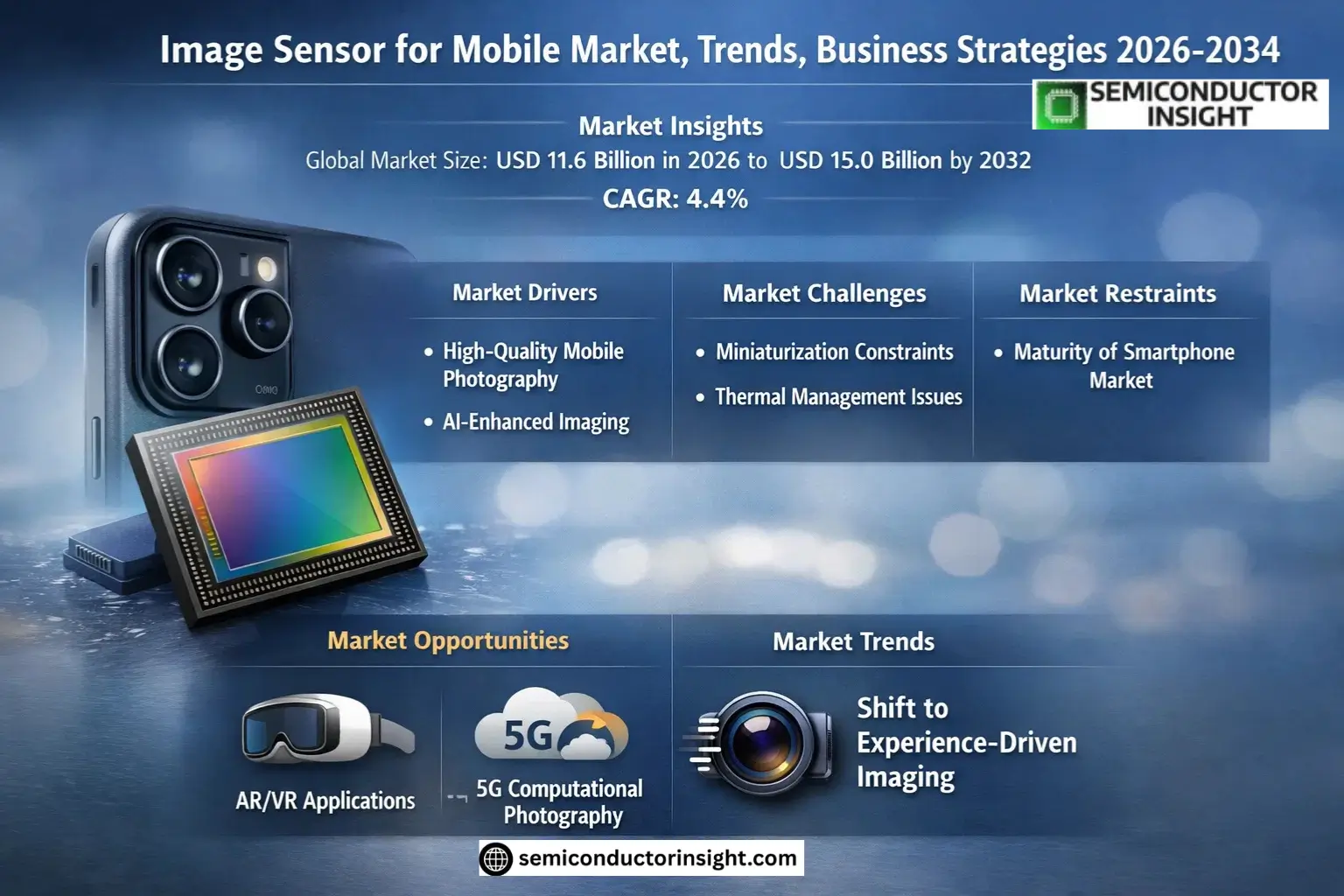
Global Image Sensor for Mobile Market size was valued at USD 11.1 billion in 2025. The market is projected to grow from USD 11.6 billion in 2026 to USD 15.0 billion by 2032, exhibiting a CAGR of 4.4% during the forecast period.
An image sensor for mobile typically a CMOS image sensor (CIS) used in smartphones and other mobile devices is the core semiconductor component that converts light into electrical signals, enabling high-quality photos and video capture. These sensors address critical challenges like low-light performance, power efficiency, and compact form factors while supporting advanced features such as computational photography, augmented reality, and biometric authentication.
The market growth is driven by rising smartphone adoption, increasing demand for multi-camera systems, and advancements in pixel technology like back-side illumination (BSI) and stacked sensors. Key players such as Sony, Samsung, and OmniVision dominate the sector with innovations in high-resolution sensors and AI-powered imaging solutions. For instance, Sony’s latest 1-inch-type mobile sensor (LYTIA series) enhances dynamic range and low-light capabilities, reflecting the industry’s shift toward premium imaging experiences.
MARKET DRIVERS
Growing Demand for High-Quality Mobile Photography
The increasing consumer preference for smartphones with advanced camera capabilities is driving the Image Sensor for Mobile Market. Over 75% of smartphone buyers consider camera quality a critical purchasing factor, leading manufacturers to integrate higher-resolution sensors.
Emergence of AI-Enhanced Imaging
Artificial intelligence integration in mobile cameras is accelerating market growth, with sensors now supporting features like night mode, real-time HDR, and portrait enhancements. This technological advancement requires specialized image sensors for mobile that can process complex algorithms efficiently.
Manufacturers are adopting quad-pixel and tetra-cell technologies to improve low-light performance, further stimulating demand for innovative sensor solutions.
MARKET CHALLENGES
Technical Limitations in Miniaturization
As smartphone designs become slimmer, developing high-performance image sensors for mobile within shrinking form factors presents significant engineering challenges. The trade-off between pixel size and sensor resolution remains a persistent obstacle.
Other Challenges
Thermal Management Issues
Higher resolution sensors generate more heat, which can affect image quality and device performance. Manufacturers must balance power consumption with thermal output in compact mobile designs.
Production Cost Pressures
The increasing complexity of advanced image sensors raises manufacturing costs, creating pricing challenges in the competitive smartphone market.
MARKET RESTRAINTS
Maturity of Smartphone Market
Slowing smartphone replacement cycles in developed markets are limiting the growth potential for image sensors for mobile applications. Consumers are keeping devices longer before upgrading, reducing the frequency of sensor technology refresh cycles.
MARKET OPPORTUNITIES
Expansion into AR/VR Applications
The rising adoption of augmented and virtual reality technologies in mobile devices creates new opportunities for specialized image sensors capable of depth sensing and spatial mapping. This emerging application could drive the next wave of sensor innovation.
5G-Enabled Computational Photography
The rollout of 5G networks enables cloud-based image processing, allowing smartphones to leverage more sophisticated image sensor technologies without increasing on-device computational loads.
Image Sensor for Mobile Market Trends
Shift from Spec-driven to Experience-driven Imaging
Image Sensor for Mobile Market is transitioning from hardware-centric specifications to holistic user experience. Premium smartphone cameras now prioritize real-world performance in challenging conditions like low light, high dynamic range scenes, and fast motion capture. This requires tight integration between sensor architecture, optical systems, stabilization mechanisms, and computational photography pipelines.
Other Trends
Multi-camera System Specialization
Modern smartphones employ role-defined camera arrays where each sensor serves a specific function. Main cameras emphasize all-around quality, ultrawide focuses on edge-to-edge clarity, while telephoto modules leverage resolution and stabilization synergy. Front-facing cameras optimize for video calls and selfie aesthetics.
Technological Advancements in Sensor Architecture
Manufacturers are adopting stacked sensor designs that separate pixel layers from processing logic, enabling faster readout speeds and improved low-light performance. Back-side illumination (BSI) technology continues to evolve, with newer implementations delivering better quantum efficiency. These developments support advanced features like multi-frame fusion and real-time HDR processing in mobile devices.
Computational Photography Integration
The rise of on-device AI processing is transforming mobile imaging into a continuous capture-to-create system. Image sensors are now co-designed with computational pipelines that handle traditional ISP tasks algorithmically, enabling features like real-time segmentation and advanced noise reduction.
Manufacturability as Competitive Edge
As hardware differentiation becomes more challenging, production yield, module consistency, and calibration accuracy have emerged as key competitive factors. Leading manufacturers are investing heavily in packaging technologies and test coverage to ensure sensor performance meets design specifications throughout mass production.
COMPETITIVE LANDSCAPE
Key Industry Players
Dominated by Semiconductor Giants with Increasing Competition from Chinese Suppliers
Image Sensor for Mobile Market is led by Sony Semiconductor Solutions, holding approximately 40% global market share with its advanced CMOS technology. Samsung System LSI follows closely with 20% share, leveraging its vertical integration with smartphone manufacturing. OmniVision Technologies (acquired by Will Semiconductor) maintains strong presence in mid-range segments through aggressive pricing and rapid design cycles. The competition intensifies with Chinese suppliers like GalaxyCore and SmartSens gaining traction through government-supported semiconductor initiatives and cost-effective solutions for domestic smartphone brands.
Emerging players such as Himax Technologies and STMicroelectronics focus on specialized segments including under-display sensors and AI-optimized imaging. SK Hynix and ON Semiconductor compete in value segments with optimized production yields. The market shows increasing stratification with premium sensors (1/1.3″ and larger) commanding 3-5x ASP compared to mainstream 1/2″-class sensors, creating distinct competitive tiers based on technological capability and manufacturing scale.
List of Key Image Sensor for Mobile Companies Profiled
- Sony Semiconductor Solutions
- Samsung System LSI
- OmniVision Technologies
- GalaxyCore
- SmartSens Technology
- Himax Technologies
- STMicroelectronics
- SK Hynix
- ON Semiconductor
- PixArt Imaging
- Silicon Optronics
- Panasonic
- Toshiba
- BYD Semiconductor
- Gpixel
Segment Analysis:
| Segment Category | Sub-Segments | Key Insights |
| By Type |
|
Stacked Sensor Architectures are emerging as the leading solution due to their superior readout bandwidth and thermal management capabilities. Key advantages include:
|
| By Application |
|
Main Rear Camera remains the dominant application area with evolving requirements:
|
| By End User |
|
Premium Smartphones drive most innovation with distinctive characteristics:
|
| By Sensor Technology |
|
Quad Bayer/Nona Bayer technologies are gaining traction due to:
|
| By Integration Level |
|
Co-Designed with ISP solutions are becoming industry standard because:
|
Regional Analysis: Image Sensor for Mobile Market
China’s concentrated smartphone manufacturing ecosystem drives 60% of global image sensor demand. Local players like OmniVision compete with Sony and Samsung through cost-competitive solutions. The government’s “Made in China 2025” initiative accelerates domestic sensor development.
South Korean tech giants integrate cutting-edge ISOCELL sensors with computational photography. Samsung’s vertical integration from sensor production to smartphone manufacturing creates unique market advantages. Local R&D focuses on ultra-small pixel technologies.
Japanese firms lead in high-end BSI and stacked CMOS sensors with Sony controlling majority market share. Partnerships between sensor makers and automotive companies drive innovations in multi-sensor fusion technologies.
Southeast Asia and India show rapid adoption of mid-range smartphones with advanced imaging capabilities. Local brands prioritize affordable devices with multiple camera arrays, creating opportunities for mid-tier image sensor suppliers.
North America
North America remains a key innovation center for mobile image sensor technologies, with significant R&D investments in computational photography. U.S.-based companies focus on AI-powered image processing and low-light performance enhancements. The premium smartphone segment drives demand for larger sensors with advanced pixel technologies. Partnerships between sensor manufacturers and mobile platform developers accelerate imaging innovations. The region also sees growing integration of image sensors in AR/VR applications for mobile devices.
Europe
European mobile market emphasizes high-quality imaging with strict privacy regulations influencing sensor development. German and French smartphone manufacturers integrate premium sensors while prioritizing data security. The region shows strong adoption of multi-camera systems in flagship devices. Research institutions collaborate with manufacturers on quantum dot and organic sensor technologies. European car manufacturers drive demand for mobile-adjacent imaging solutions in connected vehicle systems.
South America
The South American mobile market focuses on value-oriented devices with capable imaging systems. Brazilian consumers show increasing preference for smartphones with advanced camera features at accessible price points. Local assembly of mobile devices encourages regional sensor sourcing strategies. Manufacturers balance cost considerations with growing consumer expectations for better low-light and zoom capabilities in budget devices.
Middle East & Africa
Middle Eastern markets demand premium smartphones with top-tier camera systems, while African markets prioritize durability and value. Gulf countries show particular interest in high-megapixel sensors and AI photography features. Local manufacturers in emerging African markets incorporate basic image sensors with improving quality. The region presents growth potential as mobile penetration increases and 4G networks expand across rural areas.
Report Scope
This market research report provides a comprehensive analysis of the Image Sensor for Mobile Market, covering the forecast period 2025–2032. It offers detailed insights into market dynamics, technological advancements, competitive landscape, and key trends shaping the industry.
Key focus areas of the report include:
- Market Overview: The report begins with an overview outlining its current market scenario, key growth indicators, and industry transformation drivers. It discusses macroeconomic factors, demand–supply balance, regulatory landscape, and the strategic role of semiconductors in powering advancements across industries such as automotive, telecommunications, consumer electronics, and industrial automation.
- Market Size & Forecast: Historical data and future projections for revenue, unit shipments, and market value across major regions and segments.
- Segmentation Analysis: Detailed breakdown by product type, technology, application, and end-user industry to identify high-growth segments and investment opportunities.
- Regional Insights: Insights into market performance across North America, Europe, Asia-Pacific, Latin America, and the Middle East & Africa, including country-level analysis where relevant.
- Competitive Landscape: Profiles of leading market participants, including their product offerings, R&D focus, manufacturing capacity, pricing strategies, and recent developments such as mergers, acquisitions, and partnerships.
- Technology Trends & Innovation: Assessment of emerging technologies, integration of AI/IoT, semiconductor design trends, fabrication techniques, and evolving industry standards.
- Market Drivers & Restraints: Evaluation of factors driving market growth along with challenges, supply chain constraints, regulatory issues, and market-entry barriers.
- Stakeholder Insights: Insights for component suppliers, OEMs, system integrators, investors, and policymakers regarding the evolving ecosystem and strategic opportunities.
Primary and secondary research methods are employed, including interviews with industry experts, data from verified sources, and real-time market intelligence to ensure the accuracy and reliability of the insights presented.
FREQUENTLY ASKED QUESTIONS:
What is the current market size of Image Sensor for Mobile Market?
-> Image Sensor for Mobile Market size was valued at USD 11.1 billion in 2025. The market is projected to grow from USD 11.6 billion in 2026 to USD 15.0 billion by 2032, exhibiting a CAGR of 4.4% during the forecast period.
Which key companies operate in Image Sensor for Mobile Market?
-> Key players include Sony, Samsung, OmniVision, GalaxyCore, SmartSens, and Himax, among others.
What are the key growth drivers?
-> Key growth drivers include sustained demand for social sharing and short-form video creation, smartphone brands’ need for perceptible upgrade levers in mature markets, and advancements in upstream process innovation and on-device compute capabilities.
Which region dominates the market?
-> Asia is the dominant market, with key contributions from China, Japan, and South Korea.
What are the emerging trends?
-> Emerging trends include stronger readout capability, deeper stacked integration, tighter computational co-design, and ecosystem-wide platformization with cross-camera color matching and standardized calibration frameworks.
Get Sample Report PDF for Exclusive Insights
Report Sample Includes
- Table of Contents
- List of Tables & Figures
- Charts, Research Methodology, and more...
 Download Sample Report PDF


