Key Statistics
Key Takeaways
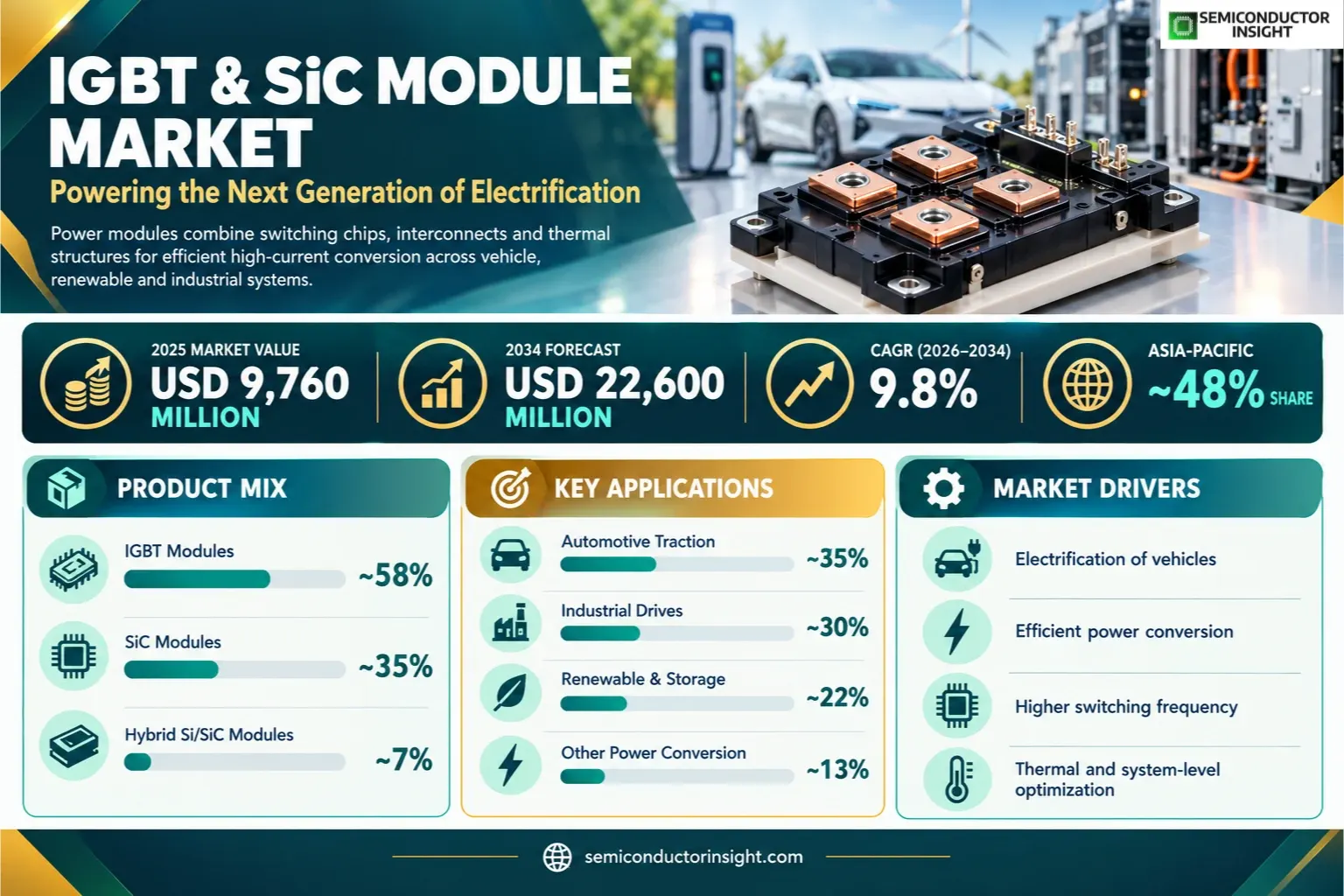
- 2025 baseline: global power-module value reaches USD 9,760 million, led by mature IGBT traction, motor-drive and industrial converter platforms; the revenue perimeter also includes SiC and hybrid module configurations rather than standalone bare semiconductor die.
- 2034 outlook: aggregate demand reaches USD 22,600 million at a reconciled 9.8% growth rate, with silicon carbide adoption, electrified vehicles and renewable-energy conversion changing the mix of modules bought by equipment makers.
- Type leadership: IGBT Modules hold an estimated ~58% of 2025 revenue; their industrial installed base supports volume while SiC Modules, at ~35%, gain sockets in higher-frequency and high-efficiency conversion.
- Application mix: Electric Vehicles lead at ~37%, followed by Renewable Energy (~24%) and Industrial Motor Drives (~21%); Rail & Grid (~12%) and Data Center Power (~6%) add distinct reliability and voltage requirements.
- Regional concentration: Asia-Pacific accounts for an estimated ~48% of 2025 value, reflecting China-based traction-inverter production, Japanese power-device engineering and broader Asian industrial-converter manufacturing.
- Technology segmentation: the 650–1200V voltage class represents ~65% of 2025 revenue, while Discrete Modules hold ~62% of integration-level value; each category has different thermal-interface and design-qualification economics.
- Competitive positioning: Infineon, STMicroelectronics, onsemi, Semikron Danfoss, Mitsubishi Electric and Wolfspeed compete through qualified packaging, power-cycling endurance, application engineering and reliable supply rather than a single universal module design.
- Growth balance: EV inverter redesign, solar and storage integration and industrial electrification raise demand, while qualification cycles, silicon-carbide substrate costs and pressure on IGBT prices limit realized revenue growth.
IGBT and SiC Module Market Overview
IGBT and SiC module market was valued at USD 9,760 million in 2025 and is projected to reach USD 22,600 million by 2034, representing a CAGR of 9.8% over the 2026–2034 market outlook. Asia-Pacific is the largest regional market with an estimated ~48% share in 2025, supported by extensive traction-inverter and industrial power-converter manufacturing.
A power semiconductor module packages multiple switching chips, their electrical interconnects and thermal structures into an assembly designed to carry substantial current at controlled losses. IGBT technology uses a bipolar conduction path driven by an insulated gate and remains commercially established in motor drives, rail traction and many grid-connected inverters. Silicon carbide MOSFET modules favor faster switching and reduced loss at demanding voltage and temperature conditions, while hybrid designs combine silicon and SiC elements to optimize converter cost and performance.
The product boundary covers IGBT power modules, SiC power modules and hybrid Si/SiC modules delivered as discrete packages, integrated power stacks or qualifying complete conversion assemblies within the defined integration-level segmentation. Bare IGBT chips, merchant SiC wafers, unrelated controllers and complete vehicles are outside the denominator; a packaged inverter stack can enter only to the extent it belongs to the specified module-and-assembly product scope. This distinction matters because the same suppliers also sell semiconductor die, drivers and whole subsystems that cannot all be counted again as module revenue.
An automotive traction inverter imposes a different qualification burden from an industrial variable-frequency drive. Vehicle power modules must tolerate vibration, fast load transients and repeated temperature excursions over a long operating life; industrial modules are often selected for predictable maintenance intervals, replacement compatibility and high availability. Both settings reward low thermal resistance, controlled parasitic inductance and a supply base capable of supporting the same package family across successive equipment generations.
Silicon carbide gains commercial traction where higher switching frequencies shrink passive components or where lower conversion loss extends vehicle range and reduces cooling demand. Its advantage is not universal: a lower-cost silicon IGBT design may remain economically superior in mature medium-frequency applications. System engineers compare semiconductor cost against heat sinks, busbars, gate-drive complexity and lifetime energy losses, so the best module is selected at the converter level rather than by transistor efficiency alone.
Investment in electrification and power conversion connects several otherwise separate markets. Traction inverters need high-current switching for vehicle propulsion; solar and battery storage inverters require efficient bidirectional or grid-connected conversion; industrial motors depend on robust drives; and data-center electrical systems increasingly prioritize dense conversion stages. These end uses share materials and packaging processes but differ in voltage, duty cycle, safety rules and acceptance testing, which creates distinct qualification paths for suppliers.
Segment Analysis: By Type
The product-type division comprises IGBT Modules, SiC Modules and Hybrid Si/SiC Modules. IGBT packages retain the largest 2025 modeled share at ~58%; SiC modules account for ~35%, while hybrid combinations represent ~7%. The three categories compete on switching loss, module price, thermal endurance and the converter design changes required for qualification. For type segmentation, the commercial test is whether a buyer can align semiconductor topology with a specified inverter duty cycle; the relevant buying decision also depends on package qualification, thermal-cycle reliability, available second sources and the lifetime of the host converter.
| Type | Engineering role | Market position |
|---|---|---|
| IGBT Modules | Silicon IGBT module assemblies combine established device processes with package families optimized for continuous high-current switching in industrial drives, rail converters and cost-sensitive vehicle powertrains. Mature field reliability and broad replacement availability remain major advantages, especially where inverter designers prioritize long service life over maximum switching frequency. For IGBT Modules, the commercial test is whether module qualification can be completed against customer inverter requirements; the relevant buying decision also depends on package qualification, thermal-cycle reliability, available second sources and the lifetime of the host converter. | ~58% of 2025 value (USD 5,661 million), a modeled ~7.1% CAGR, USD 6,063 million in 2026, USD 7,977 million by 2030 and USD 10,495 million in 2034. Purchasers value standardized footprints and proven thermal cycling. Power-converter builders can often requalify an established 1200V or 1700V module with fewer architectural changes than a complete migration to SiC, but aggressive pricing and system-efficiency rules limit the segment’s growth rate. |
| SiC Modules | SiC MOSFET module designs offer low switching loss and high temperature capability in 800V-class vehicle platforms, compact photovoltaic inverters and fast dynamic power converters. Module construction is particularly important because fast voltage edges increase sensitivity to layout inductance, gate-drive coordination and electromagnetic compatibility. For SiC Modules, the commercial test is whether module qualification can be completed against customer inverter requirements; the relevant buying decision also depends on package qualification, thermal-cycle reliability, available second sources and the lifetime of the host converter. | ~35% of 2025 value (USD 3,416 million), a modeled ~13.5% CAGR, USD 3,877 million in 2026, USD 6,434 million by 2030 and USD 10,678 million in 2034. The faster modeled growth reflects selective replacement of silicon in performance-sensitive sockets, not an assumption that all industrial converters immediately switch to SiC. Qualification focuses on short-circuit endurance, die attachment, insulation, thermal interfaces and reliable substrate supply. |
| Hybrid Si/SiC Modules | Hybrid packages place silicon IGBT and silicon carbide devices into coordinated converter topologies, using the more expensive material where it delivers the highest system benefit. Three-level renewable-energy and storage architectures can use mixed switch technologies to improve efficiency without incurring the cost of a fully SiC implementation. For Hybrid Si/SiC Modules, the commercial test is whether module qualification can be completed against customer inverter requirements; the relevant buying decision also depends on package qualification, thermal-cycle reliability, available second sources and the lifetime of the host converter. | ~7% of 2025 value (USD 683 million), a modeled ~8.5% CAGR, USD 741 million in 2026, USD 1,029 million by 2030 and USD 1,427 million in 2034. Recent power-integrated-module designs show a practical intermediate route between conventional IGBT stacks and fully wide-bandgap architectures. A hybrid assembly needs carefully balanced gate-drive timing and thermal behavior, which can increase engineering effort even as component economics improve. |
Additional segmentation: voltage class and integration level
Voltage and integration-level segmentation explain why a common IGBT or SiC die can be sold through several different commercial channels. The same device family may be qualified as a replaceable power module, as part of a cooled stack, or as a more complete assembly with protection and interconnects. Voltage-class choices also determine insulation distances and packaging constraints; these distinctions should not be confused with separate semiconductor markets. For secondary segmentation, the commercial test is whether converter architecture remains consistent with module revenue definitions; the relevant buying decision also depends on package qualification, thermal-cycle reliability, available second sources and the lifetime of the host converter.
| Axis | Member | Commercial role |
|---|---|---|
| Voltage Class | Below 650V | Low-voltage conversion includes auxiliary converters, smaller industrial drives and some data-center power stages where semiconductor selection depends on switching frequency and board-level heat removal. Module procurement competes with discrete packages when current demand is modest. The modeled category represents ~12% of 2025 value (USD 1,171 million), a modeled ~7.5% CAGR, USD 1,259 million in 2026, USD 1,681 million by 2030 and USD 2,245 million in 2034. For Below 650V, procurement reflects module design and integration rather than unrelated end-product value. |
| Voltage Class | 650–1200V | This central voltage band covers a broad set of electric traction, solar and industrial inverter designs. Its high installed base supports platform reuse, standardized busbar layouts and repeat procurement across product generations, making supply qualification especially valuable. The modeled category represents ~65% of 2025 value (USD 6,344 million), a modeled ~10.5% CAGR, USD 7,010 million in 2026, USD 10,451 million by 2030 and USD 15,582 million in 2034. For 650–1200V, procurement reflects module design and integration rather than unrelated end-product value. |
| Voltage Class | Above 1200V | Higher-voltage packages support rail traction, medium-voltage drives and grid interfaces where insulation coordination, partial discharge control and current sharing across devices become critical. Reliability and fault handling outweigh a narrow focus on component price. The modeled category represents ~23% of 2025 value (USD 2,245 million), a modeled ~8.7% CAGR, USD 2,441 million in 2026, USD 3,413 million by 2030 and USD 4,773 million in 2034. For Above 1200V, procurement reflects module design and integration rather than unrelated end-product value. |
| Integration Level | Discrete Modules | A discrete power module is purchased as a packaged semiconductor building block and integrated by the equipment manufacturer with its own gate drivers, cooling and controls. This procurement model gives designers flexibility to differentiate converter architecture. The modeled category represents ~62% of 2025 value (USD 6,051 million), a modeled ~8.5% CAGR, USD 6,566 million in 2026, USD 9,099 million by 2030 and USD 12,610 million in 2034. For Discrete Modules, procurement reflects module design and integration rather than unrelated end-product value. |
| Integration Level | Integrated Power Stacks | Integrated stacks combine modules with selected thermal, electrical or drive elements to reduce customer engineering time and simplify assembly. Their economic value comes from repeatable power-stage qualification rather than from treating a complete industrial plant as module revenue. The modeled category represents ~27% of 2025 value (USD 2,635 million), a modeled ~11.8% CAGR, USD 2,946 million in 2026, USD 4,603 million by 2030 and USD 7,191 million in 2034. For Integrated Power Stacks, procurement reflects module design and integration rather than unrelated end-product value. |
| Integration Level | Complete Systems | The publisher-defined complete-systems segment includes qualifying highly integrated power-conversion assemblies built around module technology. Its commercial boundary is the power assembly delivered to the equipment integrator, not the revenue of the final electric vehicle, wind farm or data center. The modeled category represents ~11% of 2025 value (USD 1,074 million), a modeled ~11.2% CAGR, USD 1,194 million in 2026, USD 1,828 million by 2030 and USD 2,799 million in 2034. For Complete Systems, procurement reflects module design and integration rather than unrelated end-product value. |
Segment Analysis: By Application
Electric Vehicles represent the largest modeled application at ~37% of 2025 revenue, followed by Renewable Energy (~24%), Industrial Motor Drives (~21%), Rail & Grid (~12%) and Data Center Power (~6%). These are five distinct equipment-buying environments with different qualification cycles and voltage profiles. Growth in one application does not imply an identical module mix in the others.
| Application | Demand characteristics |
|---|---|
| Electric Vehicles | ~37% of 2025 value (USD 3,611 million), a modeled ~11.0% CAGR, USD 4,008 million in 2026, USD 6,085 million by 2030 and USD 9,238 million in 2034. Vehicle traction inverters and related high-voltage conversion stages require high current density, rapid load response and durable insulation under repeated acceleration and regeneration. Silicon carbide adoption is strongest where high-voltage architectures reward lower switching loss, while IGBT solutions remain relevant in established vehicle designs and selected cost-sensitive platforms. |
| Renewable Energy | ~24% of 2025 value (USD 2,342 million), a modeled ~9.5% CAGR, USD 2,565 million in 2026, USD 3,687 million by 2030 and USD 5,301 million in 2034. Solar inverters and battery-storage power conversion systems create demand for efficient DC-to-AC and bidirectional switching assemblies. Hybrid IGBT/SiC power-integrated modules offer an intermediate approach in multi-level converter topologies, while fully SiC options are considered where loss reduction and cabinet size justify higher device costs. For Renewable Energy, the commercial test is whether the equipment maker can secure production capacity and field reliability; the relevant buying decision also depends on package qualification, thermal-cycle reliability, available second sources and the lifetime of the host converter. |
| Industrial Motor Drives | ~21% of 2025 value (USD 2,050 million), a modeled ~7.2% CAGR, USD 2,197 million in 2026, USD 2,902 million by 2030 and USD 3,832 million in 2034. Industrial variable-frequency drives favor established IGBT module footprints, documented power-cycling endurance and long product availability. Machine builders value field replacement compatibility and predictable service intervals, which slows wholesale topology changes even when silicon carbide demonstrates lower switching losses in a laboratory comparison. For Industrial Motor Drives, the commercial test is whether the equipment maker can secure production capacity and field reliability; the relevant buying decision also depends on package qualification, thermal-cycle reliability, available second sources and the lifetime of the host converter. |
| Rail & Grid | ~12% of 2025 value (USD 1,171 million), a modeled ~7.0% CAGR, USD 1,253 million in 2026, USD 1,643 million by 2030 and USD 2,153 million in 2034. Rail propulsion, substations and grid interface equipment require high-voltage isolation, fault management and rugged thermal design. These systems often operate for decades, so certification and long-term spare-part commitments can outweigh short-term efficiency gains when operators choose between established IGBT modules and new SiC packages. For Rail & Grid, the commercial test is whether the equipment maker can secure production capacity and field reliability; the relevant buying decision also depends on package qualification, thermal-cycle reliability, available second sources and the lifetime of the host converter. |
| Data Center Power | ~6% of 2025 value (USD 586 million), a modeled ~15.1% CAGR, USD 674 million in 2026, USD 1,183 million by 2030 and USD 2,076 million in 2034. Dense server facilities increasingly emphasize efficient rectification, uninterruptible power conversion and distribution equipment. High-frequency switching can reduce magnetic-component size, but acceptance depends on uptime, electromagnetic compatibility and redundancy; the opportunity should not be confused with total data-center construction expenditure or server processor sales. For Data Center Power, the commercial test is whether the equipment maker can secure production capacity and field reliability; the relevant buying decision also depends on package qualification, thermal-cycle reliability, available second sources and the lifetime of the host converter. |
Module revenue follows semiconductor content per converter as well as the number of converters built. A move from a 400V to an 800V vehicle architecture can change module specifications without proportionally changing the number of vehicles; similarly, a larger solar installation can require fewer but more powerful inverter cabinets. For this reason, electric-vehicle unit sales and renewable-energy gigawatts are useful demand context but are not substituted for power-module invoices or attributed supplier revenues. For application procurement, the commercial test is whether device and assembly revenue is separated from the total value of the final host equipment; the relevant buying decision also depends on package qualification, thermal-cycle reliability, available second sources and the lifetime of the host converter.
Regional Analysis
Asia-Pacific is the largest modeled regional market with ~48% of 2025 revenue, followed by Europe (~23%), North America (~20%), South America (~5%) and the Middle East & Africa (~4%). These estimates reflect equipment-manufacturing concentration, converter design wins and regional deployment patterns, not an allocation of national EV sales directly to semiconductor invoices. For regional demand, the commercial test is whether power module shipments align with qualified converter designs; the relevant buying decision also depends on package qualification, thermal-cycle reliability, available second sources and the lifetime of the host converter.
How do regional converter markets shape the demand for IGBT and SiC modules?
Regional demand depends on where high-current inverters are designed, manufactured, assembled and serviced. A module shipped into an automotive inverter supply chain can cross borders before the finished vehicle is sold, while a replacement IGBT for an industrial drive may be procured near the end user. Consequently, the regional model follows power-module demand associated with converter supply chains rather than assuming that vehicle registration or renewable capacity additions are direct semiconductor sales. For regional allocation, the commercial test is whether cross-border module procurement is separated from end-product delivery; the relevant buying decision also depends on package qualification, thermal-cycle reliability, available second sources and the lifetime of the host converter.
| Region | Position | Growth outlook | Demand profile | What decides supplier selection |
|---|---|---|---|---|
| Asia-Pacific | Largest (~48%) | ~10.2% CAGR | Traction, industrial and energy conversion | Qualified package supply, thermal endurance and technical support |
| Europe | Modeled (~23%) | ~9.0% CAGR | Application-specific converter procurement | Qualified package supply, thermal endurance and technical support |
| North America | Modeled (~20%) | ~9.4% CAGR | Application-specific converter procurement | Qualified package supply, thermal endurance and technical support |
| South America | Modeled (~5%) | ~8.3% CAGR | Application-specific converter procurement | Qualified package supply, thermal endurance and technical support |
| Middle East & Africa | Modeled (~4%) | ~12.4% CAGR | Application-specific converter procurement | Qualified package supply, thermal endurance and technical support |
IGBT and SiC Module Manufacturers and Competitive Landscape
Competition spans established IGBT package suppliers, automotive SiC specialists and integrated power-stage providers. The leading companies do not all sell the same mix of merchant modules, internally consumed components and converter assemblies; purchasing decisions are tied to qualified module footprints, thermal behavior, application engineering and continuity of supply. For competitive structure, the commercial test is whether module suppliers document fit with the buyer converter; the relevant buying decision also depends on package qualification, thermal-cycle reliability, available second sources and the lifetime of the host converter.
Infineon offers several module families serving industrial and automotive power conversion, including PrimePACK and automotive SiC configurations. The commercial strength of a broad portfolio lies in supporting different current ratings, cooling options and mechanical footprints under a common supplier qualification framework. That breadth is useful for inverter platforms that require several power classes, although an automotive traction module cannot be assumed interchangeable with a rail or solar product.
Semikron Danfoss and Mitsubishi Electric illustrate competition around standardized high-power packages. Their June 2026 three-level module concept aims to simplify inverter architecture and reduce terminal-layout differences for customers evaluating silicon and SiC. A package announcement does not establish shipped volume, but it reveals a route to design wins through reduced integration effort and the ability to qualify more than one semiconductor technology.
onsemi and Wolfspeed compete through high-performance SiC and hybrid module platforms for automotive and energy conversion. onsemi’s 2026 Sungrow and Sineng disclosures connect specific module technologies to storage and solar equipment, while Wolfspeed’s six-pack designs target compact propulsion inverters. These applications validate technical relevance, but no vendor-wide market-share percentage is inferred from a single customer announcement.
Japanese and Chinese producers compete across industrial, rail and electric-vehicle modules with different cost and qualification profiles. ROHM, Fuji Electric, Toshiba, BYD Semiconductor and CRRC Times Electric participate in related power-device ecosystems, while module catalog breadth and captive manufacturing roles vary. Competitive analysis therefore distinguishes a direct packaged-module supplier from an upstream chip provider or a downstream equipment integrator.
Tier structure
| Tier | Companies | Basis of competition |
|---|---|---|
| Global portfolios | Infineon Technologies; STMicroelectronics; onsemi; Mitsubishi Electric | These suppliers offer qualified IGBT and SiC products across multiple inverter applications and voltage classes, combining device technology with packaging, technical support and established OEM relationships. Competition centers on reliable deliveries, thermal cycling performance and the ability to support several platform generations rather than one isolated component specification. Customer engineering teams also compare fault response and insulation behavior during qualification. |
| Specialized module platforms | Semikron Danfoss; Wolfspeed; ROHM Semiconductor; Fuji Electric | Specialists and power-electronics-focused suppliers differentiate through traction packaging, industrial footprints, high-voltage insulation and power-stage engineering. Their design wins can depend on specific busbar geometries and cooling methods, which make qualified parts sticky even when a competing chip has a lower quoted switching loss. This supports repeat business during the life of a converter platform. |
| Regional and ecosystem participants | StarPower Semiconductor; BYD Semiconductor; CRRC Times Electric; Toshiba; Microchip; Littelfuse | Regional producers and ecosystem vendors span merchant modules, captive equipment demand and adjacent power-device portfolios. Their commercial roles must be assessed product by product, because an announced semiconductor die, traction inverter or packaging technology is not automatically a module sale in the defined market. Engineering support and customer qualification determine addressable share. |
Key companies profiled
- Infineon Technologies
- STMicroelectronics
- Wolfspeed
- ROHM Semiconductor
- onsemi
- Mitsubishi Electric
- Semikron Danfoss
- Fuji Electric
- Toshiba Electronic Devices & Storage
- Microchip Technology
- Littelfuse
- StarPower Semiconductor
- BYD Semiconductor
- CRRC Times Electric
IGBT and SiC Module Production Capacity and Packaging Analysis
Power-module capacity depends on wafer fabrication, substrate and packaging throughput, but qualified output is ultimately constrained by thermal and electrical test yield. A large stock of bare semiconductor die cannot automatically be converted into finished automotive or industrial modules because substrate attachment, interconnect assembly and power-cycling qualification are application specific. For module manufacturing, the commercial test is whether package qualification is demonstrated before production release; the relevant buying decision also depends on package qualification, thermal-cycle reliability, available second sources and the lifetime of the host converter.
IGBT module manufacturing relies on silicon device supply, ceramic or other insulating substrates, baseplates, wire bonds or advanced interconnects, encapsulation and final electrical test. Process maturity helps established producers maintain broad current and voltage portfolios. The most difficult capacity adjustment is often not simply adding assembly machines but preserving consistent voiding, thermal resistance and insulation performance as volume increases across several package variants.
SiC module assembly introduces additional material and reliability considerations. High-voltage SiC MOSFETs can switch quickly and operate at demanding thermal conditions, making parasitic inductance and die-attach durability central design constraints. Advanced sintering and interconnect technologies may improve endurance, but automotive qualification requires extensive power cycling, humidity and short-circuit testing before customers accept a redesigned package.
Hybrid modules require coordinated assembly of silicon and silicon-carbide devices with different switching and thermal characteristics. Their manufacturing economics reflect both device supply chains and the additional engineering needed to control commutation paths in multi-level circuits. The value of integration rises when the module replaces separate power-stage subassemblies, yet total inverter or energy-storage-system revenue remains outside the module denominator unless explicitly included in the defined assembly scope.
IGBT and SiC Module Market Dynamics: Drivers, Restraints and Opportunities
Market expansion is supported by electrified traction systems, renewable and storage power conversion, industrial automation and more demanding electrical infrastructure. Those opportunities are offset by lengthy module qualification, silicon-carbide material costs and price pressure in mature IGBT product families. The modeled contributions below describe percentage-point effects on the reconciled market growth path rather than separate forecasts for entire downstream industries.
MARKET DRIVERS
Drivers Impact Analysis*
| Market Drivers | Impact Rank | CAGR Contribution (%) | 2026–2028 | 2029–2031 | 2032–2034 |
|---|---|---|---|---|---|
| Electric traction inverter design wins | High | +4.20% | High | High | Medium |
| Solar and battery-storage conversion | Medium-High | +3.10% | High | High | High |
| Industrial drive replacement and automation | Medium | +2.30% | High | Medium | Medium |
| Rail and grid modernization | Low-Medium | +1.70% | Medium | Medium | High |
| Data-center power density upgrades | Low | +1.20% | Medium | High | High |
| Others (thermal packaging improvements) | Low | +0.90% | Medium | Medium | High |
Traction electrification expands qualified sockets
Vehicle manufacturers evaluate switching efficiency and heat dissipation when selecting modules for 400V and 800V powertrains. Higher-voltage architectures can increase the attractiveness of SiC while established IGBT packages continue in cost-sensitive platforms. The value opportunity arises from approved inverter designs and their semiconductor content, not from multiplying vehicle registrations by an assumed universal module price.
Storage and renewables broaden converter topologies
Solar and battery-storage power conversion requires modules capable of repetitive switching under grid-connected duty cycles. Hybrid power-integrated modules can improve efficiency in multi-level inverter designs without replacing every silicon device. onsemi’s 2026 Sungrow and Sineng announcements show customer-specific deployment pathways, while renewable capacity additions remain adjacent indicators rather than direct evidence of semiconductor shipment totals.
Factory automation preserves an installed-base market
Industrial drives continue to use standardized IGBT module packages because maintenance teams require predictable replacements and long-term reliability. Equipment makers also explore SiC in compact high-frequency designs, but each conversion involves control changes and thermal requalification. As a result, the installed base supports stable module demand while selected new machine platforms create opportunities for higher-value technology.
Grid, rail and computing add differentiated demand
Rail propulsion and grid equipment prioritize insulation coordination and long service life, while data-center power systems prioritize conversion density and continuous availability. These customers can justify higher-performing modules in different ways, but all require qualification at the complete power-stage level. The resulting market is diversified across end uses rather than dependent on a single EV growth assumption.
MARKET RESTRAINTS
Restraints Impact Analysis*
| Market Restraints | Impact Rank | CAGR Contribution (%) | 2026–2028 | 2029–2031 | 2032–2034 |
|---|---|---|---|---|---|
| Qualification and platform lock-in | High | -1.60% | High | High | Medium |
| SiC material and packaging cost | Medium-High | -1.00% | High | Medium | Medium |
| IGBT pricing and second-source competition | Medium | -0.70% | High | High | High |
| Others (converter redesign and certification) | Low | -0.30% | Medium | Medium | Low |
Long qualification cycles delay substitution
Automotive, rail and utility equipment buyers require extensive endurance and safety evidence before approving a new module. Changing package dimensions, terminal layouts or switching characteristics can force redesign of cooling and gate-drive circuits. Even when SiC offers superior laboratory efficiency, the customer may retain a qualified IGBT platform until a planned inverter refresh provides an acceptable validation window.
Wide-bandgap cost affects system economics
Silicon-carbide substrates and device processing can carry higher costs than mature silicon IGBT technology, while packaging improvements require capital and process development. System designers evaluate total energy savings against semiconductor and cooling expenses. A lower-loss module is commercially compelling only when those benefits offset qualification, sourcing and manufacturing costs at the equipment volume being targeted.
Mature IGBT categories face pricing pressure
Standardized industrial modules compete through distributor availability, electrical compatibility and multiyear supply commitments. As competing manufacturers expand comparable package families, average selling prices can soften even while unit demand remains resilient. Suppliers protect margins by improving manufacturing yield and service value, but mature-product revenue growth may lag replacement volume growth in highly price-sensitive converter categories.
System redesign adds hidden integration expense
Fast-switching SiC and hybrid modules can change electromagnetic interference, busbar design and protection behavior, which may require engineering changes beyond the semiconductor itself. Some equipment makers defer adoption until a new converter platform is scheduled. These integration expenses vary by voltage and end use, making technology migration uneven rather than a predictable straight-line replacement cycle.
MARKET OPPORTUNITIES
Qualified 1200V automotive six-pack modules
Three-phase traction inverters can benefit from integrated six-pack arrangements that reduce interconnect complexity and simplify cooling design. Wolfspeed’s November 2025 launch provides direct evidence of this product direction. Suppliers that validate power cycling and fault handling in 1200V packages can compete for higher-value inverter platforms, but product availability alone does not prove the size of a customer order.
Three-level industrial and renewable converter packages
A standardized 3-level T-type power module can reduce busbar complexity and make equipment platforms easier to adapt between IGBT and SiC. The Semikron Danfoss–Mitsubishi 2026 collaboration illustrates the importance of terminal geometry and compatible packaging. This opportunity rewards module makers that help customers simplify qualification across power classes instead of competing solely on individual transistor parameters.
Hybrid modules for utility-scale battery storage
Large battery-storage inverters need high efficiency at substantial current levels and long service life. onsemi’s October 2026 Sungrow adoption highlights how hybrid SiC modules can fit three-level power conversion architectures. The potential revenue arises from repeatable power-module placements in storage converter platforms, while gigawatt-hours of storage deployment remain a separate measure of downstream demand.
Dense industrial and data-center power stages
Data-center electrical systems and modern industrial drives value lower thermal losses, compact packages and service continuity. SiC modules can be attractive in selected high-frequency stages, while IGBT designs remain effective where current handling and proven reliability dominate. Suppliers that offer compatible driver, protection and cooling support can capture additional engineering value without counting unrelated server hardware or plant construction.
IGBT and SiC Module Supply Chain Analysis
The module supply chain begins with silicon and silicon-carbide devices, then adds insulating substrates, interconnects, thermal structures and extensive testing before a package is approved by converter makers. The commercial bottleneck can shift between device yield, module assembly, qualification capacity and OEM design schedules. For power module supply chain, the commercial test is whether material availability is converted into qualified module production; the relevant buying decision also depends on package qualification, thermal-cycle reliability, available second sources and the lifetime of the host converter.
Materials. Silicon and silicon-carbide wafers are converted into power chips that meet specified current and voltage ratings. SiC availability can influence lead times and price, but merchant wafer revenue is not counted again as finished-module revenue. Buyers monitor device traceability, material consistency and supplier qualification because chip-level variation can affect assembly yield and field performance.
Assembly. Power-module packaging connects switching devices to copper conductors and insulating substrates while moving heat into a cooler or baseplate. Interconnect geometry determines parasitic inductance, and attachment quality affects power-cycling lifetime. The package design can be as commercially important as the semiconductor die because it determines whether a customer can reuse an established inverter footprint.
Qualification. Automotive and industrial customers validate modules against specific electrical and thermal duty cycles before production release. Testing can include repeated junction-temperature swings, insulation endurance, humidity exposure and protection response under faults. A module that performs well in a catalog test may still require redesign when installed in a customer converter with different cooling and busbar arrangements.
Integration. Inverter and drive manufacturers purchase modules or qualifying integrated power stages, combine them with controls and thermal systems, and deliver finished equipment to vehicle makers, utilities or industrial users. Revenue must be assigned to the packaged semiconductor or defined assembly rather than to the full downstream project. This separation prevents double counting when a supplier participates in several stages of the same converter supply chain.
Recent Developments in the IGBT and SiC Module Market
- 14 October 2026 Module adoption
onsemi disclosed Sungrow’s adoption of EliteSiC hybrid power modules in the PowerTitan 3.0 battery-storage platform. The application uses a three-level high-power conversion architecture and provides a specific example of hybrid silicon-carbide integration in utility storage. Reported inverter efficiency improvement describes system performance, not a global semiconductor revenue figure; future purchasing volumes depend on equipment deployment and module supply agreements. Source - 8 June 2026 Package development
Semikron Danfoss and Mitsubishi Electric announced a common three-level power-module package concept based on SEMITRANS 20 and LV100-type layouts. The design targets IGBT and SiC operation up to 3.3kV and seeks to simplify power-stage interconnection. This is evidence of a packaging standardization initiative; it should not be described as verified volume shipments of every future package variant. Source - 31 March 2026 Customer program
onsemi announced its power semiconductor support for Sineng Electric solar and storage conversion products, including FS7 IGBT and EliteSiC hybrid module technology. The disclosure links a named customer program to high-power inverter applications, reinforcing the role of hybrid topologies in renewable-energy conversion. Product power ratings characterize the equipment application, while module shipment totals and worldwide sales cannot be inferred from those specifications. Source - 28 April 2026 Adjacent EV design
onsemi expanded its technology collaboration with Geely around higher-voltage electric-vehicle architectures. The announcement is relevant to demand for efficient automotive power conversion and SiC technology, but the evidence is broader than a quantified module purchase order. It is classified as adjacent design activity so that vehicle-platform milestones are not mistaken for independently reported IGBT or SiC module market sales. Source - 29 October 2025 Module launch
Infineon introduced EasyPACK C 1200V SiC MOSFET modules with enhanced interconnect technology for demanding power-conversion applications. The package emphasizes reliability and thermal cycling, both central to qualification in industrial and energy equipment. This is a direct product announcement, but product availability does not establish any specific 2025 regional sales share or customer shipment volume. For 29 October 2025, the commercial test is whether the source provides a dated and attributable product or customer milestone; the relevant buying decision also depends on package qualification, thermal-cycle reliability, available second sources and the lifetime of the host converter. Source - 17 November 2025 Module launch
Wolfspeed launched 1200V silicon-carbide six-pack power modules for electric mobility propulsion systems. The integrated three-phase package offers a path to compact traction inverter designs, where thermal interfaces and current capability affect power density. Its commercial significance is a new qualified product option for automotive engineers rather than a claim that all vehicle platforms have adopted the device. Source - 4 August 2025 Adjacent EV adoption
onsemi described its EliteSiC technology supporting Xiaomi’s YU7 electric sport-utility vehicle lineup. This connects SiC technology to a named automotive application, but the public description does not isolate the value of packaged modules sold into that vehicle. It is therefore treated as adjacent demand evidence and not used to infer supplier market share or global power-module revenue. Source
REPORT SCOPE & SEGMENTATION
| Attribute | Details |
|---|---|
| Study Period | 2021–2034 |
| Base Year | 2025 |
| Estimated Year | 2026 |
| Forecast Period | 2026–2034 |
| Historical Period | 2021–2024 |
| Market Size 2025 | USD 9,760 million |
| Market Size 2026 | USD 10,714 million |
| Market Size 2034 | USD 22,600 million |
| Growth Rate | CAGR of 9.8% from 2026–2034 |
| Unit | Value (USD million) for power modules and qualifying integrated power assemblies |
| Segmentation | By Type, By Application, By Voltage Class, By Integration Level, and By Region |
| By Type | IGBT Modules · SiC Modules · Hybrid Si/SiC Modules |
| By Application | Electric Vehicles · Renewable Energy · Industrial Motor Drives · Rail & Grid · Data Center Power |
| By Voltage Class | Below 650V · 650–1200V · Above 1200V |
| By Integration Level | Discrete Modules · Integrated Power Stacks · Complete Systems |
| By Region | Each region assessed by product type, application, voltage class, integration level and country North AmericaUnited States, Canada, Mexico EuropeGermany, France, Italy and other European markets Asia-PacificChina, Japan, India, South Korea and Southeast Asia South AmericaBrazil, Chile, Argentina and neighboring markets Middle East & AfricaSaudi Arabia, UAE, South Africa and neighboring markets |
| Key Companies Profiled | Infineon Technologies, STMicroelectronics, Wolfspeed, ROHM Semiconductor, onsemi, Mitsubishi Electric, Semikron Danfoss, Fuji Electric, Toshiba Electronic Devices & Storage, Microchip Technology, Littelfuse, StarPower Semiconductor, BYD Semiconductor, CRRC Times Electric |
| Customization Scope | Report customization may include country-specific inverter supply chains, detailed module voltage classes, additional company comparisons and application-specific package qualification. |
Frequently Asked Questions
What is the current size of the global IGBT and SiC module market?
The global IGBT and SiC module market was valued at USD 9,760 million in 2025 and is projected to reach USD 22,600 million by 2034, with a reconciled CAGR of 9.8% over the market outlook. Demand comes from electric traction, renewable-energy conversion, industrial drives and power infrastructure, while qualification schedules and material costs affect the pace at which module designs reach production.
Which module technology leads the market?
IGBT Modules lead with an estimated ~58% share of 2025 revenue, while SiC Modules represent ~35% and Hybrid Si/SiC Modules ~7%. Mature industrial and rail equipment sustains silicon IGBT purchases, whereas higher-voltage traction and compact renewable converters increasingly favor SiC. Hybrid solutions bridge the technologies where designers can reduce loss without converting an entire power stage to wide-bandgap switches. For Which module technology leads the market?, the commercial test is whether the scope and module qualification boundary are understood; the relevant buying decision also depends on package qualification, thermal-cycle reliability, available second sources and the lifetime of the host converter.
Which application purchases the most IGBT and SiC modules?
Electric Vehicles are the largest modeled application at ~37% of 2025 revenue, followed by Renewable Energy (~24%), Industrial Motor Drives (~21%), Rail & Grid (~12%) and Data Center Power (~6%). Each category has different current, voltage and thermal duty cycles. A vehicle production statistic is not equivalent to module revenue because semiconductor content and converter architecture vary across platforms. For Which application purchases the most IGBT and SiC modules?, the commercial test is whether the scope and module qualification boundary are understood; the relevant buying decision also depends on package qualification, thermal-cycle reliability, available second sources and the lifetime of the host converter.
Which region leads global module demand?
Asia-Pacific accounts for an estimated ~48% of 2025 value, ahead of Europe at ~23% and North America at ~20%. China contributes substantial traction-inverter and renewable converter demand, while Japan supports industrial and railway power-module engineering. South America and the Middle East & Africa are smaller markets where imported equipment and service logistics influence the timing of module purchases. For Which region leads global module demand?, the commercial test is whether the scope and module qualification boundary are understood; the relevant buying decision also depends on package qualification, thermal-cycle reliability, available second sources and the lifetime of the host converter.
What voltage class has the highest market share?
The 650–1200V class holds an estimated ~65% of 2025 module value, reflecting traction inverters, solar conversion and industrial drives. Above 1200V accounts for ~23% in high-voltage grid, rail and industrial equipment, while Below 650V represents ~12% in auxiliary and smaller conversion stages. Voltage ratings influence insulation, packaging and gate-drive design, not merely the price of a chip. For What voltage class has the highest market share?, the commercial test is whether the scope and module qualification boundary are understood; the relevant buying decision also depends on package qualification, thermal-cycle reliability, available second sources and the lifetime of the host converter.
How does silicon carbide differ from an IGBT in a power module?
A silicon carbide MOSFET can reduce switching losses and support higher switching frequencies, potentially shrinking cooling and passive components. A silicon IGBT often remains economical in mature, lower-frequency and high-current designs. Both require suitable module packaging, protection and thermal management; converter makers compare full-system cost and lifetime energy loss rather than assuming that the newer device is always preferable. For How does silicon carbide differ from an IGBT in a power module?, the commercial test is whether the scope and module qualification boundary are understood; the relevant buying decision also depends on package qualification, thermal-cycle reliability, available second sources and the lifetime of the host converter.
What are hybrid Si/SiC power modules used for?
Hybrid modules combine silicon and SiC switching elements within coordinated converter circuits, often to improve efficiency while limiting the cost of a fully SiC design. Three-level solar and battery-storage conversion is a relevant application, as shown by named module customer programs. The hybrid segment is modeled at ~7% of 2025 value and requires careful gate-drive and thermal coordination. For What are hybrid Si/SiC power modules used for?, the commercial test is whether the scope and module qualification boundary are understood; the relevant buying decision also depends on package qualification, thermal-cycle reliability, available second sources and the lifetime of the host converter.
Which manufacturers compete in the module market?
Important suppliers and ecosystem participants include Infineon, STMicroelectronics, onsemi, Semikron Danfoss, Mitsubishi Electric, Wolfspeed, ROHM, Fuji Electric and several Japanese and Chinese companies. Their roles differ across merchant modules, internally consumed power devices and complete conversion assemblies. A valid competitive comparison focuses on qualified module portfolios and named design wins rather than treating each corporate revenue total as module sales.
What are the largest restraints on market growth?
Customer qualification cycles, SiC device and packaging costs, and price competition in mature IGBT products are the principal constraints. A module change can force new cooling, busbar and protection design even when its electrical rating looks compatible. Long equipment lifetimes make industrial and rail customers particularly cautious, while automotive programs require extensive durability and safety validation. For What are the largest restraints on market growth?, the commercial test is whether the scope and module qualification boundary are understood; the relevant buying decision also depends on package qualification, thermal-cycle reliability, available second sources and the lifetime of the host converter.
What products and regions are included in this market?
The study covers IGBT Modules, SiC Modules and Hybrid Si/SiC Modules across electric vehicles, renewables, industrial drives, rail and grid, and data-center power. It also evaluates voltage classes and integration levels, including qualifying power stacks and complete assemblies. Regional coverage spans Asia-Pacific, Europe, North America, South America and the Middle East & Africa, excluding unrelated wafer sales and entire downstream facilities.
Research Sources & Evidence Base

Get Sample Report PDF for Exclusive Insights
Report Sample Includes
- Table of Contents
- List of Tables & Figures
- Charts, Research Methodology, and more...
 Download Sample Report PDF