
MARKET INSIGHTS
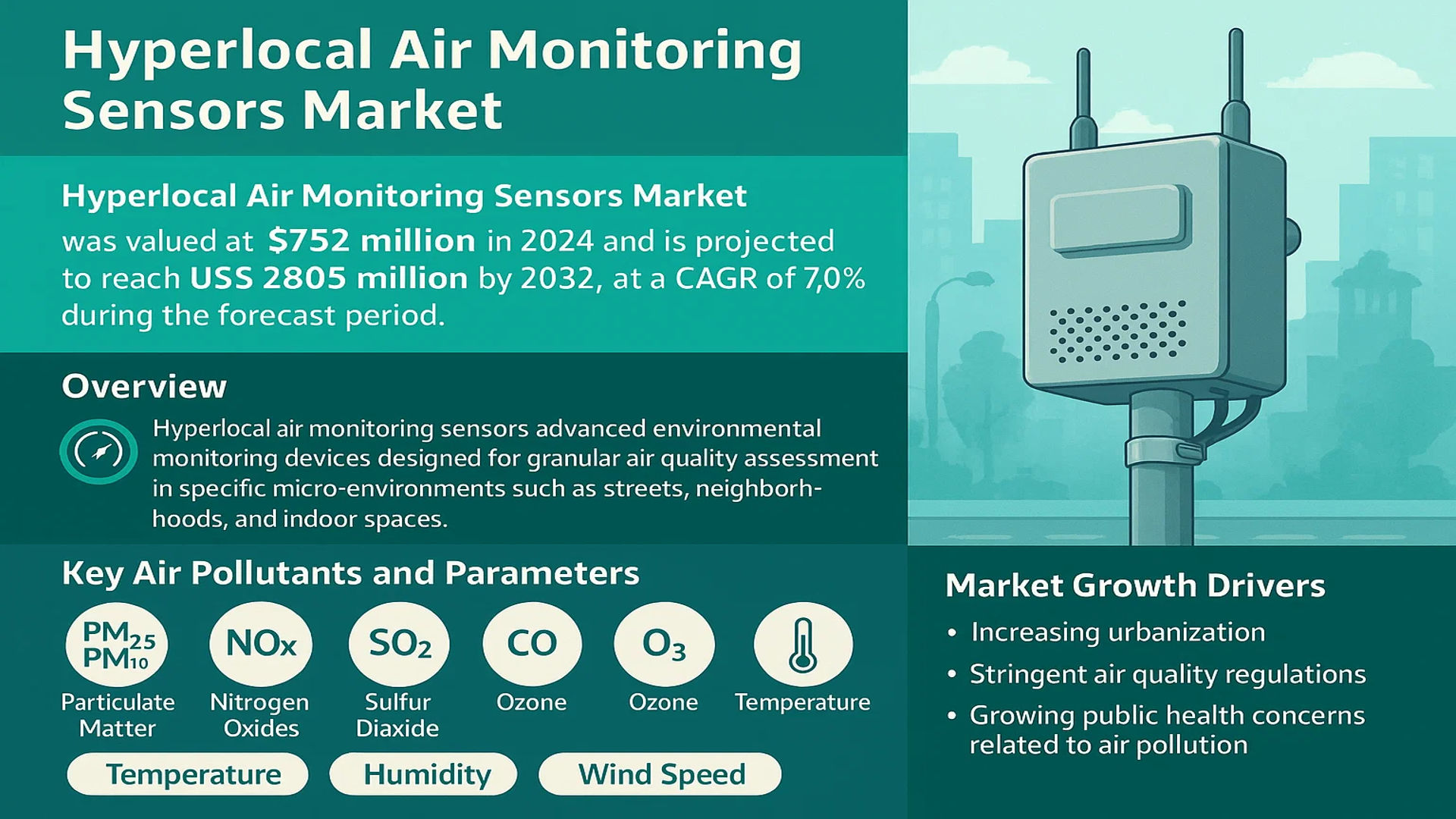
The global Hyperlocal Air Monitoring Sensors Market was valued at 1752 million in 2024 and is projected to reach US$ 2805 million by 2032, at a CAGR of 7.0% during the forecast period.
Hyperlocal air monitoring sensors are advanced environmental monitoring devices designed for granular air quality assessment in specific micro-environments such as streets, neighborhoods, and indoor spaces. These IoT-enabled sensors measure key air pollutants including particulate matter (PM2.5, PM10), nitrogen oxides (NOx), sulfur dioxide (SO2), carbon monoxide (CO), ozone (O3), and volatile organic compounds (VOCs), along with meteorological parameters like temperature, humidity, and wind speed.
Market growth is driven by increasing urbanization, stringent air quality regulations, and growing public health concerns related to air pollution. The Particulate Matter (PM) Sensor segment currently dominates the market, accounting for over 35% of total revenues in 2024. North America leads regional adoption with 42% market share, followed by Asia-Pacific which is projected to grow at 8.2% CAGR through 2032 due to rapid smart city development in China and India. Key players like Acoem, Clarity Movement, and Aeroqual are expanding their portfolios with AI-powered analytics capabilities to meet the demand for real-time pollution monitoring solutions.
MARKET DYNAMICS
MARKET DRIVERS
Growing Urbanization and Smart City Initiatives Fuel Demand for Hyperlocal Air Monitoring
The rapid urbanization across emerging economies is creating substantial demand for hyperlocal air quality monitoring solutions. With over 56% of the global population now living in urban areas, cities face mounting pressure to manage air pollution effectively. Municipal governments are increasingly deploying hyperlocal sensor networks as part of smart city infrastructure projects, with investments in smart city technologies projected to exceed $1 trillion by 2025. These sensors provide real-time, street-level pollution data that helps urban planners implement targeted mitigation strategies. For instance, several European cities have successfully used hyperlocal data to optimize traffic flow and reduce congestion-related emissions by up to 30% in critical zones.
Heightened Public Awareness of Air Quality Health Impacts Drives Adoption
Increased public understanding of the health consequences of air pollution is accelerating market growth. Studies show that exposure to PM2.5 contributes to approximately 4.2 million premature deaths annually, making real-time air quality monitoring a public health priority. This awareness has led to greater demand from residential communities, schools, and healthcare facilities for localized monitoring solutions. Consumer-grade sensors have become particularly popular, with unit sales growing at over 20% annually as individuals seek to monitor personal exposure levels. Furthermore, the integration of air quality data with health apps and wearable devices is creating new use cases that extend beyond traditional environmental monitoring applications.
Stringent Environmental Regulations Create Compliance-Driven Demand
Governments worldwide are implementing stricter air quality standards and reporting requirements, compelling industries to adopt advanced monitoring technologies. The European Union’s revised Air Quality Directive, for example, mandates real-time pollution monitoring at hyperlocal levels near industrial facilities. Similar regulations in North America and Asia are driving compliance investments, particularly in the oil & gas, manufacturing, and transportation sectors. Industrial applications now account for nearly 35% of hyperlocal sensor deployments as companies seek to avoid substantial fines and demonstrate environmental responsibility. This regulatory push complements growing corporate sustainability initiatives that prioritize emissions monitoring and reduction.
MARKET RESTRAINTS
High Deployment and Maintenance Costs Limit Market Penetration
While hyperlocal air monitoring solutions offer significant benefits, their widespread adoption faces financial barriers. Advanced sensor systems require substantial upfront investment, with professional-grade units costing several thousand dollars each. Additionally, regular calibration and maintenance can increase total cost of ownership by 20-30% annually. These expenses make comprehensive sensor networks prohibitively expensive for many municipalities and small businesses, particularly in developing regions. Even in wealthy nations, budget constraints often result in sparse monitoring coverage that fails to capture true hyperlocal variation in air quality. This cost challenge persists despite recent price reductions in sensor components and IoT connectivity solutions.
Data Quality and Standardization Issues Create Implementation Challenges
The lack of universal standards for hyperlocal air monitoring impacts data reliability and comparability. Different sensor technologies exhibit varying levels of accuracy, with some low-cost models showing error margins exceeding 30% for certain pollutants. This variability complicates regulatory compliance and limits the usefulness of aggregated data from mixed sensor networks. Furthermore, the absence of standardized calibration protocols makes it difficult to ensure consistent performance across deployments. These quality concerns have slowed adoption in critical applications where precise measurements are required, such as health impact assessments and environmental enforcement actions.
Limited Battery Life and Connectivity Constraints Hamper Rural Deployments
Infrastructure limitations present significant barriers to expanding hyperlocal monitoring in remote and rural areas. Many advanced sensors require consistent power sources and cellular connectivity, which may be unavailable in developing regions. Even in developed markets, the power requirements of continuous monitoring can challenge off-grid deployments. Solar-powered solutions have emerged but often struggle with reliability issues during extended periods of low sunlight. These technical constraints currently restrict hyperlocal monitoring to well-serviced urban areas, leaving significant gaps in rural air quality understanding despite growing concerns about agricultural emissions and biomass burning impacts.
MARKET OPPORTUNITIES
Integration with Smart Building Systems Creates New Growth Avenues
The convergence of hyperlocal air monitoring with building automation presents significant commercial opportunities. Modern HVAC systems increasingly incorporate real-time air quality data to optimize ventilation and filtration, improving indoor environmental quality while reducing energy consumption. This integration is particularly valuable for commercial real estate, where studies show improved air quality can enhance cognitive function by up to 80% and reduce sick days by 20%. As building codes evolve to prioritize occupant health, the market for building-integrated sensors is projected to grow at nearly 25% annually through 2030, creating substantial opportunities for manufacturers of multi-parameter monitoring solutions.
Artificial Intelligence Enhances Predictive Capabilities and Market Potential
Advances in machine learning are unlocking new value from hyperlocal air quality data. AI-powered analytics can now predict pollution spikes with over 90% accuracy up to 48 hours in advance by combining sensor data with weather patterns and historical trends. This predictive capability enables proactive public health interventions and dynamic pollution control measures. Several cities have already implemented AI-driven systems that automatically adjust traffic signals and industrial operations based on anticipated air quality conditions. The global market for AI in environmental monitoring is expected to exceed $3 billion by 2027, with air quality applications representing the fastest-growing segment.
Emerging Economies Present Untapped Growth Potential
Developing nations with severe air pollution challenges represent the next frontier for market expansion. Cities across South Asia and Africa often experience pollution levels 10-15 times above WHO guidelines, yet have minimal monitoring infrastructure. International development funding for environmental projects in these regions has increased by 40% since 2020, creating opportunities for cost-effective sensor solutions tailored to local conditions. Local manufacturers are entering the market with rugged, low-maintenance devices priced 50-70% below Western alternatives, making hyperlocal monitoring feasible for budget-constrained municipalities. This emerging market segment is expected to account for over 35% of global sensor shipments by 2028.
MARKET CHALLENGES
Public Skepticism About Data Accuracy Undermines Adoption
Despite technological advancements, public trust in hyperlocal monitoring data remains inconsistent. High-profile cases of sensor malfunction and calibration drift have raised concerns about data reliability, particularly when measurements conflict with government-reported figures. This skepticism is exacerbated by the proliferation of low-cost consumer sensors with unverified performance characteristics. Building confidence in hyperlocal data requires robust validation protocols and transparent quality assurance processes, which many current systems lack. Until these issues are addressed, the full potential of hyperlocal monitoring to inform public policy and individual decision-making will remain unrealized.
Cybersecurity Risks Threaten Network Integrity
The increasing connectivity of air quality monitoring infrastructure creates new vulnerability to cyberattacks. Distributed sensor networks present multiple potential entry points for malicious actors seeking to manipulate environmental data or disrupt monitoring systems. Several cities have reported instances of sensor spoofing that falsely indicated dangerous pollution levels, triggering unnecessary public alerts. As political and economic decisions become increasingly data-driven, ensuring the security of hyperlocal monitoring networks will require substantial investments in encryption, authentication protocols, and anomaly detection systems. These security measures add complexity and cost to deployments while creating new technical challenges for network operators.
Regulatory Fragmentation Complicates Cross-Border Deployments
The lack of harmonized international standards for hyperlocal air monitoring creates operational challenges for global solution providers. Different regions employ varying measurement methodologies, reporting formats, and certification requirements for environmental sensors. This regulatory fragmentation forces manufacturers to develop multiple product variants and limits the scalability of monitoring solutions. Furthermore, inconsistent data collection and reporting practices hinder comparative analysis of air quality across jurisdictions, reducing the effectiveness of transnational pollution control initiatives. Industry efforts to establish universal technical standards have made progress but face resistance from governments protective of their regulatory authority.
HYPERLOCAL AIR MONITORING SENSORS MARKET TRENDS
Rising Smart City Initiatives Fuel Demand for Hyperlocal Air Monitoring
The global push toward smart city development has emerged as a primary driver for the hyperlocal air monitoring sensors market. Governments worldwide are prioritizing real-time air quality data to enhance urban planning and public health measures, leading to increased adoption of IoT-enabled sensor networks. Over 500 cities globally have already deployed hyperlocal air monitoring systems, and this number is expected to grow significantly as environmental regulations tighten. The ability of these sensors to detect pollutants like PM2.5, NO2, and VOCs at street-level precision supports targeted pollution control strategies. Leading manufacturers are responding with compact, low-power sensors that integrate seamlessly with smart city infrastructure, reinforcing market expansion.
Other Trends
Technological Advancements in Sensor Miniaturization
Recent breakthroughs in MEMS (Micro-Electro-Mechanical Systems) technology have enabled the production of ultra-compact, high-accuracy air quality sensors at reduced costs. Innovations such as laser-based particulate detection and electrochemical gas sensors now offer sub-μg/m3 precision, making hyperlocal monitoring feasible for residential and small-scale industrial applications. Partnerships between sensor manufacturers and cloud analytics providers are further enhancing data usability, with real-time dashboards becoming standard for municipal and commercial users. This trend is particularly pronounced in Asia-Pacific, where rapid urbanization necessitates scalable air quality solutions.
Growing Emphasis on Industrial Compliance and Worker Safety
Stringent occupational safety regulations are accelerating hyperlocal sensor adoption in manufacturing, construction, and energy sectors. The U.S. OSHA and EU-OSHA now mandate continuous air quality monitoring in high-risk workplaces, driving a 22% annual growth in industrial sensor deployments. Real-time detection of hazardous gases like CO and SO2 helps prevent accidents while ensuring regulatory compliance. Emerging applications include integration with personal protective equipment (PPE), where wearable sensors alert workers to dangerous airborne particulates. This trend aligns with broader Industry 4.0 initiatives, positioning hyperlocal monitoring as a critical component of connected factory ecosystems.
COMPETITIVE LANDSCAPE
Key Industry Players
Innovation and Strategic Expansion Drive Market Leadership in Hyperlocal Air Monitoring
The global hyperlocal air monitoring sensors market is characterized by a dynamic competitive environment, with both established technology leaders and emerging innovators vying for market share. Acoem Group and Clarity Movement currently dominate the landscape, leveraging their extensive product portfolios and established distribution networks. The market saw the top five players collectively account for approximately 38% of global revenue in 2024, indicating a semi-consolidated structure.
Sensirion has emerged as a particularly strong competitor, capitalizing on its expertise in environmental sensing technologies. The company’s recent launch of its next-generation PM2.5 sensors has significantly strengthened its position in smart city applications. Similarly, PurpleAir continues to gain traction through its citizen science approach, making air quality monitoring accessible to community groups and individuals.
Several companies are pursuing aggressive expansion strategies to gain market share. Vaisala recently completed the acquisition of Aeroqual Limited, combining their atmospheric monitoring capabilities to create a more comprehensive solution for industrial customers. This trend towards consolidation is expected to continue as companies seek to broaden their technological capabilities and geographic reach.
List of Key Hyperlocal Air Monitoring Sensor Companies Profiled
- Acoem Group (France)
- Clarity Movement (U.S.)
- Aeroqual Limited (New Zealand)
- Sensirion AG (Switzerland)
- PurpleAir (U.S.)
- Vaisala (Finland)
- Plantower (China)
- Hikvision (China)
- Siemens (Germany)
- AirSENCE (UAE)
- AirGradient (Thailand)
- Breeze Technologies (Germany)
- Dylos Corporation (U.S.)
Segment Analysis:
By Type
Particulate Matter (PM) Sensor Segment Leads Due to Rising Urban Pollution Concerns
The market is segmented based on type into:
- Particulate Matter (PM) Sensor
- Subtypes: PM1.0, PM2.5, PM10 sensors
- Gas Sensor
- Subtypes: NOx, SOx, CO, O3, VOCs sensors
- Weather Parameter Sensor
- Subtypes: Temperature, humidity, wind speed, pressure sensors
- Multi-Parameter Sensors
By Application
Smart City Construction Segment Dominates as Governments Prioritize Sustainable Urban Development
The market is segmented based on application into:
- Smart City Construction
- Public Health Protection
- Industry and Energy
- Construction and Transportation
- Others
By End User
Municipal Authorities Lead Adoption Through Environmental Monitoring Programs
The market is segmented based on end user into:
- Municipal Authorities
- Environmental Agencies
- Industrial Facilities
- Research Institutions
- Commercial Complexes
Regional Analysis: Hyperlocal Air Monitoring Sensors Market
North America
North America leads the hyperlocal air monitoring sensors market, driven by stringent environmental policies and advanced IoT infrastructure. The U.S. EPA’s Clean Air Act mandates rigorous air quality monitoring, accelerating demand for hyperlocal sensors across cities like Los Angeles, New York, and Chicago. The region accounted for approximately 35% of the global market revenue in 2024. Key players such as Clarity Movement, Aeroqual, and PurpleAir dominate with IoT-integrated solutions for smart city projects and industrial compliance. However, high costs of precision sensors and data management remain adoption barriers. Investments in 5G networks and AI-driven analytics are expected to sustain growth, particularly for PM2.5 and VOCs monitoring in urban areas.
Asia-Pacific
The Asia-Pacific region is the fastest-growing market, projected to register a CAGR of 9.2% (2024–2032), fueled by urbanization and worsening air pollution in China and India. China’s “Blue Sky” initiative has deployed over 24,000 hyperlocal sensors nationwide, with Plantower and Hikvision emerging as key suppliers. India’s National Clean Air Programme (NCAP) prioritizes sensor-based monitoring, though cost sensitivity limits adoption of advanced technologies. Southeast Asian cities like Jakarta and Bangkok are partnering with startups like AirGradient to combat transboundary haze. Despite growth, inconsistent regulatory enforcement and limited technical expertise in rural areas pose challenges.
Europe
Europe’s market thrives on strict EU directives, such as the Ambient Air Quality Directive, pushing for real-time pollution tracking. Germany and France are primary adopters, with SIEMENS and Bosch providing industrial-grade sensors for NO2 and O3 monitoring. The EU-funded “Copernicus Atmosphere Monitoring Service” integrates hyperlocal data for policy-making. Scandina-vian countries emphasize portable sensors for public health, exemplified by Airthings’ consumer devices. High R&D investments in low-power, long-life sensors offset by slower adoption in Eastern Europe due to budget constraints.
Middle East & Africa
This region shows nascent but promising growth, with the UAE and Saudi Arabia investing in smart city projects like NEOM and Dubai’s Air Quality Strategy. Vaisala and Libelium supply sensors for dust and SO2 monitoring in oil-intensive economies. South Africa’s urban centers deploy low-cost sensors from AirSENCE, yet funding gaps and arid climates affecting sensor durability hinder scalability. Long-term potential lies in public-private partnerships to address air quality in growing megacities.
South America
Brazil and Argentina are pivotal markets, where hyperlocal sensors monitor emissions from agriculture and transportation. São Paulo’s environmental agency uses Acoem sensors to tackle vehicular pollution, while economic instabilities delay large-scale rollouts. Chile’s mining sector adopts MicroSensor’s ruggedized devices, though lack of standardized regulations slows market maturation. Grassroots initiatives, like Chile’s “Aire Libre” network, demonstrate community-driven demand for localized air quality data.
Report Scope
This market research report provides a comprehensive analysis of the global and regional Hyperlocal Air Monitoring Sensors markets, covering the forecast period 2024–2032. It offers detailed insights into market dynamics, technological advancements, competitive landscape, and key trends shaping the industry.
Key focus areas of the report include:
- Market Size & Forecast: Historical data and future projections for revenue, unit shipments, and market value across major regions and segments. The global Hyperlocal Air Monitoring Sensors market was valued at USD 1,752 million in 2024 and is projected to reach USD 2,805 million by 2032, at a CAGR of 7.0% during the forecast period.
- Segmentation Analysis: Detailed breakdown by product type (Particulate Matter (PM) Sensor, Gas Sensor, Weather Parameter Sensor), application (Smart City Construction, Public Health Protection, Industry and Energy, Construction and Transportation, Others), and end-user industry to identify high-growth segments and investment opportunities.
- Regional Outlook: Insights into market performance across North America, Europe, Asia-Pacific, Latin America, and the Middle East & Africa, including country-level analysis. The U.S. market size is estimated at USD million in 2024, while China is projected to reach USD million by 2032.
- Competitive Landscape: Profiles of leading market participants, including their product offerings, R&D focus, manufacturing capacity, pricing strategies, and recent developments such as mergers, acquisitions, and partnerships. Key players include Acoem, Clarity Movement, Aeroqual, AccuWeather, Sensirion, PurpleAir, Vaisala, Plantower, MicroSensor, and Cube Sensors.
- Technology Trends & Innovation: Assessment of emerging technologies, integration of AI/IoT, miniaturization of sensors, real-time data transmission, and evolving industry standards.
- Market Drivers & Restraints: Evaluation of factors driving market growth, such as increasing urbanization, stringent environmental regulations, and rising health concerns, along with challenges like high costs and technical complexities.
- Stakeholder Analysis: Insights for component suppliers, OEMs, system integrators, investors, and policymakers regarding the evolving ecosystem and strategic opportunities.
Primary and secondary research methods are employed, including interviews with industry experts, data from verified sources, and real-time market intelligence to ensure the accuracy and reliability of the insights presented.
FREQUENTLY ASKED QUESTIONS:
What is the current market size of Global Hyperlocal Air Monitoring Sensors Market?
-> Hyperlocal Air Monitoring Sensors Market was valued at 1752 million in 2024 and is projected to reach US$ 2805 million by 2032, at a CAGR of 7.0% during the forecast period.
Which key companies operate in Global Hyperlocal Air Monitoring Sensors Market?
-> Key players include Acoem, Clarity Movement, Aeroqual, AccuWeather, Sensirion, PurpleAir, Vaisala, Plantower, MicroSensor, and Cube Sensors, among others.
What are the key growth drivers?
-> Key growth drivers include increasing urbanization, stringent environmental regulations, rising health concerns, and the need for real-time air quality monitoring.
Which region dominates the market?
-> Asia-Pacific is the fastest-growing region, while North America remains a dominant market due to advanced infrastructure and regulatory frameworks.
What are the emerging trends?
-> Emerging trends include integration of AI/IoT, miniaturization of sensors, real-time data transmission, and increasing adoption in smart city projects.

Get Sample Report PDF for Exclusive Insights
Report Sample Includes
- Table of Contents
- List of Tables & Figures
- Charts, Research Methodology, and more...
 Download Sample Report PDF


