
MARKET INSIGHTS
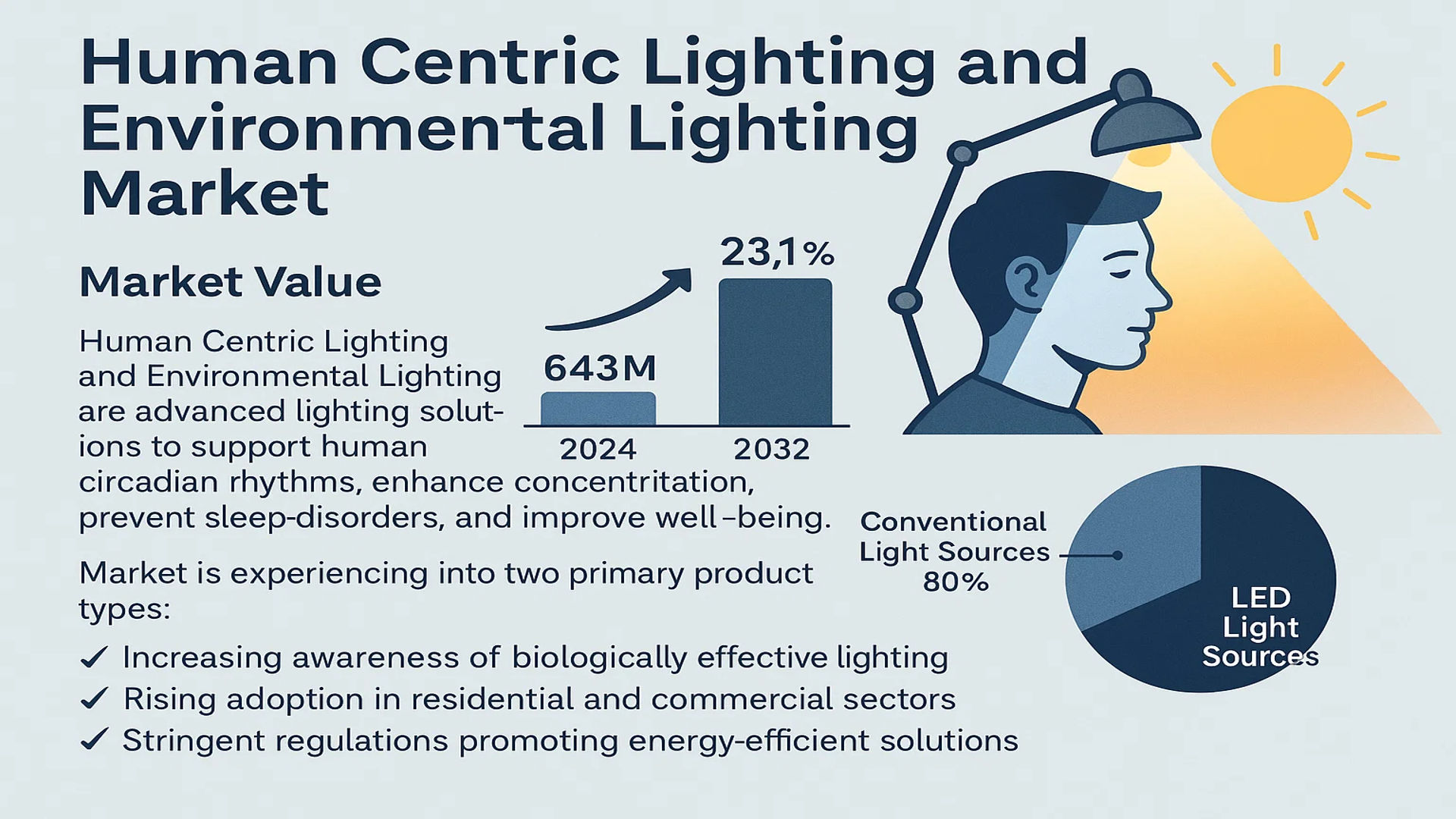
The global Human Centric Lighting and Environmental Lighting Market was valued at 643 million in 2024 and is projected to reach US$ 2661 million by 2032, at a CAGR of 23.1% during the forecast period.
Human Centric Lighting (HCL) and Environmental Lighting are advanced lighting solutions designed to support human circadian rhythms, enhance concentration, prevent sleep disorders, and improve overall well-being. These systems dynamically adjust light intensity and color temperature throughout the day to mimic natural daylight patterns, thereby positively influencing biological functions and productivity. The market comprises two primary product types: Conventional Light Sources, which still hold a dominant share of approximately 80%, and the rapidly advancing LED Light Sources segment.
The market is experiencing robust growth driven by increasing awareness of the health benefits of biologically effective lighting, rising adoption in residential and commercial sectors, and stringent regulations promoting energy-efficient solutions. Germany stands as the largest production hub, accounting for nearly 50% of global output, due to its strong manufacturing base and technological leadership. Key players such as Lumitech, which holds a significant portfolio of patents and serves high-end customers, along with OSRAM, Philips, and Regiolux, are actively driving innovation and market expansion through continuous product development and strategic initiatives.
MARKET DYNAMICS
MARKET DRIVERS
Rising Awareness of Health and Well-being to Propel Market Growth
The growing emphasis on health and wellness is significantly driving the adoption of human centric lighting solutions globally. These systems are designed to align with the human circadian rhythm, enhancing mood, productivity, and overall physiological well-being. With increasing evidence linking proper lighting to reduced sleep disorders and improved cognitive performance, demand is surging across residential, commercial, and healthcare sectors. The market is further bolstered by a rising prevalence of conditions such as seasonal affective disorder and increased screen time, which disrupt natural light exposure. Investments in research demonstrating the benefits of tunable white light and dynamic lighting scenarios have validated their role in creating healthier indoor environments, making them integral to modern architectural and interior design practices.
Technological Advancements and Smart Building Integration to Accelerate Adoption
Technological innovation is a critical driver for the human centric and environmental lighting market. The integration of Internet of Things (IoT) capabilities, sensors, and advanced control systems allows for real-time adjustments in lighting based on occupancy, time of day, and natural light availability. These smart lighting systems not only enhance energy efficiency but also contribute to personalized user experiences. The shift toward LED technology, which offers superior controllability and longer lifespan compared to conventional light sources, has been a major enabler. Furthermore, the convergence of lighting with building management systems enables seamless automation, reducing operational costs and supporting sustainability goals. This technological synergy is expanding applications in smart cities, corporate offices, and healthcare facilities, driving consistent market expansion.
Regulatory Support and Sustainability Initiatives to Fuel Demand
Government regulations and global sustainability initiatives are playing a pivotal role in market growth. Stricter energy efficiency standards and green building certifications, such as LEED and WELL, encourage the adoption of human centric and environmental lighting solutions. These systems contribute significantly to reducing energy consumption while improving occupant well-being, aligning with corporate social responsibility goals. Incentives for retrofitting existing infrastructure with energy-efficient lighting further stimulate market demand. Additionally, public health organizations are increasingly recognizing the role of lighting in mental and physical health, leading to supportive policies and guidelines. This regulatory environment, combined with rising consumer awareness, creates a strong foundation for sustained market development.
MARKET CHALLENGES
High Initial Investment and Installation Costs to Hinder Market Penetration
Despite the promising growth trajectory, the high upfront costs associated with human centric lighting systems present a significant challenge. These systems require specialized fixtures, sensors, control interfaces, and often extensive customization, making them more expensive than traditional lighting solutions. The initial investment can be prohibitive for small and medium-sized enterprises, as well as budget-conscious residential consumers. Additionally, retrofitting existing buildings with these advanced systems involves not only product costs but also expenses related to structural modifications, professional installation, and system integration. This financial barrier slows adoption rates, particularly in price-sensitive markets and developing regions, where cost remains a primary decision-making factor.
Other Challenges
Complexity in Design and Implementation
The complexity of designing and implementing human centric lighting systems poses a substantial challenge. Creating lighting environments that effectively mimic natural light patterns requires careful planning, spectral tuning, and integration with architectural elements. Inconsistent results due to improper design can lead to user dissatisfaction and undermine the perceived benefits. Moreover, the need for ongoing calibration and maintenance adds to the operational challenges, requiring specialized knowledge and resources.
Lack of Standardization and Awareness
The absence of universally accepted standards for human centric lighting parameters creates ambiguity in product development and application. This lack of standardization can result in varying product quality and performance, confusing consumers and potentially eroding trust in the technology. Furthermore, despite growing awareness, a significant portion of the market remains uninformed about the benefits and functionalities of these systems, slowing mainstream adoption and limiting market potential.
MARKET RESTRAINTS
Economic Volatility and Supply Chain Disruptions to Constrain Market Growth
Economic instability and global supply chain challenges present significant restraints for the human centric and environmental lighting market. Fluctuations in raw material costs, particularly for semiconductors and rare earth elements used in LED manufacturing, impact product pricing and profitability. Geopolitical tensions and trade restrictions can disrupt the supply of critical components, leading to production delays and increased costs. Additionally, economic downturns reduce discretionary spending by businesses and consumers, delaying investments in advanced lighting solutions. These factors collectively create an uncertain business environment, making long-term planning and expansion more challenging for market participants.
MARKET OPPORTUNITIES
Expansion in Healthcare and Educational Sectors to Unlock New Growth Avenues
The healthcare and education sectors present substantial growth opportunities for human centric lighting. In healthcare facilities, these systems are increasingly used to support patient recovery, regulate sleep-wake cycles, and improve staff alertness and performance. Similarly, in educational institutions, optimized lighting enhances student concentration, reduces eye strain, and creates more conducive learning environments. The growing recognition of these benefits, coupled with increasing investments in healthcare infrastructure and educational modernization, is driving demand. Tailored solutions for these sectors, supported by evidence-based research, offer significant potential for market expansion and innovation.
Emerging Markets and Urbanization Trends to Drive Future Demand
Rapid urbanization and economic development in emerging markets create lucrative opportunities for human centric and environmental lighting. Growing urban populations and increasing construction activities, particularly in Asia-Pacific and Middle Eastern regions, drive the need for advanced lighting solutions in residential, commercial, and public infrastructure projects. Rising disposable incomes and growing awareness of sustainable living further support market growth. Additionally, government initiatives promoting smart city development and energy efficiency provide a favorable regulatory environment, encouraging the adoption of innovative lighting technologies in these high-growth regions.
HUMAN CENTRIC LIGHTING AND ENVIRONMENTAL LIGHTING MARKET TRENDS
Integration of IoT and Smart Building Ecosystems Emerges as a Dominant Trend
The integration of Internet of Things (IoT) technology with Human Centric Lighting (HCL) and Environmental Lighting systems is fundamentally reshaping the market landscape. These intelligent systems dynamically adjust color temperature and intensity throughout the day to align with natural circadian rhythms, thereby enhancing occupant well-being and productivity. The global market, valued at 643 million in 2024, is experiencing accelerated growth due to this technological convergence, with projections indicating it will reach 2661 million by 2032. This represents a compound annual growth rate of 23.1%, significantly outpacing many other segments within the broader lighting industry. The proliferation of connected devices and sensors enables real-time data collection on occupancy patterns, daylight availability, and user preferences, allowing for fully automated, personalized lighting environments. Furthermore, the interoperability of these systems with broader Building Management Systems (BMS) creates a seamless, energy-efficient ecosystem that is becoming a standard requirement in new commercial and high-end residential construction projects worldwide.
Other Trends
Rising Demand in Healthcare and Corporate Wellness Applications
The application of Human Centric Lighting is expanding rapidly within the healthcare sector and corporate wellness programs, driven by a growing body of scientific evidence supporting its benefits. In clinical settings, these lighting solutions are proven to aid patient recovery, reduce depression rates, and regulate sleep-wake cycles, particularly in environments like hospitals and senior living facilities. For instance, studies have shown that tailored lighting can improve sleep efficiency by up to 15% in healthcare environments. Simultaneously, the corporate world is increasingly adopting HCL to enhance employee well-being and productivity. Offices equipped with circadian lighting systems report reductions in eyestrain and headaches among workers, while some data suggests a potential increase in cognitive performance and alertness during afternoon hours. This dual demand from healthcare and corporate wellness is a substantial driver, accounting for a significant portion of the non-residential market segment.
Technological Advancements and Market Consolidation
The market is characterized by rapid technological advancements, particularly in LED technology, which now dominates new installations. While conventional light sources still hold a considerable share of the existing installed base at nearly 80%, the shift toward LED-based HCL solutions is accelerating due to their superior controllability, energy efficiency, and longer lifespan. Germany stands as the epicenter of production and innovation, manufacturing nearly 50% of global output, with companies like Lumitech leading through extensive patent portfolios and high-end technological development. This has created a somewhat concentrated market landscape where a few key players hold significant influence. The industry is also witnessing increased merger and acquisition activity as larger electronics and lighting conglomerates seek to acquire specialized HCL technology and expertise to integrate into their broader smart building and IoT offerings, further consolidating the market around technologically advanced leaders.
COMPETITIVE LANDSCAPE
Key Industry Players
Market Leaders Focus on Innovation and Strategic Expansion to Capture Growth
The global Human Centric Lighting and Environmental Lighting market exhibits a semi-consolidated structure, characterized by the presence of established multinational corporations, specialized medium-sized enterprises, and emerging innovators. Lumitech (Austria) stands as the undisputed technological leader, holding a significant portfolio of key patents and maintaining a near-monopoly position with high-end clientele. Their dominance is rooted in pioneering research on circadian-effective lighting solutions and a stronghold in the European market, which accounts for nearly 50% of global production.
OSRAM (Germany) and Signify (Philips Lighting) (Netherlands) are other major forces, leveraging their vast global distribution networks and extensive brand recognition. These companies hold substantial market share due to their comprehensive product offerings that span both conventional and advanced LED-based Human Centric Lighting systems. Their growth is further propelled by continuous investment in R&D, focusing on IoT integration and smart lighting ecosystems that enhance user well-being and energy efficiency.
Meanwhile, several other players are strengthening their positions through targeted strategies. Companies like Trilux (Germany) and Glamox Luxo (Norway) are aggressively expanding their market presence by focusing on specific applications such as office and industrial lighting, where demand for ergonomic and biologically effective lighting is rising. Their growth initiatives often include geographical expansion into high-growth regions like Asia-Pacific and strategic partnerships with building management system providers.
Furthermore, specialized firms such as Waldmann (Germany) and Regiolux (Germany) are consolidating their niches—particularly in healthcare and education lighting—through significant investments in clinical research that proves the efficacy of their products in improving patient outcomes and student concentration. This focus on evidence-based design and application-specific solutions is expected to be a key differentiator and growth driver in the coming years.
List of Key Companies Profiled in the Human Centric Lighting and Environmental Lighting Market
- Lumitech (Austria)
- OSRAM Licht AG (Germany)
- Signify N.V. (Philips Lighting) (Netherlands)
- Regiolux (Germany)
- Glamox Luxo AS (Norway)
- OEM Systems Group (U.K.)
- Waldmann Lighting (Germany)
- Riegens A/S (Denmark)
- TRILUX GmbH & Co. KG (Germany)
Segment Analysis:
By Light Source Type
Conventional Light Sources Segment Dominates the Market Due to Established Infrastructure and Cost-Effectiveness
The market is segmented based on light source type into:
- Conventional Light Sources
- Subtypes: Fluorescent, Halogen, Incandescent, and others
- LED Light Sources
By Application
Residential Segment Leads Due to Growing Consumer Focus on Health, Wellness, and Home Comfort
The market is segmented based on application into:
- Residential
- Office
- Industrial
- Hospital
- Education
- Others
By Technology
Tunable White Technology Gains Traction for its Ability to Mimic Natural Daylight Patterns
The market is segmented based on technology into:
- Tunable White
- Color Tuning
- Dimming
- Standard Static Lighting
By System Type
Integrated Systems are Favored for Seamless Control and Synchronization Across Environments
The market is segmented based on system type into:
- Integrated Lighting Systems
- Standalone Fixtures
- Retrofit Solutions
Regional Analysis: Human Centric Lighting and Environmental Lighting Market
Europe
Europe is the undisputed leader in the Human Centric Lighting (HCL) and Environmental Lighting market, driven by a combination of technological innovation, stringent regulatory frameworks, and a deep-rooted cultural emphasis on well-being and sustainability. Germany stands as the production powerhouse for the region, accounting for nearly 50% of global production. This dominance is largely attributed to the presence of industry pioneers like Lumitech, which holds key technologies and patents, effectively creating a near-monopoly position in the high-end segment. The region’s growth is further propelled by the EU’s Green Deal and building certifications such as WELL and BREEAM, which incentivize the adoption of lighting solutions that enhance occupant health and reduce energy consumption. While Conventional Light Sources still hold an 80% market share by type due to existing infrastructure, there is a rapid and decisive shift towards LED Light Sources because of their superior tunability and energy efficiency. The primary application remains the Residential sector, which constitutes over 45% of the regional market, as consumers increasingly invest in home environments that support their circadian rhythms and overall well-being.
North America
The North American market is characterized by robust growth, fueled by a rising awareness of the health benefits associated with circadian lighting and the modernization of commercial and residential infrastructure. The United States is the largest contributor, with significant adoption in the Office and Healthcare sectors. Major corporations are retrofitting workspaces with HCL systems to boost employee productivity, concentration, and well-being, while hospitals are utilizing these solutions to aid patient recovery and regulate sleep disorders. The market is highly competitive, with global giants like Philips and OSRAM actively competing with specialized firms. However, a key challenge is the higher initial cost of advanced HCL systems compared to conventional lighting, which can slow adoption in more cost-sensitive segments. Despite this, long-term energy savings and proven health outcomes are driving increased investment, positioning North America as a high-value, innovation-driven market.
Asia-Pacific
The Asia-Pacific region represents the fastest-growing market for HCL, albeit from a smaller base, driven by massive urbanization, rapid infrastructure development, and a growing middle class. While the region is a volume leader in conventional lighting manufacturing, the adoption of sophisticated Human Centric Lighting is currently concentrated in high-end commercial projects, luxury residential developments, and new healthcare facilities in countries like China, Japan, and South Korea. The market is highly price-sensitive, which means Conventional Light Sources still dominate overall sales. However, government initiatives promoting smart cities and green buildings are beginning to create a fertile ground for more advanced environmental lighting solutions. The potential for growth is enormous because of the sheer scale of construction activity, but widespread adoption hinges on reducing costs and increasing awareness of the non-visual benefits of light beyond mere illumination.
South America
The South American market for Human Centric Lighting is in a nascent stage of development. Economic volatility and fluctuating currency values remain significant barriers, making the import and installation of high-cost, advanced lighting systems a challenge for many projects. Adoption is currently limited to isolated, high-budget projects in major urban centers within countries like Brazil and Argentina, often within the commercial office or luxury residential sectors. There is a general lack of stringent regulations or building standards specifically mandating human-centric lighting principles, which further slows market momentum. Nonetheless, as awareness of environmental sustainability and occupant well-being grows among architects and developers, a gradual increase in demand is anticipated over the long term, presenting a future opportunity for market players.
Middle East & Africa
The market in the Middle East & Africa is emerging and is primarily driven by large-scale infrastructure and luxury development projects, particularly in Gulf Cooperation Council (GCC) nations like the UAE, Saudi Arabia, and Qatar. These countries are incorporating HCL principles into iconic commercial towers, high-end hotels, and new healthcare cities as a marker of innovation and luxury. The focus is often on the environmental lighting aspect—achieving high energy efficiency and meeting green building standards like LEED. However, the broader adoption of lighting for its human-centric, biological benefits is still limited to these premium segments. Across the wider region, progress is hindered by economic constraints, a lack of specific regulations, and limited local manufacturing capabilities, making it a market with potential that is yet to be fully realized.
Report Scope
This market research report provides a comprehensive analysis of the global Human Centric Lighting and Environmental Lighting market, covering the forecast period 2025–2032. It offers detailed insights into market dynamics, technological advancements, competitive landscape, and key trends shaping the industry.
Key focus areas of the report include:
- Market Size & Forecast: Historical data and future projections for revenue, unit shipments, and market value across major regions and segments.
- Segmentation Analysis: Detailed breakdown by product type, technology, application, and end-user industry to identify high-growth segments and investment opportunities.
- Regional Outlook: Insights into market performance across North America, Europe, Asia-Pacific, Latin America, and the Middle East & Africa, including country-level analysis where relevant.
- Competitive Landscape: Profiles of leading market participants, including their product offerings, R&D focus, manufacturing capacity, pricing strategies, and recent developments such as mergers, acquisitions, and partnerships.
- Technology Trends & Innovation: Assessment of emerging technologies, integration of IoT and smart building systems, circadian lighting design trends, and evolving industry standards.
- Market Drivers & Restraints: Evaluation of factors driving market growth along with challenges, supply chain constraints, regulatory issues, and market-entry barriers.
- Stakeholder Analysis: Insights for component suppliers, OEMs, system integrators, investors, and policymakers regarding the evolving ecosystem and strategic opportunities.
Primary and secondary research methods are employed, including interviews with industry experts, data from verified sources, and real-time market intelligence to ensure the accuracy and reliability of the insights presented.
FREQUENTLY ASKED QUESTIONS:
What is the current market size of Global Human Centric Lighting and Environmental Lighting Market?
->Human Centric Lighting and Environmental Lighting Market was valued at 643 million in 2024 and is projected to reach US$ 2661 million by 2032, at a CAGR of 23.1% during the forecast period.
Which key companies operate in Global Human Centric Lighting and Environmental Lighting Market?
-> Key players include Lumitech, OSRAM, Philips, Regiolux, Glamox Luxo, OEM Systems Group, Waldmann, Riegens, and Trilux, among others.
What are the key growth drivers?
-> Key growth drivers include increasing awareness of health and well-being benefits, adoption in smart buildings, and stringent energy efficiency regulations.
Which region dominates the market?
-> Europe is the dominant market, with Germany accounting for nearly 50% of global production.
What are the emerging trends?
-> Emerging trends include integration with IoT systems, tunable LED solutions, and increased adoption in healthcare and educational facilities.

Get Sample Report PDF for Exclusive Insights
Report Sample Includes
- Table of Contents
- List of Tables & Figures
- Charts, Research Methodology, and more...
 Download Sample Report PDF



