Key Statistics
Key Takeaways
- The market is valued at USD 143.06 million in 2025 and is projected to reach USD 221.22 million by 2034, representing a 5.0% CAGR over 2026–2034.
- 2000 ppm is a major product segment, while adjacent variants are expanding as performance, integration and cost requirements evolve.
- Medical is a leading application area, supported by demand across Automotive, Food & Consumer Goods.
- Asia Pacific is the largest market in 2025 based on current demand, technology concentration and ecosystem maturity.
Hot Wire Semiconductor Sensors Market Overview
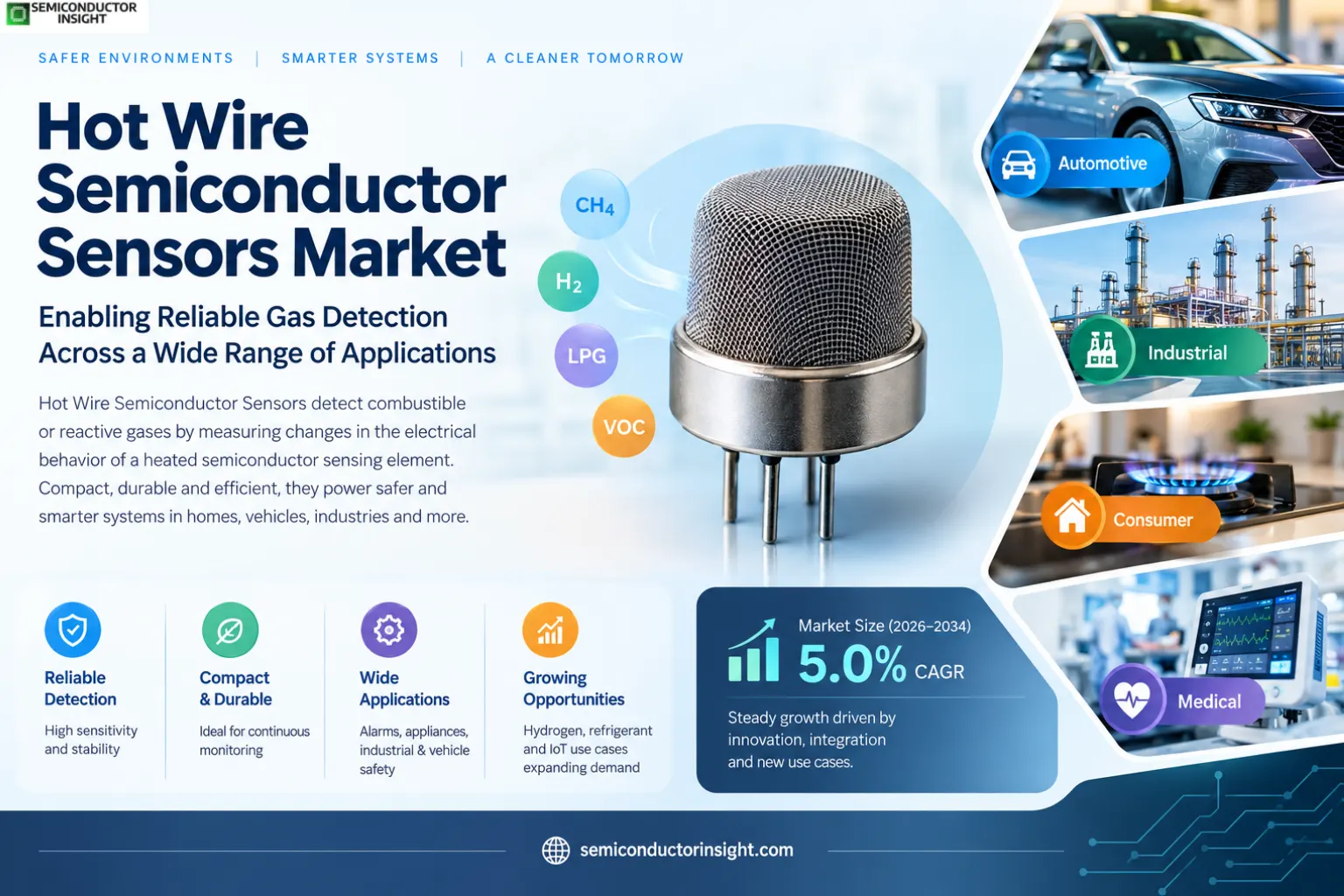
Hot Wire Semiconductor Sensors detect combustible or reactive gases by measuring changes in the electrical behavior of a heated semiconductor sensing element. The architecture is compact, durable and well suited to continuous monitoring, allowing manufacturers to integrate gas sensing into alarms, appliances, industrial equipment and vehicle safety systems. Commercial adoption of Hot Wire Semiconductor Sensors products therefore depends on system-level productivity, integration requirements, reliability expectations and the economics of replacing established alternatives in real operating environments.
Market growth is steady rather than explosive because the technology is mature, but new hydrogen, refrigerant and IoT use cases are widening demand. Suppliers are improving selectivity, power consumption and calibration stability while shrinking sensor size, helping hot-wire and related semiconductor sensors move into battery-powered and embedded platforms. Suppliers that translate technical improvements into measurable gains in efficiency, uptime, cost, throughput or workflow simplicity are better positioned to win long-duration programs and repeat purchases.
Segment Analysis: By Type
2000 ppm and 5000 ppm devices address common combustible-gas and low-concentration monitoring ranges, while specialized products extend above or below these levels for leak detection and air-quality tasks. Selection depends on sensitivity, alarm threshold, cross-sensitivity and calibration strategy rather than range alone. Within this segment, customers increasingly compare lifecycle support, qualification requirements, integration effort and total ownership cost rather than relying on a single specification or upfront price.
| Segment | Market Relevance |
|---|---|
| 2000 ppm | Common low-concentration detection range. |
| 5000 ppm | Broad combustible-gas monitoring range. |
| Other Detection Ranges | Application-specific sensitivity and full-scale ranges. |
Segment Analysis: By Application
Automotive and industrial safety are important growth applications because hydrogen, refrigerant and combustible-gas monitoring is becoming more common in vehicles, plants and HVAC systems. Medical and consumer applications favor miniaturized sensors with low power and stable baseline behavior. Within this segment, customers increasingly compare lifecycle support, qualification requirements, integration effort and total ownership cost rather than relying on a single specification or upfront price.
| Segment | Market Relevance |
|---|---|
| Medical | Breath, gas-flow and clinical monitoring niches. |
| Automotive | Hydrogen, refrigerant and cabin safety. |
| Food & Consumer Goods | Appliance and indoor safety applications. |
| Industrial Safety | Fixed and portable leak detection. |
| Others | Smart-home and specialty monitoring. |
Segment Analysis: By Sensing Principle
Hot-wire semiconductor sensors combine heated sensing elements with semiconductor gas response to provide long life and strong sensitivity in compact packages. MOS and MEMS variants reduce power and size, while catalytic hybrid approaches remain useful where combustible-gas linearity is the priority. Within this segment, customers increasingly compare lifecycle support, qualification requirements, integration effort and total ownership cost rather than relying on a single specification or upfront price.
| Segment | Market Relevance |
|---|---|
| Hot-Wire Semiconductor | Long-life heated semiconductor architecture. |
| MOS / MEMS Semiconductor | Low-power miniaturized integration. |
| Catalytic Hybrid | Combustible-gas accuracy in selected applications. |
Segment Analysis: By Target Gas
Methane and LPG remain the largest residential and safety gases, hydrogen is gaining importance through fuel-cell and battery infrastructure, refrigerant monitoring is expanding with lower-GWP HVAC transitions, and VOC sensing supports indoor-air-quality and process applications. Within this segment, customers increasingly compare lifecycle support, qualification requirements, integration effort and total ownership cost rather than relying on a single specification or upfront price.
| Segment | Market Relevance |
|---|---|
| Methane & LPG | Largest traditional safety use. |
| Hydrogen | Fast-growing clean-energy monitoring. |
| Refrigerants | HVAC and heat-pump transition opportunity. |
| VOCs / Other Gases | Air-quality and process monitoring. |
Regional Analysis
Asia Pacific is the largest market because Japan and China combine major sensor manufacturing with large automotive, appliance and industrial-safety demand. Europe and North America remain important through safety regulation, HVAC transitions and expanding hydrogen infrastructure. Regional share also reflects supplier depth, engineering support, manufacturing concentration and the speed at which new Hot Wire Semiconductor Sensors designs can move from evaluation into repeat deployment.
| Region | Position | Growth | Profile |
|---|---|---|---|
| Asia Pacific | Largest | Strong | Sensor manufacturing and industrial demand led |
| North America | Large safety market | Moderate-strong | HVAC, industrial and automotive led |
| Europe | Regulation-driven market | Moderate-strong | HVAC, automotive and industrial safety led |
| South America | Emerging | Moderate | Residential and industrial safety led |
| Middle East & Africa | Developing | Moderate | Industrial, energy and building safety led |
Detailed Regional Blocks
Why does Asia Pacific matter in this market?
Asia Pacific leads because Japan hosts specialist gas-sensor companies such as Figaro and New Cosmos Electric, while China provides large appliance, automotive and industrial markets. Regional manufacturing scale supports both mature safety sensors and newer low-power MEMS products. In Asia Pacific, procurement decisions also depend on service coverage, qualification resources, logistics and long-term availability, so ecosystem maturity can materially influence adoption even when core technology performance is similar.
| Country / Market | Role | Context |
|---|---|---|
| Japan | Technology and supplier hub | Figaro and New Cosmos provide mature semiconductor gas-sensing platforms. |
| China | Large volume market | Appliances, industrial safety and hydrogen infrastructure support demand. |
| South Korea | Automotive and electronics | Connected devices and vehicle systems broaden use. |
- Figaro states that it commercialized semiconductor-type gas sensors more than 50 years ago and lists production capacity of 3.0 million sensors per month.
- New Cosmos lists proprietary hot-wire semiconductor technology in semiconductor-factory detector systems.
- MEMS-type semiconductor sensors are expanding where lower power and smaller packages are required.
Why does North America matter in this market?
North America combines strict safety practices with large HVAC, industrial and mobility markets. Refrigerant transitions and hydrogen projects create incremental opportunities beyond traditional residential combustible-gas alarms. In North America, procurement decisions also depend on service coverage, qualification resources, logistics and long-term availability, so ecosystem maturity can materially influence adoption even when core technology performance is similar.
| Country / Market | Role | Context |
|---|---|---|
| United States | Largest regional market | Industrial safety, HVAC and clean-energy projects drive demand. |
| Canada | Industrial and hydrogen niche | Energy and transport projects support monitoring. |
| Mexico | Automotive and appliance manufacturing | Assembly creates downstream sensor use. |
- Low-power embedded sensing is increasingly useful in connected HVAC and building products.
- Hydrogen monitoring creates new opportunities around fueling, storage and vehicle systems.
- Portable leak detectors remain important for installation and service technicians.
Why does Europe matter in this market?
Europe is a significant market because refrigerant regulation, industrial safety and automotive electrification increase demand for gas sensing. Sensor makers compete on standards compliance, lifetime and resistance to interfering gases. In Europe, procurement decisions also depend on service coverage, qualification resources, logistics and long-term availability, so ecosystem maturity can materially influence adoption even when core technology performance is similar.
| Country / Market | Role | Context |
|---|---|---|
| Germany | Industrial and automotive hub | Hydrogen and HVAC applications support sensors. |
| Netherlands | Gas-detection technology base | New Cosmos Europe supports industrial markets. |
| France | HVAC and industrial demand | Low-GWP refrigerant transitions create monitoring needs. |
- New Cosmos Europe lists hot-wire semiconductor as one of its core gas-detection technologies.
- Sensor filtering is important where alcohols, VOCs or humidity could cause false alarms.
- European OEMs increasingly require documented functional lifetime and standards compliance.
Why does South America matter in this market?
South America is an emerging market led by Brazil, where gas appliances, industrial facilities and automotive production create demand. Cost sensitivity keeps mature semiconductor sensors competitive. In South America, procurement decisions also depend on service coverage, qualification resources, logistics and long-term availability, so ecosystem maturity can materially influence adoption even when core technology performance is similar.
| Country / Market | Role | Context |
|---|---|---|
| Brazil | Largest regional market | Gas appliances and industrial users drive demand. |
| Argentina | Residential and industrial niche | Combustible-gas detection supports steady use. |
- Imported sensors dominate local detector manufacturing.
- Long service life and minimal calibration are important purchasing factors.
- Hydrogen and refrigerant opportunities remain early-stage.
Why does Middle East & Africa matter in this market?
Middle East and Africa demand is concentrated in energy, industrial facilities and urban building systems. Gas-rich economies provide a natural installed base for combustible-gas detection. In Middle East & Africa, procurement decisions also depend on service coverage, qualification resources, logistics and long-term availability, so ecosystem maturity can materially influence adoption even when core technology performance is similar.
| Country / Market | Role | Context |
|---|---|---|
| Saudi Arabia | Energy and industrial market | Gas facilities create monitoring demand. |
| United Arab Emirates | Buildings and industry | Safety systems support sensors. |
| South Africa | Industrial and residential market | Gas detection is used across factories and facilities. |
- Harsh temperature conditions increase the importance of sensor stability.
- Connected gas alarms are gaining relevance in smart-building projects.
- Most sensing elements are imported from global suppliers.
Competitive Landscape
Figaro Engineering, New Cosmos Electric, Hanwei/Winsen, Nissha and specialist gas-sensor companies compete on sensitivity, lifetime, cross-sensitivity, power consumption and calibration requirements. Japanese suppliers retain strong technology heritage, while Chinese companies add aggressive cost and scale.
| Company | Competitive Context |
|---|---|
| Figaro Engineering | Long-standing semiconductor gas-sensor supplier with high-volume production and MEMS product development. |
| New Cosmos Electric | Hot-wire semiconductor and multi-technology gas-detection portfolio for industrial and semiconductor use. |
| Hanwei Electronics / Winsen | Broad Chinese gas-sensor portfolio serving consumer and industrial applications. |
| Nissha | Relevant participant with products, IP or system-level presence in this market. |
| KOMYO RIKAGAKU KOGYO | Relevant participant with products, IP or system-level presence in this market. |
| Honeywell | Relevant participant with products, IP or system-level presence in this market. |
Production Capacity Analysis
Capacity depends on ceramic or MEMS sensing elements, heater structures, catalyst or semiconductor coatings, packaging, aging and gas calibration. High-volume suppliers can automate assembly, but stable calibration still requires controlled gas test and statistical screening. Scaling output without degrading consistency requires stable upstream materials, disciplined process control and final testing that catches performance drift before products reach high-value customer systems.
Effective capacity increasingly includes application-specific firmware and sensor compensation because temperature, humidity and interference gases influence field performance. Suppliers with large calibration databases can shorten OEM design-in and reduce false-alarm risk. Second-source planning and regional technical support therefore become increasingly important as deployments expand and buyers seek supply continuity without repeating lengthy qualification work.
Market Dynamics
The market is moving toward lower power and greater integration. Traditional hot-wire devices are durable but consume heater power, so MEMS microheaters and improved materials are helping semiconductor gas sensors enter portable and battery-powered products. This is changing competitive behavior because vendors increasingly sell system-level value, workflow integration and lifecycle economics rather than an isolated component specification.
Application growth is also shifting from traditional natural-gas alarms toward hydrogen and refrigerant detection. Each target gas has different selectivity and safety thresholds, so suppliers must tailor filters, sensing materials and signal processing rather than relying on one universal sensor. Buyers consequently evaluate total ownership cost, qualification effort and roadmap stability across the life of a program instead of focusing only on initial purchase price.
Market Drivers
Industrial safety regulation
Hydrogen infrastructure
HVAC refrigerant transition
IoT integration
Market Restraints
Cross-sensitivity
Heater power consumption
Calibration requirements
Price pressure
Market Opportunities
MEMS hot-wire sensors
Hydrogen safety
A2L refrigerants
Smart appliances
Supply Chain Analysis
The value chain combines sensing ceramics or MEMS structures, heater elements, semiconductor coatings, package filters, electronics and gas calibration. Field performance depends on materials plus compensation and filter design. Traceability and coordination between component suppliers, integrators and end users are important because failures found late in the chain can be far more expensive than the underlying part itself.
| Stage | Role |
|---|---|
| Sensor material and heater fabrication | Semiconductor films and heaters create the gas-sensitive element. |
| Packaging and filtering | Caps and filters manage airflow and interference gases. |
| Calibration and aging | Sensors are stabilized and checked against target gas concentrations. |
| Detector integration | OEMs add electronics, alarms, wireless connectivity and application logic. |
Recent Developments
Report Scope & Segmentation
| Base Year | 2025 |
| Estimated Year | 2026 |
| Forecast Year | 2034 |
| Forecast Period | 2026–2034 |
| Market Size, 2025 | USD 143.06 million |
| Projected Market Size, 2034 | USD 221.22 million |
| CAGR, 2026–2034 | 5.0% |
| Largest Market in 2025 | Asia Pacific |
| Segmentation Coverage | By Type, By Application, By Sensing Principle, By Target Gas |
Frequently Asked Questions
What is the Hot Wire Semiconductor Sensors market size in 2025?
The market is valued at USD 143.06 million in 2025.
What is the projected Hot Wire Semiconductor Sensors market size by 2034?
The market is projected to reach USD 221.22 million by 2034.
What is the CAGR for the Hot Wire Semiconductor Sensors market from 2026 to 2034?
The market is projected to expand at a 5.0% CAGR from 2026 to 2034.
Which region leads the Hot Wire Semiconductor Sensors market?
Asia Pacific is the largest market in 2025.
What are the main types in the Hot Wire Semiconductor Sensors market?
Key types include 2000 ppm, 5000 ppm, Other Detection Ranges.
What are the main applications for Hot Wire Semiconductor Sensors?
Major applications include Medical, Automotive, Food & Consumer Goods, Industrial Safety, Others.
What is driving growth in the Hot Wire Semiconductor Sensors market?
Continuous gas monitoring reduces leak and explosion risk.
What is a key restraint for the Hot Wire Semiconductor Sensors market?
Humidity and interfering gases can cause drift or false alarms.
Which companies are important in the Hot Wire Semiconductor Sensors market?
Important participants include Figaro Engineering, New Cosmos Electric, Hanwei Electronics / Winsen, Nissha, KOMYO RIKAGAKU KOGYO, Honeywell.
What opportunity is emerging in the Hot Wire Semiconductor Sensors market?
Microheaters can reduce size and power.
Research Sources & Evidence Base
View research sources used for this overview.
- Figaro Engineering — Gas Sensors & Modules: Current semiconductor, MEMS, catalytic and electrochemical gas-sensor portfolio.
- Figaro Engineering — Company Profile: Production capacity and history of semiconductor gas-sensor commercialization.
- New Cosmos Electric — Gas Detection Technologies: Current hot-wire semiconductor and related sensing technologies.

Get Sample Report PDF for Exclusive Insights
Report Sample Includes
- Table of Contents
- List of Tables & Figures
- Charts, Research Methodology, and more...
 Download Sample Report PDF