High Voltage DC Valve Market Insights
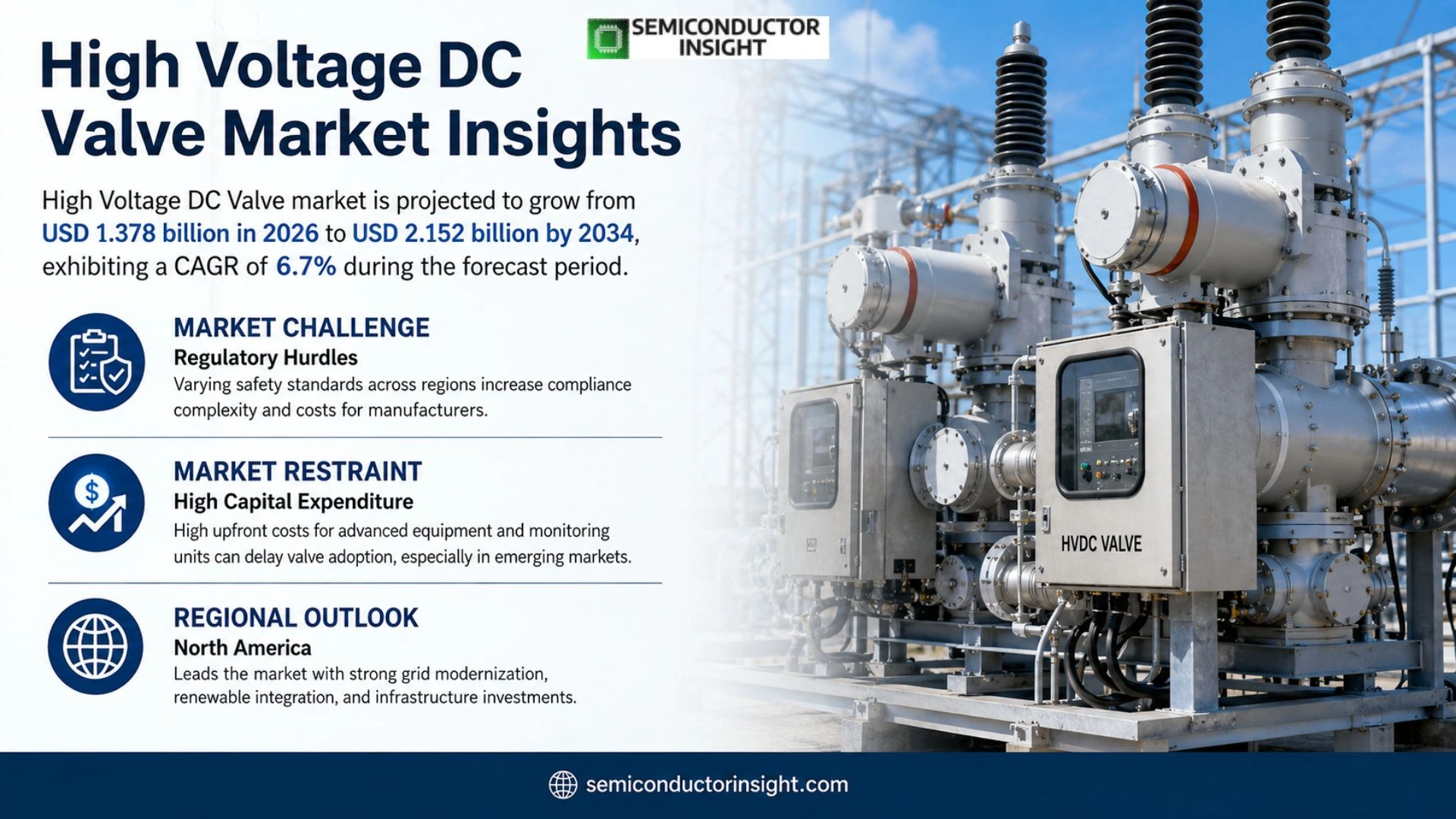
High Voltage DC Valve market is projected to grow from USD 1.378 billion in 2026 to USD 2.152 billion by 2034, exhibiting a CAGR of 6.7% during the forecast period.
High‑voltage direct‑current (HVDC) valves are core power‑conversion devices installed in converter stations to transform alternating current (AC) into direct current (DC). They comprise series‑connected semiconductor modules,traditional thyristors or modern IGBTs,arranged according to topologies such as LCC or VSC/MMC, together with voltage‑sharing networks, insulation frames, cooling systems and protective instrumentation designed for ultra‑high voltages (±500 kV to ±1100 kV) and high currents. In 2025, worldwide production reached approximately 18.86 million units, yielding an average unit price of roughly USD 80. These valves enable long‑distance, low‑loss transmission of renewable energy and support grid inter‑regional interconnection.
MARKET DRIVERS
Electrification of Transportation
The push toward electric buses, trucks and rail systems has elevated the demand for reliable high‑current switching components. High Voltage DC Valve Market players are witnessing increased orders as OEMs integrate DC distribution architectures that require robust valve solutions capable of handling 1 kV and above. The shift reduces reliance on mechanical relays, shortening maintenance windows and improving fleet uptime.
Renewable Energy Integration
Grid‑scale solar and offshore wind farms increasingly adopt DC collection and transmission to cut losses. This architecture mandates high‑voltage DC valves for fault isolation and power flow control. Project developers favor modular valve designs that can be retrofitted to existing substations, creating a steady pipeline of retrofit projects.
➤ “Valve reliability now dictates the financial viability of large‑scale DC projects,” says a senior engineering director at a leading equipment supplier.
Manufacturers that combine silicon‑carbide (SiC) semiconductor technology with advanced sealing materials are seeing higher price acceptance. Buyers recognize that lower conduction losses and longer service intervals translate into a superior total cost of ownership.
MARKET CHALLENGES
Supply‑Chain Volatility
Global shortages of high‑purity silicon and specialty alloys have lengthened lead times for critical valve components. End users must balance inventory costs against the risk of production downtime, prompting many to negotiate long‑term supply contracts that lock in pricing for up to five years.
Other Challenges
Regulatory Hurdles
Differing safety certification regimes across Europe, North America and Asia create a fragmented compliance landscape. Firms that invest in multi‑regional testing facilities gain a competitive edge, yet the upfront capital outlay can deter smaller entrants.
MARKET RESTRAINTS
High Capital Expenditure
Adopting high‑voltage DC valve systems often requires significant upfront investment in auxiliary equipment such as insulated gate bipolar transistors and advanced monitoring units. For projects with constrained budgets, the perceived cost risk can delay or cancel valve procurement, especially in emerging markets where financing options remain limited.
MARKET OPPORTUNITIES
Digital Monitoring and Predictive Maintenance
Embedding IoT sensors within valve housings enables real‑time condition monitoring, allowing operators to predict wear before catastrophic failure. Service providers that bundle analytics platforms with hardware stand to capture recurring revenue streams, while end users benefit from reduced unplanned outages.
High Voltage DC Valve Market Trends
Shift to Inter‑regional HVDC Links and Renewable Integration
The power sector is undergoing a structural rebalancing that privileges long‑distance, low‑loss transmission. Utilities are routing increasing volumes of wind, solar and hydro output through ultra‑high‑voltage corridors that span hundreds of kilometres. This architecture compels converters to handle voltages between ±500 kV and ±1100 kV while sustaining currents that exceed traditional limits. As a result, the demand for robust semiconductor assemblies,thyristor and IGBT‑based valve stacks,has risen sharply. Manufacturers are channeling R&D funds into modular VSC/MMC topologies that offer finer control and easier maintenance, a response to operators’ desire for flexibility in grid‑balancing. The net effect is a noticeable uptick in production runs, with 2025 seeing close to 19 million units fabricated, reflecting both new build programs and replacement cycles in aging converter stations.
Other Trends
Margin Compression from Aggressive Contracting
While valve designs have become more sophisticated, the commercial environment is tightening. Project‑level tenders often award contracts to the lowest qualified bidder, pressuring gross margins, especially for domestic manufacturers whose price points hover between 18 % and 30 %. International players, leveraging established supply chains for high‑purity silicon and advanced cooling solutions, retain margins in the 25 %‑35 % band but are not immune to cost escalations for key components. The tension between maintaining high reliability,failure rates must stay below one in ten thousand,and staying price‑competitive forces firms to adopt leaner testing regimes and to explore localized sourcing of insulators and heat exchangers.
Emerging Applications in Transportation and Grid Support
Beyond traditional bulk power transmission, high‑voltage DC valves are finding roles in railway electrification, offshore wind export, and large‑scale energy storage interfaces. These niche applications demand compact, fast‑acting valve packages that can survive harsh marine or high‑vibration environments. Suppliers that can certify modules for such conditions are positioning themselves to capture a growing slice of the market, as policymakers incentivize green corridors and cross‑border interconnectors. The strategic implication for industry players is clear: diversification beyond classic converter stations can offset pressure in the core market, while also opening pathways for premium pricing tied to specialized performance criteria.
COMPETITIVE LANDSCAPE
Key Industry Players
High Voltage DC Valve Market – Competitive Overview
Hitachi Energy continues to shape the global HVDC valve arena, leveraging its long‑standing involvement in ultra‑high‑voltage converter stations across Europe, Asia and the Americas. Its portfolio blends LCC‑type thyristor modules with the newer VSC/MMC architectures, enabling customers to meet stringent reliability criteria while minimizing lifecycle cost. The firm’s ability to secure multi‑billion‑dollar EPC contracts gives it leverage over upstream component suppliers, translating into a pricing advantage that sustains healthy gross margins in the 25‑35 % bracket. Strategic investments in localized production hubs, especially in China and the United States, have also insulated Hitachi Energy from raw‑material price volatility and tightened delivery cycles, reinforcing its position as the de‑facto market reference for large‑scale interconnection projects.
Beyond the tier‑one group, a cluster of regional manufacturers is reshaping the competitive set. Siemens Energy, GE Vernova Grid Solutions, Mitsubishi Electric and ABB Sifang each command niche leadership in either VSC‑based modular converters or specialty mercury‑arc solutions, often aligning with national grid expansion policies. Chinese firms such as XJ Electric, NR Electric, NARI Technology, China XD Group, TBEA and LS Electric have cultivated a domestic supply chain that emphasizes cost‑effective assembly and rapid field service, allowing them to win bids in emerging markets where price sensitivity eclipses brand prestige. Meanwhile, specialist players like C‑EPR, Beijing Sifang Automation, GEIRI, RXPE and Hyosung Heavy Industries supply tailored valve modules for offshore wind farms and high‑speed rail corridors, illustrating how diversification across application segments mitigates exposure to single‑project risk.
List of Key High Voltage DC Valve Companies Profiled
- Hitachi Energy
- Siemens Energy
- GE Vernova Grid Solutions
- Mitsubishi Electric
- Toshiba
- ABB Sifang
- XJ Electric
- NR Electric
- NARI Technology
- China XD Group
- C‑EPR
- Beijing Sifang Automation
- GEIRI
- TBEA
- RXPE
- Hyosung Heavy Industries
- LS Electric
Segment Analysis:
| Segment Category | Sub-Segments | Key Insights |
| By Type |
|
Electrically Controlled DC Valves are the dominant choice because they align with the industry’s move toward fully automated converter stations.
|
| By Application |
|
Renewable Energy Integration drives the most rapid advancement of HVDC valve technology.
|
| By End User |
|
Transmission Operators value reliability above all, shaping valve specifications.
|
| By Technology Architecture |
|
Modular Multi‑Level Converters (MMC) are gaining prominence as the leading architecture.
|
| By Performance Requirement |
|
Ultra‑High Voltage Rating defines the most critical performance niche.
|
Regional Analysis: High Voltage DC Valve Market
Utilities are undertaking large‑scale upgrades of transmission corridors, favouring DC valve systems that enable tighter voltage control and lower losses. The shift away from legacy electromechanical relays reflects a strategic focus on resilience and longer asset life cycles.
The surge in offshore wind and utility‑scale solar projects compels operators to adopt DC valves capable of handling fluctuating power flows, ensuring grid stability while accommodating variable generation.
Federal and state incentive programs target emission reductions and grid efficiency, indirectly boosting demand for high‑voltage DC valve technologies that meet stringent performance criteria.
A blend of legacy manufacturers expanding their DC portfolios and agile newcomers introducing novel semiconductor designs intensifies innovation pressure across the market.
Europe
European utilities are leveraging High Voltage DC Valve technology to harmonize cross‑border electricity flows as the continent deepens its interconnection strategy. The European Union’s emphasis on a carbon‑neutral grid by 2030 motivates investment in DC solutions that can efficiently convey power from offshore wind farms in the North Sea to inland load centres. Moreover, stringent environmental standards compel manufacturers to enhance valve efficiency and reduce thermal footprints, driving a wave of product refinements tailored to the region’s dense network topology.
Asia‑Pacific
In Asia‑Pacific, rapid urbanisation and the emergence of mega‑project initiatives in China, India, and Southeast Asia create fertile ground for DC valve adoption. Grid operators confront escalating peak‑load pressures and are turning to high‑voltage DC platforms to enable long‑distance power transmission with minimal losses. The region’s aggressive renewable targets, particularly in solar and wind, compel utilities to integrate flexible valve architectures that can accommodate intermittent generation while preserving system stability.
South America
South American markets are beginning to explore high‑voltage DC valve solutions as they modernise aging transmission assets and expand inter‑regional interconnections, notably between Brazil and neighboring countries. Hydro‑rich basins provide abundant renewable generation, yet the need to transfer power efficiently across vast distances positions DC valves as a strategic enabler. Policy frameworks that support private‑sector participation in grid upgrades further stimulate demand for advanced valve technologies.
Middle East & Africa
The Middle East & Africa region exhibits a mixed landscape: affluent Gulf states are investing heavily in solar‑driven DC grid pilots, while Africa’s growing electrification agenda spurs interest in scalable, high‑performance valve solutions for new transmission corridors. Energy diversification strategies in the Gulf, coupled with Africa’s ambition to reduce reliance on fossil‑fuel generation, generate a nascent but promising market for DC valve deployments that can bridge solar farms to urban load centres.
Report Scope
This market research report provides a comprehensive analysis of the High Voltage DC Valve Market , covering the forecast period 2026–2034. It offers detailed insights into market dynamics, technological advancements, competitive landscape, and key trends shaping the industry.
Key focus areas of the report include:
- Market Overview: The report begins with an overview outlining its current market scenario, key growth indicators, and industry transformation drivers. It discusses macroeconomic factors, demand–supply balance, regulatory landscape, and the strategic role of semiconductors in powering advancements across industries such as automotive, telecommunications, consumer electronics, and industrial automation.
- Market Size & Forecast: Historical data and future projections for revenue, unit shipments, and market value across major regions and segments.
- Segmentation Analysis: Detailed breakdown by product type, technology, application, and end-user industry to identify high-growth segments and investment opportunities.
- Regional Insights: Insights into market performance across North America, Europe, Asia-Pacific, Latin America, and the Middle East & Africa, including country-level analysis where relevant.
- Competitive Landscape: Profiles of leading market participants, including their product offerings, R&D focus, manufacturing capacity, pricing strategies, and recent developments such as mergers, acquisitions, and partnerships.
- Technology Trends & Innovation: Assessment of emerging technologies, integration of AI/IoT, semiconductor design trends, fabrication techniques, and evolving industry standards.
- Market Drivers & Restraints: Evaluation of factors driving market growth along with challenges, supply chain constraints, regulatory issues, and market-entry barriers.
- Stakeholder Insights: Insights for component suppliers, OEMs, system integrators, investors, and policymakers regarding the evolving ecosystem and strategic opportunities.
Primary and secondary research methods are employed, including interviews with industry experts, data from verified sources, and real-time market intelligence to ensure the accuracy and reliability of the insights presented.
FREQUENTLY ASKED QUESTIONS:
What is the current market size of High Voltage DC Valve Market?
-> High Voltage DC Valve market is projected to grow from USD 1.378 billion in 2026 to USD 2.152 billion by 2034, exhibiting a CAGR of 6.7%
Which key companies operate in High Voltage DC Valve Market?
-> Key players include Hitachi Energy, Siemens Energy, GE Vernova Grid Solutions, Mitsubishi Electric, Toshiba, ABB Sifang, XJ Electric, NR Electric, NARI Technology, China XD Group, C‑EPR, Beijing Sifang Automation, GEIRI, TBEA, RXPE, Hyosung Heavy Industries, and LS Electric, among others.
What are the key growth drivers?
-> Key growth drivers include the structural shift from local balancing to inter‑regional interconnection, large‑scale renewable energy transmission, expanding UHVDC and flexible VSC projects, and the need for grid resilience and low‑loss power transfer.
Which region dominates the market?
-> Asia‑Pacific is the fastest‑growing region, while Europe remains a major market due to extensive HVDC infrastructure investments.
What are the emerging trends?
-> Emerging trends include flexible MMC valve architectures, digital twin and condition‑monitoring solutions, and the adoption of high‑efficiency IGBT/SiC based converter technologies.

Get Sample Report PDF for Exclusive Insights
Report Sample Includes
- Table of Contents
- List of Tables & Figures
- Charts, Research Methodology, and more...
 Download Sample Report PDF