High Voltage Carbon Film Resistors Market Insights
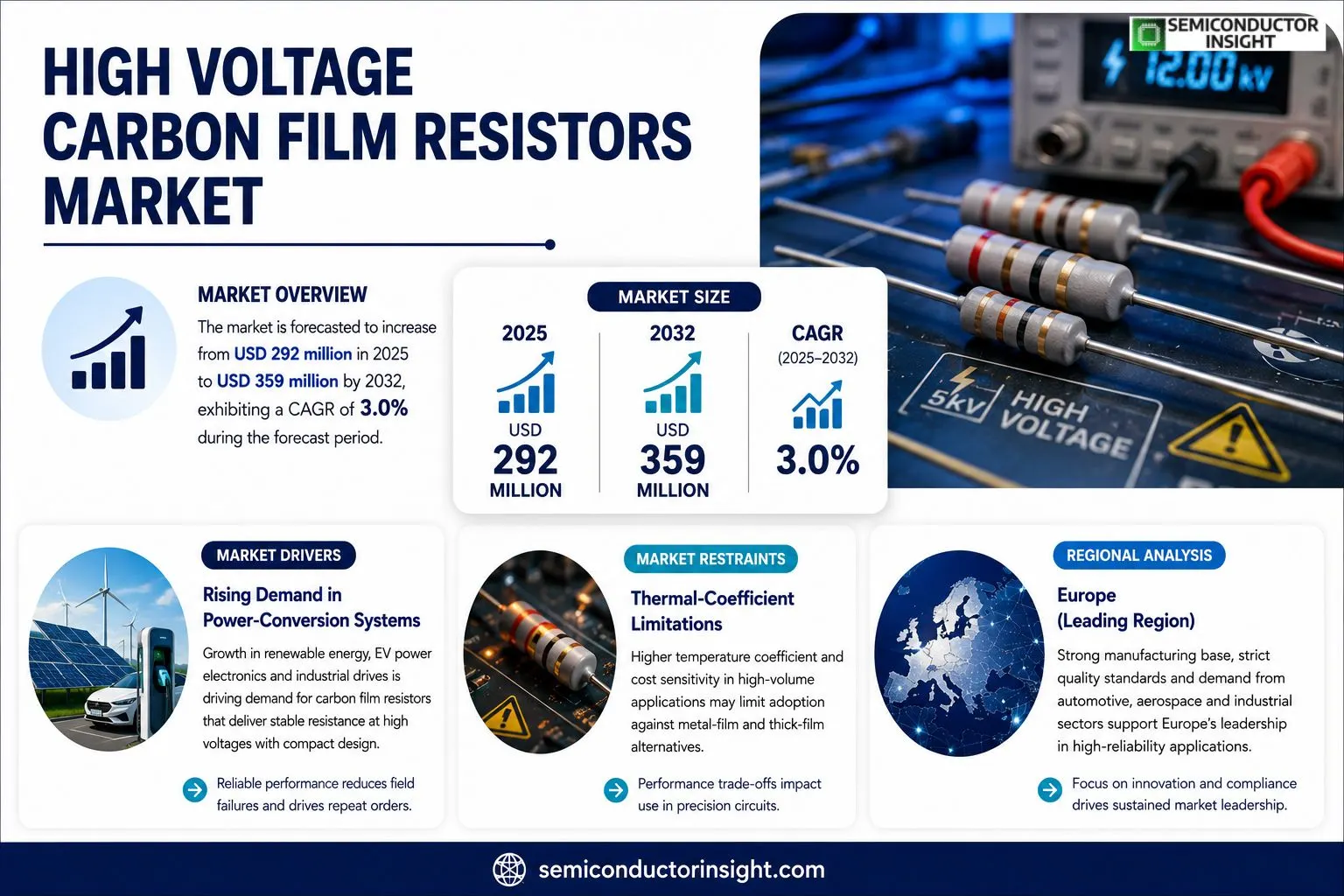
High Voltage Carbon Film Resistors market size was valued at USD 292 million in 2025. The market is forecasted to increase from USD 292 million in 2025 to USD 359 million by 2032, exhibiting a CAGR of 3.0% during the forecast period.
High‑voltage carbon film resistors are fixed resistors formed by depositing a carbon film on a ceramic or glass substrate; resistance values are set through helical trimming while a specialised coating improves voltage‑withstand capability. Their high rated voltages, strong pulse‑handling capacity and stable temperature characteristics make them ideal for current limiting and voltage regulation in power supplies, voltage dividers, medical imaging systems, industrial control equipment and related high‑voltage applications.The market gains traction because expanding renewable‑energy projects, electric‑vehicle power electronics and high‑voltage testing apparatus raise demand for reliable voltage‑limiting components. Meanwhile, competition from metal‑film and thick‑film alternatives pressures pricing structures. Manufacturers in Japan, Europe and North America concentrate on high‑reliability niches, whereas firms in Taiwan and mainland China exploit scale advantages for mass markets; recent moves such as Yageo’s acquisition of a Taiwanese thin‑film resistor line in early 2024 illustrate strategic efforts to broaden portfolios while preserving gross margins that typically range between 18 % and 28 %.
MARKET DRIVERS
Rising Demand in Power‑Conversion Systems
High Voltage Carbon Film Resistors Market is benefiting from the surge in power‑conversion architectures that require precise voltage regulation at elevated potentials. Designers of industrial drives, renewable‑energy inverters, and aerospace power units are opting for carbon‑film technology because it delivers stable resistance over wide voltage ranges while maintaining a compact footprint. This shift translates into higher unit shipments for manufacturers that can guarantee tight tolerance and low noise performance.
Stringent Reliability Requirements
Regulatory bodies and OEM quality programs are tightening acceptance criteria for components that operate above 5 kV. Carbon‑film resistors are favoured for their ability to withstand repetitive voltage spikes without degradation of resistance value. Companies that invest in advanced annealing processes and rigorous burn‑in testing are capturing a larger share of contracts where long‑term reliability is non‑negotiable.
➤ Clients that integrate high‑temperature‑stable carbon‑film parts report a measurable drop in field failures, driving repeat orders.
These dynamics are compelling equipment makers to re‑evaluate their bill of materials, favouring suppliers that combine high voltage capability with proven endurance. As a result, the competitive landscape is increasingly defined by technical differentiation rather than price alone.
MARKET CHALLENGES
Cost Sensitivity in High‑Volume Applications
While performance advantages are clear, many manufacturers face pressure to lower component costs in mass‑production environments such as consumer‑grade power supplies. Carbon‑film resistors, especially those rated for >10 kV, carry higher material and processing expenses than standard metal‑film equivalents, creating a tension between specification fidelity and budget constraints.
Other Challenges
Supply Chain Volatility
Fluctuations in specialty carbon feedstock and the limited number of foundries capable of producing ultra‑high‑voltage films have introduced lead‑time uncertainties. End‑users must plan inventory more conservatively, which can dampen order velocity in the short term.
MARKET RESTRAINTS
Thermal‑Coefficient Limitations
Carbon‑film resistors exhibit a higher temperature coefficient of resistance (TCR) compared with some ceramic or metal‑oxide alternatives. In applications where ambient temperature swings exceed ±50 °C, this characteristic can compromise circuit precision, prompting designers to resort to alternative technologies despite the voltage advantage of carbon film.
MARKET OPPORTUNITIES
Growth of Electric‑Vehicle Power Trains
The migration toward electric‑vehicle platforms introduces a new class of high‑voltage subsystemon‑board chargers, DC‑DC converters, and motor‑controller modulesthat demand reliable resistance values at potentials up to 12 kV. Manufacturers that can certify carbon‑film resistors for automotive‑grade durability are poised to secure long‑term supply contracts in this rapidly evolving sector.
High Voltage Carbon Film Resistors Market Trends
Elevated Demand from Power‑Electronics Platforms
High Voltage Carbon Film Resistors Market is seeing a steady lift as manufacturers of renewable‑energy inverters and automotive chargers require components that can sustain high pulse currents while maintaining tight tolerance. The 292 million‑dollar valuation recorded in 2025 and the forecasted rise toward roughly 359 million dollars by 2032 reflect a market that is absorbing incremental volume without dramatic spikes. Production volumes of about 2,667 million units at an average price of $0.12 illustrate a cost structure where economies of scale are preserving margin windows of 18 % to 28 %. The trend is underpinned by the need for reliable voltage‑division networks in grid‑tie converters, where failure rates translate directly into costly downtime. Consequently, suppliers that can guarantee consistent coating integrity and precise helical trimming are gaining preference, prompting mid‑stream firms to invest in tighter process controls.
Other Trends
Supply Landscape Shift
Fragmentation remains a hallmark of High Voltage Carbon Film Resistors Market, yet a subtle re‑balancing is evident. Traditional players in Japan, Europe, and North America continue to dominate high‑reliability niches such as medical imaging and defense‑grade equipment, leveraging long‑standing expertise in low‑noise, temperature‑stable designs. Meanwhile, manufacturers in Taiwan and mainland China are consolidating capacitynow exceeding 3,500 million unitsto serve bulk industrial power‑supply applications where price competitiveness is paramount. This dichotomy creates a two‑tier ecosystem: the “first tier” focuses on differentiated performance, while the “second tier” capitalizes on volume and cost efficiency. The divergence compels original equipment manufacturers to adopt a dual‑sourcing strategy, pairing premium‑grade parts for critical subsystems with cost‑optimized units for less sensitive blocks.
Regional Innovation Hotspots
Geographically, Asia is emerging as the primary arena for product development, driven by accelerated rollout of electric‑vehicle charging infrastructure and aggressive industrial automation programs. In China, the convergence of local government incentives and a dense supplier base has accelerated the introduction of sulfurization‑resistant structures, addressing reliability concerns in high‑temperature environments. Europe, however, retains a niche advantage in standards‑intensive sectors, where compliance with stringent medical‑device regulations fuels demand for ultra‑stable resistors. North America’s focus on legacy power‑distribution upgrades sustains a modest but steady flow of orders. These regional dynamics suggest that firms capable of tailoring their portfolios to distinct regulatory and performance expectations will be best positioned to capture incremental share as the market matures.
COMPETITIVE LANDSCAPE
Key Industry Players
High Voltage Carbon Film Resistors – Competitive Overview
The market is anchored by a handful of multinational firms that dominate the high‑reliability segment. Yageo Corporation, Vishay Intertechnology and KOA Corporation leverage extensive product catalogs and distribution networks to secure long‑term contracts with power‑supply OEMs, medical‑imaging equipment makers, and defense contractors. Their ability to combine precise trimming technology with robust coating processes yields low failure rates, a decisive factor for customers who cannot tolerate downtime. Consequently, these players capture a disproportionate share of the premium pricing tier, translating into gross margins that comfortably exceed 20 %.Beyond the first tier, a sizable second tier of Asian manufacturers competes aggressively on cost and volume. Companies such as Panasonic Holdings, TT Electronics, Ohmite Manufacturing, Stackpole Electronics, Kamaya Electric, Fenghua Advanced Technology, Caddock Electronics, MIBA Resistors, Littelfuse, Murata Manufacturing, Rohm Semiconductor and AVX Corporation operate large‑scale fabs in Taiwan and mainland China. Their economies of scale allow them to price units near $0.10 while still meeting the basic voltage‑withstand specifications required by industrial control and consumer‑appliance applications. Some have begun to specialize in niche structurese.g., sulfurization‑resistant filmsto differentiate their offerings within the crowded mid‑range market.
List of Key High Voltage Carbon Film Resistors Companies Profiled
- Yageo Corporation
- Vishay Intertechnology
- KOA Corporation
- Panasonic Holdings
- TT Electronics
- Ohmite Manufacturing
- Stackpole Electronics
- Kamaya Electric
- Fenghua Advanced Technology
- Caddock Electronics
- MIBA Resistors
- Littelfuse
- Murata Manufacturing
- Rohm Semiconductor
- AVX Corporation
Segment Analysis:
| Segment Category | Sub-Segments | Key Insights |
| By Type |
|
Nominal Resistance ±2%
|
| By Application |
|
Medical Industry
|
| By End User |
|
Power Supply Manufacturers
|
| By Voltage Rating |
|
5 kV – 10 kV range
|
| By Structure Type |
|
Sulfurization‑Resistant
|
Regional Analysis: High Voltage Carbon Film Resistors Market
Europe
The push toward electric drivetrains intensifies the need for robust high‑voltage resistor stacks in power‑train control units. European car makers favour carbon‑film variants for their stable performance under rapid thermal cycling, a requirement that drives OEM‑supplier collaboration on bespoke form factors.
Factories upgrading to digitized control architectures rely on precise voltage regulation. Carbon‑film resistors offer the low drift needed for motor‑drive converters, prompting equipment manufacturers to embed them as standard components in new product lines.
Mission‑critical platforms demand components that survive extreme altitude and temperature swings. The European defence sector values carbon‑film resistors for their proven track record in reliability, leading to longer procurement cycles but higher unit spend.
Inverter modules for wind and solar farms increasingly incorporate high‑voltage resistors to manage surge protection. The continent’s aggressive renewable targets translate into design preferences that prioritize the stability of carbon‑film technology.
North America
North American demand for High Voltage Carbon Film Resistors is shaped by a strong emphasis on innovation within the defense and aerospace sectors. Defense contractors prioritize parts that can endure rigorous testing standards, leading to a preference for carbon‑film solutions with documented long‑term reliability. Simultaneously, the continent’s burgeoning data‑center infrastructure imposes tighter voltage control requirements, encouraging system integrators to adopt resistors that maintain consistent performance under high‑density power loads. Supplier strategies therefore focus on rapid prototyping capabilities and flexible supply agreements to meet the fast‑paced development cycles characteristic of the region.
Asia‑Pacific
The Asia‑Pacific corridor exhibits a blend of high‑volume manufacturing and emerging high‑precision markets. While mass‑produced electronic goods drive baseline demand, countries such as Japan and South Korea invest heavily in automotive electrification and advanced robotics, where voltage accuracy is non‑negotiable. Local firms are expanding material‑science labs to refine carbon‑film formulations, aiming to reduce tolerance drift. This dual‑track approach creates a market environment where volume‑oriented producers coexist with niche players catering to ultra‑reliable applications, prompting distributors to segment their portfolios accordingly.
South America
In South America, the market remains modest but is buoyed by infrastructure projects that require durable high‑voltage components. Power‑grid modernization initiatives inspire utilities to replace aging resistor stocks with carbon‑film alternatives that promise longer service intervals. Additionally, a growing electronics assembly sector in Brazil leverages cost‑effective carbon‑film options to meet regional price sensitivity while still delivering acceptable performance for consumer‑grade devices.
Middle East & Africa
The Middle East & Africa region reflects a pattern where oil‑related industries and emerging renewable projects intersect. High‑temperature environments typical of desert installations place a premium on resistor materials that resist thermal degradation, positioning carbon‑film technology as a pragmatic choice. Meanwhile, renewable‑energy pilots in the Gulf states incorporate these resistors within inverter designs to safeguard against voltage spikes, fostering a niche but technically sophisticated demand segment.
Report Scope
This market research report provides a comprehensive analysis of the High Voltage Carbon Film Resistors Market , covering the forecast period 2026–2034. It offers detailed insights into market dynamics, technological advancements, competitive landscape, and key trends shaping the industry.
Key focus areas of the report include:
- Market Overview: The report begins with an overview outlining its current market scenario, key growth indicators, and industry transformation drivers. It discusses macroeconomic factors, demand–supply balance, regulatory landscape, and the strategic role of semiconductors in powering advancements across industries such as automotive, telecommunications, consumer electronics, and industrial automation.
- Market Size & Forecast: Historical data and future projections for revenue, unit shipments, and market value across major regions and segments.
- Segmentation Analysis: Detailed breakdown by product type, technology, application, and end-user industry to identify high-growth segments and investment opportunities.
- Regional Insights: Insights into market performance across North America, Europe, Asia-Pacific, Latin America, and the Middle East & Africa, including country-level analysis where relevant.
- Competitive Landscape: Profiles of leading market participants, including their product offerings, R&D focus, manufacturing capacity, pricing strategies, and recent developments such as mergers, acquisitions, and partnerships.
- Technology Trends & Innovation: Assessment of emerging technologies, integration of AI/IoT, semiconductor design trends, fabrication techniques, and evolving industry standards.
- Market Drivers & Restraints: Evaluation of factors driving market growth along with challenges, supply chain constraints, regulatory issues, and market-entry barriers.
- Stakeholder Insights: Insights for component suppliers, OEMs, system integrators, investors, and policymakers regarding the evolving ecosystem and strategic opportunities.
Primary and secondary research methods are employed, including interviews with industry experts, data from verified sources, and real-time market intelligence to ensure the accuracy and reliability of the insights presented.
FREQUENTLY ASKED QUESTIONS:
What is the current market size of High Voltage Carbon Film Resistors Market?
-> High Voltage Carbon Film Resistors Market was valued at USD 292 million in 2025 and is expected to reach USD 359 million by 2032.
Which key companies operate in High Voltage Carbon Film Resistors Market?
-> Key players include Yageo Corporation, Vishay Intertechnology, KOA Corporation, Panasonic Holdings, TT Electronics, Ohmite Manufacturing, Stackpole Electronics, Kamaya Electric, Fenghua Advanced Technology, Caddock Electronics, MIBA Resistors, among others.
What are the key growth drivers?
-> Key growth drivers include advancements in new energy vehicles, power electronics equipment, high‑voltage testing apparatus, and demand from high‑voltage power supplies, medical imaging systems, and industrial control systems.
Which region dominates the market?
-> Asia holds a dominant position due to large‑scale manufacturing and cost advantages, while Europe and North America are noted for high‑reliability and high‑voltage stability products.
What are the emerging trends?
-> Emerging trends include increased focus on high‑reliability, military‑grade resistors, and the substitution pressure from metal‑film and thick‑film technologies driving innovation in carbon‑film designs.
Get Sample Report PDF for Exclusive Insights
Report Sample Includes
- Table of Contents
- List of Tables & Figures
- Charts, Research Methodology, and more...
 Download Sample Report PDF