High Temperature Variable Reluctance Speed Sensor Market, Trends, Business Strategies 2025-2032

High Temperature Variable Reluctance Speed Sensor Market size was valued at US$ 87 million in 2024 and is projected to reach US$ 143 million by 2032, at a CAGR of 7.4% during the forecast period 2025-2032

PDF Icon Download Sample Report PDF
  • Quick Dispatch

    All Orders

  • Secure Payment

    100% Secure Payment

Price range: $1,500.00 through $4,250.00

Clear

MARKET INSIGHTS

The global High Temperature Variable Reluctance Speed Sensor Market size was valued at US$ 87 million in 2024 and is projected to reach US$ 143 million by 2032, at a CAGR of 7.4% during the forecast period 2025-2032. The U.S. market accounted for 32% of global revenue in 2024, while China is expected to grow at a faster 6.8% CAGR through 2032.

High Temperature VRS sensors are specialized electromechanical devices designed to measure rotational or linear speed in extreme environments. These rugged sensors operate reliably at temperatures up to 260°C (450°F) and feature sealed front-end variants for exposure to fluids, lubricants, or harsh conditions. Their robust construction typically utilizes aluminum or stainless steel housings, with key applications in aerospace propulsion systems, military equipment, and industrial machinery.

The market growth is driven by increasing demand for precision speed monitoring in extreme environments, particularly in aerospace turbine monitoring and defense applications. Recent technological advancements in sensor materials and signal processing algorithms are enhancing measurement accuracy at elevated temperatures. Key industry players like Honeywell and TE Connectivity are expanding their high-temperature sensor portfolios through strategic R&D investments, with the aluminum housing segment projected to reach USD 210 million by 2032.
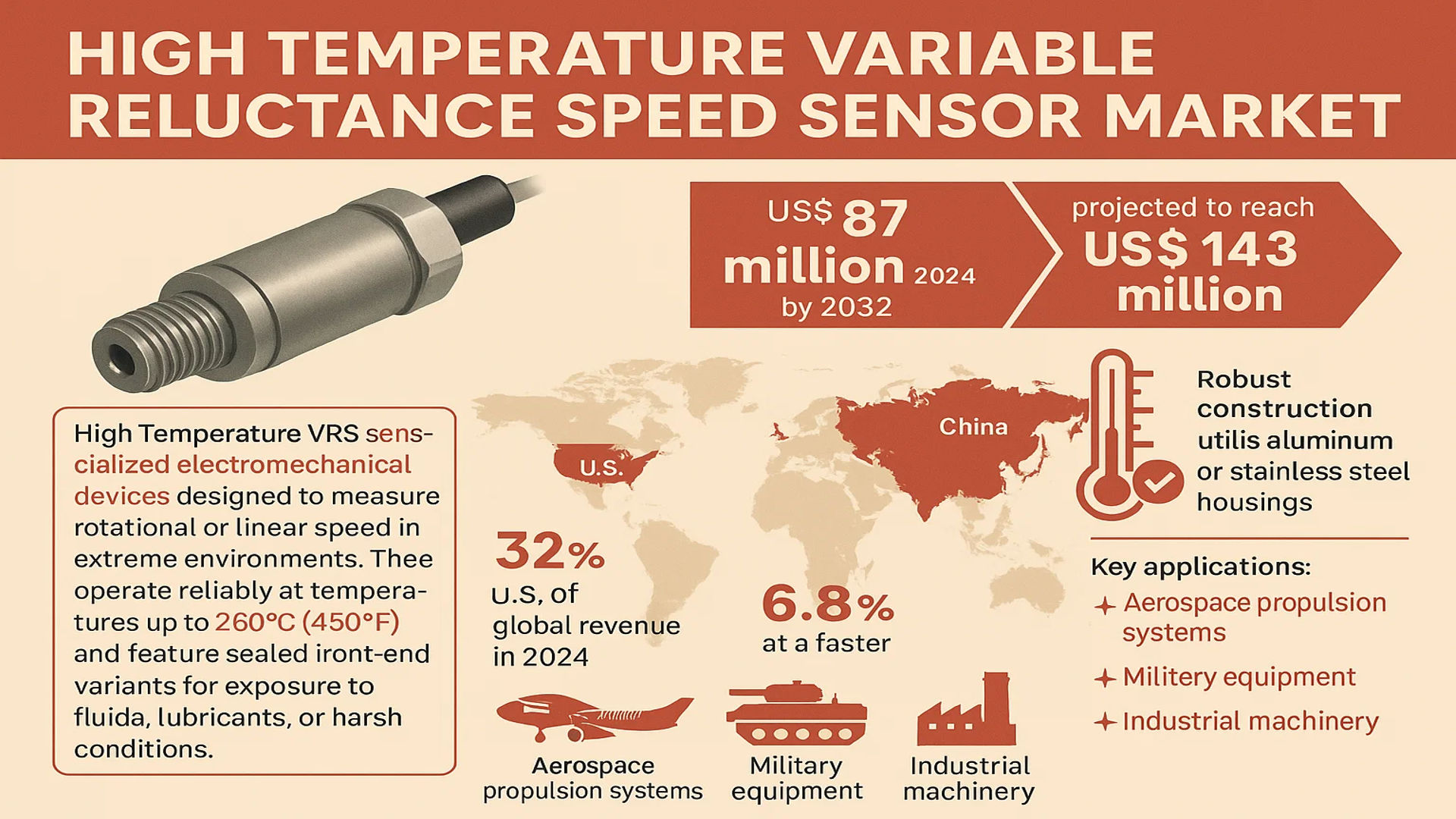
High Temperature Variable Reluctance Speed Sensor Market

MARKET DYNAMICS

MARKET DRIVERS

Growing Demand from Aerospace and Military Applications to Fuel Market Expansion

The aerospace and defense sectors are witnessing increased adoption of high-temperature variable reluctance speed sensors due to their ability to operate reliably in extreme environments. These sensors play a critical role in monitoring turbine engine speeds, landing gear systems, and other high-temperature applications where conventional sensors might fail. With global military expenditures reaching record levels and commercial aerospace sectors expanding rapidly, the demand for robust sensor solutions is accelerating. The commercial aviation sector alone is projected to require over 40,000 new aircraft in the next two decades, creating sustained demand for reliable speed sensing technologies.

Stringent Safety Regulations Driving Adoption Across Industries

Regulatory mandates across multiple industries are compelling manufacturers to implement more reliable speed monitoring systems. In oil and gas operations, where process safety is paramount, government regulations now require continuous monitoring of rotating equipment in hazardous areas. Similarly, automotive emission control systems operating at high temperatures increasingly incorporate these sensors to comply with tightening environmental standards. These regulatory pressures, coupled with the growing emphasis on predictive maintenance strategies, are creating sustained market growth opportunities across industrial sectors.

Recent standards updates in industrial automation now explicitly recommend variable reluctance sensors for high-temperature applications above 200°C, recognizing their superior reliability compared to Hall-effect alternatives.

Furthermore, the development of advanced materials and manufacturing techniques has significantly improved sensor durability, making them more viable for harsh environment applications. This technological evolution is removing previous barriers to adoption while opening new application possibilities.

MARKET CHALLENGES

High Development and Certification Costs Create Market Entry Barriers

While the market potential is significant, developing high-temperature capable variable reluctance sensors involves substantial engineering challenges and associated costs. The specialized materials required to withstand extreme thermal cycling can increase production costs by 30-50% compared to standard sensors. Moreover, certification processes for aerospace and military applications often require extensive testing protocols spanning several months, significantly delaying time-to-market. These factors combine to create significant barriers for new market entrants and can limit innovation from smaller manufacturers.

Other Challenges

Material Compatibility Issues
Extended operation at high temperatures can lead to material degradation and performance drift in conventional sensor designs. The thermal expansion mismatch between sensor components and mounting surfaces presents ongoing engineering challenges that require continuous R&D investment to overcome.

Supply Chain Vulnerabilities
The reliance on specialty alloys and high-performance materials makes the supply chain particularly susceptible to geopolitical disruptions and commodity price fluctuations. Recent supply chain analyses indicate lead times for critical sensor components have extended by 40-60% compared to pre-pandemic levels.

MARKET RESTRAINTS

Competition from Alternative Technologies Limits Market Penetration

Despite their advantages, high-temperature variable reluctance sensors face strong competition from emerging sensing technologies. Optical encoders and fiber-optic sensors are gaining traction in applications where electromagnetic interference is a concern, while advanced Hall-effect sensors continue to improve their high-temperature performance. In the industrial automation sector, the growing adoption of wireless sensor networks and vibration monitoring systems is displacing traditional speed sensing solutions in some applications. These competing technologies are benefitting from significant R&D investments, resulting in progressive performance improvements that threaten to erode the value proposition of traditional variable reluctance designs.

Additionally, the relatively low accuracy of variable reluctance sensors compared to these alternatives limits their applicability in precision applications, further constraining market growth potential in some segments.

MARKET OPPORTUNITIES

Expansion in Energy Sector Presents Significant Growth Potential

The global shift toward renewable energy systems is creating new opportunities for high-temperature sensor applications. In concentrated solar power plants, where mirror arrays focus sunlight to generate extreme temperatures, reliable speed monitoring of tracking mechanisms is critical. Similarly, advanced geothermal energy projects require robust sensing solutions capable of withstanding harsh underground conditions. As governments worldwide continue to increase investment in alternative energy infrastructure, these applications are expected to drive substantial demand for specialized sensor solutions.

Moreover, the oil and gas industry’s transition toward digital transformation is generating demand for more sophisticated monitoring solutions. The integration of high-temperature sensors with Industrial Internet of Things (IIoT) platforms enables real-time equipment health monitoring, creating opportunities for sensor manufacturers to develop more intelligent, networked solutions. Industry projections suggest the market for smart sensors in harsh environments will grow substantially as asset owners increasingly prioritize predictive maintenance capabilities.

HIGH TEMPERATURE VARIABLE RELUCTANCE SPEED SENSOR MARKET TRENDS

Demand for High-Tolerance Industrial Applications Drives Growth

The High Temperature Variable Reluctance Speed (VRS) Sensor market is experiencing significant expansion due to increasing demand from industries requiring robust sensing solutions in extreme conditions. These sensors, capable of operating in temperatures up to 260°C (450°F), are indispensable in aerospace, military, and heavy industrial applications where traditional sensors fail. In 2024, the market was valued at millions, with projections indicating a strong compound annual growth rate (CAGR) through 2032. The aluminum housing segment is particularly poised for accelerated growth, anticipated to reach multi-million-dollar benchmarks within six years.

Other Trends

Technological Advancements in Material Science

Innovations in sensor materials, including corrosion-resistant alloys and advanced polymers, are enhancing the durability and accuracy of high-temperature VRS sensors. Manufacturers are focusing on improving sensor housings—such as stainless steel variants—to extend operational lifespans in harsh environments like jet engines and industrial turbines. Sealed front-end designs are also gaining traction for applications exposed to fluids and extreme weather conditions, further solidifying their adoption in critical sectors.

Expansion in Aerospace and Defense Sectors

The aerospace and defense industries are key drivers of market growth, accounting for a substantial share of revenue. High-temperature VRS sensors are critical for monitoring turbine speeds, propeller rotations, and other high-stress mechanical systems in aircraft and military vehicles. With global defense budgets increasing—particularly in regions like North America and Asia-Pacific—the demand for reliable, high-performance sensors is expected to rise proportionally. The U.S. currently leads in market size, while China is projected to close the gap by 2032 due to aggressive investments in indigenous aerospace technologies.

Supply Chain Optimization and Regional Manufacturing

To mitigate disruptions, major players like Honeywell and TE Connectivity are localizing production facilities in emerging markets, reducing lead times and costs. This strategy not only addresses logistical challenges but also aligns with regional regulatory requirements, particularly in Europe and Asia. Meanwhile, collaborative R&D initiatives between sensor manufacturers and end-users are accelerating the development of application-specific solutions, such as lightweight sensors for next-generation aircraft.

COMPETITIVE LANDSCAPE

Key Industry Players

Sensor Manufacturers Expand High-Temperature Capabilities to Meet Industrial Demands

The global high temperature variable reluctance speed (VRS) sensor market features a mix of established aerospace/defense suppliers and specialized sensor manufacturers. Honeywell maintains a dominant position due to its extensive application expertise in extreme environment sensing and trusted reputation in aerospace markets where precision reliability is non-negotiable. Their 2024 product refresh of the HTVR series with improved thermal stabilization demonstrates continued category leadership.

TE Connectivity captured nearly 18% market share in 2024 through strategic acquisitions in industrial sensing and proprietary alloy developments that extended operating ceilings to 300°C. Meanwhile, Bosch Sensortec leverages automotive sector synergies, adapting magnetic sensing architectures originally developed for engine management systems to serve adjacent high-temperature industrial applications.

Specialist players like Spectec Thunderbird differentiate through customized sealing solutions for fluid immersion scenarios, holding 62% of the military marine propulsion sub-segment. Their patented dual-housing designs effectively address both thermal and corrosion challenges in naval applications.

Emerging competition comes from motion control specialists such as Motion Sensors Inc., who recently partnered with three tier-1 aerospace suppliers to co-develop next-generation sensors with embedded condition monitoring capabilities. This reflects broader industry convergence between sensing and predictive maintenance functionalities.

List of Key High Temperature VRS Sensor Manufacturers

Consolidation accelerated in 2024 with three mid-sized players acquired by conglomerates seeking sensor technology portfolios. This reflects the growing strategic value of high-temperature sensing IP as industries push operational envelopes. However, nimble specialists continue thriving in niche applications through material science innovations and application-specific calibration services.

Segment Analysis:

By Type

Aluminum Housing Segment Leads Due to Lightweight and Cost-Effective Properties

The market is segmented based on type into:

  • Aluminum Housing
  • Stainless Steel Housing

By Application

Aerospace Segment Dominates Owing to High Demand for Engine Monitoring Systems

The market is segmented based on application into:

  • Aerospace
  • Military
  • Others

By Temperature Range

Standard Range (Up to 260°C) Segment Holds Majority Share Due to Wide Industrial Applications

The market is segmented based on temperature range into:

  • Standard Range (Up to 260°C)
  • Extended Range (Above 260°C)

By End-User

Commercial Aviation Segment Leads Due to High Fleet Expansion Activities

The market is segmented based on end-user into:

  • Commercial Aviation
  • Defense
  • Industrial
  • Energy

Regional Analysis: High Temperature Variable Reluctance Speed Sensor Market

North America
North America leads the global High Temperature Variable Reluctance Speed Sensor (HT-VRS) market, driven by robust aerospace and military spending, particularly in the U.S. The region’s dominance stems from technological advancements, stringent regulatory standards for high-performance sensors, and strong R&D investments by key players like Honeywell and TE Connectivity. The U.S. Department of Defense’s continued modernization programs, with a $842 billion budget allocation in 2024, further accelerate demand for reliable speed sensors in extreme-condition applications. However, supply chain disruptions and stringent export controls pose challenges for manufacturers operating in this region.

Europe
Europe holds significant market share in HT-VRS sensors, supported by advanced automotive and aerospace industries across Germany, France, and the UK. The region’s focus on Industry 4.0 automation and precision engineering creates steady demand for high-temperature capable sensors. EU regulations mandating fail-safe components in transportation systems and energy infrastructure reinforce market growth. While labor costs remain high, European manufacturers differentiate through superior material science, particularly in stainless steel housing sensors that dominate high-end applications. Competition from Asian suppliers and Brexit-related trade complexities present ongoing challenges for the regional market.

Asia-Pacific
The Asia-Pacific region exhibits the fastest growth potential for HT-VRS sensors, propelled by China’s expanding aerospace sector and accelerating industrialization. Local manufacturing capabilities have improved significantly, with Chinese firms now producing cost-competitive aluminum housing sensors suitable for mid-range applications. Japan and South Korea contribute strong demand from their automotive and robotics industries, while India emerges as a promising market with its defense modernization initiatives. However, intellectual property protection concerns and inconsistent quality standards in some countries restrain faster adoption of advanced sensor technologies across the region.

South America
South America represents a developing market for HT-VRS sensors, with Brazil and Argentina showing gradual uptake in mining and oil & gas applications. The region benefits from its abundant natural resources that require rugged sensing solutions for extraction equipment. Economic volatility and reliance on imports for high-end sensor components limit market expansion, though local assembly partnerships with global suppliers are beginning to establish footholds. Infrastructure constraints and political uncertainties in some countries continue to deter larger investments in sensor technology upgrades.

Middle East & Africa
The Middle East & Africa region demonstrates niche demand for HT-VRS sensors, primarily driven by oilfield operations and selected defense applications in GCC countries. Saudi Arabia’s Vision 2030 diversification strategy includes growing investments in aerospace and industrial automation that may boost sensor adoption. In Africa, South Africa leads in mining-related sensor deployments while other nations show minimal uptake due to limited industrialization. The region overall faces challenges including harsh operating environments, lack of technical expertise, and budget constraints for advanced sensor systems.

Report Scope

This market research report provides a comprehensive analysis of the Global High Temperature Variable Reluctance Speed Sensor Market, covering the forecast period 2025–2032. It offers detailed insights into market dynamics, technological advancements, competitive landscape, and key trends shaping the industry.

Key focus areas of the report include:

  • Market Size & Forecast: Historical data and future projections for revenue, unit shipments, and market value across major regions and segments. The market was valued at US$ 87 million in 2024 and is projected to reach US$ 143 million by 2032, growing at a CAGR of 7.4%.
  • Segmentation Analysis: Detailed breakdown by product type (Aluminum Housing, Stainless Steel Housing), application (Aerospace, Military, Others), and end-user industry to identify high-growth segments and investment opportunities.
  • Regional Outlook: Insights into market performance across North America, Europe, Asia-Pacific, Latin America, and the Middle East & Africa. The U.S. market is estimated at USD  million in 2024, while China is projected to reach USD  million by 2032.
  • Competitive Landscape: Profiles of leading market participants, including Honeywell, TE Connectivity, BoschSensortec, and Spectec Thunderbird International Corp, covering their product portfolios, market share, and strategic initiatives.
  • Technology Trends & Innovation: Assessment of emerging sensor technologies, high-temperature material advancements, and integration with IoT platforms.
  • Market Drivers & Restraints: Evaluation of factors such as increasing demand from aerospace sector, harsh environment applications, alongside challenges like supply chain disruptions.
  • Stakeholder Analysis: Strategic insights for sensor manufacturers, system integrators, and investors regarding market opportunities and competitive positioning.

The research methodology combines primary interviews with industry experts and analysis of verified secondary data sources to ensure accuracy and reliability.

FREQUENTLY ASKED QUESTIONS:

What is the current market size of Global High Temperature Variable Reluctance Speed Sensor Market?

-> High Temperature Variable Reluctance Speed Sensor Market size was valued at c and is projected to reach US$ 143 million by 2032, at a CAGR of 7.4% during the forecast period 2025-2032.

Which key companies operate in this market?

-> Key players include Honeywell, Motion Sensors, TE Connectivity, BoschSensortec, and Spectec Thunderbird International Corp.

What are the key growth drivers?

-> Growth is driven by increasing aerospace applications, demand for harsh environment sensors, and industrial automation trends.

Which region dominates the market?

-> North America currently leads, while Asia-Pacific shows the fastest growth potential.

What are the emerging trends?

-> Emerging trends include development of ultra-high temperature sensors, miniaturization, and smart sensor integration.

High Temperature Variable Reluctance Speed Sensor Market, Trends, Business Strategies 2025-2032

Get Sample Report PDF for Exclusive Insights

Report Sample Includes

  • Table of Contents
  • List of Tables & Figures
  • Charts, Research Methodology, and more...

PDF Icon Download Sample Report PDF
SKU: fade630ba083
Category:

Download Sample Report

Table of Content

1 Introduction to Research & Analysis Reports
1.1 High Temperature Variable Reluctance Speed Sensor Market Definition
1.2 Market Segments
1.2.1 Segment by Type
1.2.2 Segment by Application
1.3 Global High Temperature Variable Reluctance Speed Sensor Market Overview
1.4 Features & Benefits of This Report
1.5 Methodology & Sources of Information
1.5.1 Research Methodology
1.5.2 Research Process
1.5.3 Base Year
1.5.4 Report Assumptions & Caveats
2 Global High Temperature Variable Reluctance Speed Sensor Overall Market Size
2.1 Global High Temperature Variable Reluctance Speed Sensor Market Size: 2024 VS 2032
2.2 Global High Temperature Variable Reluctance Speed Sensor Market Size, Prospects & Forecasts: 2020-2032
2.3 Global High Temperature Variable Reluctance Speed Sensor Sales: 2020-2032
3 Company Landscape
3.1 Top High Temperature Variable Reluctance Speed Sensor Players in Global Market
3.2 Top Global High Temperature Variable Reluctance Speed Sensor Companies Ranked by Revenue
3.3 Global High Temperature Variable Reluctance Speed Sensor Revenue by Companies
3.4 Global High Temperature Variable Reluctance Speed Sensor Sales by Companies
3.5 Global High Temperature Variable Reluctance Speed Sensor Price by Manufacturer (2020-2025)
3.6 Top 3 and Top 5 High Temperature Variable Reluctance Speed Sensor Companies in Global Market, by Revenue in 2024
3.7 Global Manufacturers High Temperature Variable Reluctance Speed Sensor Product Type
3.8 Tier 1, Tier 2, and Tier 3 High Temperature Variable Reluctance Speed Sensor Players in Global Market
3.8.1 List of Global Tier 1 High Temperature Variable Reluctance Speed Sensor Companies
3.8.2 List of Global Tier 2 and Tier 3 High Temperature Variable Reluctance Speed Sensor Companies
4 Sights by Product
4.1 Overview
4.1.1 Segment by Type – Global High Temperature Variable Reluctance Speed Sensor Market Size Markets, 2024 & 2032
4.1.2 Aluminum Housing
4.1.3 Stainless Steel Housing
4.2 Segment by Type – Global High Temperature Variable Reluctance Speed Sensor Revenue & Forecasts
4.2.1 Segment by Type – Global High Temperature Variable Reluctance Speed Sensor Revenue, 2020-2025
4.2.2 Segment by Type – Global High Temperature Variable Reluctance Speed Sensor Revenue, 2026-2032
4.2.3 Segment by Type – Global High Temperature Variable Reluctance Speed Sensor Revenue Market Share, 2020-2032
4.3 Segment by Type – Global High Temperature Variable Reluctance Speed Sensor Sales & Forecasts
4.3.1 Segment by Type – Global High Temperature Variable Reluctance Speed Sensor Sales, 2020-2025
4.3.2 Segment by Type – Global High Temperature Variable Reluctance Speed Sensor Sales, 2026-2032
4.3.3 Segment by Type – Global High Temperature Variable Reluctance Speed Sensor Sales Market Share, 2020-2032
4.4 Segment by Type – Global High Temperature Variable Reluctance Speed Sensor Price (Manufacturers Selling Prices), 2020-2032
5 Sights by Application
5.1 Overview
5.1.1 Segment by Application – Global High Temperature Variable Reluctance Speed Sensor Market Size, 2024 & 2032
5.1.2 Aerospace
5.1.3 Military
5.1.4 Other
5.2 Segment by Application – Global High Temperature Variable Reluctance Speed Sensor Revenue & Forecasts
5.2.1 Segment by Application – Global High Temperature Variable Reluctance Speed Sensor Revenue, 2020-2025
5.2.2 Segment by Application – Global High Temperature Variable Reluctance Speed Sensor Revenue, 2026-2032
5.2.3 Segment by Application – Global High Temperature Variable Reluctance Speed Sensor Revenue Market Share, 2020-2032
5.3 Segment by Application – Global High Temperature Variable Reluctance Speed Sensor Sales & Forecasts
5.3.1 Segment by Application – Global High Temperature Variable Reluctance Speed Sensor Sales, 2020-2025
5.3.2 Segment by Application – Global High Temperature Variable Reluctance Speed Sensor Sales, 2026-2032
5.3.3 Segment by Application – Global High Temperature Variable Reluctance Speed Sensor Sales Market Share, 2020-2032
5.4 Segment by Application – Global High Temperature Variable Reluctance Speed Sensor Price (Manufacturers Selling Prices), 2020-2032
6 Sights by Region
6.1 By Region – Global High Temperature Variable Reluctance Speed Sensor Market Size, 2024 & 2032
6.2 By Region – Global High Temperature Variable Reluctance Speed Sensor Revenue & Forecasts
6.2.1 By Region – Global High Temperature Variable Reluctance Speed Sensor Revenue, 2020-2025
6.2.2 By Region – Global High Temperature Variable Reluctance Speed Sensor Revenue, 2026-2032
6.2.3 By Region – Global High Temperature Variable Reluctance Speed Sensor Revenue Market Share, 2020-2032
6.3 By Region – Global High Temperature Variable Reluctance Speed Sensor Sales & Forecasts
6.3.1 By Region – Global High Temperature Variable Reluctance Speed Sensor Sales, 2020-2025
6.3.2 By Region – Global High Temperature Variable Reluctance Speed Sensor Sales, 2026-2032
6.3.3 By Region – Global High Temperature Variable Reluctance Speed Sensor Sales Market Share, 2020-2032
6.4 North America
6.4.1 By Country – North America High Temperature Variable Reluctance Speed Sensor Revenue, 2020-2032
6.4.2 By Country – North America High Temperature Variable Reluctance Speed Sensor Sales, 2020-2032
6.4.3 United States High Temperature Variable Reluctance Speed Sensor Market Size, 2020-2032
6.4.4 Canada High Temperature Variable Reluctance Speed Sensor Market Size, 2020-2032
6.4.5 Mexico High Temperature Variable Reluctance Speed Sensor Market Size, 2020-2032
6.5 Europe
6.5.1 By Country – Europe High Temperature Variable Reluctance Speed Sensor Revenue, 2020-2032
6.5.2 By Country – Europe High Temperature Variable Reluctance Speed Sensor Sales, 2020-2032
6.5.3 Germany High Temperature Variable Reluctance Speed Sensor Market Size, 2020-2032
6.5.4 France High Temperature Variable Reluctance Speed Sensor Market Size, 2020-2032
6.5.5 U.K. High Temperature Variable Reluctance Speed Sensor Market Size, 2020-2032
6.5.6 Italy High Temperature Variable Reluctance Speed Sensor Market Size, 2020-2032
6.5.7 Russia High Temperature Variable Reluctance Speed Sensor Market Size, 2020-2032
6.5.8 Nordic Countries High Temperature Variable Reluctance Speed Sensor Market Size, 2020-2032
6.5.9 Benelux High Temperature Variable Reluctance Speed Sensor Market Size, 2020-2032
6.6 Asia
6.6.1 By Region – Asia High Temperature Variable Reluctance Speed Sensor Revenue, 2020-2032
6.6.2 By Region – Asia High Temperature Variable Reluctance Speed Sensor Sales, 2020-2032
6.6.3 China High Temperature Variable Reluctance Speed Sensor Market Size, 2020-2032
6.6.4 Japan High Temperature Variable Reluctance Speed Sensor Market Size, 2020-2032
6.6.5 South Korea High Temperature Variable Reluctance Speed Sensor Market Size, 2020-2032
6.6.6 Southeast Asia High Temperature Variable Reluctance Speed Sensor Market Size, 2020-2032
6.6.7 India High Temperature Variable Reluctance Speed Sensor Market Size, 2020-2032
6.7 South America
6.7.1 By Country – South America High Temperature Variable Reluctance Speed Sensor Revenue, 2020-2032
6.7.2 By Country – South America High Temperature Variable Reluctance Speed Sensor Sales, 2020-2032
6.7.3 Brazil High Temperature Variable Reluctance Speed Sensor Market Size, 2020-2032
6.7.4 Argentina High Temperature Variable Reluctance Speed Sensor Market Size, 2020-2032
6.8 Middle East & Africa
6.8.1 By Country – Middle East & Africa High Temperature Variable Reluctance Speed Sensor Revenue, 2020-2032
6.8.2 By Country – Middle East & Africa High Temperature Variable Reluctance Speed Sensor Sales, 2020-2032
6.8.3 Turkey High Temperature Variable Reluctance Speed Sensor Market Size, 2020-2032
6.8.4 Israel High Temperature Variable Reluctance Speed Sensor Market Size, 2020-2032
6.8.5 Saudi Arabia High Temperature Variable Reluctance Speed Sensor Market Size, 2020-2032
6.8.6 UAE High Temperature Variable Reluctance Speed Sensor Market Size, 2020-2032
7 Manufacturers & Brands Profiles
7.1 Honeywell
7.1.1 Honeywell Company Summary
7.1.2 Honeywell Business Overview
7.1.3 Honeywell High Temperature Variable Reluctance Speed Sensor Major Product Offerings
7.1.4 Honeywell High Temperature Variable Reluctance Speed Sensor Sales and Revenue in Global (2020-2025)
7.1.5 Honeywell Key News & Latest Developments
7.2 Motion Sensors
7.2.1 Motion Sensors Company Summary
7.2.2 Motion Sensors Business Overview
7.2.3 Motion Sensors High Temperature Variable Reluctance Speed Sensor Major Product Offerings
7.2.4 Motion Sensors High Temperature Variable Reluctance Speed Sensor Sales and Revenue in Global (2020-2025)
7.2.5 Motion Sensors Key News & Latest Developments
7.3 Spectec Thunderbird International Corp
7.3.1 Spectec Thunderbird International Corp Company Summary
7.3.2 Spectec Thunderbird International Corp Business Overview
7.3.3 Spectec Thunderbird International Corp High Temperature Variable Reluctance Speed Sensor Major Product Offerings
7.3.4 Spectec Thunderbird International Corp High Temperature Variable Reluctance Speed Sensor Sales and Revenue in Global (2020-2025)
7.3.5 Spectec Thunderbird International Corp Key News & Latest Developments
7.4 TE Connectivity
7.4.1 TE Connectivity Company Summary
7.4.2 TE Connectivity Business Overview
7.4.3 TE Connectivity High Temperature Variable Reluctance Speed Sensor Major Product Offerings
7.4.4 TE Connectivity High Temperature Variable Reluctance Speed Sensor Sales and Revenue in Global (2020-2025)
7.4.5 TE Connectivity Key News & Latest Developments
7.5 HarcoSemco
7.5.1 HarcoSemco Company Summary
7.5.2 HarcoSemco Business Overview
7.5.3 HarcoSemco High Temperature Variable Reluctance Speed Sensor Major Product Offerings
7.5.4 HarcoSemco High Temperature Variable Reluctance Speed Sensor Sales and Revenue in Global (2020-2025)
7.5.5 HarcoSemco Key News & Latest Developments
7.6 BoschSensortec
7.6.1 BoschSensortec Company Summary
7.6.2 BoschSensortec Business Overview
7.6.3 BoschSensortec High Temperature Variable Reluctance Speed Sensor Major Product Offerings
7.6.4 BoschSensortec High Temperature Variable Reluctance Speed Sensor Sales and Revenue in Global (2020-2025)
7.6.5 BoschSensortec Key News & Latest Developments
8 Global High Temperature Variable Reluctance Speed Sensor Production Capacity, Analysis
8.1 Global High Temperature Variable Reluctance Speed Sensor Production Capacity, 2020-2032
8.2 High Temperature Variable Reluctance Speed Sensor Production Capacity of Key Manufacturers in Global Market
8.3 Global High Temperature Variable Reluctance Speed Sensor Production by Region
9 Key Market Trends, Opportunity, Drivers and Restraints
9.1 Market Opportunities & Trends
9.2 Market Drivers
9.3 Market Restraints
10 High Temperature Variable Reluctance Speed Sensor Supply Chain Analysis
10.1 High Temperature Variable Reluctance Speed Sensor Industry Value Chain
10.2 High Temperature Variable Reluctance Speed Sensor Upstream Market
10.3 High Temperature Variable Reluctance Speed Sensor Downstream and Clients
10.4 Marketing Channels Analysis
10.4.1 Marketing Channels
10.4.2 High Temperature Variable Reluctance Speed Sensor Distributors and Sales Agents in Global
11 Conclusion
12 Appendix
12.1 Note
12.2 Examples of Clients
12.3 DisclaimerList of Tables
Table 1. Key Players of High Temperature Variable Reluctance Speed Sensor in Global Market
Table 2. Top High Temperature Variable Reluctance Speed Sensor Players in Global Market, Ranking by Revenue (2024)
Table 3. Global High Temperature Variable Reluctance Speed Sensor Revenue by Companies, (US$, Mn), 2020-2025
Table 4. Global High Temperature Variable Reluctance Speed Sensor Revenue Share by Companies, 2020-2025
Table 5. Global High Temperature Variable Reluctance Speed Sensor Sales by Companies, (K Units), 2020-2025
Table 6. Global High Temperature Variable Reluctance Speed Sensor Sales Share by Companies, 2020-2025
Table 7. Key Manufacturers High Temperature Variable Reluctance Speed Sensor Price (2020-2025) & (US$/Unit)
Table 8. Global Manufacturers High Temperature Variable Reluctance Speed Sensor Product Type
Table 9. List of Global Tier 1 High Temperature Variable Reluctance Speed Sensor Companies, Revenue (US$, Mn) in 2024 and Market Share
Table 10. List of Global Tier 2 and Tier 3 High Temperature Variable Reluctance Speed Sensor Companies, Revenue (US$, Mn) in 2024 and Market Share
Table 11. Segment by Type – Global High Temperature Variable Reluctance Speed Sensor Revenue, (US$, Mn), 2024 & 2032
Table 12. Segment by Type – Global High Temperature Variable Reluctance Speed Sensor Revenue (US$, Mn), 2020-2025
Table 13. Segment by Type – Global High Temperature Variable Reluctance Speed Sensor Revenue (US$, Mn), 2026-2032
Table 14. Segment by Type – Global High Temperature Variable Reluctance Speed Sensor Sales (K Units), 2020-2025
Table 15. Segment by Type – Global High Temperature Variable Reluctance Speed Sensor Sales (K Units), 2026-2032
Table 16. Segment by Application – Global High Temperature Variable Reluctance Speed Sensor Revenue, (US$, Mn), 2024 & 2032
Table 17. Segment by Application – Global High Temperature Variable Reluctance Speed Sensor Revenue, (US$, Mn), 2020-2025
Table 18. Segment by Application – Global High Temperature Variable Reluctance Speed Sensor Revenue, (US$, Mn), 2026-2032
Table 19. Segment by Application – Global High Temperature Variable Reluctance Speed Sensor Sales, (K Units), 2020-2025
Table 20. Segment by Application – Global High Temperature Variable Reluctance Speed Sensor Sales, (K Units), 2026-2032
Table 21. By Region – Global High Temperature Variable Reluctance Speed Sensor Revenue, (US$, Mn), 2025-2032
Table 22. By Region – Global High Temperature Variable Reluctance Speed Sensor Revenue, (US$, Mn), 2020-2025
Table 23. By Region – Global High Temperature Variable Reluctance Speed Sensor Revenue, (US$, Mn), 2026-2032
Table 24. By Region – Global High Temperature Variable Reluctance Speed Sensor Sales, (K Units), 2020-2025
Table 25. By Region – Global High Temperature Variable Reluctance Speed Sensor Sales, (K Units), 2026-2032
Table 26. By Country – North America High Temperature Variable Reluctance Speed Sensor Revenue, (US$, Mn), 2020-2025
Table 27. By Country – North America High Temperature Variable Reluctance Speed Sensor Revenue, (US$, Mn), 2026-2032
Table 28. By Country – North America High Temperature Variable Reluctance Speed Sensor Sales, (K Units), 2020-2025
Table 29. By Country – North America High Temperature Variable Reluctance Speed Sensor Sales, (K Units), 2026-2032
Table 30. By Country – Europe High Temperature Variable Reluctance Speed Sensor Revenue, (US$, Mn), 2020-2025
Table 31. By Country – Europe High Temperature Variable Reluctance Speed Sensor Revenue, (US$, Mn), 2026-2032
Table 32. By Country – Europe High Temperature Variable Reluctance Speed Sensor Sales, (K Units), 2020-2025
Table 33. By Country – Europe High Temperature Variable Reluctance Speed Sensor Sales, (K Units), 2026-2032
Table 34. By Region – Asia High Temperature Variable Reluctance Speed Sensor Revenue, (US$, Mn), 2020-2025
Table 35. By Region – Asia High Temperature Variable Reluctance Speed Sensor Revenue, (US$, Mn), 2026-2032
Table 36. By Region – Asia High Temperature Variable Reluctance Speed Sensor Sales, (K Units), 2020-2025
Table 37. By Region – Asia High Temperature Variable Reluctance Speed Sensor Sales, (K Units), 2026-2032
Table 38. By Country – South America High Temperature Variable Reluctance Speed Sensor Revenue, (US$, Mn), 2020-2025
Table 39. By Country – South America High Temperature Variable Reluctance Speed Sensor Revenue, (US$, Mn), 2026-2032
Table 40. By Country – South America High Temperature Variable Reluctance Speed Sensor Sales, (K Units), 2020-2025
Table 41. By Country – South America High Temperature Variable Reluctance Speed Sensor Sales, (K Units), 2026-2032
Table 42. By Country – Middle East & Africa High Temperature Variable Reluctance Speed Sensor Revenue, (US$, Mn), 2020-2025
Table 43. By Country – Middle East & Africa High Temperature Variable Reluctance Speed Sensor Revenue, (US$, Mn), 2026-2032
Table 44. By Country – Middle East & Africa High Temperature Variable Reluctance Speed Sensor Sales, (K Units), 2020-2025
Table 45. By Country – Middle East & Africa High Temperature Variable Reluctance Speed Sensor Sales, (K Units), 2026-2032
Table 46. Honeywell Company Summary
Table 47. Honeywell High Temperature Variable Reluctance Speed Sensor Product Offerings
Table 48. Honeywell High Temperature Variable Reluctance Speed Sensor Sales (K Units), Revenue (US$, Mn) and Average Price (US$/Unit) & (2020-2025)
Table 49. Honeywell Key News & Latest Developments
Table 50. Motion Sensors Company Summary
Table 51. Motion Sensors High Temperature Variable Reluctance Speed Sensor Product Offerings
Table 52. Motion Sensors High Temperature Variable Reluctance Speed Sensor Sales (K Units), Revenue (US$, Mn) and Average Price (US$/Unit) & (2020-2025)
Table 53. Motion Sensors Key News & Latest Developments
Table 54. Spectec Thunderbird International Corp Company Summary
Table 55. Spectec Thunderbird International Corp High Temperature Variable Reluctance Speed Sensor Product Offerings
Table 56. Spectec Thunderbird International Corp High Temperature Variable Reluctance Speed Sensor Sales (K Units), Revenue (US$, Mn) and Average Price (US$/Unit) & (2020-2025)
Table 57. Spectec Thunderbird International Corp Key News & Latest Developments
Table 58. TE Connectivity Company Summary
Table 59. TE Connectivity High Temperature Variable Reluctance Speed Sensor Product Offerings
Table 60. TE Connectivity High Temperature Variable Reluctance Speed Sensor Sales (K Units), Revenue (US$, Mn) and Average Price (US$/Unit) & (2020-2025)
Table 61. TE Connectivity Key News & Latest Developments
Table 62. HarcoSemco Company Summary
Table 63. HarcoSemco High Temperature Variable Reluctance Speed Sensor Product Offerings
Table 64. HarcoSemco High Temperature Variable Reluctance Speed Sensor Sales (K Units), Revenue (US$, Mn) and Average Price (US$/Unit) & (2020-2025)
Table 65. HarcoSemco Key News & Latest Developments
Table 66. BoschSensortec Company Summary
Table 67. BoschSensortec High Temperature Variable Reluctance Speed Sensor Product Offerings
Table 68. BoschSensortec High Temperature Variable Reluctance Speed Sensor Sales (K Units), Revenue (US$, Mn) and Average Price (US$/Unit) & (2020-2025)
Table 69. BoschSensortec Key News & Latest Developments
Table 70. High Temperature Variable Reluctance Speed Sensor Capacity of Key Manufacturers in Global Market, 2023-2025 (K Units)
Table 71. Global High Temperature Variable Reluctance Speed Sensor Capacity Market Share of Key Manufacturers, 2023-2025
Table 72. Global High Temperature Variable Reluctance Speed Sensor Production by Region, 2020-2025 (K Units)
Table 73. Global High Temperature Variable Reluctance Speed Sensor Production by Region, 2026-2032 (K Units)
Table 74. High Temperature Variable Reluctance Speed Sensor Market Opportunities & Trends in Global Market
Table 75. High Temperature Variable Reluctance Speed Sensor Market Drivers in Global Market
Table 76. High Temperature Variable Reluctance Speed Sensor Market Restraints in Global Market
Table 77. High Temperature Variable Reluctance Speed Sensor Raw Materials
Table 78. High Temperature Variable Reluctance Speed Sensor Raw Materials Suppliers in Global Market
Table 79. Typical High Temperature Variable Reluctance Speed Sensor Downstream
Table 80. High Temperature Variable Reluctance Speed Sensor Downstream Clients in Global Market
Table 81. High Temperature Variable Reluctance Speed Sensor Distributors and Sales Agents in Global Market

List of Figures
Figure 1. High Temperature Variable Reluctance Speed Sensor Product Picture
Figure 2. High Temperature Variable Reluctance Speed Sensor Segment by Type in 2024
Figure 3. High Temperature Variable Reluctance Speed Sensor Segment by Application in 2024
Figure 4. Global High Temperature Variable Reluctance Speed Sensor Market Overview: 2024
Figure 5. Key Caveats
Figure 6. Global High Temperature Variable Reluctance Speed Sensor Market Size: 2024 VS 2032 (US$, Mn)
Figure 7. Global High Temperature Variable Reluctance Speed Sensor Revenue: 2020-2032 (US$, Mn)
Figure 8. High Temperature Variable Reluctance Speed Sensor Sales in Global Market: 2020-2032 (K Units)
Figure 9. The Top 3 and 5 Players Market Share by High Temperature Variable Reluctance Speed Sensor Revenue in 2024
Figure 10. Segment by Type – Global High Temperature Variable Reluctance Speed Sensor Revenue, (US$, Mn), 2024 & 2032
Figure 11. Segment by Type – Global High Temperature Variable Reluctance Speed Sensor Revenue Market Share, 2020-2032
Figure 12. Segment by Type – Global High Temperature Variable Reluctance Speed Sensor Sales Market Share, 2020-2032
Figure 13. Segment by Type – Global High Temperature Variable Reluctance Speed Sensor Price (US$/Unit), 2020-2032
Figure 14. Segment by Application – Global High Temperature Variable Reluctance Speed Sensor Revenue, (US$, Mn), 2024 & 2032
Figure 15. Segment by Application – Global High Temperature Variable Reluctance Speed Sensor Revenue Market Share, 2020-2032
Figure 16. Segment by Application – Global High Temperature Variable Reluctance Speed Sensor Sales Market Share, 2020-2032
Figure 17. Segment by Application -Global High Temperature Variable Reluctance Speed Sensor Price (US$/Unit), 2020-2032
Figure 18. By Region – Global High Temperature Variable Reluctance Speed Sensor Revenue, (US$, Mn), 2025 & 2032
Figure 19. By Region – Global High Temperature Variable Reluctance Speed Sensor Revenue Market Share, 2020 VS 2024 VS 2032
Figure 20. By Region – Global High Temperature Variable Reluctance Speed Sensor Revenue Market Share, 2020-2032
Figure 21. By Region – Global High Temperature Variable Reluctance Speed Sensor Sales Market Share, 2020-2032
Figure 22. By Country – North America High Temperature Variable Reluctance Speed Sensor Revenue Market Share, 2020-2032
Figure 23. By Country – North America High Temperature Variable Reluctance Speed Sensor Sales Market Share, 2020-2032
Figure 24. United States High Temperature Variable Reluctance Speed Sensor Revenue, (US$, Mn), 2020-2032
Figure 25. Canada High Temperature Variable Reluctance Speed Sensor Revenue, (US$, Mn), 2020-2032
Figure 26. Mexico High Temperature Variable Reluctance Speed Sensor Revenue, (US$, Mn), 2020-2032
Figure 27. By Country – Europe High Temperature Variable Reluctance Speed Sensor Revenue Market Share, 2020-2032
Figure 28. By Country – Europe High Temperature Variable Reluctance Speed Sensor Sales Market Share, 2020-2032
Figure 29. Germany High Temperature Variable Reluctance Speed Sensor Revenue, (US$, Mn), 2020-2032
Figure 30. France High Temperature Variable Reluctance Speed Sensor Revenue, (US$, Mn), 2020-2032
Figure 31. U.K. High Temperature Variable Reluctance Speed Sensor Revenue, (US$, Mn), 2020-2032
Figure 32. Italy High Temperature Variable Reluctance Speed Sensor Revenue, (US$, Mn), 2020-2032
Figure 33. Russia High Temperature Variable Reluctance Speed Sensor Revenue, (US$, Mn), 2020-2032
Figure 34. Nordic Countries High Temperature Variable Reluctance Speed Sensor Revenue, (US$, Mn), 2020-2032
Figure 35. Benelux High Temperature Variable Reluctance Speed Sensor Revenue, (US$, Mn), 2020-2032
Figure 36. By Region – Asia High Temperature Variable Reluctance Speed Sensor Revenue Market Share, 2020-2032
Figure 37. By Region – Asia High Temperature Variable Reluctance Speed Sensor Sales Market Share, 2020-2032
Figure 38. China High Temperature Variable Reluctance Speed Sensor Revenue, (US$, Mn), 2020-2032
Figure 39. Japan High Temperature Variable Reluctance Speed Sensor Revenue, (US$, Mn), 2020-2032
Figure 40. South Korea High Temperature Variable Reluctance Speed Sensor Revenue, (US$, Mn), 2020-2032
Figure 41. Southeast Asia High Temperature Variable Reluctance Speed Sensor Revenue, (US$, Mn), 2020-2032
Figure 42. India High Temperature Variable Reluctance Speed Sensor Revenue, (US$, Mn), 2020-2032
Figure 43. By Country – South America High Temperature Variable Reluctance Speed Sensor Revenue Market Share, 2020-2032
Figure 44. By Country – South America High Temperature Variable Reluctance Speed Sensor Sales, Market Share, 2020-2032
Figure 45. Brazil High Temperature Variable Reluctance Speed Sensor Revenue, (US$, Mn), 2020-2032
Figure 46. Argentina High Temperature Variable Reluctance Speed Sensor Revenue, (US$, Mn), 2020-2032
Figure 47. By Country – Middle East & Africa High Temperature Variable Reluctance Speed Sensor Revenue, Market Share, 2020-2032
Figure 48. By Country – Middle East & Africa High Temperature Variable Reluctance Speed Sensor Sales, Market Share, 2020-2032
Figure 49. Turkey High Temperature Variable Reluctance Speed Sensor Revenue, (US$, Mn), 2020-2032
Figure 50. Israel High Temperature Variable Reluctance Speed Sensor Revenue, (US$, Mn), 2020-2032
Figure 51. Saudi Arabia High Temperature Variable Reluctance Speed Sensor Revenue, (US$, Mn), 2020-2032
Figure 52. UAE High Temperature Variable Reluctance Speed Sensor Revenue, (US$, Mn), 2020-2032
Figure 53. Global High Temperature Variable Reluctance Speed Sensor Production Capacity (K Units), 2020-2032
Figure 54. The Percentage of Production High Temperature Variable Reluctance Speed Sensor by Region, 2024 VS 2032
Figure 55. High Temperature Variable Reluctance Speed Sensor Industry Value Chain
Figure 56. Marketing Channels
