High-Speed Switching Photorelay Market Insights
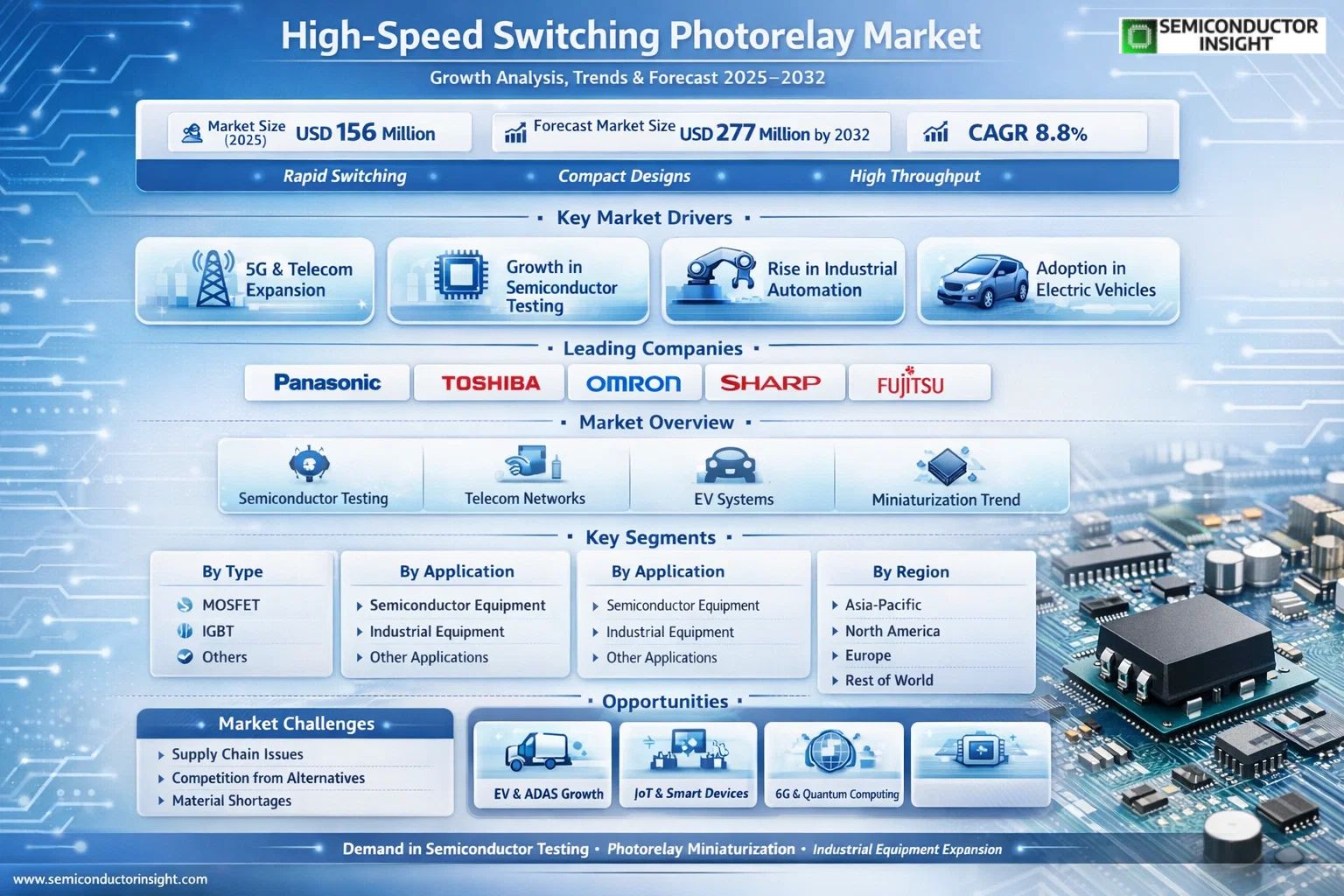
Global High-Speed Switching Photorelay market was valued at USD 156 million in 2025 and is projected to reach USD 277 million by 2032, exhibiting a CAGR of 8.8% during the forecast period.
High-speed switching photorelays are advanced optoelectronic devices that enable rapid switching in high-throughput applications. They utilize light to activate semiconductors like MOSFETs, minimizing switching delays in semiconductor testers designed to handle numerous devices under test (DUT) with multiple pins simultaneously. This high-speed capability reduces test time losses significantly. Moreover, miniaturization allows mounting large numbers of these photorelays on constrained board spaces. Key types include MOSFET, IGBT, and others.
The market is experiencing robust growth driven by surging demand in semiconductor equipment and industrial sectors. Rising needs for efficient throughput in testing, coupled with advancements in compact designs, propel expansion. Key players such as Panasonic, Toshiba, OMRON, Sharp, TE Connectivity, and Fujitsu Limited lead with innovative portfolios. Their ongoing developments in faster, smaller photorelays further accelerate market momentum, positioning the industry for sustained progress.
MARKET DRIVERS
Rising Demand in 5G and Telecom Infrastructure
High-Speed Switching Photorelay Market is experiencing robust growth due to the global rollout of 5G networks, which require ultra-fast signal switching for base stations and routers. These devices offer switching speeds below 1ms, enabling efficient data transmission in high-frequency applications. Telecom equipment manufacturers increasingly adopt them over mechanical relays for their reliability and compact size, driving market expansion at a projected CAGR of 7.5% through 2028.
Expansion in Semiconductor Testing and ATE
High-speed switching photorelay demand surges in automatic test equipment (ATE) for semiconductors, where precise, low-on-resistance switching is critical for high-volume testing. With semiconductor production ramping up for AI chips and IoT devices, the market benefits from enhanced throughput in testing processes. Leading players report a 20% year-over-year increase in orders from fabless chip designers.
➤ The integration of high-speed switching photorelay in battery management systems for EVs supports over 10 million annual vehicle inspections, boosting market volumes.
Additionally, automotive electrification fuels adoption in battery monitoring, where isolation and fast response prevent faults. This convergence of telecom, testing, and EV sectors positions High-Speed Switching Photorelay Market for sustained momentum amid digital transformation.
MARKET CHALLENGES
Supply Chain Vulnerabilities and Material Shortages
High-Speed Switching Photorelay Market faces hurdles from semiconductor supply chain disruptions, exacerbated by geopolitical tensions and raw material scarcity. Key components like GaAs substrates experience delays, pushing lead times to 20-30 weeks and inflating costs by 15%. Manufacturers struggle to meet demand spikes from 5G deployments.
Other Challenges
Competition from Solid-State Alternatives
MOSFETs and SiC relays offer higher voltage handling at competitive prices, challenging photorelay dominance in industrial applications. This shift erodes market share, particularly in Europe where energy efficiency regulations favor alternatives. Design complexity in integrating photodiodes adds to development cycles, slowing innovation pace.Intense price pressures from Asian competitors further strain margins, with average selling prices dropping 10% annually. These dynamics demand strategic sourcing and R&D investments to maintain foothold in High-Speed Switching Photorelay Market.
MARKET RESTRAINTS
Technical Limitations in Power Handling
High-Speed Switching Photorelay Market growth is tempered by inherent constraints in handling high voltages above 100V, limiting use in power-intensive sectors like renewables. Off-state leakage currents remain a concern, risking system failures in precision applications and capping adoption rates below 30% in high-power telecom gear.Regulatory compliance with RoHS and UL standards imposes rigorous testing, delaying product launches by 6-12 months. Maturity in core technologies also leads to incremental improvements only, with switching speeds plateauing at 0.5ms for most devices.Market fragmentation among niche suppliers hinders economies of scale, keeping unit costs elevated. These factors collectively restrain broader penetration of high-speed switching photorelay in emerging high-voltage domains.
MARKET OPPORTUNITIES
Proliferation of EVs and Advanced Driver Assistance Systems
High-Speed Switching Photorelay Market holds significant potential in electric vehicles, where fast relays enable efficient battery junction boxes and ADAS modules. With global EV sales forecasted to hit 17 million units in 2025, demand for isolated switching solutions rises sharply.IoT expansion creates niches in smart sensors and edge computing, favoring compact, low-power photorelay designs. Miniaturization trends align with SiP integration, opening doors for 40V/1A devices in wearables.Emerging 6G research and quantum computing tests promise further uptake, with prototypes requiring sub-microsecond switching. Strategic partnerships in Asia-Pacific could capture 25% additional market share for high-speed switching photorelay innovations.
High-Speed Switching Photorelay Market Trends
Surge in Demand from Semiconductor Testing Equipment
In High-Speed Switching Photorelay Market, a dominant trend is the growing requirement for high-speed switching in semiconductor testers to boost throughput efficiency. These testers must handle numerous devices under test with multiple pins simultaneously, minimizing test time losses during switching. This drives the need for photorelays that deliver rapid response times, enabling testers to process higher volumes without compromising accuracy. Manufacturers are prioritizing designs that support seamless integration into dense testing setups, reflecting the broader push in semiconductor production for faster cycle times amid rising chip complexity.
Other Trends
Miniaturization for Board Space Optimization
Another key development in High-Speed Switching Photorelay Market involves aggressive miniaturization efforts to fit more units onto limited board spaces in testing equipment. As semiconductor testers evolve to accommodate larger pin counts, compact photorelay packages become essential, allowing higher density without sacrificing performance. This trend aligns with advancements in fabrication techniques, enabling smaller footprints while maintaining robust isolation and switching speeds critical for precision applications.
Expansion into Industrial Equipment Applications
High-Speed Switching Photorelay Market is witnessing broader adoption beyond semiconductor tools into industrial equipment, where reliable solid-state switching enhances automation and control systems. Segments like MOSFET-based photorelays dominate due to their efficiency in high-frequency operations, supporting diverse uses from power management to signal routing. Leading players such as Panasonic, Toshiba, and OMRON are innovating to address these demands, fostering competition that accelerates product enhancements like improved longevity and lower on-resistance. Regionally, Asia-Pacific leads with strong contributions from Japan and China, driven by manufacturing hubs, while North America and Europe focus on specialized high-reliability variants. This diversification strengthens market resilience against sector-specific fluctuations, positioning photorelays as versatile components in evolving electromechanical landscapes.
COMPETITIVE LANDSCAPE
Key Industry Players
Top High-Speed Switching Photorelay Manufacturers and Market Share Analysis
High-Speed Switching Photorelay Market exhibits a moderately concentrated structure, dominated by a few key semiconductor and electronics giants. Panasonic and Toshiba lead the pack, leveraging their advanced MOSFET-based photorelays optimized for high-throughput semiconductor testing equipment. In 2025, the global top five players, including these leaders, captured approximately 60-70% of the market revenue, underscoring their technological edge in miniaturization and switching speeds critical for reducing test time losses in multi-pin DUT measurements. This oligopolistic dynamic fosters innovation in applications like industrial automation, where reliability under high-speed conditions is paramount.
Beyond the frontrunners, niche players such as OMRON, Sharp, and TE Connectivity provide specialized solutions tailored to industrial equipment and other segments, emphasizing IGBT variants and robust integration capabilities. Emerging competitors like Hongfa Technology and Infineon are gaining traction through cost-effective offerings and expansions in Asia-Pacific markets, particularly China and Japan. Companies like Crydom, Fujitsu Limited, Schneider Electric, Siemens, and IXYS (now under Littelfuse) contribute with differentiated products addressing regional demands in North America and Europe, enhancing overall market diversity amid a projected CAGR of 8.8% through 2032.
List of Key High-Speed Switching Photorelay Companies Profiled
- Panasonic
- Toshiba
- OMRON
- Sharp
- TE Connectivity
- Fujitsu Limited
- Crydom
- Schneider Electric
- Siemens
- IXYS (Littelfuse)
- Hongfa Technology
- Infineon
- Mitsubishi Electric
- Vishay Intertechnology
- Broadcom
Segment Analysis:
| Segment Category | Sub-Segments | Key Insights |
| By Type |
|
MOSFET leads the type segment owing to its exceptional suitability for high-speed applications.
|
| By Application |
|
Semiconductor Equipment dominates applications due to critical performance demands.
|
| By End User |
|
Semiconductor Test Equipment Manufacturers represent the leading end user group with specialized needs.
|
| By Mounting Style |
|
Surface Mount Device (SMD) is the preferred mounting style for modern designs.
|
| By Voltage Rating |
|
Low Voltage leads voltage ratings for precision applications.
|
Regional Analysis: High-Speed Switching Photorelay Market
Asia-Pacific
Robust electronics manufacturing hubs drive High-Speed Switching Photorelay Market, with telecommunications and automotive sectors leading adoption. 5G infrastructure rollout demands ultra-fast, low-loss switching, while EV production scales require durable components for high-voltage applications. Industrial IoT expansion further accelerates demand, supported by favorable policies enhancing supply chain efficiency.
High-Speed Switching Photorelay finds prominence in testing equipment, semiconductor fabrication, and power management systems. Telecom base stations utilize them for signal routing, automotive inverters for efficient power delivery, and medical devices for precise control. Renewable energy inverters also leverage their compactness and reliability in harsh environments.
Japanese firms like Panasonic and Toshiba pioneered photorelay technology, maintaining dominance through innovation. Chinese and South Korean players expand via cost-competitive production, fostering intense rivalry. Strategic partnerships with global OEMs bolster market share, emphasizing quality and miniaturization to meet diverse High-Speed Switching Photorelay Market demands.
Emerging trends in edge computing and AI-driven automation unlock prospects in High-Speed Switching Photorelay Market. Expansion into consumer electronics and smart grids offers new avenues, while sustainable manufacturing practices attract eco-conscious buyers. Regional investments in R&D ensure sustained leadership amid global tech shifts.
North America
North America exhibits strong momentum in High-Speed Switching Photorelay Market, propelled by cutting-edge innovation in data centers and automotive technologies. Tech giants in Silicon Valley integrate these relays for hyperscale computing, enabling rapid signal switching in AI servers. The push toward electric vehicles fosters demand in advanced driver-assistance systems and onboard chargers, prioritizing safety and efficiency. Aerospace and defense sectors value their radiation resistance for mission-critical applications. Collaborative ecosystems between universities and firms accelerate development, though reliance on Asian imports poses supply challenges. Strategic reshoring efforts aim to bolster domestic production, enhancing resilience in High-Speed Switching Photorelay Market.
Europe
Europe advances steadily in High-Speed Switching Photorelay Market, anchored by industrial automation and renewable energy transitions. Germany and France lead with smart manufacturing initiatives, deploying relays in PLCs and motion control for Industry 4.0 factories. Wind and solar inverters benefit from their high isolation and switching speeds. Automotive manufacturers emphasize electrification, incorporating them in hybrid powertrains. stringent regulatory standards drive quality focus, while EU-funded projects promote energy-efficient components. Cross-border collaborations strengthen supply chains, positioning Europe as a key player despite competitive pressures from Asia.
South America
South America emerges as a growing contender in High-Speed Switching Photorelay Market, with Brazil and Mexico at the forefront amid industrial modernization. Telecom infrastructure upgrades support 5G rollout, requiring reliable switching for network expansion. Automotive assembly plants adopt them for local EV production, aiding export competitiveness. Oil and gas automation integrates relays for harsh-environment control systems. Economic recovery fuels investments, though infrastructure gaps hinder pace. Partnerships with global suppliers bridge technology deficits, fostering gradual market penetration.
Middle East & Africa
The Middle East & Africa region shows nascent potential in High-Speed Switching Photorelay Market, driven by diversification beyond oil. UAE and South Africa invest in smart cities and data centers, utilizing relays for efficient power distribution. Renewable projects in solar farms demand robust switching solutions. Industrial upgrades in mining and manufacturing incorporate them for automation. Geopolitical stability initiatives support tech adoption, while skill development programs enhance local capabilities. International collaborations accelerate growth, laying foundations for broader High-Speed Switching Photorelay integration.
Report Scope
This market research report provides a comprehensive analysis of High-Speed Switching Photorelay Market, covering the forecast period 2025–2032. It offers detailed insights into market dynamics, technological advancements, competitive landscape, and key trends shaping the industry.
Key focus areas of the report include:
- Market Overview: The report begins with an overview outlining its current market scenario, key growth indicators, and industry transformation drivers. It discusses macroeconomic factors, demand–supply balance, regulatory landscape, and the strategic role of semiconductors in powering advancements across industries such as automotive, telecommunications, consumer electronics, and industrial automation.
- Market Size & Forecast: Historical data and future projections for revenue, unit shipments, and market value across major regions and segments.
- Segmentation Analysis: Detailed breakdown by product type, technology, application, and end-user industry to identify high-growth segments and investment opportunities.
- Regional Insights: Insights into market performance across North America, Europe, Asia-Pacific, Latin America, and the Middle East & Africa, including country-level analysis where relevant.
- Competitive Landscape: Profiles of leading market participants, including their product offerings, R&D focus, manufacturing capacity, pricing strategies, and recent developments such as mergers, acquisitions, and partnerships.
- Technology Trends & Innovation: Assessment of emerging technologies, integration of AI/IoT, semiconductor design trends, fabrication techniques, and evolving industry standards.
- Market Drivers & Restraints: Evaluation of factors driving market growth along with challenges, supply chain constraints, regulatory issues, and market-entry barriers.
- Stakeholder Insights: Insights for component suppliers, OEMs, system integrators, investors, and policymakers regarding the evolving ecosystem and strategic opportunities.
Primary and secondary research methods are employed, including interviews with industry experts, data from verified sources, and real-time market intelligence to ensure the accuracy and reliability of the insights presented.
FREQUENTLY ASKED QUESTIONS:
What is the current market size of High-Speed Switching Photorelay Market?
-> Global High-Speed Switching Photorelay market was valued at USD 156 million in 2025 and is projected to reach USD 277 million by 2032, at a CAGR of 8.8% during the forecast period.
Which key companies operate in High-Speed Switching Photorelay Market?
-> Key players include Panasonic, Toshiba, Crydom, OMRON, Sharp, TE Connectivity, Fujitsu Limited, Schneider, Siemens, and IXYS, among others.
What are the key growth drivers?
-> Key growth drivers include demand for throughput-efficient semiconductor testers requiring high-speed switching to reduce test time losses and miniaturized photorelays for mounting large numbers on limited board space.
Which region dominates the market?
-> Asia is the fastest-growing region, while North America remains a significant market.
What are the emerging trends?
-> Emerging trends include miniaturization of photorelays, high-speed MOSFET switching advancements, and expanding applications in semiconductor and industrial equipment.

Get Sample Report PDF for Exclusive Insights
Report Sample Includes
- Table of Contents
- List of Tables & Figures
- Charts, Research Methodology, and more...
 Download Sample Report PDF