MARKET INSIGHTS
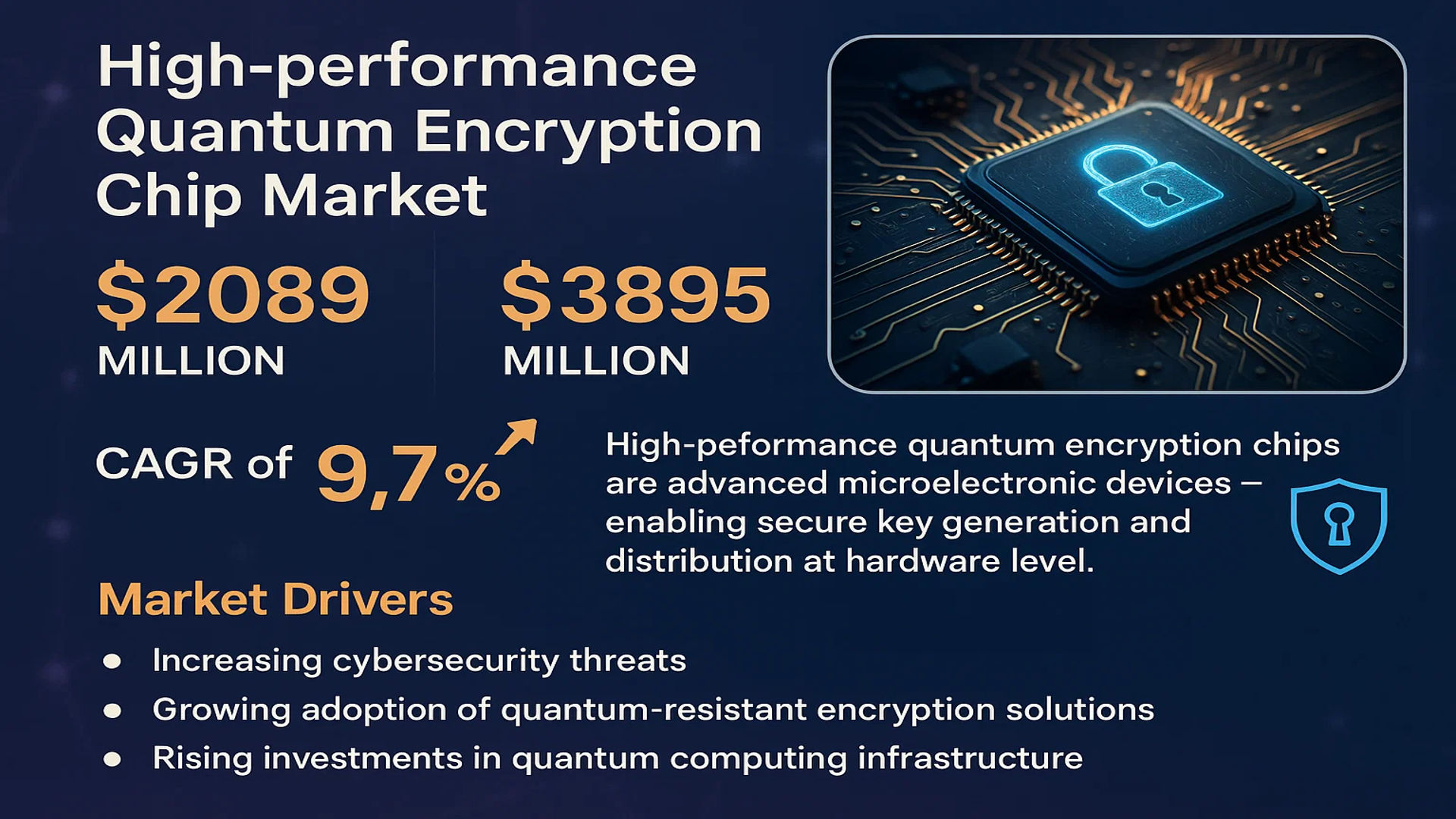
The global High-performance Quantum Encryption Chip Market was valued at 2089 million in 2024 and is projected to reach US$ 3895 million by 2032, at a CAGR of 9.7% during the forecast period.
High-performance quantum encryption chips are advanced microelectronic devices that integrate quantum key distribution (QKD) technology, enabling secure key generation and distribution at the hardware level. These chips leverage quantum mechanics principles to ensure virtually unbreakable encryption for communication systems, making them critical for safeguarding sensitive data across industries such as finance, military, and telecommunications.
The market is driven by increasing cybersecurity threats, growing adoption of quantum-resistant encryption solutions, and rising investments in quantum computing infrastructure. While North America currently dominates due to strong government and private sector initiatives, Asia-Pacific is expected to witness rapid growth because of technological advancements in China and Japan. Key players like Google, Toshiba, and Infineon are actively developing next-generation quantum encryption solutions to address evolving security challenges in an increasingly connected world.
MARKET DYNAMICS
MARKET DRIVERS
Rising Cybersecurity Threats to Drive Adoption of Quantum Encryption Chips
The global cybersecurity landscape is witnessing an alarming surge in sophisticated cyberattacks, with annual damages projected to exceed $10.5 trillion by 2025. High-performance quantum encryption chips are emerging as a critical defense mechanism against these threats by providing mathematically unbreakable security through quantum key distribution (QKD). Financial institutions and government agencies are leading adoption, with some Asian markets reporting over 300% year-over-year growth in quantum security investments since 2022. Unlike conventional encryption that could be broken by quantum computers, quantum chips offer future-proof protection by leveraging the fundamental laws of physics.
Government Initiatives and Funding Accelerate Commercialization
Substantial public sector investments are propelling quantum encryption technology from labs to market. Several nations have committed over $25 billion collectively to quantum technology development through 2030, with encryption applications receiving approximately 40% of allocated funds. The U.S. National Quantum Initiative Act and China’s Quantum Information Science National Laboratory exemplify strategic pushes to establish technological leadership. These programs have reduced commercialization timelines from an estimated 10-15 years to just 5-7 years, catalyzing private sector participation.
➤ For instance, the European Commission’s Quantum Flagship program recently allocated €55 million specifically for quantum secure communication infrastructure development across member states.
Increasing standardization efforts by international bodies are further accelerating adoption. Recent technical standards for quantum cryptography in financial networks have enabled seamless integration with existing security architectures, removing a significant barrier to enterprise adoption.
MARKET RESTRAINTS
High Implementation Costs Limit Widespread Enterprise Adoption
The current price point of quantum encryption chips presents a significant adoption barrier, with unit costs ranging 50-100 times higher than conventional encryption hardware. Full system implementation including specialized infrastructure often requires capital expenditures exceeding $500,000 for mid-sized enterprises. While costs have decreased by approximately 35% since 2020, they remain prohibitive for most commercial applications beyond high-security sectors like defense and finance.
Other Restraints
Technical Limitations in Operational Environments
Current quantum encryption systems demonstrate reduced performance in real-world conditions, particularly in high-temperature environments or when integrated with legacy infrastructure. Signal fidelity decreases significantly beyond 80 kilometers without expensive repeater stations, limiting practical deployment scenarios.
Regulatory Uncertainty Slows Market Entry
Lack of unified global standards creates compliance challenges for multinational deployments. Divergent national regulations regarding quantum technology exports and usage restrictions complicate supply chains and go-to-market strategies.
MARKET CHALLENGES
Quantum Decoherence and Environmental Sensitivity Create Reliability Issues
Maintaining quantum states in commercial chips remains technologically challenging, with even minor environmental vibrations or temperature fluctuations causing performance degradation. Field tests show approximately 15-20% of quantum keys become unusable in uncontrolled environments, necessitating redundant systems that increase costs. The industry faces fundamental physics challenges in developing quantum chips that maintain coherence under standard operating conditions without expensive cryogenic cooling systems.
Talent Shortage Constrains Innovation Pipeline
The specialized interdisciplinary expertise required for quantum encryption development creates severe talent bottlenecks. Current workforce projections indicate a global shortage of over 50,000 qualified quantum engineers through 2030. Educational institutions are struggling to scale quantum technology programs fast enough, with fewer than 30 universities worldwide offering comprehensive quantum engineering degrees. This scarcity drives up labor costs and slows product development cycles across the industry.
MARKET OPPORTUNITIES
5G and IoT Deployments Create Massive Addressable Market
The rollout of 5G networks and expansion of IoT ecosystems present transformative opportunities for quantum encryption. With over 75 billion connected devices projected by 2025 requiring upgraded security, quantum chips could become standard in next-generation network hardware. Recent breakthroughs in miniaturization have enabled prototypes small enough for mobile devices, opening markets worth over $12 billion annually for consumer and industrial applications. Telecommunications providers are piloting quantum-secure 5G backbones in several metropolitan areas with promising early results.
Hybrid Cryptographic Systems Bridge Transition Period
Development of hybrid solutions combining classical and quantum encryption provides near-term commercialization pathways. These systems leverage quantum chips for key distribution while maintaining compatibility with existing security protocols, reducing implementation risks. Early adopters in the banking sector report 60% faster ROI from hybrid deployments compared to full system overhauls. The approach creates a transitional market segment estimated to generate over $3.5 billion in revenue by 2027 while the quantum infrastructure matures.
HIGH-PERFORMANCE QUANTUM ENCRYPTION CHIP MARKET TRENDS
Rising Demand for Unbreakable Security Solutions Propels Market Growth
The global high-performance quantum encryption chip market is experiencing rapid expansion, driven by escalating cybersecurity threats and the urgent need for unbreakable encryption technologies. With cyberattacks growing in sophistication—projected to cost businesses over $10.5 trillion annually by 2025—organizations are prioritizing quantum-resistant security solutions. Quantum encryption chips, leveraging Quantum Key Distribution (QKD), provide theoretically unhackable data protection by utilizing quantum mechanics principles such as photon polarization. Governments and enterprises worldwide are increasingly adopting these chips, particularly in sectors handling sensitive data like defense, finance, and healthcare.
Other Trends
Adoption in Financial Infrastructure
Financial institutions are emerging as early adopters of high-performance quantum encryption chips to safeguard transactions and client data. With banking fraud losses exceeding $42 billion globally in 2023, quantum encryption offers a future-proof solution against both classical and quantum computing attacks. Major payment networks and central banks are piloting quantum-secured communication channels, with several European banks already implementing QKD-based systems for inter-branch data transfers.
Technological Advancements in Post-Quantum Cryptography
As quantum computing progresses—with some estimates suggesting practical quantum systems may emerge within 5-10 years—the race to develop quantum-resistant encryption has intensified. Recent breakthroughs include photonic integrated circuits that significantly reduce the size and cost of quantum encryption systems while improving reliability. Leading manufacturers have successfully miniaturized QKD systems into semiconductor chips compatible with existing network infrastructure, enabling both universal and specialized applications across different industries. These innovations are expected to drive down implementation costs by nearly 40% by 2026, making quantum encryption more accessible to mid-sized enterprises.
Government Initiatives Accelerating Deployment
National security concerns are prompting governments worldwide to invest heavily in quantum encryption technologies. The U.S. National Quantum Initiative and China’s quantum communications infrastructure projects have collectively allocated over $3 billion for quantum technology development. Such initiatives are creating structured roadmaps for quantum-secure communications, with several countries mandating quantum-resistant standards for critical infrastructure by 2025. This policy push is significantly boosting R&D investments across the quantum encryption supply chain, from semiconductor manufacturers to network providers.
COMPETITIVE LANDSCAPE
Key Industry Players
Quantum Encryption Pioneers Accelerate Innovation Amid Rising Security Demands
The global high-performance quantum encryption chip market exhibits a dynamic competitive environment, characterized by rapid technological advancements and strategic collaborations. Google and Toshiba currently dominate the market, collectively holding over 35% revenue share in 2024. These tech giants have established early leadership through substantial R&D investments and successful commercialization of quantum encryption solutions for enterprise and government applications.
PQShield and SEEQC have emerged as formidable challengers, specializing in quantum-resistant cryptographic solutions. These firms demonstrate particularly strong growth in the financial services sector, where vulnerability to quantum attacks has prompted urgent infrastructure upgrades. Their patented chip architectures offer backward compatibility with existing systems while providing quantum-level security – a crucial advantage driving adoption.
The competitive landscape is further enriched by semiconductor veterans like Infineon and quantum specialists such as QuantumCTek. Infineon leverages its established fabrication capabilities to deliver cost-optimized solutions, while QuantumCTek focuses on China’s burgeoning quantum technology ecosystem. Regional players are gaining traction through government-backed initiatives, particularly in strategic sectors like defense and critical infrastructure protection.
List of Key High-performance Quantum Encryption Chip Manufacturers
- Google Quantum AI (U.S.)
- Toshiba Corporation (Japan)
- PQShield Ltd. (U.K.)
- SEEQC (U.S.)
- Infineon Technologies (Germany)
- Turing Quantum (China)
- C*Core Technology (China)
- QuantumCTek Co., Ltd. (China)
Segment Analysis:
By Type
Universal Chip Segment Leads the Market Due to Rising Demand for Multi-purpose Encryption Solutions
The market is segmented based on type into:
- Universal Chip
- Special Chip
By Application
Financial Sector Drives Adoption Through Need for Secure Transactions
The market is segmented based on application into:
- Finance
- Subtypes: Banking, Digital Payments, and others
- Military
- Medical
- Communications
- Subtypes: Telecom Networks, Satellite Communications, and others
- Others
By Technology
Quantum Key Distribution (QKD) Technology Remains Foundation for Secure Encryption
The market is segmented based on technology into:
- Quantum Key Distribution (QKD)
- Post-Quantum Cryptography
- Hybrid Encryption
By Security Level
High-Security Chips Dominating Government and Defense Applications
The market is segmented based on security level into:
- Standard Security
- High Security
- Military-Grade Security
Regional Analysis: High-performance Quantum Encryption Chip Market
North America
North America leads the global quantum encryption chip market, driven by substantial government and private sector investments in cybersecurity and quantum technologies. The U.S. government’s allocation of $1.2 billion for quantum research through the National Quantum Initiative Act has accelerated R&D in secure communication systems. Major tech firms like Google and startups such as SEEQC are pioneering chip innovations, focusing on defense and financial applications. The region’s strict data protection regulations, including compliance requirements for industries like healthcare (HIPAA) and finance (SOX), further boost adoption. However, high development costs and the need for specialized infrastructure remain challenges for widespread deployment beyond enterprise and government use.
Europe
Europe is a key market, with the EU’s Quantum Flagship program committing €1 billion to advance quantum technologies, including encryption chips. Countries like Germany, France, and the U.K. are at the forefront, leveraging academic-industry collaborations. The region’s emphasis on GDPR-compliant data security drives demand in banking and telecommunications. Companies like Toshiba and Infineon are actively developing solutions tailored to European infrastructure. While growth is robust, fragmented regulatory frameworks across member states and competition from North American and Asian players pose hurdles for localized market expansion.
Asia-Pacific
The Asia-Pacific region is projected to witness the highest CAGR, fueled by China’s aggressive investments in quantum technology as part of its 14th Five-Year Plan. Chinese firms like QuantumCTek and C*Core Technology dominate local production, supported by government mandates for secure military and telecom networks. India and Japan are emerging as significant markets, with initiatives such as India’s National Quantum Mission and Japan’s Q-LEAP program. Cost-effective manufacturing and rapid digital transformation create opportunities, though intellectual property concerns and reliance on imports for advanced components temper growth potential in some countries.
South America
South America’s market is nascent but growing, with Brazil and Argentina piloting quantum encryption projects for critical infrastructure. Limited R&D funding and economic instability slow progress, but increasing cyber threats are pushing governments to explore partnerships with global chip manufacturers. The banking sector shows early adoption, though the lack of localized expertise and high import costs constrain the market to niche applications. Long-term growth will depend on cross-border collaborations and policy support for technology transfer.
Middle East & Africa
The Middle East, particularly the UAE and Saudi Arabia, is investing in quantum encryption to diversify economies under initiatives like Saudi Vision 2030. Smart city projects and secure oil/gas infrastructure are key drivers, with partnerships involving firms like PQShield. Africa’s market remains underdeveloped due to limited infrastructure, though South Africa and Kenya are exploring use cases in finance and governance. While geopolitical tensions heighten demand for secure communication, the high cost of deployment and skill gaps delay large-scale adoption across the region.
Report Scope
This market research report provides a comprehensive analysis of the Global High-performance Quantum Encryption Chip Market, covering the forecast period 2024–2032. It offers detailed insights into market dynamics, technological advancements, competitive landscape, and key trends shaping the industry.
Key focus areas of the report include:
- Market Size & Forecast: Historical data and future projections for revenue, unit shipments, and market value across major regions and segments. The market was valued at USD 2,089 million in 2024 and is projected to reach USD 3,895 million by 2032, growing at a CAGR of 9.7%.
- Segmentation Analysis: Detailed breakdown by product type (Universal Chip, Special Chip) and application (Finance, Military, Medical, Communications, Others) to identify high-growth segments and investment opportunities.
- Regional Outlook: Insights into market performance across North America, Europe, Asia-Pacific, Latin America, and the Middle East & Africa, including country-level analysis where relevant.
- Competitive Landscape: Profiles of leading market participants including Google, Toshiba, PQShield, SEEQC, Infineon, Turing Quantum, C*Core Technology, and QuantumCTek, covering their product offerings, R&D focus, and recent developments.
- Technology Trends & Innovation: Assessment of emerging quantum encryption technologies, integration with existing security systems, and evolving industry standards.
- Market Drivers & Restraints: Evaluation of factors driving market growth along with challenges, including increasing cyber threats, regulatory requirements for data security, and high implementation costs.
- Stakeholder Analysis: Insights for component suppliers, OEMs, system integrators, investors, and policymakers regarding the evolving quantum encryption ecosystem and strategic opportunities.
Primary and secondary research methods are employed, including interviews with industry experts, data from verified sources, and real-time market intelligence to ensure the accuracy and reliability of the insights presented.
FREQUENTLY ASKED QUESTIONS:
What is the current market size of Global High-performance Quantum Encryption Chip Market?
-> High-performance Quantum Encryption Chip Market was valued at 2089 million in 2024 and is projected to reach US$ 3895 million by 2032, at a CAGR of 9.7% during the forecast period.
Which key companies operate in Global High-performance Quantum Encryption Chip Market?
-> Key players include Google, Toshiba, PQShield, SEEQC, Infineon, Turing Quantum, C*Core Technology, and QuantumCTek, among others.
What are the key growth drivers?
-> Key growth drivers include rising cybersecurity threats, increasing adoption in defense and finance sectors, and government investments in quantum technology.
Which region dominates the market?
-> North America currently leads the market, while Asia-Pacific is expected to show the highest growth rate during the forecast period.
What are the emerging trends?
-> Emerging trends include integration with 5G networks, development of post-quantum cryptography standards, and increasing adoption in healthcare data security.

Get Sample Report PDF for Exclusive Insights
Report Sample Includes
- Table of Contents
- List of Tables & Figures
- Charts, Research Methodology, and more...
 Download Sample Report PDF