
High Frequency SAW Filter Market Insights
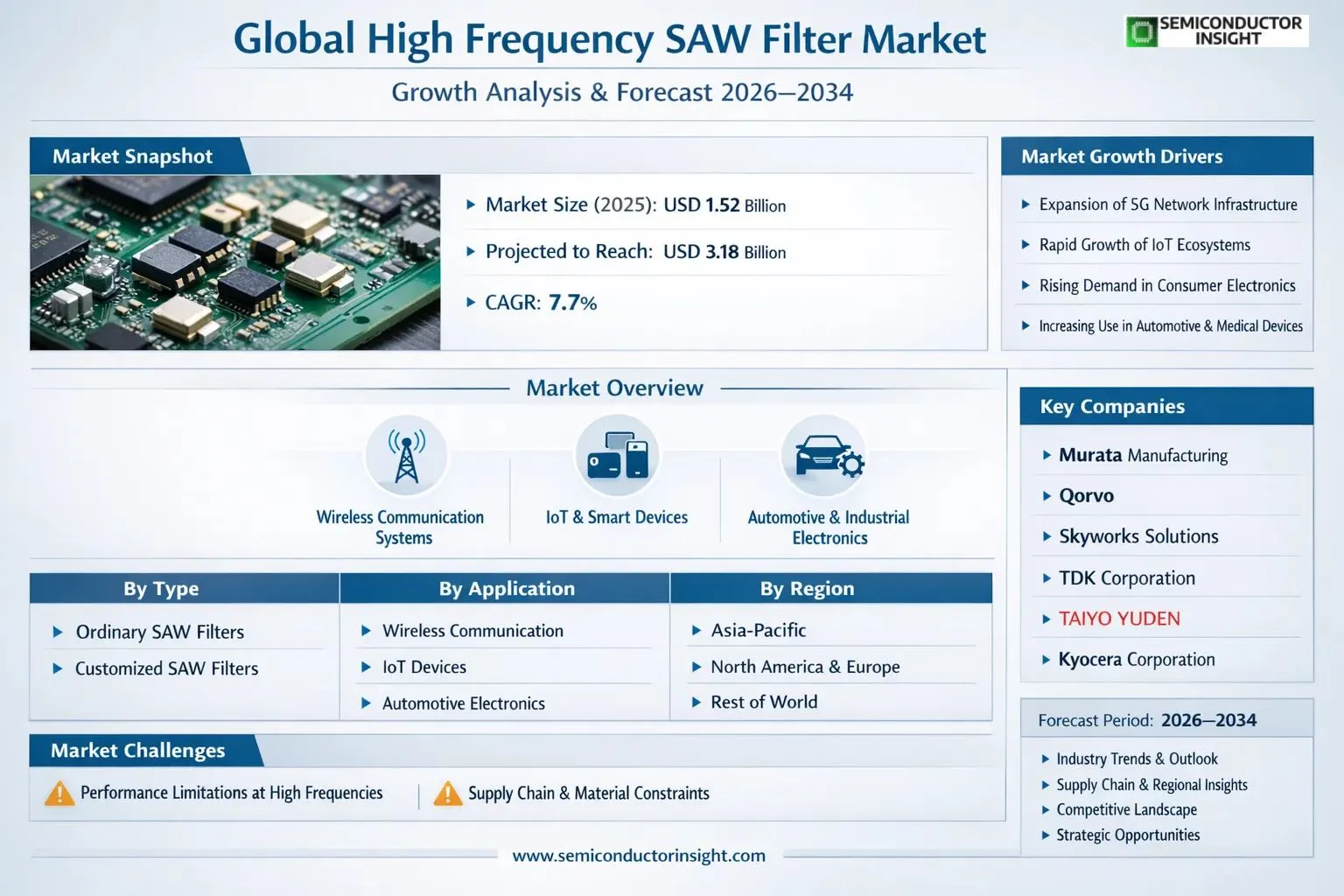
Global High Frequency SAW Filter market size was valued at USD 1.52 billion in 2025. The market is projected to grow from USD 1.63 billion in 2026 to USD 3.18 billion by 2034, exhibiting a CAGR of 7.7% during the forecast period.
High-frequency SAW filters , full name high-frequency surface acoustic wave filters (Surface Acoustic Wave Filters) , are electronic devices that leverage surface acoustic wave (SAW) technology to achieve precise signal filtering. These components utilize the phenomenon of acoustic wave propagation on solid surfaces to deliver signal filtering and modulation, offering distinct advantages such as high precision, low insertion loss, miniaturization, and seamless integration. SAW filters exploit the properties of piezoelectric crystals to generate and propagate surface acoustic waves along the crystal’s surface. These elastic waves, whose amplitude decreases rapidly with increasing substrate depth, enable the filter to select specific frequencies based on the relationship between propagation speed and wavelength, while absorbing all other frequencies through an attenuation layer.
The market is witnessing robust growth driven by the accelerating deployment of 5G networks and the rapid expansion of the Internet of Things (IoT) ecosystem. As a critical component in wireless communications, high-frequency SAW filters are widely adopted across cellular devices, GPS systems, tablet computers, and audio-visual home appliances , with cellular devices representing the largest downstream application, accounting for approximately 82% of total market share. Furthermore, rising adoption in automotive electronics, medical equipment, and industrial automation is opening new and significant revenue streams. Key market participants such as Murata Manufacturing, Qorvo, Skyworks, TDK, and TAIYO YUDEN continue to operate with broad and competitive product portfolios, reinforcing the market’s steady global growth trajectory.
MARKET DRIVERS
Surging Demand from 5G Infrastructure and Advanced Wireless Communication Networks
High Frequency SAW Filter Market is experiencing robust expansion, primarily driven by the accelerated global rollout of 5G telecommunications infrastructure. Surface Acoustic Wave (SAW) filters operating at high frequencies are integral components in base stations, small cells, and user equipment, enabling precise frequency band selection and signal integrity across crowded RF spectrums. As mobile network operators worldwide invest heavily in sub-6 GHz and millimeter-wave 5G deployments, the demand for high frequency SAW filters capable of handling increasingly complex multi-band configurations has intensified significantly. The proliferation of 5G-enabled smartphones, which commonly integrate more than ten RF filter components per device, has further amplified production volumes across the value chain.
Rapid Expansion of IoT Ecosystems and Connected Device Proliferation
The explosive growth of Internet of Things (IoT) applications across industrial automation, smart healthcare, smart cities, and consumer electronics represents a powerful structural driver for High Frequency SAW Filter Market. IoT devices operating across Wi-Fi, Bluetooth, Zigbee, and proprietary sub-GHz bands require compact, low-insertion-loss, and thermally stable filtering solutions. High frequency SAW filters meet these requirements effectively, offering miniaturized form factors that align with the industry’s demand for smaller and more power-efficient components. As connected device counts continue scaling globally, sustained procurement of advanced SAW filter components by tier-one electronics manufacturers is reinforcing market momentum.
➤ The convergence of 5G connectivity, IoT device proliferation, and automotive electronic advancement is collectively creating an unprecedented demand environment for high frequency SAW filter technologies, positioning the market for sustained long-term growth across multiple end-use verticals.
Automotive electronics constitute another significant demand engine within High Frequency SAW Filter Market. Modern vehicles incorporate advanced driver-assistance systems (ADAS), vehicle-to-everything (V2X) communication modules, telematics units, and in-vehicle infotainment systems, all of which depend on reliable RF filtering for signal clarity and electromagnetic compatibility. The ongoing transition toward connected and autonomous vehicles is necessitating the integration of high-performance filtering components capable of operating reliably in thermally and vibrationally demanding environments. This automotive-driven demand is broadening the addressable market beyond traditional consumer electronics applications.
MARKET CHALLENGES
Technical Limitations at Ultra-High Frequency Bands Constraining Broader Adoption
Despite favorable demand dynamics, High Frequency SAW Filter Market faces notable technical challenges that constrain its expansion into certain high-frequency application segments. Conventional SAW filter technology encounters performance degradation at frequencies exceeding approximately 3 GHz, including elevated insertion loss, reduced power handling capability, and diminished temperature stability. These inherent physical limitations have necessitated the development of alternative or complementary technologies such as Bulk Acoustic Wave (BAW) filters and Film Bulk Acoustic Resonator (FBAR) filters, which offer superior performance at higher frequency bands. As the telecommunications industry pushes deeper into 5G mmWave frequencies, SAW filter manufacturers face mounting pressure to innovate beyond conventional design boundaries to remain competitive.
Other Challenges
Supply Chain Concentration and Raw Material Dependencies
High Frequency SAW Filter Market is characterized by a relatively concentrated supplier base for critical piezoelectric substrates, including lithium tantalate and lithium niobate crystals. Geopolitical disruptions, export controls, and limited geographic diversification of substrate production have periodically created supply chain vulnerabilities, leading to component shortages and pricing volatility. Manufacturers are under pressure to develop alternative material sources and diversify their procurement strategies to mitigate these risks, although such transitions require substantial capital investment and extended qualification timelines.
Intensifying Price Competition and Margin Compression
The commoditization of standard high frequency SAW filter designs, particularly within the consumer electronics segment, has introduced significant pricing pressure across the market. Aggressive competition from Asian manufacturers offering cost-competitive alternatives has compressed profit margins for established players, incentivizing continuous investment in differentiated, high-performance product lines. Balancing cost efficiency with technological advancement remains a persistent challenge for companies operating within High Frequency SAW Filter Market, particularly those serving price-sensitive end markets.
MARKET RESTRAINTS
Performance Ceiling of SAW Technology Relative to Emerging Acoustic Filter Alternatives
A fundamental restraint facing High Frequency SAW Filter Market is the growing competitive displacement risk posed by BAW and FBAR technologies in premium high-frequency applications. As 5G network architectures increasingly rely on frequency bands above 3 GHz where SAW filters struggle to maintain adequate performance metrics, system designers are progressively specifying BAW-based solutions for these critical applications. This technology substitution dynamic is limiting the addressable market available to SAW filter manufacturers, particularly within flagship smartphone RF front-end modules and advanced base station filter arrays. While Temperature Compensated SAW (TC-SAW) and I.H.P. SAW innovations are extending the viable frequency range of SAW technology, the performance gap relative to BAW at the highest frequencies remains a structural restraint on market expansion.
High Capital Investment Requirements and Extended Product Qualification Cycles
The manufacturing of high frequency SAW filters demands sophisticated semiconductor-grade fabrication facilities, precision photolithographic equipment, and stringent process control systems, resulting in substantial capital expenditure requirements for market participants. New entrants face significant barriers to achieving the manufacturing yields and product consistency required to qualify components for tier-one OEM supply chains, particularly in automotive and aerospace applications where qualification processes can span multiple years. These high barriers to entry and long qualification cycles restrain the pace of competitive expansion within High Frequency SAW Filter Market, concentrating production capacity among a limited number of established manufacturers and limiting supply elasticity during periods of sudden demand acceleration.
MARKET OPPORTUNITIES
Technological Innovation in TC-SAW and Advanced SAW Variants Opening New Application Frontiers
Significant market opportunities exist for companies investing in next-generation SAW filter architectures, particularly Temperature Compensated SAW and Incredible High Performance SAW (I.H.P. SAW) technologies that extend viable operating frequencies while maintaining competitive cost structures relative to BAW alternatives. These advanced SAW variants are enabling renewed penetration into mid-to-high frequency 5G bands, recapturing application segments that were at risk of permanent migration to BAW technology. Innovation in packaging, including wafer-level chip-scale packaging (WL-CSP) and embedded die configurations, is further expanding the integration possibilities for high frequency SAW filter components within compact RF front-end module architectures, creating incremental design-win opportunities with major smartphone and IoT device manufacturers.
Emerging Demand from Satellite Communication and Low Earth Orbit Network Infrastructure
The rapid commercialization of Low Earth Orbit (LEO) satellite constellations and the broader expansion of satellite-based broadband services represent a strategically important emerging opportunity for High Frequency SAW Filter Market. User terminals for LEO satellite services require compact, high-performance RF filtering solutions capable of operating reliably across Ku and Ka frequency bands under dynamic signal conditions. As satellite internet services expand their subscriber bases globally, particularly in underserved markets lacking terrestrial broadband infrastructure, the associated demand for specialized high frequency filtering components is expected to grow. SAW filter manufacturers with the capability to develop radiation-tolerant and environmentally robust solutions for satellite ground terminal applications are well-positioned to capture meaningful share in this emerging high-value segment.
Industrial Automation and Smart Manufacturing Adoption Accelerating RF Component Demand
The accelerating adoption of Industry 4.0 principles and wireless-enabled smart manufacturing environments is generating incremental demand for reliable high frequency RF filtering components in industrial settings. Factory automation systems, wireless sensor networks, collaborative robotics, and real-time asset tracking platforms operating on industrial Wi-Fi 6, 5G private networks, and LPWAN technologies require high frequency SAW filters that deliver stable performance in electromagnetically challenging industrial environments. This industrial digitalization trend, supported by significant government and private sector investment across North America, Europe, and Asia-Pacific, is diversifying the end-market exposure of High Frequency SAW Filter Market beyond its traditional consumer electronics and telecommunications base, providing a durable source of incremental demand growth over the medium to long term.
High Frequency SAW Filter Market () Trends
5G Network Expansion Driving Surge in High Frequency SAW Filter Demand
High Frequency SAW Filter Market is experiencing significant momentum, primarily fueled by the rapid global rollout of 5G networks. As telecom operators accelerate infrastructure deployments across North America, Asia, and Europe, the demand for high-precision signal filtering components has intensified considerably. High-frequency SAW filters, which leverage surface acoustic wave technology to deliver low insertion loss and miniaturized form factors, are increasingly indispensable in next-generation wireless devices. Cellular devices remain the dominant application segment, accounting for approximately 82% of total market consumption, underlining the critical role these components play in mobile communication ecosystems. The growing complexity of 5G radio frequency front-end modules , requiring multiple filters to manage diverse frequency bands simultaneously , is further amplifying unit demand per device, making this one of the most consequential trends shaping the market today.
Other Trends
IoT Proliferation Expanding Application Scope
Beyond cellular communications, the Internet of Things (IoT) is emerging as a high-growth application vertical for High Frequency SAW Filter Market. As connected devices proliferate across smart homes, industrial automation platforms, and asset tracking systems, the need for reliable, compact RF filtering solutions has grown substantially. SAW filters are well suited for IoT applications due to their integration compatibility and ability to operate efficiently at high frequencies with minimal power consumption , a critical requirement for battery-dependent IoT endpoints. This diversification beyond traditional cellular use cases is broadening the market’s overall demand base and reducing its dependence on any single application segment.
Automotive and Medical Sectors Emerging as New Growth Frontiers
High Frequency SAW Filter Market is also witnessing increased traction in automotive electronics and medical equipment applications. In the automotive sector, advanced driver-assistance systems (ADAS), vehicle-to-everything (V2X) communication, and connected car platforms are driving demand for high-frequency filtering components capable of operating reliably in electromagnetically challenging environments. Similarly, in medical equipment, wireless patient monitoring devices and diagnostic imaging systems are increasingly incorporating SAW filters to ensure signal integrity and regulatory compliance. These emerging verticals are generating new growth opportunities and contributing to a more diversified market structure.
Asia-Pacific Manufacturing Leadership and Competitive Landscape Intensifying
From a regional perspective, Asia-Pacific maintains a dominant position in High Frequency SAW Filter Market, driven by the concentration of leading manufacturers and robust electronics production ecosystems in Japan, South Korea, and China. Key players including Murata Manufacturing, TDK, TAIYO YUDEN, Kyocera Corporation, Qorvo, and Skyworks continue to invest in advanced fabrication capabilities and product innovation to maintain competitive positioning. The market is also witnessing growing contributions from Chinese manufacturers such as CETC Deqing Huaying Electronics and Huayuan Microelectronics, reflecting a broader trend of regional supply chain development. Customized SAW filter solutions are gaining traction alongside standard offerings, as end-users in specialized industries seek application-specific performance characteristics, further differentiating the competitive environment.
COMPETITIVE LANDSCAPE
Key Industry Players
High Frequency SAW Filter Market – Competitive Dynamics, Leading Manufacturers, and Strategic Positioning
Global High Frequency SAW Filter market is characterized by a moderately consolidated competitive landscape, with a handful of dominant players commanding a significant share of global revenues. Murata Manufacturing consistently leads the market, leveraging its extensive portfolio of surface acoustic wave filter solutions, advanced piezoelectric crystal technologies, and deeply integrated global supply chains. The company’s dominance is reinforced by its strong foothold in the cellular device segment, which accounts for approximately 82% of total SAW filter demand. Alongside Murata, Qorvo and Skyworks Solutions have emerged as formidable competitors, particularly within the 5G wireless communications and mobile device ecosystems. These companies invest heavily in R&D to address the growing frequency and miniaturization requirements driven by 5G network rollout and the expanding Internet of Things (IoT) infrastructure. TDK Corporation and TAIYO YUDEN further strengthen the competitive field by offering highly precise, low-insertion-loss SAW filter products that cater to automotive electronics, medical equipment, and industrial automation verticals , segments that are rapidly emerging as new growth frontiers for the industry.
Beyond the tier-one global leaders, a range of niche and regionally significant players are actively shaping market competition. Tai-Saw Technology and Kyocera Corporation have established strong reputations for customized SAW filter solutions tailored to radar systems and specialty communication applications. Chinese manufacturers, including Starshine Semiconductor, Shoulder Electronics, CETC Deqing Huaying Electronics, and Huayuan Microelectronics, are increasingly gaining market traction by offering cost-competitive products and benefiting from strong domestic demand tied to China’s expansive 5G deployment and consumer electronics manufacturing base. These players are scaling their production capabilities and investing in technology upgrades to close the performance gap with established Japanese and American counterparts. The competitive intensity across High Frequency SAW Filter Market continues to escalate as companies pursue mergers, acquisitions, and strategic partnerships to expand their product portfolios, geographical reach, and technological capabilities in response to evolving end-market demands.
List of Key High Frequency SAW Filter Companies Profiled
- Murata Manufacturing
- Qorvo
- Skyworks Solutions
- TDK Corporation
- TAIYO YUDEN
- Tai-Saw Technology
- Kyocera Corporation
- Starshine Semiconductor
- Shoulder Electronics
- CETC Deqing Huaying Electronics
- Huayuan Microelectronics
Segment Analysis:
| Segment Category | Sub-Segments | Key Insights |
| By Type |
|
Ordinary SAW Filters dominate Global High Frequency SAW Filter market owing to their widespread adoption across mass-market consumer electronics applications.
|
| By Application |
|
Wireless Communication stands as the most dominant application segment in High Frequency SAW Filter Market, underpinned by Global rollout of 5G infrastructure and the ever-increasing demand for high-speed, low-latency mobile connectivity.
|
| By End User |
|
Consumer Electronics Manufacturers represent the leading end-user segment for high-frequency SAW filters, reflecting the enormous global production volumes of smartphones, tablets, GPS devices, and audio-visual home appliances that integrate these components as essential signal management solutions.
|
| By Frequency Range |
|
1 GHz – 3 GHz SAW Filters currently lead the frequency range segment, as this band encompasses the majority of widely deployed 4G LTE and lower-band 5G NR frequencies that power global mobile communication networks and a broad range of wireless connectivity standards.
|
| By Substrate Material |
|
Lithium Tantalate (LiTaO₃) is the leading substrate material segment in the high-frequency SAW filter market, prized for its excellent electromechanical coupling coefficient and superior temperature stability characteristics, which are critical for maintaining consistent filter performance across varying operating environments.
|
Regional Analysis: High Frequency SAW Filter Market
Asia-Pacific
The rapid deployment of 5G networks across China, Japan, South Korea, and emerging Southeast Asian economies is generating sustained demand for high frequency SAW filters. Telecom operators are aggressively upgrading base station infrastructure, and each new installation requires multiple high-performance filtering components to manage increasingly complex spectrum environments, making Asia-Pacific the epicenter of infrastructure-driven filter demand.
Asia-Pacific hosts the world’s largest concentration of consumer electronics manufacturers, including global smartphone OEMs and their extensive supplier networks. The relentless drive toward thinner, more capable mobile devices has intensified demand for compact, high-frequency SAW filter solutions capable of supporting multi-band operation, placing regional component makers at the forefront of advanced filter design and volume production.
Government-led programs across China, Japan, and South Korea are channeling significant investment into domestic semiconductor and RF component manufacturing. These policy initiatives are reducing reliance on foreign supply chains, cultivating local talent, and accelerating the development of next-generation SAW filter technologies, positioning Asia-Pacific to deepen its competitive advantages in High Frequency SAW Filter Market well into the coming decade.
Beyond smartphones and telecom infrastructure, Asia-Pacific is experiencing robust growth in IoT device deployments and connected automotive electronics, both of which rely heavily on high frequency SAW filters for reliable wireless communication. Regional automotive OEMs and industrial IoT solution providers are increasingly integrating advanced RF filtering components, creating diversified and resilient demand streams that extend well beyond traditional consumer electronics applications.
North America
North America represents a strategically significant market within Global High Frequency SAW Filter Market, underpinned by its advanced telecommunications landscape, robust defense and aerospace sector, and its concentration of world-class research institutions and fabless semiconductor design companies. The United States, as the region’s anchor market, is experiencing accelerating demand for high frequency SAW filters driven by the ongoing commercial 5G rollout, which continues to expand into suburban and rural areas following early urban densification phases. The defense sector adds a unique dimension to North American demand, with military communication systems, radar platforms, and electronic warfare applications requiring highly specialized, ruggedized SAW filter solutions that meet stringent performance specifications. Additionally, the region’s thriving automotive industry, particularly in the area of connected and autonomous vehicle development, is emerging as a meaningful demand driver. North America’s innovation-driven business environment supports continuous advancement in filter design, and strong intellectual property frameworks encourage sustained research and development investment by leading RF component companies operating in the region.
Europe
Europe occupies a meaningful position in High Frequency SAW Filter Market, shaped by its sophisticated industrial base, strong automotive heritage, and growing emphasis on smart connectivity across manufacturing and infrastructure sectors. Germany, France, and the United Kingdom are among the primary contributors to regional demand, with Germany’s world-renowned automotive industry increasingly integrating high frequency SAW filters into advanced driver-assistance systems, vehicle-to-everything communication platforms, and in-vehicle infotainment networks. Europe’s industrial IoT ambitions, supported by the broader Industry 4.0 movement, are also creating new and expanding use cases for high-performance RF filtering components. The region’s regulatory environment, characterized by stringent electromagnetic compatibility standards, is pushing manufacturers toward more precise and capable filter solutions. Furthermore, Europe’s active participation in 5G spectrum allocation and network deployment is generating demand from both telecom operators and equipment vendors, reinforcing the region’s steady and quality-driven growth trajectory in High Frequency SAW Filter Market.
South America
South America is an emerging participant in High Frequency SAW Filter Market, with growth prospects closely tied to the gradual expansion of mobile broadband infrastructure and the increasing penetration of smartphones and connected devices across the region. Brazil stands out as the dominant national market, benefiting from a large and youthful population with growing digital connectivity needs and ongoing investment in telecommunications network modernization. While the region’s manufacturing base for RF components remains relatively nascent, South American telecom operators are steadily upgrading their networks to accommodate higher data throughput requirements, which in turn drives demand for advanced filtering solutions. Economic variability and infrastructure investment cycles may influence the pace of adoption, but the long-term trajectory for High Frequency SAW Filter Market across South America remains constructive, supported by rising consumer electronics consumption and expanding digital services ecosystems across major urban centers.
Middle East & Africa
The Middle East and Africa region represents a developing frontier for High Frequency SAW Filter Market, where growth is primarily being catalyzed by ambitious digital transformation agendas, smart city initiatives, and the accelerating rollout of mobile broadband infrastructure. Gulf Cooperation Council nations, particularly the United Arab Emirates and Saudi Arabia, are investing heavily in 5G network deployment and smart infrastructure as part of broader economic diversification strategies, creating pockets of concentrated demand for high frequency SAW filters within the region. Africa’s mobile-first digital economy, characterized by rapid smartphone adoption and leapfrogging of traditional fixed-line infrastructure, is gradually contributing to filter demand as network operators invest in spectrum efficiency. While the region currently accounts for a smaller share of Global High Frequency SAW Filter Market, its long-term potential is supported by favorable demographic trends, increasing urbanization, and sustained government commitment to building world-class digital connectivity frameworks.
Report Scope
This market research report provides a comprehensive analysis of High Frequency SAW Filter Market, covering the forecast period 2026–2034. It offers detailed insights into market dynamics, technological advancements, competitive landscape, and key trends shaping the industry.
Key focus areas of the report include:
- Market Overview: The report begins with an overview outlining its current market scenario, key growth indicators, and industry transformation drivers. It discusses macroeconomic factors, demand–supply balance, regulatory landscape, and the strategic role of high-frequency SAW filters in powering advancements across industries such as wireless communications, automotive electronics, consumer electronics, and industrial automation.
- Market Size & Forecast: Historical data and future projections for revenue, unit shipments, and market value across major regions and segments.
- Segmentation Analysis: Detailed breakdown by product type, technology, application, and end-user industry to identify high-growth segments and investment opportunities.
- Regional Insights: Insights into market performance across North America, Europe, Asia-Pacific, Latin America, and the Middle East & Africa, including country-level analysis where relevant.
- Competitive Landscape: Profiles of leading market participants, including their product offerings, R&D focus, manufacturing capacity, pricing strategies, and recent developments such as mergers, acquisitions, and partnerships.
- Technology Trends & Innovation: Assessment of emerging technologies, integration of AI/IoT, semiconductor design trends, fabrication techniques, and evolving industry standards.
- Market Drivers & Restraints: Evaluation of factors driving market growth along with challenges, supply chain constraints, regulatory issues, and market-entry barriers.
- Stakeholder Insights: Insights for component suppliers, OEMs, system integrators, investors, and policymakers regarding the evolving ecosystem and strategic opportunities.
Primary and secondary research methods are employed, including interviews with industry experts, data from verified sources, and real-time market intelligence to ensure the accuracy and reliability of the insights presented.
FREQUENTLY ASKED QUESTIONS:
What is the current market size of High Frequency SAW Filter Market?
-> High Frequency SAW Filter Market was valued at USD million in 2025 and is expected to reach USD million by 2034, growing at a CAGR of % during the forecast period 2026–2034.
Which key companies operate in High Frequency SAW Filter Market?
-> Key players include Murata Manufacturing, Qorvo, Skyworks, TDK, TAIYO YUDEN, Tai-Saw Technology, Kyocera Corporation, Starshine Semiconductor, Shoulder Electronics, CETC Deqing Huaying Electronics, and Huayuan Microelectronics, among others.
What are the key growth drivers?
-> Key growth drivers include the rapid proliferation of 5G networks, growing adoption of the Internet of Things (IoT), rising demand for cellular devices (accounting for approximately 82% of downstream market share), and expanding applications in automotive electronics, medical equipment, and industrial automation.
Which region dominates the market?
-> Asia is a dominant region in High Frequency SAW Filter Market, with key contributions from China, Japan, and South Korea, while North America also holds a significant share driven by advanced wireless communication infrastructure and defense applications.
What are the emerging trends?
-> Emerging trends include miniaturization and integration of SAW filter components, increasing adoption in IoT and automotive electronics, growing demand driven by 5G network deployments, and expansion into medical equipment and industrial automation applications.

Get Sample Report PDF for Exclusive Insights
Report Sample Includes
- Table of Contents
- List of Tables & Figures
- Charts, Research Methodology, and more...
 Download Sample Report PDF


