High-Frequency RF Components Market, Trends, Business Strategies 2026-2036

Global High-Frequency RF Components Market was valued at USD 11,750 million in 2025 and is projected to reach USD 20,130 million by 2032, growing at a CAGR of 8.2% during the forecast period

PDF Icon Download Sample Report PDF
  • Quick Dispatch

    All Orders

  • Secure Payment

    100% Secure Payment

Price range: $1,500.00 through $4,250.00

Clear

High-Frequency RF Components Market Insights

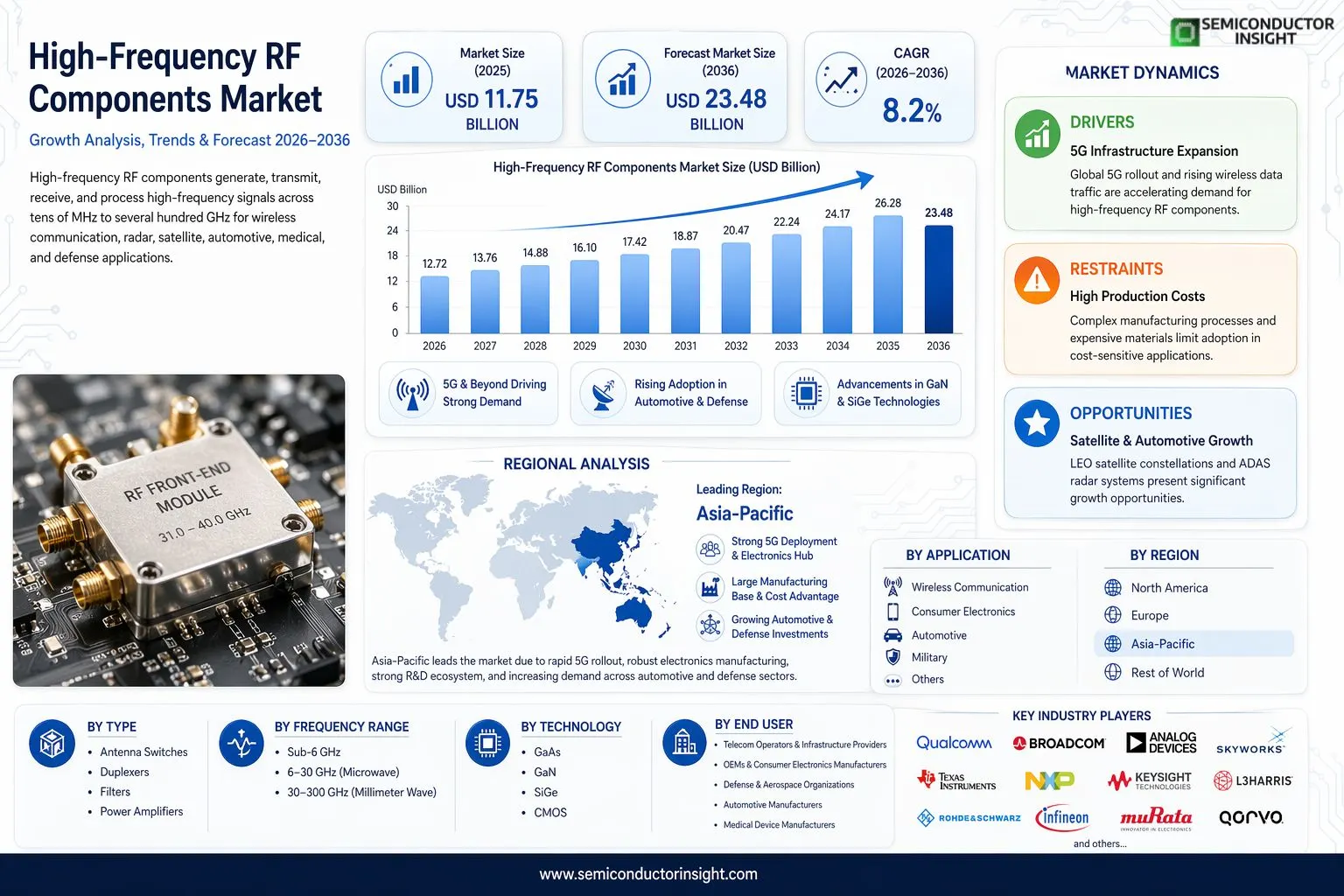
Global High-Frequency RF Components market size was valued at USD 11.75 billion in 2025. The market is projected to grow from USD 12.72 billion in 2026 to USD 23.48 billion by 2036, exhibiting a CAGR of 8.2% during the forecast period.

High-frequency RF components are electronic parts designed to generate, transmit, receive, and process high-frequency signals typically in the range of tens of MHz to several hundred GHz. These components are essential for the operation of wireless communication systems, radar, satellite communication, broadcasting, medical devices, and various other applications requiring high-frequency signal transmission. The component landscape spans a broad range of product types, including Antenna Switches, Duplexers, Filters, and Power Amplifiers, each playing a critical role in ensuring signal integrity across diverse use cases. High-frequency RF components ensure stable signal performance, minimizing interference, and enabling high-speed, efficient communication and data transfer.

The market is experiencing robust growth driven by the accelerating global rollout of 5G infrastructure, rising demand for advanced wireless communication systems, and increasing adoption of RF components across the automotive and defense sectors. Furthermore, the expansion of consumer electronics and the growing need for high-bandwidth, low-latency connectivity are reinforcing demand across all key application segments. Qualcomm, Broadcom, Analog Devices, Skyworks Solutions, Texas Instruments, NXP Semiconductors, Keysight Technologies, L3Harris Technologies, Rohde & Schwarz, and Infineon Technologies are among the leading companies operating in Global High-Frequency RF Components market with extensive and diversified product portfolios.
 High-Frequency RF Components Market

MARKET DRIVERS

5G Infrastructure Rollout Accelerating Demand for High-Frequency RF Components

Global expansion of 5G networks remains one of the most powerful catalysts propelling High-Frequency RF Components Market forward. Telecom operators and infrastructure providers are investing heavily in deploying millimeter-wave (mmWave) and sub-6 GHz base stations, both of which require advanced RF front-end modules, filters, amplifiers, and antenna systems capable of operating at elevated frequencies. As 5G penetration deepens across North America, Europe, and Asia-Pacific, the volume demand for high-frequency components has risen substantially, creating consistent upstream momentum for component manufacturers and semiconductor foundries.

Proliferation of Connected Devices and IoT Ecosystems

The rapid growth of Internet of Things (IoT) ecosystems has expanded the application scope of High-Frequency RF Components Market well beyond traditional telecommunications. Smart home devices, industrial sensors, wearable electronics, and connected automotive systems all depend on reliable high-frequency RF components for wireless communication. Global number of active IoT endpoints has grown significantly in recent years, and each connected device typically integrates one or more RF components including oscillators, mixers, and low-noise amplifiers. This device proliferation translates directly into higher component volumes and greater product diversity requirements across the supply chain.

The convergence of 5G, satellite communications, and IoT is creating multi-layered demand dynamics within High-Frequency RF Components Market, compelling manufacturers to develop components that deliver superior performance across a broader frequency spectrum while meeting increasingly stringent size and power efficiency requirements.

Defense and aerospace applications further reinforce market growth, with radar systems, electronic warfare platforms, and satellite communication terminals requiring highly reliable, ruggedized RF components that maintain performance at frequencies extending into the Ka and V bands. Governments in the United States, Europe, China, and India have continued to allocate substantial defense modernization budgets, a portion of which directly funds RF component procurement and next-generation system development. This sustained institutional demand provides a stable, counter-cyclical growth layer for the broader High-Frequency RF Components industry.

MARKET CHALLENGES

Technical Complexity and Miniaturization Pressures Creating Engineering Barriers

One of the most persistent challenges facing High-Frequency RF Components Market is the escalating technical difficulty involved in designing components that operate reliably at higher frequencies while conforming to ever-shrinking form factors. As end-use devices become more compact, RF engineers must achieve greater integration density without compromising signal integrity, thermal performance, or electromagnetic compatibility. The physics of high-frequency signal propagation introduce challenges such as increased path loss, substrate dielectric losses, and parasitic effects that become more pronounced as operating frequencies climb into the mmWave range, demanding advanced packaging techniques and novel material solutions.

Supply Chain Vulnerabilities and Semiconductor Material Constraints

High-Frequency RF Components Market depends heavily on specialized semiconductor materials including gallium nitride (GaN), gallium arsenide (GaAs), and silicon germanium (SiGe), the production of which is concentrated among a limited number of global suppliers. Geopolitical tensions, export controls, and periodic raw material shortages have exposed vulnerabilities in this supply chain, creating procurement uncertainty for component manufacturers and OEMs alike. Lead times for certain compound semiconductor wafers and substrates have extended during periods of peak demand, constraining production capacity and potentially delaying product launches across the consumer, industrial, and defense segments.

Other Challenges

Regulatory and Spectrum Allocation Complexity

Navigating the patchwork of national and regional spectrum regulations adds compliance cost and market entry complexity for manufacturers of High-Frequency RF Components. Different jurisdictions allocate frequency bands differently, requiring product variants tailored to specific regulatory environments, which increases SKU proliferation, certification costs, and time-to-market timelines.

High Capital Investment Requirements

Establishing or upgrading fabrication facilities capable of producing compound semiconductor RF components demands significant capital expenditure. The cost of advanced lithography equipment, cleanroom infrastructure, and process development for GaN or GaAs wafer fabrication presents a formidable barrier to entry and limits the number of qualified manufacturers capable of serving the high-frequency segment of the RF components market at scale.

MARKET RESTRAINTS

High Production Costs and Pricing Pressures Constraining Market Margins

The cost structure associated with manufacturing high-performance RF components at elevated frequencies remains a meaningful restraint on High-Frequency RF Components Market. Compound semiconductor processes are inherently more expensive than standard silicon CMOS fabrication, with lower wafer yields, higher material input costs, and more complex processing steps contributing to elevated per-unit costs. In price-sensitive commercial segments such as consumer electronics and mass-market IoT, this cost differential creates competitive pressure that can limit adoption of premium high-frequency solutions, particularly when lower-cost silicon-based alternatives offer acceptable performance trade-offs for less demanding applications.

Technological Obsolescence Risk and Rapid Product Lifecycle Turnover

High-Frequency RF Components Market is characterized by rapid technological evolution, which exposes manufacturers and investors to meaningful obsolescence risk. The transition from 4G to 5G, and the ongoing development of 6G research frameworks, requires continuous reinvestment in new component architectures, frequency capabilities, and integration approaches. Companies that fail to maintain pace with evolving wireless standards risk seeing their existing product portfolios become obsolete before achieving full return on development investment. This dynamic shortens effective product lifecycles and intensifies the pressure on research and development expenditure, which can strain profitability, particularly for mid-tier suppliers operating with limited financial reserves.

Geopolitical Tensions Disrupting Global Trade in RF Component Supply Chains

Trade restrictions and technology export controls imposed between major economies have introduced structural disruptions in Global supply chain for High-Frequency RF Components. Restrictions on the export of advanced semiconductor manufacturing equipment and certain compound semiconductor technologies have compelled some regional players to pursue costly domestic substitution programs, while creating sourcing uncertainty for manufacturers dependent on cross-border material and component flows. These geopolitical headwinds represent a restraint that is structural in nature rather than cyclical, and their resolution is subject to diplomatic and policy developments that remain difficult to forecast with confidence.

MARKET OPPORTUNITIES

Expansion of Satellite Broadband and Low Earth Orbit Constellation Programs

The rapid commercial development of low Earth orbit (LEO) satellite constellations for global broadband coverage represents a significant emerging opportunity for High-Frequency RF Components Market. LEO satellite systems require large quantities of phased array antenna modules, power amplifiers, frequency converters, and beam-steering components capable of operating across Ku, Ka, and V bands. As multiple operators advance their constellation deployment programs and user terminal production scales to millions of units, demand for cost-effective, high-performance RF components tailored to satellite communication applications is expected to grow substantially over the coming years.

Automotive Radar and Advanced Driver Assistance Systems Driving RF Component Adoption

The automotive industry’s accelerating transition toward advanced driver assistance systems (ADAS) and autonomous driving capabilities is creating a rapidly expanding addressable market for High-Frequency RF Components. Automotive radar systems operating at 77 GHz and 79 GHz require specialized mmWave RF front-end components including monolithic microwave integrated circuits (MMICs), voltage-controlled oscillators, and high-frequency filters. As regulatory mandates and consumer safety expectations drive higher ADAS content per vehicle globally, automotive RF component volumes are projected to increase significantly, offering manufacturers a diversified, high-growth end market beyond traditional wireless infrastructure.

Next-Generation Military and Electronic Warfare Modernization Programs

Defense modernization initiatives across major military powers are generating substantial procurement opportunities for advanced High-Frequency RF Components. Next-generation radar platforms, electronic warfare systems, and secure communications infrastructure require components that deliver high output power, wide bandwidth, and reliable operation across extreme environmental conditions. GaN-based high-electron-mobility transistors (HEMTs) and wideband RF modules are increasingly specified for these demanding defense applications. Government procurement programs characterized by long contract durations and stringent qualification requirements offer manufacturers the opportunity to secure stable, high-value revenue streams that provide meaningful insulation from commercial market cyclicality.

Trends

Surging Demand for Wireless Communication Driving High-Frequency RF Components Market

High-Frequency RF Components Market is experiencing significant momentum driven by the accelerating global rollout of next-generation wireless networks and the proliferation of connected devices. High-frequency RF components , including antenna switches, duplexers, filters, and power amplifiers , are fundamental to enabling reliable, high-speed signal transmission across a wide range of applications. As wireless communication infrastructures expand globally, the need for precision RF components capable of operating across tens of MHz to several hundred GHz continues to intensify. Leading manufacturers such as Qualcomm, Broadcom, Skyworks Solutions, Analog Devices, and NXP Semiconductors are actively investing in R&D to develop components that deliver superior signal integrity, reduced interference, and enhanced energy efficiency.

Other Trends

Expansion Across Consumer Electronics and Automotive Applications

Consumer electronics remains one of the most dynamic application segments within High-Frequency RF Components Market. Smartphones, tablets, wearables, and smart home devices all depend on high-performance RF components to support multi-band connectivity. Simultaneously, the automotive sector is emerging as a fast-growing end-use segment, with modern vehicles incorporating advanced driver-assistance systems (ADAS), vehicle-to-everything (V2X) communication, and in-vehicle infotainment platforms , all requiring robust high-frequency RF solutions. This dual growth across consumer electronics and automotive sectors is reinforcing demand for miniaturized, high-efficiency components that can function reliably across diverse operating environments.

Military and Aerospace Sector Fueling Demand for High-Performance RF Solutions

The military and defense segment is a critical growth driver for High-Frequency RF Components Market. Defense agencies worldwide are increasing procurement of advanced radar systems, secure communication platforms, electronic warfare equipment, and satellite communication technologies , all of which require highly specialized RF components. Companies such as L3Harris Technologies and Rohde & Schwarz are well-positioned within this segment, offering components engineered for high reliability under extreme operational conditions. Geopolitical developments and rising defense budgets across North America, Europe, and Asia-Pacific are expected to sustain elevated demand within this vertical.

Asia-Pacific Leading Regional Growth Amid Robust Manufacturing and 5G Investments

From a regional perspective, Asia-Pacific , particularly China, Japan, South Korea, and India , represents the most active geography in High-Frequency RF Components Market. China’s aggressive 5G deployment strategy, combined with a thriving consumer electronics manufacturing ecosystem, positions the region as both a dominant production hub and a major consumption center. South Korea and Japan contribute significantly through the presence of advanced semiconductor manufacturers and technology innovators. Meanwhile, North America maintains strong market relevance driven by defense spending, research initiatives, and the concentration of leading RF component developers. Europe, anchored by Germany and the United Kingdom, is witnessing steady demand supported by automotive electrification trends and telecommunications infrastructure upgrades. Collectively, these regional dynamics underscore a globally distributed yet highly competitive marketplace shaped by technological advancement, spectrum efficiency demands, and the ongoing convergence of communications and sensing technologies.

COMPETITIVE LANDSCAPE

Key Industry Players

High-Frequency RF Components Market , Global Competitive Landscape and Leading Manufacturer Analysis

Global High-Frequency RF Components market is characterized by the presence of several well-established semiconductor and electronics giants competing across product segments including antenna switches, duplexers, filters, and power amplifiers. Qualcomm and Broadcom collectively command a significant portion of Global revenue share, leveraging their extensive intellectual property portfolios, advanced process nodes, and deeply integrated supply chains. Skyworks Solutions and Analog Devices have also cemented their positions as top-tier players, particularly in wireless communication and defense-grade RF front-end modules. The market, valued at approximately USD 11,750 million in 2025 and projected to reach USD 20,130 million by 2032 at a CAGR of 8.2%, reflects the intensifying demand from consumer electronics, automotive radar systems, 5G infrastructure, and military communication platforms. Strategic mergers, acquisitions, and capacity expansions have further consolidated competitive dynamics among leading players, making differentiation through miniaturization, power efficiency, and broadband frequency coverage a key battleground.

Beyond the dominant players, several niche and regionally significant manufacturers are making meaningful contributions to the High-Frequency RF Components landscape. NXP Semiconductors has carved out a strong position in automotive RF applications, while Texas Instruments continues to serve industrial and embedded RF use cases with precision analog front-ends. On the instrumentation and test-equipment side, Keysight Technologies and Rohde & Schwarz are recognized globally for their RF measurement solutions that underpin the entire ecosystem. L3Harris Technologies focuses on defense and mission-critical RF systems, and Infineon Technologies brings strength in RF power transistors and GaN-based components critical for base stations and radar. Murata Manufacturing and Qorvo are also notable contributors, particularly in compact passive RF components and integrated front-end modules for mobile devices. Collectively, the top five global players accounted for a substantial share of global revenue in 2025, with competition expected to intensify further as 5G deployment accelerates and new application verticals such as autonomous vehicles and satellite IoT emerge.

List of Key High-Frequency RF Components Companies Profiled

Segment Analysis:

Segment Category Sub-Segments Key Insights
By Type
  • Antenna Switches
  • Duplexers
  • Filters
  • Power Amplifiers
Power Amplifiers represent the leading segment within High-Frequency RF Components Market by type, driven by their indispensable role across virtually every wireless and communication platform.

  • Power amplifiers are critical in boosting signal strength for long-range transmission in both commercial and defense-grade applications, making them a foundational component across the RF signal chain.
  • The accelerating rollout of 5G infrastructure globally has intensified demand for high-efficiency, broadband power amplifiers capable of operating across multiple frequency bands simultaneously without signal degradation.
  • Antenna switches and duplexers are closely competitive segments, gaining traction as multi-band and carrier aggregation architectures become standard in modern mobile devices, requiring precise signal routing and simultaneous transmit-receive capability.
  • Filters, particularly BAW (Bulk Acoustic Wave) and SAW (Surface Acoustic Wave) variants, are increasingly sought after for their ability to eliminate interference in densely populated frequency environments, supporting cleaner signal transmission in IoT and satellite systems.
By Application
  • Consumer Electronics
  • Wireless Communication
  • Automotive
  • Military
  • Others
Wireless Communication dominates the application landscape for High-Frequency RF Components, underpinned by Global transition toward next-generation connectivity standards and the exponential growth in mobile data traffic.

  • The widespread deployment of 5G networks across urban and suburban regions is creating sustained demand for high-performance RF front-end modules, including filters, amplifiers, and switches optimized for sub-6 GHz and mmWave frequency bands.
  • Consumer electronics remains a highly significant application segment, with smartphones, tablets, wearables, and smart home devices integrating increasingly sophisticated RF component architectures to support multi-band connectivity and reduce power consumption.
  • The automotive segment is emerging as a high-growth application area, fueled by the proliferation of connected vehicle platforms, V2X (vehicle-to-everything) communication systems, and advanced radar technologies for autonomous driving assistance.
  • Military and defense applications demand the highest-performance RF components, particularly those rated for extreme environmental conditions, wide frequency agility, and electronic warfare resilience, making this a premium and strategically important application vertical.
By End User
  • Telecom Operators & Network Infrastructure Providers
  • OEMs & Consumer Electronics Manufacturers
  • Defense & Aerospace Organizations
  • Automotive Manufacturers
  • Medical Device Manufacturers
Telecom Operators & Network Infrastructure Providers constitute the leading end-user category, as they represent the primary consumers of large-volume, high-performance RF components deployed in base stations, repeaters, and small cell networks.

  • Massive investments in 5G infrastructure upgrades and network densification initiatives by telecom operators worldwide are driving sustained procurement of advanced RF front-end components, particularly those supporting MIMO antenna configurations and beamforming technologies.
  • OEMs and consumer electronics manufacturers form a closely adjacent and volume-intensive end-user group, integrating RF components into billions of devices annually, thereby demanding high levels of miniaturization, integration, and cost efficiency from component suppliers.
  • Defense and aerospace organizations, while operating in lower volumes, exert a disproportionate influence on component innovation due to their requirements for ruggedized, high-reliability parts capable of operating across extreme temperatures and hostile electromagnetic environments.
  • Medical device manufacturers represent a growing niche end-user segment, leveraging high-frequency RF components in applications such as wireless patient monitoring, MRI systems, and implantable device communication modules.
By Frequency Range
  • Sub-6 GHz
  • 6 GHz – 30 GHz (Microwave)
  • 30 GHz – 300 GHz (Millimeter Wave)
Sub-6 GHz remains the dominant frequency range segment, owing to its wide adoption across established and next-generation wireless communication standards, its favorable propagation characteristics, and the broad existing device ecosystem built around it.

  • Sub-6 GHz components continue to benefit from Global transition to 5G NR (New Radio) networks, where this frequency range offers an optimal balance between coverage area and data throughput, making it the preferred band for wide-scale network deployments in both developed and emerging markets.
  • The millimeter wave segment is gaining strategic importance, particularly in dense urban environments and high-bandwidth applications such as fixed wireless access and stadium connectivity, where its ability to deliver ultra-low latency and high capacity communications is unmatched.
  • Microwave range components serve a critical role in satellite communication, point-to-point backhaul links, and radar systems, with growing adoption driven by expanding satellite broadband constellations and modernization of air traffic management infrastructure.
By Technology
  • Gallium Arsenide (GaAs)
  • Gallium Nitride (GaN)
  • Silicon Germanium (SiGe)
  • Complementary Metal-Oxide-Semiconductor (CMOS)
Gallium Arsenide (GaAs) technology holds the leading position in High-Frequency RF Components Market, owing to its superior electron mobility, high breakdown voltage, and proven reliability across a broad spectrum of commercial and defense-grade RF applications.

  • GaAs-based components are extensively favored in power amplifier and low-noise amplifier designs for mobile handsets and wireless infrastructure due to their excellent linearity characteristics and ability to deliver consistent performance at high frequencies while maintaining relatively low noise figures.
  • Gallium Nitride (GaN) technology is rapidly gaining ground as a transformative alternative, particularly in high-power applications such as base station power amplifiers, radar transmitters, and electronic warfare systems, where its ability to handle higher voltages and deliver greater power density offers compelling performance advantages over GaAs.
  • Silicon Germanium (SiGe) and CMOS-based RF components are increasingly competitive in cost-sensitive, high-volume applications, with ongoing advances in process node scaling enabling these technologies to address higher frequency ranges that were previously exclusive to compound semiconductor solutions.

Regional Analysis: High-Frequency RF Components Market

North America

North America continues to assert its dominance in High-Frequency RF Components Market, driven by a deeply entrenched ecosystem of defense contractors, telecommunications innovators, and semiconductor manufacturers. The United States, in particular, serves as the nerve center of RF component development, where federal investments in next-generation military communication systems and advanced radar technologies consistently fuel demand. The proliferation of 5G infrastructure across the region has further accelerated the adoption of high-frequency RF components, as network operators race to expand mmWave spectrum capabilities in dense urban environments. Canada, though a smaller contributor, is carving a niche through its burgeoning aerospace and satellite communication sectors. Research institutions and universities across the continent maintain strong pipelines of RF engineering talent, ensuring that innovation remains robust and commercially viable. Strategic partnerships between defense agencies and private technology firms continue to shape the competitive landscape, positioning North America as the most mature and technologically advanced region within Global High-Frequency RF Components Market through the forecast period of 2026 to 2036.
Defense & Aerospace Demand
The United States Department of Defense remains one of the most significant end-users of high-frequency RF components in North America. Advanced radar systems, electronic warfare platforms, and satellite-based communication technologies require precision RF components capable of operating at extreme frequency ranges. This sustained government-backed procurement cycle ensures consistent market activity regardless of broader economic fluctuations, giving North America a structurally resilient demand base.
5G & Telecom Infrastructure
The aggressive rollout of 5G networks across the United States and Canada has created enormous demand for millimeter-wave RF components. Carriers and infrastructure providers are sourcing high-performance filters, amplifiers, and switches to support dense small-cell deployments. As High-Frequency RF Components Market evolves, North America’s advanced telecom operators are expected to remain early adopters of cutting-edge RF solutions designed for next-generation connectivity.
Semiconductor Manufacturing Base
North America houses several globally recognized semiconductor fabrication and design firms that specialize in RF-grade materials such as gallium nitride and gallium arsenide. This in-region manufacturing capability reduces supply chain dependencies and allows for rapid prototyping and commercialization of novel high-frequency RF components. Recent government initiatives to reshore semiconductor production further strengthen the region’s self-sufficiency within High-Frequency RF Components Market.
R&D and Innovation Ecosystem
Leading research universities, national laboratories, and private R&D centers across North America are actively advancing the theoretical and applied frontiers of RF technology. Collaborative ventures between academic institutions and industry players accelerate the transition from laboratory breakthroughs to commercially deployable high-frequency RF components, sustaining a continuous cycle of innovation that reinforces North America’s leadership position throughout the forecast period.

Europe
Europe represents a strategically important region within High-Frequency RF Components Market, characterized by a blend of industrial precision, regulatory sophistication, and a strong commitment to technological sovereignty. Germany, France, and the United Kingdom lead regional demand, each contributing through distinct industrial verticals including automotive radar systems, industrial automation, and defense modernization programs. The European Union’s emphasis on establishing homegrown semiconductor and RF component supply chains, particularly in response to recent global supply disruptions, is reshaping procurement strategies across the continent. The automotive sector’s rapid transition toward advanced driver assistance systems and vehicle-to-everything communication is generating a new and expanding demand stream for high-frequency RF components. European aerospace consortia and satellite communication initiatives also represent significant growth vectors. Despite facing competitive pressure from Asian manufacturers on cost, European firms differentiate through engineering quality, customization capabilities, and compliance with stringent electromagnetic compatibility standards, ensuring sustained relevance in Global High-Frequency RF Components Market landscape through 2036.

Asia-Pacific
Asia-Pacific stands as the fastest-growing region in High-Frequency RF Components Market, propelled by large-scale 5G deployments, expanding consumer electronics manufacturing, and increasing defense modernization across key economies including China, Japan, South Korea, and India. China’s domestic push to develop self-reliant RF component supply chains has catalyzed significant investment in indigenous semiconductor design and fabrication capabilities. South Korea and Japan, home to globally competitive electronics conglomerates, continue to advance high-frequency component miniaturization and integration technologies. India is emerging as an increasingly relevant player, with government-backed initiatives supporting domestic electronics manufacturing and defense indigenization creating new demand pockets. The sheer scale of telecommunications infrastructure expansion across the region, coupled with a growing base of RF-intensive consumer devices, makes Asia-Pacific a market that global component suppliers cannot afford to overlook. Competitive pricing dynamics and manufacturing scale further cement the region’s pivotal role in Global High-Frequency RF Components Market through the forecast horizon.

South America
South America occupies a developing but progressively significant position within High-Frequency RF Components Market. Brazil leads regional demand, supported by an expanding telecommunications sector and government initiatives aimed at broadening broadband connectivity across urban and semi-urban areas. As regional carriers begin to lay groundwork for 5G rollout, demand for high-frequency RF components is expected to grow steadily, particularly for base station equipment and antenna systems. The region’s defense sector, while smaller in scale compared to North America or Europe, is gradually modernizing, contributing incremental demand for specialized RF solutions. Infrastructure challenges and import dependencies on advanced semiconductor components remain constraints on faster market expansion. Nevertheless, increasing foreign direct investment in South American technology sectors and a growing middle-class consumer base are creating favorable conditions for High-Frequency RF Components Market to gain traction across the region during the 2026 to 2036 forecast period.

Middle East & Africa
The Middle East and Africa region presents a unique growth narrative within High-Frequency RF Components Market, shaped by divergent development trajectories across its constituent economies. Gulf Cooperation Council nations, particularly the United Arab Emirates and Saudi Arabia, are investing heavily in smart city infrastructure, advanced surveillance systems, and military modernization programs that require sophisticated high-frequency RF components. Africa’s market, while nascent in terms of advanced RF component consumption, is witnessing growing telecommunications infrastructure investment aimed at bridging connectivity gaps across underserved populations. The expansion of satellite-based communication solutions across the African continent is creating a meaningful and durable demand stream for specific high-frequency RF components. Regional system integrators are increasingly sourcing advanced RF solutions to support both civilian and defense-oriented projects. As economic diversification efforts gain momentum across the Middle East and investment flows into Africa’s digital infrastructure continue, the region is poised to become a progressively important contributor to Global High-Frequency RF Components Market through 2036.

Report Scope

This market research report provides a comprehensive analysis of High-Frequency RF Components Market, covering the forecast period 2026–2036. It offers detailed insights into market dynamics, technological advancements, competitive landscape, and key trends shaping the industry.

Key focus areas of the report include:

  • Market Overview: The report begins with an overview outlining its current market scenario, key growth indicators, and industry transformation drivers. It discusses macroeconomic factors, demand–supply balance, regulatory landscape, and the strategic role of semiconductors in powering advancements across industries such as automotive, telecommunications, consumer electronics, and industrial automation.
  • Market Size & Forecast: Historical data and future projections for revenue, unit shipments, and market value across major regions and segments.
  • Segmentation Analysis: Detailed breakdown by product type, technology, application, and end-user industry to identify high-growth segments and investment opportunities.
  • Regional Insights: Insights into market performance across North America, Europe, Asia-Pacific, Latin America, and the Middle East & Africa, including country-level analysis where relevant.
  • Competitive Landscape: Profiles of leading market participants, including their product offerings, R&D focus, manufacturing capacity, pricing strategies, and recent developments such as mergers, acquisitions, and partnerships.
  • Technology Trends & Innovation: Assessment of emerging technologies, integration of AI/IoT, semiconductor design trends, fabrication techniques, and evolving industry standards.
  • Market Drivers & Restraints: Evaluation of factors driving market growth along with challenges, supply chain constraints, regulatory issues, and market-entry barriers.
  • Stakeholder Insights: Insights for component suppliers, OEMs, system integrators, investors, and policymakers regarding the evolving ecosystem and strategic opportunities.

Primary and secondary research methods are employed, including interviews with industry experts, data from verified sources, and real-time market intelligence to ensure the accuracy and reliability of the insights presented.

FREQUENTLY ASKED QUESTIONS:

What is the current market size of High-Frequency RF Components Market?

-> Global High-Frequency RF Components Market was valued at USD 11,750 million in 2025 and is projected to reach USD 20,130 million by 2032, growing at a CAGR of 8.2% during the forecast period.

Which key companies operate in High-Frequency RF Components Market?

-> Key players include Qualcomm, Broadcom, Analog Devices, Skyworks Solutions, Texas Instruments, NXP Semiconductors, Keysight Technologies, L3Harris Technologies, Rohde & Schwarz, and Infineon Technologies, among others.

What are the key growth drivers?

-> Key growth drivers include rising demand for wireless communication systems, expansion of 5G infrastructure, growing adoption of radar and satellite communication technologies, increasing use of high-frequency RF components in medical devices, and advancements in consumer electronics and automotive applications.

Which region dominates the market?

-> Asia-Pacific is the fastest-growing region driven by rapid 5G deployment and electronics manufacturing, while North America remains a dominant market owing to strong presence of leading RF component manufacturers and significant defense and aerospace investments.

What are the emerging trends?

-> Emerging trends include miniaturization of RF components, integration of AI and IoT in wireless systems, development of high-frequency components for mmWave 5G, growing use of RF components in military and defense applications, and advancements in power amplifier and filter technologies.

High-Frequency RF Components Market, Trends, Business Strategies 2026-2036

Get Sample Report PDF for Exclusive Insights

Report Sample Includes

  • Table of Contents
  • List of Tables & Figures
  • Charts, Research Methodology, and more...

PDF Icon Download Sample Report PDF
SKU: 81be31960d74
Category:
License Type

Corporate License, Excel License, PDF and Excel Databook License

Download Sample Report

Table of Content

1 Introduction to Research & Analysis Reports
1.1 High-Frequency RF Components Market Definition
1.2 Market Segments
1.2.1 Segment by Type
1.2.2 Segment by Application
1.3 Global High-Frequency RF Components Market Overview
1.4 Features & Benefits of This Report
1.5 Methodology & Sources of Information
1.5.1 Research Methodology
1.5.2 Research Process
1.5.3 Base Year
1.5.4 Report Assumptions & Caveats
2 Global High-Frequency RF Components Overall Market Size
2.1 Global High-Frequency RF Components Market Size: 2025 VS 2032
2.2 Global High-Frequency RF Components Market Size, Prospects & Forecasts: 2021-2032
2.3 Global High-Frequency RF Components Sales: 2021-2032
3 Company Landscape
3.1 Top High-Frequency RF Components Players in Global Market
3.2 Top Global High-Frequency RF Components Companies Ranked by Revenue
3.3 Global High-Frequency RF Components Revenue by Companies
3.4 Global High-Frequency RF Components Sales by Companies
3.5 Global High-Frequency RF Components Price by Manufacturer (2021-2026)
3.6 Top 3 and Top 5 High-Frequency RF Components Companies in Global Market, by Revenue in 2025
3.7 Global Manufacturers High-Frequency RF Components Product Type
3.8 Tier 1, Tier 2, and Tier 3 High-Frequency RF Components Players in Global Market
3.8.1 List of Global Tier 1 High-Frequency RF Components Companies
3.8.2 List of Global Tier 2 and Tier 3 High-Frequency RF Components Companies
4 Sights by Type
4.1 Overview
4.1.1 Segment by Type – Global High-Frequency RF Components Market Size Markets, 2025 & 2032
4.1.2 Antenna Switches
4.1.3 Duplexer
4.1.4 Filters
4.1.5 Power Amplifer
4.2 Segment by Type – Global High-Frequency RF Components Revenue & Forecasts
4.2.1 Segment by Type – Global High-Frequency RF Components Revenue, 2021-2026
4.2.2 Segment by Type – Global High-Frequency RF Components Revenue, 2027-2032
4.2.3 Segment by Type – Global High-Frequency RF Components Revenue Market Share, 2021-2032
4.3 Segment by Type – Global High-Frequency RF Components Sales & Forecasts
4.3.1 Segment by Type – Global High-Frequency RF Components Sales, 2021-2026
4.3.2 Segment by Type – Global High-Frequency RF Components Sales, 2027-2032
4.3.3 Segment by Type – Global High-Frequency RF Components Sales Market Share, 2021-2032
4.4 Segment by Type – Global High-Frequency RF Components Price (Manufacturers Selling Prices), 2021-2032
5 Sights by Application
5.1 Overview
5.1.1 Segment by Application – Global High-Frequency RF Components Market Size, 2025 & 2032
5.1.2 Consumer Electronics
5.1.3 Wireless Communication
5.1.4 Automotive
5.1.5 Military
5.2 Segment by Application – Global High-Frequency RF Components Revenue & Forecasts
5.2.1 Segment by Application – Global High-Frequency RF Components Revenue, 2021-2026
5.2.2 Segment by Application – Global High-Frequency RF Components Revenue, 2027-2032
5.2.3 Segment by Application – Global High-Frequency RF Components Revenue Market Share, 2021-2032
5.3 Segment by Application – Global High-Frequency RF Components Sales & Forecasts
5.3.1 Segment by Application – Global High-Frequency RF Components Sales, 2021-2026
5.3.2 Segment by Application – Global High-Frequency RF Components Sales, 2027-2032
5.3.3 Segment by Application – Global High-Frequency RF Components Sales Market Share, 2021-2032
5.4 Segment by Application – Global High-Frequency RF Components Price (Manufacturers Selling Prices), 2021-2032
6 Sights Region
6.1 By Region – Global High-Frequency RF Components Market Size, 2025 & 2032
6.2 By Region – Global High-Frequency RF Components Revenue & Forecasts
6.2.1 By Region – Global High-Frequency RF Components Revenue, 2021-2026
6.2.2 By Region – Global High-Frequency RF Components Revenue, 2027-2032
6.2.3 By Region – Global High-Frequency RF Components Revenue Market Share, 2021-2032
6.3 By Region – Global High-Frequency RF Components Sales & Forecasts
6.3.1 By Region – Global High-Frequency RF Components Sales, 2021-2026
6.3.2 By Region – Global High-Frequency RF Components Sales, 2027-2032
6.3.3 By Region – Global High-Frequency RF Components Sales Market Share, 2021-2032
6.4 North America
6.4.1 By Country – North America High-Frequency RF Components Revenue, 2021-2032
6.4.2 By Country – North America High-Frequency RF Components Sales, 2021-2032
6.4.3 United States High-Frequency RF Components Market Size, 2021-2032
6.4.4 Canada High-Frequency RF Components Market Size, 2021-2032
6.4.5 Mexico High-Frequency RF Components Market Size, 2021-2032
6.5 Europe
6.5.1 By Country – Europe High-Frequency RF Components Revenue, 2021-2032
6.5.2 By Country – Europe High-Frequency RF Components Sales, 2021-2032
6.5.3 Germany High-Frequency RF Components Market Size, 2021-2032
6.5.4 France High-Frequency RF Components Market Size, 2021-2032
6.5.5 U.K. High-Frequency RF Components Market Size, 2021-2032
6.5.6 Italy High-Frequency RF Components Market Size, 2021-2032
6.5.7 Russia High-Frequency RF Components Market Size, 2021-2032
6.5.8 Nordic Countries High-Frequency RF Components Market Size, 2021-2032
6.5.9 Benelux High-Frequency RF Components Market Size, 2021-2032
6.6 Asia
6.6.1 By Region – Asia High-Frequency RF Components Revenue, 2021-2032
6.6.2 By Region – Asia High-Frequency RF Components Sales, 2021-2032
6.6.3 China High-Frequency RF Components Market Size, 2021-2032
6.6.4 Japan High-Frequency RF Components Market Size, 2021-2032
6.6.5 South Korea High-Frequency RF Components Market Size, 2021-2032
6.6.6 Southeast Asia High-Frequency RF Components Market Size, 2021-2032
6.6.7 India High-Frequency RF Components Market Size, 2021-2032
6.7 South America
6.7.1 By Country – South America High-Frequency RF Components Revenue, 2021-2032
6.7.2 By Country – South America High-Frequency RF Components Sales, 2021-2032
6.7.3 Brazil High-Frequency RF Components Market Size, 2021-2032
6.7.4 Argentina High-Frequency RF Components Market Size, 2021-2032
6.8 Middle East & Africa
6.8.1 By Country – Middle East & Africa High-Frequency RF Components Revenue, 2021-2032
6.8.2 By Country – Middle East & Africa High-Frequency RF Components Sales, 2021-2032
6.8.3 Turkey High-Frequency RF Components Market Size, 2021-2032
6.8.4 Israel High-Frequency RF Components Market Size, 2021-2032
6.8.5 Saudi Arabia High-Frequency RF Components Market Size, 2021-2032
6.8.6 UAE High-Frequency RF Components Market Size, 2021-2032
7 Manufacturers & Brands Profiles
7.1 Qualcomm
7.1.1 Qualcomm Company Summary
7.1.2 Qualcomm Business Overview
7.1.3 Qualcomm High-Frequency RF Components Major Product Offerings
7.1.4 Qualcomm High-Frequency RF Components Sales and Revenue in Global (2021-2026)
7.1.5 Qualcomm Key News & Latest Developments
7.2 Broadcom
7.2.1 Broadcom Company Summary
7.2.2 Broadcom Business Overview
7.2.3 Broadcom High-Frequency RF Components Major Product Offerings
7.2.4 Broadcom High-Frequency RF Components Sales and Revenue in Global (2021-2026)
7.2.5 Broadcom Key News & Latest Developments
7.3 Analog Devices
7.3.1 Analog Devices Company Summary
7.3.2 Analog Devices Business Overview
7.3.3 Analog Devices High-Frequency RF Components Major Product Offerings
7.3.4 Analog Devices High-Frequency RF Components Sales and Revenue in Global (2021-2026)
7.3.5 Analog Devices Key News & Latest Developments
7.4 Skyworks Solutions
7.4.1 Skyworks Solutions Company Summary
7.4.2 Skyworks Solutions Business Overview
7.4.3 Skyworks Solutions High-Frequency RF Components Major Product Offerings
7.4.4 Skyworks Solutions High-Frequency RF Components Sales and Revenue in Global (2021-2026)
7.4.5 Skyworks Solutions Key News & Latest Developments
7.5 Texas Instruments
7.5.1 Texas Instruments Company Summary
7.5.2 Texas Instruments Business Overview
7.5.3 Texas Instruments High-Frequency RF Components Major Product Offerings
7.5.4 Texas Instruments High-Frequency RF Components Sales and Revenue in Global (2021-2026)
7.5.5 Texas Instruments Key News & Latest Developments
7.6 NXP Semiconductors
7.6.1 NXP Semiconductors Company Summary
7.6.2 NXP Semiconductors Business Overview
7.6.3 NXP Semiconductors High-Frequency RF Components Major Product Offerings
7.6.4 NXP Semiconductors High-Frequency RF Components Sales and Revenue in Global (2021-2026)
7.6.5 NXP Semiconductors Key News & Latest Developments
7.7 Keysight Technologies
7.7.1 Keysight Technologies Company Summary
7.7.2 Keysight Technologies Business Overview
7.7.3 Keysight Technologies High-Frequency RF Components Major Product Offerings
7.7.4 Keysight Technologies High-Frequency RF Components Sales and Revenue in Global (2021-2026)
7.7.5 Keysight Technologies Key News & Latest Developments
7.8 L3Harris Technologies
7.8.1 L3Harris Technologies Company Summary
7.8.2 L3Harris Technologies Business Overview
7.8.3 L3Harris Technologies High-Frequency RF Components Major Product Offerings
7.8.4 L3Harris Technologies High-Frequency RF Components Sales and Revenue in Global (2021-2026)
7.8.5 L3Harris Technologies Key News & Latest Developments
7.9 Rohde & Schwarz
7.9.1 Rohde & Schwarz Company Summary
7.9.2 Rohde & Schwarz Business Overview
7.9.3 Rohde & Schwarz High-Frequency RF Components Major Product Offerings
7.9.4 Rohde & Schwarz High-Frequency RF Components Sales and Revenue in Global (2021-2026)
7.9.5 Rohde & Schwarz Key News & Latest Developments
7.10 Infineon Technologies
7.10.1 Infineon Technologies Company Summary
7.10.2 Infineon Technologies Business Overview
7.10.3 Infineon Technologies High-Frequency RF Components Major Product Offerings
7.10.4 Infineon Technologies High-Frequency RF Components Sales and Revenue in Global (2021-2026)
7.10.5 Infineon Technologies Key News & Latest Developments
8 Global High-Frequency RF Components Production Capacity, Analysis
8.1 Global High-Frequency RF Components Production Capacity, 2021-2032
8.2 High-Frequency RF Components Production Capacity of Key Manufacturers in Global Market
8.3 Global High-Frequency RF Components Production by Region
9 Key Market Trends, Opportunity, Drivers and Restraints
9.1 Market Opportunities & Trends
9.2 Market Drivers
9.3 Market Restraints
10 High-Frequency RF Components Supply Chain Analysis
10.1 High-Frequency RF Components Industry Value Chain
10.2 High-Frequency RF Components Upstream Market
10.3 High-Frequency RF Components Downstream and Clients
10.4 Marketing Channels Analysis
10.4.1 Marketing Channels
10.4.2 High-Frequency RF Components Distributors and Sales Agents in Global
11 Conclusion
12 Appendix
12.1 Note
12.2 Examples of Clients
12.3 DisclaimerList of Tables
Table 1. Key Players of High-Frequency RF Components in Global Market
Table 2. Top High-Frequency RF Components Players in Global Market, Ranking by Revenue (2025)
Table 3. Global High-Frequency RF Components Revenue by Companies, (US$, Mn), 2021-2026
Table 4. Global High-Frequency RF Components Revenue Share by Companies, 2021-2026
Table 5. Global High-Frequency RF Components Sales by Companies, (K Units), 2021-2026
Table 6. Global High-Frequency RF Components Sales Share by Companies, 2021-2026
Table 7. Key Manufacturers High-Frequency RF Components Price (2021-2026) & (US$/Unit)
Table 8. Global Manufacturers High-Frequency RF Components Product Type
Table 9. List of Global Tier 1 High-Frequency RF Components Companies, Revenue (US$, Mn) in 2025 and Market Share
Table 10. List of Global Tier 2 and Tier 3 High-Frequency RF Components Companies, Revenue (US$, Mn) in 2025 and Market Share
Table 11. Segment by Type – Global High-Frequency RF Components Revenue, (US$, Mn), 2025 & 2032
Table 12. Segment by Type – Global High-Frequency RF Components Revenue (US$, Mn), 2021-2026
Table 13. Segment by Type – Global High-Frequency RF Components Revenue (US$, Mn), 2027-2032
Table 14. Segment by Type – Global High-Frequency RF Components Sales (K Units), 2021-2026
Table 15. Segment by Type – Global High-Frequency RF Components Sales (K Units), 2027-2032
Table 16. Segment by Application – Global High-Frequency RF Components Revenue, (US$, Mn), 2025 & 2032
Table 17. Segment by Application – Global High-Frequency RF Components Revenue, (US$, Mn), 2021-2026
Table 18. Segment by Application – Global High-Frequency RF Components Revenue, (US$, Mn), 2027-2032
Table 19. Segment by Application – Global High-Frequency RF Components Sales, (K Units), 2021-2026
Table 20. Segment by Application – Global High-Frequency RF Components Sales, (K Units), 2027-2032
Table 21. By Region – Global High-Frequency RF Components Revenue, (US$, Mn), 2025 & 2032
Table 22. By Region – Global High-Frequency RF Components Revenue, (US$, Mn), 2021-2026
Table 23. By Region – Global High-Frequency RF Components Revenue, (US$, Mn), 2027-2032
Table 24. By Region – Global High-Frequency RF Components Sales, (K Units), 2021-2026
Table 25. By Region – Global High-Frequency RF Components Sales, (K Units), 2027-2032
Table 26. By Country – North America High-Frequency RF Components Revenue, (US$, Mn), 2021-2026
Table 27. By Country – North America High-Frequency RF Components Revenue, (US$, Mn), 2027-2032
Table 28. By Country – North America High-Frequency RF Components Sales, (K Units), 2021-2026
Table 29. By Country – North America High-Frequency RF Components Sales, (K Units), 2027-2032
Table 30. By Country – Europe High-Frequency RF Components Revenue, (US$, Mn), 2021-2026
Table 31. By Country – Europe High-Frequency RF Components Revenue, (US$, Mn), 2027-2032
Table 32. By Country – Europe High-Frequency RF Components Sales, (K Units), 2021-2026
Table 33. By Country – Europe High-Frequency RF Components Sales, (K Units), 2027-2032
Table 34. By Region – Asia High-Frequency RF Components Revenue, (US$, Mn), 2021-2026
Table 35. By Region – Asia High-Frequency RF Components Revenue, (US$, Mn), 2027-2032
Table 36. By Region – Asia High-Frequency RF Components Sales, (K Units), 2021-2026
Table 37. By Region – Asia High-Frequency RF Components Sales, (K Units), 2027-2032
Table 38. By Country – South America High-Frequency RF Components Revenue, (US$, Mn), 2021-2026
Table 39. By Country – South America High-Frequency RF Components Revenue, (US$, Mn), 2027-2032
Table 40. By Country – South America High-Frequency RF Components Sales, (K Units), 2021-2026
Table 41. By Country – South America High-Frequency RF Components Sales, (K Units), 2027-2032
Table 42. By Country – Middle East & Africa High-Frequency RF Components Revenue, (US$, Mn), 2021-2026
Table 43. By Country – Middle East & Africa High-Frequency RF Components Revenue, (US$, Mn), 2027-2032
Table 44. By Country – Middle East & Africa High-Frequency RF Components Sales, (K Units), 2021-2026
Table 45. By Country – Middle East & Africa High-Frequency RF Components Sales, (K Units), 2027-2032
Table 46. Qualcomm Company Summary
Table 47. Qualcomm High-Frequency RF Components Product Offerings
Table 48. Qualcomm High-Frequency RF Components Sales (K Units), Revenue (US$, Mn) and Average Price (US$/Unit) & (2021-2026)
Table 49. Qualcomm Key News & Latest Developments
Table 50. Broadcom Company Summary
Table 51. Broadcom High-Frequency RF Components Product Offerings
Table 52. Broadcom High-Frequency RF Components Sales (K Units), Revenue (US$, Mn) and Average Price (US$/Unit) & (2021-2026)
Table 53. Broadcom Key News & Latest Developments
Table 54. Analog Devices Company Summary
Table 55. Analog Devices High-Frequency RF Components Product Offerings
Table 56. Analog Devices High-Frequency RF Components Sales (K Units), Revenue (US$, Mn) and Average Price (US$/Unit) & (2021-2026)
Table 57. Analog Devices Key News & Latest Developments
Table 58. Skyworks Solutions Company Summary
Table 59. Skyworks Solutions High-Frequency RF Components Product Offerings
Table 60. Skyworks Solutions High-Frequency RF Components Sales (K Units), Revenue (US$, Mn) and Average Price (US$/Unit) & (2021-2026)
Table 61. Skyworks Solutions Key News & Latest Developments
Table 62. Texas Instruments Company Summary
Table 63. Texas Instruments High-Frequency RF Components Product Offerings
Table 64. Texas Instruments High-Frequency RF Components Sales (K Units), Revenue (US$, Mn) and Average Price (US$/Unit) & (2021-2026)
Table 65. Texas Instruments Key News & Latest Developments
Table 66. NXP Semiconductors Company Summary
Table 67. NXP Semiconductors High-Frequency RF Components Product Offerings
Table 68. NXP Semiconductors High-Frequency RF Components Sales (K Units), Revenue (US$, Mn) and Average Price (US$/Unit) & (2021-2026)
Table 69. NXP Semiconductors Key News & Latest Developments
Table 70. Keysight Technologies Company Summary
Table 71. Keysight Technologies High-Frequency RF Components Product Offerings
Table 72. Keysight Technologies High-Frequency RF Components Sales (K Units), Revenue (US$, Mn) and Average Price (US$/Unit) & (2021-2026)
Table 73. Keysight Technologies Key News & Latest Developments
Table 74. L3Harris Technologies Company Summary
Table 75. L3Harris Technologies High-Frequency RF Components Product Offerings
Table 76. L3Harris Technologies High-Frequency RF Components Sales (K Units), Revenue (US$, Mn) and Average Price (US$/Unit) & (2021-2026)
Table 77. L3Harris Technologies Key News & Latest Developments
Table 78. Rohde & Schwarz Company Summary
Table 79. Rohde & Schwarz High-Frequency RF Components Product Offerings
Table 80. Rohde & Schwarz High-Frequency RF Components Sales (K Units), Revenue (US$, Mn) and Average Price (US$/Unit) & (2021-2026)
Table 81. Rohde & Schwarz Key News & Latest Developments
Table 82. Infineon Technologies Company Summary
Table 83. Infineon Technologies High-Frequency RF Components Product Offerings
Table 84. Infineon Technologies High-Frequency RF Components Sales (K Units), Revenue (US$, Mn) and Average Price (US$/Unit) & (2021-2026)
Table 85. Infineon Technologies Key News & Latest Developments
Table 86. High-Frequency RF Components Capacity of Key Manufacturers in Global Market, 2024-2026 (K Units)
Table 87. Global High-Frequency RF Components Capacity Market Share of Key Manufacturers, 2024-2026
Table 88. Global High-Frequency RF Components Production by Region, 2021-2026 (K Units)
Table 89. Global High-Frequency RF Components Production by Region, 2027-2032 (K Units)
Table 90. High-Frequency RF Components Market Opportunities & Trends in Global Market
Table 91. High-Frequency RF Components Market Drivers in Global Market
Table 92. High-Frequency RF Components Market Restraints in Global Market
Table 93. High-Frequency RF Components Raw Materials
Table 94. High-Frequency RF Components Raw Materials Suppliers in Global Market
Table 95. Typical High-Frequency RF Components Downstream
Table 96. High-Frequency RF Components Downstream Clients in Global Market
Table 97. High-Frequency RF Components Distributors and Sales Agents in Global Market

List of Figures
Figure 1. High-Frequency RF Components Product Picture
Figure 2. High-Frequency RF Components Segment by Type in 2025
Figure 3. High-Frequency RF Components Segment by Application in 2025
Figure 4. Global High-Frequency RF Components Market Overview: 2025
Figure 5. Key Caveats
Figure 6. Global High-Frequency RF Components Market Size: 2025 VS 2032 (US$, Mn)
Figure 7. Global High-Frequency RF Components Revenue: 2021-2032 (US$, Mn)
Figure 8. High-Frequency RF Components Sales in Global Market: 2021-2032 (K Units)
Figure 9. The Top 3 and 5 Players Market Share by High-Frequency RF Components Revenue in 2025
Figure 10. Segment by Type – Global High-Frequency RF Components Revenue, (US$, Mn), 2025 & 2032
Figure 11. Segment by Type – Global High-Frequency RF Components Revenue Market Share, 2021-2032
Figure 12. Segment by Type – Global High-Frequency RF Components Sales Market Share, 2021-2032
Figure 13. Segment by Type – Global High-Frequency RF Components Price (US$/Unit), 2021-2032
Figure 14. Segment by Application – Global High-Frequency RF Components Revenue, (US$, Mn), 2025 & 2032
Figure 15. Segment by Application – Global High-Frequency RF Components Revenue Market Share, 2021-2032
Figure 16. Segment by Application – Global High-Frequency RF Components Sales Market Share, 2021-2032
Figure 17. Segment by Application -Global High-Frequency RF Components Price (US$/Unit), 2021-2032
Figure 18. By Region – Global High-Frequency RF Components Revenue, (US$, Mn), 2025 & 2032
Figure 19. By Region – Global High-Frequency RF Components Revenue Market Share, 2021 VS 2025 VS 2032
Figure 20. By Region – Global High-Frequency RF Components Revenue Market Share, 2021-2032
Figure 21. By Region – Global High-Frequency RF Components Sales Market Share, 2021-2032
Figure 22. By Country – North America High-Frequency RF Components Revenue Market Share, 2021-2032
Figure 23. By Country – North America High-Frequency RF Components Sales Market Share, 2021-2032
Figure 24. United States High-Frequency RF Components Revenue, (US$, Mn), 2021-2032
Figure 25. Canada High-Frequency RF Components Revenue, (US$, Mn), 2021-2032
Figure 26. Mexico High-Frequency RF Components Revenue, (US$, Mn), 2021-2032
Figure 27. By Country – Europe High-Frequency RF Components Revenue Market Share, 2021-2032
Figure 28. By Country – Europe High-Frequency RF Components Sales Market Share, 2021-2032
Figure 29. Germany High-Frequency RF Components Revenue, (US$, Mn), 2021-2032
Figure 30. France High-Frequency RF Components Revenue, (US$, Mn), 2021-2032
Figure 31. U.K. High-Frequency RF Components Revenue, (US$, Mn), 2021-2032
Figure 32. Italy High-Frequency RF Components Revenue, (US$, Mn), 2021-2032
Figure 33. Russia High-Frequency RF Components Revenue, (US$, Mn), 2021-2032
Figure 34. Nordic Countries High-Frequency RF Components Revenue, (US$, Mn), 2021-2032
Figure 35. Benelux High-Frequency RF Components Revenue, (US$, Mn), 2021-2032
Figure 36. By Region – Asia High-Frequency RF Components Revenue Market Share, 2021-2032
Figure 37. By Region – Asia High-Frequency RF Components Sales Market Share, 2021-2032
Figure 38. China High-Frequency RF Components Revenue, (US$, Mn), 2021-2032
Figure 39. Japan High-Frequency RF Components Revenue, (US$, Mn), 2021-2032
Figure 40. South Korea High-Frequency RF Components Revenue, (US$, Mn), 2021-2032
Figure 41. Southeast Asia High-Frequency RF Components Revenue, (US$, Mn), 2021-2032
Figure 42. India High-Frequency RF Components Revenue, (US$, Mn), 2021-2032
Figure 43. By Country – South America High-Frequency RF Components Revenue Market Share, 2021-2032
Figure 44. By Country – South America High-Frequency RF Components Sales, Market Share, 2021-2032
Figure 45. Brazil High-Frequency RF Components Revenue, (US$, Mn), 2021-2032
Figure 46. Argentina High-Frequency RF Components Revenue, (US$, Mn), 2021-2032
Figure 47. By Country – Middle East & Africa High-Frequency RF Components Revenue, Market Share, 2021-2032
Figure 48. By Country – Middle East & Africa High-Frequency RF Components Sales, Market Share, 2021-2032
Figure 49. Turkey High-Frequency RF Components Revenue, (US$, Mn), 2021-2032
Figure 50. Israel High-Frequency RF Components Revenue, (US$, Mn), 2021-2032
Figure 51. Saudi Arabia High-Frequency RF Components Revenue, (US$, Mn), 2021-2032
Figure 52. UAE High-Frequency RF Components Revenue, (US$, Mn), 2021-2032
Figure 53. Global High-Frequency RF Components Production Capacity (K Units), 2021-2032
Figure 54. The Percentage of Production High-Frequency RF Components by Region, 2025 VS 2032
Figure 55. High-Frequency RF Components Industry Value Chain
Figure 56. Marketing Channels