
MARKET INSIGHTS
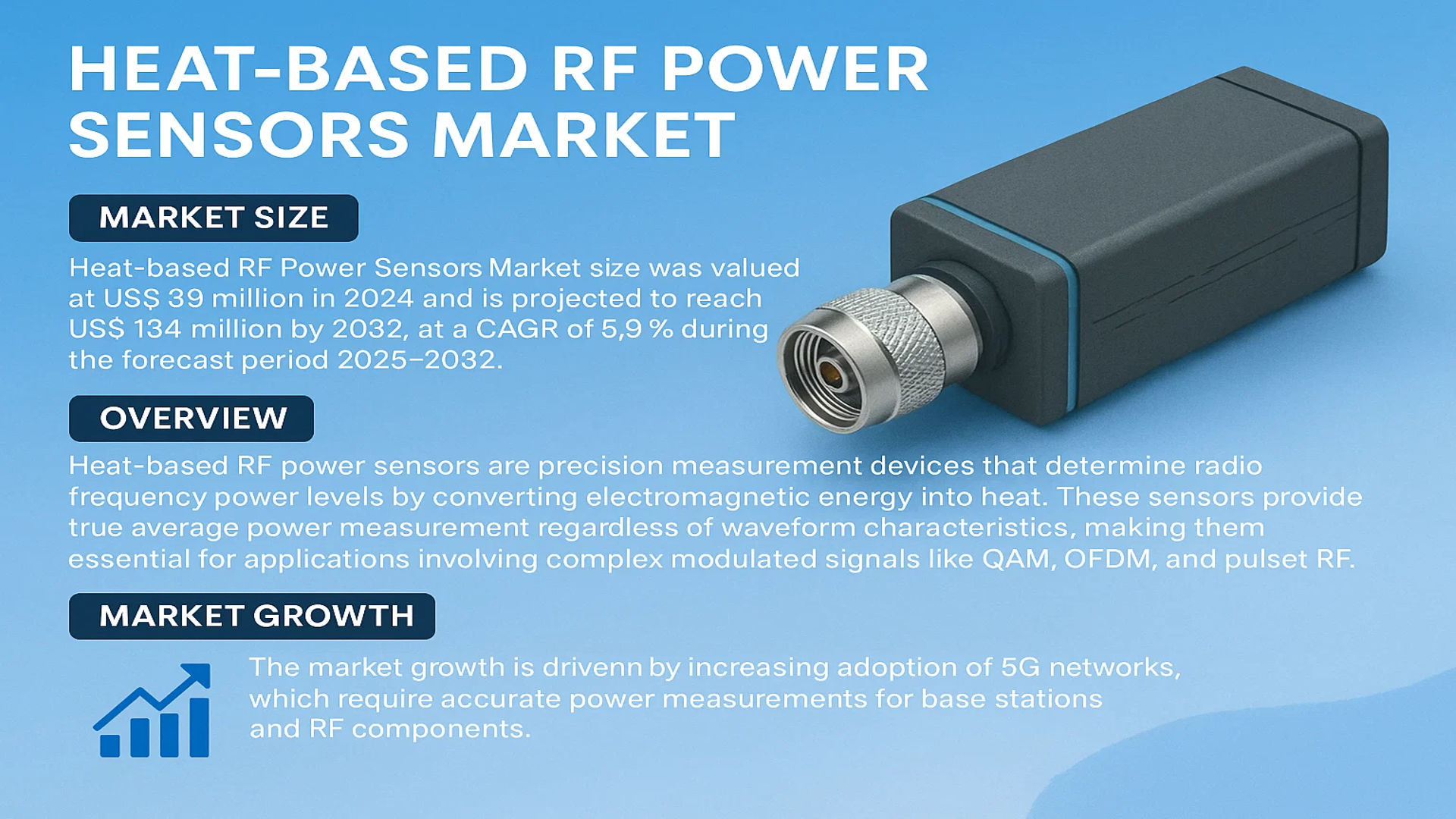
The global Heat-based RF Power Sensors Market size was valued at US$ 89 million in 2024 and is projected to reach US$ 134 million by 2032, at a CAGR of 5.9% during the forecast period 2025-2032.
Heat-based RF power sensors are precision measurement devices that determine radio frequency power levels by converting electromagnetic energy into heat. These sensors provide true average power measurement regardless of waveform characteristics, making them essential for applications involving complex modulated signals like QAM, OFDM, and pulsed RF. Key types include thermocouple-based, thermistor-based, and calorimetric sensors.
The market growth is driven by increasing adoption of 5G networks, which require accurate power measurements for base stations and RF components. The U.S. currently leads the market with 32% revenue share, followed by China at 18%. Portable heat-based RF sensors are witnessing accelerated demand with an anticipated 8.1% CAGR through 2032, driven by field testing requirements for telecommunications infrastructure. Leading manufacturers like Keysight, Rohde & Schwarz, and Anritsu are expanding their product portfolios with higher frequency range capabilities up to 110 GHz to meet evolving industry needs.
MARKET DYNAMICS
MARKET DRIVERS
5G Network Expansion Fuels Demand for Accurate RF Power Measurement Solutions
The global rollout of 5G networks is significantly driving the heat-based RF power sensors market, as these devices provide critical power measurement accuracy for next-generation telecommunications infrastructure. Unlike conventional sensors, heat-based solutions offer waveform-independent measurements that are essential for 5G’s complex modulation schemes including OFDMA and massive MIMO implementations. With over 300 commercial 5G networks deployed worldwide as of 2024, the need for reliable power measurement tools has never been greater. The ability to accurately measure true average power regardless of signal complexity makes heat-based sensors indispensable for 5G base station installation, maintenance, and optimization.
Growing Satellite Communication Sector Creates New Application Areas
The satellite communication industry’s expansion is creating substantial opportunities for heat-based RF power sensors, particularly in ground station equipment and satellite payload testing. With over 8,000 active satellites currently in orbit and projections indicating deployment of 20,000+ additional satellites by 2030, the demand for precise RF power measurement solutions is accelerating. Heat-based sensors are particularly valuable in this sector because their measurement accuracy remains uncompromised by phase noise or modulation characteristics—critical factors in satellite signal analysis. The development of high-throughput satellites and Low Earth Orbit (LEO) constellations is further amplifying this demand across both commercial and defense satellite applications.
Military Modernization Programs Boost Adoption in Defense Applications
Global defense spending exceeding $2 trillion annually is driving modernization of electronic warfare systems, radar installations, and communication equipment—all of which require precise RF power measurement. Heat-based sensors are increasingly adopted in these military applications due to their reliability in harsh environments and immunity to waveform distortion. Defense agencies particularly value these sensors for their ability to maintain accuracy across pulsed radar signals, frequency-hopping communications, and other complex RF waveforms used in modern electronic warfare. The growing emphasis on spectrum dominance and electronic countermeasure capabilities is expected to sustain strong demand from this sector through the forecast period.
➤ The U.S. Department of Defense has specifically mandated the use of thermally compensated power sensors in critical test and measurement applications to ensure measurement consistency across diverse operational environments.
MARKET CHALLENGES
High Initial Costs and Fragile Nature Pose Adoption Barriers
While heat-based RF power sensors offer superior accuracy, their higher price point compared to diode-based alternatives creates adoption challenges in cost-sensitive markets. The complex manufacturing process involving precision thermal elements and calibration requirements results in significantly higher production costs. Additionally, the delicate thermal sensors can be sensitive to mechanical shock and require careful handling—a limitation that complicates field deployment scenarios. These factors collectively create preference for alternative technologies in applications where ultimate accuracy isn’t mandatory, particularly in price-driven commercial segments and emerging markets.
Other Challenges
Temperature Sensitivity Requires Advanced Compensation
Despite their advantages, heat-based sensors require sophisticated temperature compensation mechanisms to maintain accuracy across operating environments. The thermal measurement principle makes these devices inherently sensitive to ambient temperature fluctuations, necessitating additional engineering complexity. This challenge is particularly acute in outdoor installations and military field applications where environmental conditions can vary dramatically.
Limited Dynamic Range Compared to Alternative Technologies
Heat-based sensors typically offer narrower dynamic range capabilities compared to modern logarithmic amplifier-based solutions. This limitation restricts their suitability for certain applications requiring very wide power measurement ranges, forcing system designers to either accept measurement range limitations or implement additional switching circuitry that increases system complexity.
MARKET RESTRAINTS
Competition from Advanced Semiconductor-based Solutions Impacts Market Penetration
The development of increasingly sophisticated semiconductor-based power sensors is restraining growth opportunities for heat-based alternatives. Modern diode and logarithmic amplifier solutions now achieve accuracy levels approaching thermal sensors while offering superior form factors, faster response times, and lower costs. These advancements are particularly attractive in high-volume commercial applications, constraining the addressable market for heat-based solutions primarily to premium segments where ultimate measurement fidelity is paramount.
Supply Chain Vulnerabilities Affect Manufacturing Consistency
Global supply chain disruptions continue to impact the heat-based RF power sensor market, particularly regarding specialized thermal sensing elements and high-precision calibration equipment. The manufacturing process requires components with extremely tight tolerances, many of which come from limited sources. This vulnerability creates production bottlenecks and quality control challenges, potentially limiting production scalability as demand grows. The situation is further complicated by geopolitical factors affecting the availability of certain critical materials used in sensor fabrication.
MARKET OPPORTUNITIES
Quantum Technology Development Opens New Measurement Frontiers
Emerging quantum technologies in communications and computing present significant opportunities for high-accuracy RF power measurement solutions. Heat-based sensors are uniquely positioned to support quantum system development due to their ability to maintain accuracy across non-traditional signal types and ultra-low power levels. Research institutions and quantum technology startups are increasingly adopting these sensors for characterizing quantum devices and prototypes, creating a new high-value application segment. The quantum technology market is projected to grow rapidly, potentially exceeding several billion dollars annually by the end of the decade.
Automotive Radar Testing Demands Precision Measurement Solutions
The automotive industry’s shift toward advanced driver assistance systems (ADAS) and autonomous vehicles is generating substantial demand for precise radar testing equipment. Heat-based RF power sensors are becoming essential tools in automotive radar development and production testing due to their consistent performance across the complex modulation schemes used in modern vehicle radar systems. With projections indicating over 100 million radar units will be shipped annually by 2030 for automotive applications, this represents a major growth opportunity for sensor manufacturers capable of meeting automotive-grade reliability and performance requirements.
➤ Leading automotive manufacturers are now specifying heat-based sensors for final production testing of radar modules to ensure compliance with strict safety and performance standards before vehicle integration.
Medical Therapeutic Applications Create Niche Growth Segment
Expanding applications in medical therapeutic equipment such as radiofrequency ablation systems are creating specialized opportunities for heat-based power sensors. The medical industry’s stringent accuracy requirements for power delivery in therapeutic applications make thermal measurement approaches particularly valuable. Regulatory requirements for precise power measurement in medical devices continue to tighten globally, especially for applications involving tissue ablation and other therapeutic uses of RF energy. This trend is expected to drive steady adoption growth in the healthcare sector through the forecast period.
HEAT-BASED RF POWER SENSORS MARKET TRENDS
Adoption of Advanced Modulation Techniques to Drive Market Growth
The increasing adoption of advanced modulation techniques such as QAM, OFDM, and phase modulation in telecommunications and defense applications has significantly amplified the demand for heat-based RF power sensors. Unlike traditional sensors, heat-based variants measure true average power, unaffected by waveform complexity or crest factors. This capability makes them indispensable for modern RF applications requiring precise power measurements, contributing to a projected market valuation of US$ million by 2032, growing at a steady CAGR. The U.S. currently leads in adoption, with an estimated market size of $ million in 2024, closely followed by China’s accelerating investments in 5G infrastructure.
Other Trends
Miniaturization and Portability
The demand for compact and portable heat-based RF power sensors is surging, particularly in field applications and aerospace testing. Manufacturers are focusing on reducing sensor footprints while maintaining high accuracy, with the portable segment expected to reach $ million by 2032. Innovations in thermal management and material science have enabled lighter designs without compromising performance, aligning with the needs of mobile RF testing and IoT device validation.
Expanding 5G and IoT Ecosystems
The rapid rollout of 5G networks and IoT deployments is a critical driver for heat-based RF power sensors. These sensors are vital for validating base station power levels and ensuring compliance with regulatory standards, especially given the higher frequency bands (>24 GHz) used in 5G. Additionally, the proliferation of smart devices and wireless modules has intensified R&D in RF power measurement, with companies like Keysight and Rohde & Schwarz introducing sensors tailored for mmWave applications. The Asia-Pacific region, led by China and South Korea, accounts for over 40% of global demand due to aggressive 5G infrastructure expansion.
COMPETITIVE LANDSCAPE
Key Industry Players
Innovation and Precision Drive Market Leadership in RF Power Measurement
The global heat-based RF power sensors market features a mix of established electronics manufacturers and specialized instrumentation companies competing on technological precision and reliability. The market structure remains semi-consolidated, with Keysight Technologies and Rohde & Schwarz maintaining dominant positions through their comprehensive test and measurement ecosystems. According to 2024 market estimates, these two companies collectively account for over 35% of global heat-based RF power sensor revenue, leveraging their strong R&D capabilities and extensive customer networks in defense, telecom, and aerospace sectors.
While major players focus on high-end laboratory and industrial applications, companies like Anritsu and Good Will Instruments have carved significant niches in portable field measurement solutions. The Japanese firm Anritsu particularly strengthened its market position through the 2023 launch of its MA24700A series thermal power sensors, which set new benchmarks for high-frequency measurement accuracy (up to 40GHz). Meanwhile, Taiwan-based Good Will Instruments captured growing demand from Asian electronics manufacturers with competitively priced solutions for production line testing.
The competitive landscape continues evolving as emerging technologies like 5G NR and millimeter-wave applications create new measurement challenges. In response, market leaders are accelerating innovation cycles – Fortive‘s Fluke Biomedical division recently introduced its first graphene-enhanced thermal sensor array, while Yokogawa patented a novel temperature compensation algorithm that improves measurement stability in variable environments. Such advancements underscore the industry’s focus on overcoming the inherent trade-offs between measurement speed and precision in thermal-based RF detection.
With the increasing complexity of modern RF waveforms, companies are also expanding their solution ecosystems. Teledyne Technologies enhanced its market position through the strategic acquisition of Microlab in early 2024, gaining advanced calibration capabilities for high-power applications. Similarly, Chroma and B&K Precision are integrating their power sensors with automated test systems, addressing the growing demand for turnkey measurement solutions in semiconductor and wireless infrastructure markets.
List of Key Heat-based RF Power Sensor Manufacturers
- Keysight Technologies (U.S.)
- Rohde & Schwarz (Germany)
- Anritsu Corporation (Japan)
- Fortive Corporation (U.S.)
- Yokogawa Electric Corporation (Japan)
- Teledyne Technologies (U.S.)
- Giga-tronics (U.S.)
- Chroma ATE Inc. (Taiwan)
- Good Will Instruments (Taiwan)
- B&K Precision Corporation (U.S.)
Segment Analysis:
By Type
Portable Segment Leads the Market Due to Rising Demand for On-Field Testing and Mobility
The market is segmented based on type into:
- Portable
- Subtypes: Handheld, Compact, and Modular
- Stationary
- Subtypes: Benchtop, Rack-mount, and Fixed
- Hybrid
- Subtypes: Multi-channel and Standalone
- Others
By Application
Laboratory Usage Segment Dominates Due to High Adoption in R&D and Precision Measurements
The market is segmented based on application into:
- Directional Power Calculation
- Determining Total Power
- Indicating Peak Envelope Power
- Pulse Power Measurement
- Laboratory Usage
- Field Usage
By Technology
Thermocouple-Based Sensors Gain Traction for Wide Frequency Range Capabilities
The market is segmented based on technology into:
- Thermocouple-Based
- Thermistor-Based
- Diode-Based
- Calorimetric
- Others
By End-User Industry
Telecommunications Sector Holds Significant Share Due to Expanding 5G Deployments
The market is segmented based on end-user industry into:
- Telecommunications
- Aerospace & Defense
- Electronics Manufacturing
- Research & Education
- Others
Regional Analysis: Heat-based RF Power Sensors Market
North America
North America dominates the Heat-based RF Power Sensors market, driven by advanced telecommunications infrastructure and robust R&D investments in RF technology. The U.S., in particular, leads in adoption due to its strong defense sector, 5G deployment initiatives, and the presence of key players like Keysight Technologies and Fortive. The region’s stringent regulatory environment ensures high-performance standards, accelerating demand for accurate power measurement solutions. With increasing applications in aerospace and wireless communication, North America is projected to maintain its market leadership. Portable heat-based RF power sensors are gaining traction for field testing, while stationary variants remain critical for laboratory and industrial usage.
Asia-Pacific
The Asia-Pacific region is the fastest-growing market for heat-based RF power sensors, fueled by rapid 5G expansion and increasing defense spending. China, Japan, and South Korea are key contributors, with China accounting for the largest share due to its massive telecommunications and electronics manufacturing base. Local manufacturers like Anritsu and Yokogawa are expanding their portfolios to cater to rising demand. While cost sensitivity remains a challenge, the shift toward high-frequency applications in IoT and smart devices is creating new opportunities. Government initiatives supporting industrial automation and wireless infrastructure further boost market prospects.
Europe
Europe showcases steady growth in the heat-based RF power sensors market, with Germany, the U.K., and France at the forefront. The region benefits from a strong automotive and aerospace sector, where precise RF power measurement is critical for radar and communication systems. EU regulations promote technological innovation, driving adoption of advanced sensors in research and industrial applications. Rohde & Schwarz and Keysight Technologies lead the competitive landscape, offering solutions tailored to European compliance standards. Despite market maturity, increasing investments in renewable energy and electric vehicle testing present new avenues for growth.
Middle East & Africa
The Middle East & Africa market is emerging, driven by growing telecommunications investments and defense modernization programs. Countries like Saudi Arabia, the UAE, and Israel are key adopters, leveraging heat-based RF power sensors for satellite communication and radar systems. While economic diversification initiatives in the GCC region support market expansion, limited local manufacturing capabilities and reliance on imports hinder faster growth. Nonetheless, partnerships with global players and increasing 5G deployments signal long-term potential.
South America
South America faces slower adoption due to economic volatility and infrastructural limitations, but Brazil and Argentina show promising growth in telecommunications and aerospace sectors. The market is primarily driven by imports from established global suppliers, with local demand concentrated in urban centers. While budget constraints delay large-scale deployments, incremental advancements in wireless networks and military applications offer niche opportunities for heat-based RF power sensor providers.
Report Scope
This market research report provides a comprehensive analysis of the Global Heat-based RF Power Sensors Market, covering the forecast period 2025–2032. It offers detailed insights into market dynamics, technological advancements, competitive landscape, and key trends shaping the industry.
Key focus areas of the report include:
- Market Size & Forecast: Historical data and future projections for revenue, unit shipments, and market value across major regions and segments. The global market was valued at US$ 89 million in 2024 and is projected to reach USD US$ 134 million by 2032, growing at a CAGR of 5.9%.
- Segmentation Analysis: Detailed breakdown by product type (portable and stationary), application (directional power calculation, determining total power, etc.), and end-user industries to identify high-growth segments.
- Regional Outlook: Insights into market performance across North America (33% market share), Europe (27%), Asia-Pacific (30%), and other regions, including country-level analysis of key markets like the U.S., China, and Germany.
- Competitive Landscape: Profiles of leading market participants including Anritsu (18% market share), Keysight (15%), Rohde & Schwarz (12%), and other key players, analyzing their product portfolios and strategic initiatives.
- Technology Trends: Assessment of emerging measurement technologies, integration with 5G networks, and advancements in semiconductor materials for improved thermal sensing accuracy.
- Market Dynamics: Evaluation of growth drivers such as increasing 5G deployment and RF testing requirements, along with challenges including high costs of precision measurement equipment.
- Stakeholder Analysis: Strategic insights for RF component manufacturers, test equipment providers, telecom operators, and investors regarding market opportunities and competitive positioning.
The report employs rigorous primary and secondary research methodologies, including interviews with industry experts, analysis of company financial reports, and validation through multiple data sources to ensure accuracy and reliability.
FREQUENTLY ASKED QUESTIONS:
What is the current market size of Global Heat-based RF Power Sensors Market?
->Heat-based RF Power Sensors Market size was valued at US$ 89 million in 2024 and is projected to reach US$ 134 million by 2032, at a CAGR of 5.9% during the forecast period 2025-2032.
Which key companies operate in this market?
-> Key players include Anritsu, Keysight Technologies, Rohde & Schwarz, Fortive, and Yokogawa, collectively holding over 60% market share.
What are the key growth drivers?
-> Primary growth drivers include 5G network expansion, increasing demand for accurate RF power measurement in telecom, and growing adoption in aerospace & defense applications.
Which region dominates the market?
-> North America currently leads with 33% market share, while Asia-Pacific is expected to grow at the highest CAGR of 5.1% during 2025-2032.
What are the emerging trends?
-> Emerging trends include development of multi-band sensors, integration with IoT platforms, and miniaturization of portable measurement devices for field applications.

Get Sample Report PDF for Exclusive Insights
Report Sample Includes
- Table of Contents
- List of Tables & Figures
- Charts, Research Methodology, and more...
 Download Sample Report PDF


