Hardware security module (HSM) chip for vehicle V2X communication Market Insights
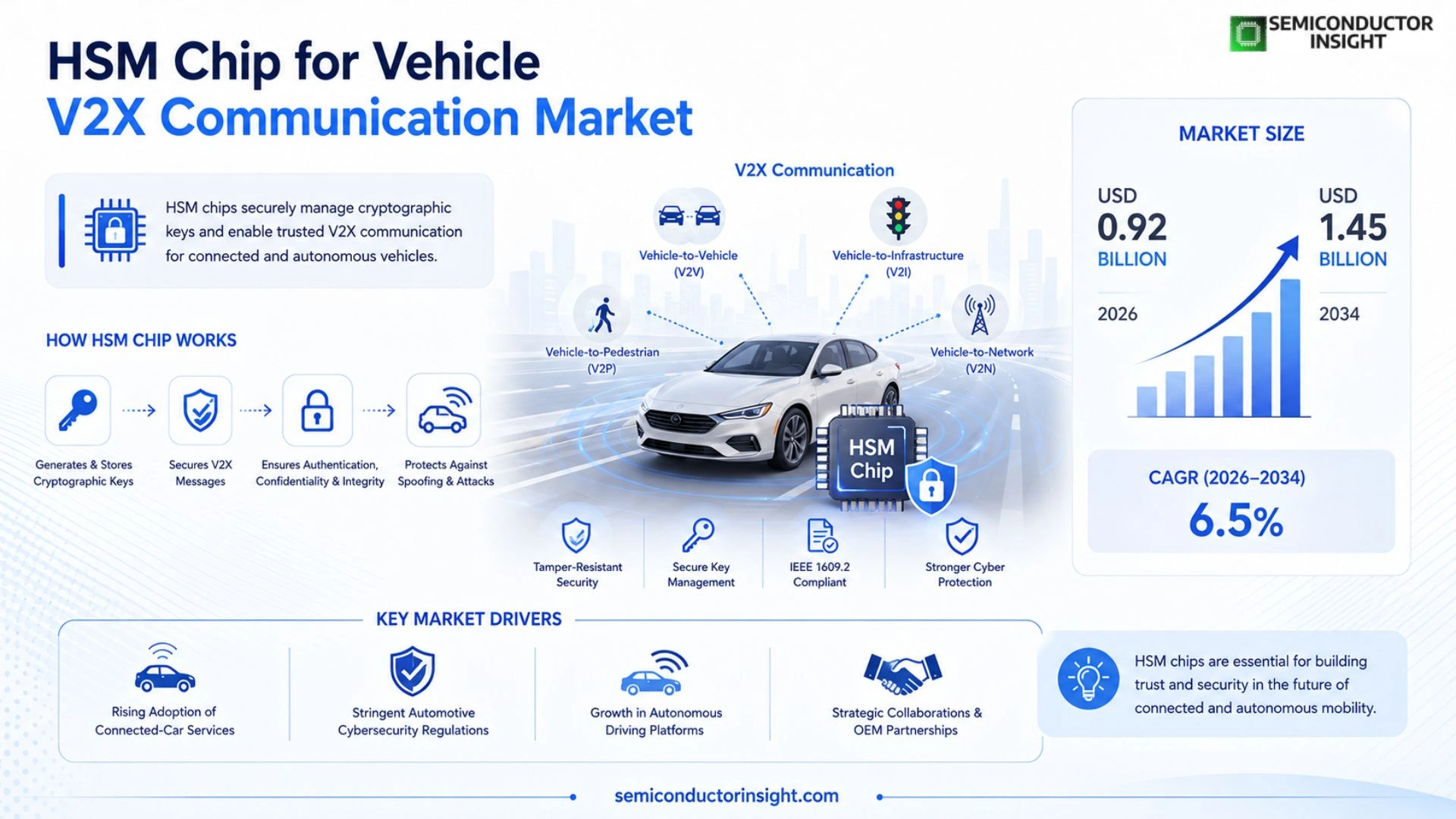
Global HSM chip for vehicle V2X communication market size was valued at USD 0.85 billion in 2025. The market is projected to grow from USD 0.92 billion in 2026 to USD 1.45 billion by 2034, exhibiting a CAGR of 6.5% during the forecast period.
Hardware security modules (HSMs) are tamper‑resistant micro‑chips designed to generate, store, and manage cryptographic keys within automotive electronic control units (ECUs). They ensure secure V2X message authentication, confidentiality, and integrity, protecting vehicles against spoofing and cyber‑attacks while supporting standards such as IEEE 1609.2.
The market is experiencing rapid growth due to rising adoption of connected‑car services, stringent automotive cybersecurity regulations, and increasing investment in autonomous driving platforms. Furthermore, collaborations between semiconductor manufacturers and automotive OEMs accelerate integration of HSMs into next‑generation V2X stacks. For instance, in March 2024 a leading chip supplier partnered with a major car maker to embed certified HSMs in its fleet of Level‑3 autonomous vehicles.
MARKET DRIVERS
Growing Demand for Secure V2X Communications
Hardware security module (HSM) chip for vehicle V2X communication Market is propelled by a surge in vehicle‑to‑everything (V2X) deployments, with more than 45 % of new car models slated to support V2X by 2027. Automakers require tamper‑proof cryptographic processors to protect safety‑critical messages, driving rapid adoption of HSM chips.
Regulatory Mandates and Industry Standards
Legislation such as the U.S. Federal Motor Vehicle Safety Standard (FMVSS) 302 and Europe’s UN R155 obligate manufacturers to embed certificate‑based security in V2X modules, creating a mandatory market pull for HSM solutions. Compliance costs push OEMs toward integrated HSM chips that meet these standards out‑of‑the‑box.
➤ Analysts estimate that regulatory compliance alone could account for up to 30 % of the total addressable market for HSM chips by 2028.
Furthermore, fleet operators are investing in secure over‑the‑air (OTA) updates, which rely on HSM‑backed key management. This trend enhances vehicle uptime and data integrity, reinforcing the strategic importance of robust hardware security.
MARKET CHALLENGES
High Integration Complexity
Integrating HSM chips into automotive ECUs demands cross‑functional expertise in silicon design, automotive safety standards, and cryptographic algorithms. OEMs often face longer development cycles, raising time‑to‑market risks.
Other Challenges
Cost Constraints
The premium pricing of qualified HSM silicon,averaging $12 per unit for high‑volume production,can strain budget allocations, especially for budget‑segment manufacturers seeking cost‑effective security.
MARKET RESTRAINTS
Limited Chip Supply Chain Resilience
Global semiconductor shortages have tightened the supply of advanced HSM chips, leading to lead times of 12‑18 months for automotive orders. This bottleneck restricts the ability of manufacturers to scale V2X security solutions quickly.
Additionally, the specialized manufacturing process for tamper‑resistant ASICs limits the number of qualified foundries, exacerbating capacity constraints.
These supply‑side pressures may cause OEMs to defer HSM integration in mid‑cycle refreshes, potentially slowing overall market growth.
MARKET OPPORTUNITIES
Emerging Autonomous Driving Platforms
Autonomous vehicles require end‑to‑end encryption for sensor data, decision‑making algorithms, and V2X signaling. The expanding autonomous‑driving ecosystem is projected to generate over $4 billion in HSM chip sales by 2032, presenting a lucrative growth corridor.
Moreover, the rollout of 5G‑based V2X networks creates new attack surfaces, prompting demand for next‑generation HSMs that support post‑quantum cryptography. Early movers offering quantum‑resistant modules can capture premium market share.
Strategic partnerships between semiconductor vendors and automotive tier‑1 suppliers also unlock co‑development opportunities, accelerating time‑to‑market for integrated security solutions.
Hardware security module (HSM) chip for vehicle V2X communication Market Trends
Regulatory Momentum Accelerates Secure V2X Deployments
The tightening of automotive cybersecurity standards across North America, Europe and Asia‑Pacific is compelling OEMs to embed tamper‑resistant cryptographic modules directly into electronic control units. Recent revisions to UNECE WP.29 and the adoption of IEEE 1609.2 as a de‑facto baseline require authenticated V2X messages, making Hardware security module (HSM) chip for vehicle V2X communication Market a strategic necessity for any new vehicle platform. As a result, manufacturers are prioritizing HSM integration during early hardware design cycles rather than treating it as an after‑market retrofit, which shortens time‑to‑market for secure V2X services.
Other Trends
Integration with Autonomous Driving Platforms
Autonomous driving stacks rely on high‑definition maps and real‑time sensor fusion, both of which generate large volumes of data that must be exchanged securely with surrounding infrastructure. HSM chips now support edge‑based key management and fast symmetric encryption, enabling Level‑3 and Level‑4 prototypes to verify map updates and coordinate maneuvers without exposing cryptographic keys to external attackers. Field trials conducted in 2023 demonstrated that vehicles equipped with certified HSMs could authenticate V2X beacons with latency under 5 ms, satisfying the latency budgets for cooperative adaptive cruise control.
Collaborative Ecosystem Between Semiconductor Suppliers and OEMs
Partnerships that combine semiconductor expertise with automotive domain knowledge are reshaping the supply chain. In March 2024 a leading chip supplier announced a joint development program with a major car maker to embed pre‑qualified HSMs in a fleet of Level‑3 autonomous vehicles slated for pilot deployment in 2025. The collaboration includes co‑engineered firmware that aligns with the vehicle’s functional safety architecture, reducing certification cycles by up to 30 percent. Similar alliances are emerging in Europe, where chipset firms are working with tier‑1 suppliers to create modular HSM libraries that can be customized for different V2X radio access technologies, further accelerating adoption across vehicle segments.
COMPETITIVE LANDSCAPE
Key Industry Players
Competitive Landscape of HSM Chip for Vehicle V2X Communication
HSM chip market for vehicle V2X communication is now anchored by a handful of semiconductor giants that benefit from deep automotive engineering capabilities and extensive IP portfolios. Infineon Technologies and NXP Semiconductors together account for roughly 40 % of total shipments, leveraging their mature automotive‑grade process nodes and long‑standing relationships with OEMs. Both firms have introduced tamper‑resistant modules that meet ISO/SAE 21434 and IEEE 1609.2 certification requirements, enabling secure key storage and fast cryptographic operations within ECUs. Texas Instruments follows closely, positioning its HSM family as a low‑power solution for battery‑electric vehicles and providing a robust development ecosystem that accelerates integration into V2X stacks. The market structure is therefore characterized by a tier‑1 segment dominated by these integrated device manufacturers, complemented by a growing ecosystem of software partners that supply secure boot and remote attestation services, driving a consolidated yet technologically vibrant landscape.
Beyond the tier‑1 leaders, a diverse set of niche and specialist players is expanding the competitive set. STMicroelectronics offers a cost‑effective HSM line that targets volume‑produced mid‑range models, while Renesas Electronics focuses on safety‑critical applications with built‑in functional safety features. Qualcomm’s automotive portfolio incorporates HSM functionality into its Snapdragon automotive platforms, delivering high‑throughput cryptography for connected‑car services. Thales and its subsidiary Gemalto contribute hardened security modules for premium vehicles, emphasizing certified key‑management workflows. Smaller firms such as SecureMicro, MaxLinear, and Microchip Technology round out the field, delivering custom ASICs and programmable solutions that address specific V2X use cases such as platooning and infrastructure‑to‑vehicle messaging. This breadth of players ensures intense innovation pressure and provides OEMs with multiple sourcing options to meet regional regulatory demands.
List of Key Hardware Security Module (HSM) Companies Profiled
- Infineon Technologies
- NXP Semiconductors
- Texas Instruments
- STMicroelectronics
- Renesas Electronics
- Qualcomm
- Thales
- Microchip Technology
- SecureMicro
- MaxLinear
- ON Semiconductor
- Broadcom
- Gemalto (Thales)
- Hensoldt
- Cypress Semiconductor
Segment Analysis:
| Segment Category | Sub-Segments | Key Insights |
| By Type |
|
ASIC‑based HSMs dominate because they provide the highest level of tamper resistance and deterministic performance.
|
| By Application |
|
Secure V2X Message Signing is the primary driver as it ensures the authenticity and integrity of safety‑critical broadcasts.
|
| By End User |
|
OEMs lead the adoption curve because they integrate HSM chips at the design stage of vehicle platforms.
|
| By Integration Level |
|
Embedded HSM IP Cores are gaining traction due to their flexibility in diverse vehicle architectures.
|
| By Security Function |
|
Cryptographic Key Storage stands out as the foundational function that underpins all other security mechanisms.
|
Regional Analysis: North America
The continuous development of more secure and efficient HSM chips is a key driver. Innovations in cryptographic algorithms and hardware architectures are enhancing the resilience of V2X communication against sophisticated attacks. The integration of AI and machine learning for threat detection and response is also gaining traction.
Stringent data privacy regulations and cybersecurity standards are influencing the adoption of HSM chips. Compliance with regulations like GDPR and CCPA necessitates robust security measures in connected vehicles, thereby boosting demand for these specialized chips for Hardware security module (HSM) chip for vehicle V2X communication Market.
Collaboration between automotive manufacturers, technology providers, and security solution vendors is fostering innovation and market growth. Strategic alliances are facilitating the development and deployment of integrated HSM solutions for V2X communication.
The increasing deployment of V2X communication systems in commercial vehicles and passenger cars is directly driving the demand for HSM chips. The benefits of enhanced safety and efficiency through V2X are accelerating its adoption across various sectors.
Europe
Europe represents a significant market for Hardware security module (HSM) chip for vehicle V2X communication Market. The region’s proactive stance on data protection and cybersecurity aligns well with the requirements of secure vehicle-to-everything (V2X) communication. Stringent regulations such as the General Data Protection Regulation (GDPR) are pushing automotive manufacturers to prioritize data security, creating a strong demand for HSM solutions. Furthermore, the increasing focus on connected and autonomous driving initiatives, supported by government funding and collaborative research projects, is fostering market growth. The presence of a robust automotive industry and a strong emphasis on technological innovation contribute to Europe’s position as a key player in this market. The European market is characterized by a strong preference for advanced security features and a willingness to invest in cutting-edge technologies to mitigate the risks associated with connected vehicles. The demand for Hardware security module (HSM) chip for vehicle V2X communication Market is expected to see sustainable growth throughout the forecast period.
Asia-Pacific
Asia-Pacific is poised for rapid growth in Hardware security module (HSM) chip for vehicle V2X communication Market. The region’s burgeoning automotive industry, particularly in China and India, coupled with increasing investments in smart city infrastructure, is driving the demand for secure V2X communication systems. The growing adoption of electric vehicles (EVs) and connected car technologies further fuels this demand. Government initiatives promoting innovation and technological advancements are also contributing to market expansion. The increasing awareness of cybersecurity threats in vehicles is a key driver for the adoption of HSM chips. The Asia-Pacific market presents a significant opportunity for Hardware security module (HSM) chip for vehicle V2X communication Market players, owing to its large and rapidly growing automotive market and increasing focus on connected vehicle technologies.
South America
South America presents a developing market for Hardware security module (HSM) chip for vehicle V2X communication Market. While the adoption rate is currently lower compared to North America and Europe, the region holds significant potential for future growth. Increasing investments in automotive manufacturing and the growing popularity of connected vehicles are expected to drive demand. The rising awareness of cybersecurity risks in vehicles, coupled with supportive government policies, is fostering market development. The focus on enhancing road safety and improving traffic management through V2X communication is also contributing to the market’s growth prospects. Hardware security module (HSM) chip for vehicle V2X communication Market in South America is expected to witness a steady growth trajectory in the coming years, driven by the increasing adoption of connected car technologies and a growing emphasis on cybersecurity.
Middle East & Africa
The Middle East & Africa region represents an emerging market for Hardware security module (HSM) chip for vehicle V2X communication Market. The automotive industry in this region is experiencing significant growth, particularly in countries like Saudi Arabia and the United Arab Emirates. Increasing investments in smart city initiatives and the adoption of connected vehicle technologies are driving the demand for secure V2X communication solutions. Government initiatives promoting technological advancements and cybersecurity are also fostering market development. The region’s growing awareness of cybersecurity threats and the need to protect vehicle data are key drivers for the adoption of HSM chips. Hardware security module (HSM) chip for vehicle V2X communication Market in the Middle East & Africa is expected to witness robust growth in the coming years, driven by the expanding automotive market and increasing adoption of connected vehicle technologies.
Report Scope
This market research report provides a comprehensive analysis of the Hardware security module (HSM) chip for vehicle V2X communication Market , covering the forecast period 2026–2034. It offers detailed insights into market dynamics, technological advancements, competitive landscape, and key trends shaping the industry.
Key focus areas of the report include:
- Market Overview: The report begins with an overview outlining its current market scenario, key growth indicators, and industry transformation drivers. It discusses macroeconomic factors, demand–supply balance, regulatory landscape, and the strategic role of semiconductors in powering advancements across industries such as automotive, telecommunications, consumer electronics, and industrial automation.
- Market Size & Forecast: Historical data and future projections for revenue, unit shipments, and market value across major regions and segments.
- Segmentation Analysis: Detailed breakdown by product type, technology, application, and end-user industry to identify high-growth segments and investment opportunities.
- Regional Insights: Insights into market performance across North America, Europe, Asia-Pacific, Latin America, and the Middle East & Africa, including country-level analysis where relevant.
- Competitive Landscape: Profiles of leading market participants, including their product offerings, R&D focus, manufacturing capacity, pricing strategies, and recent developments such as mergers, acquisitions, and partnerships.
- Technology Trends & Innovation: Assessment of emerging technologies, integration of AI/IoT, semiconductor design trends, fabrication techniques, and evolving industry standards.
- Market Drivers & Restraints: Evaluation of factors driving market growth along with challenges, supply chain constraints, regulatory issues, and market-entry barriers.
- Stakeholder Insights: Insights for component suppliers, OEMs, system integrators, investors, and policymakers regarding the evolving ecosystem and strategic opportunities.
Primary and secondary research methods are employed, including interviews with industry experts, data from verified sources, and real-time market intelligence to ensure the accuracy and reliability of the insights presented.
FREQUENTLY ASKED QUESTIONS:
What is the current market size of Hardware security module (HSM) chip for vehicle V2X communication Market?
-> HSM chip for vehicle V2X communication market size projected to grow from USD 0.92 billion in 2026 to USD 1.45 billion by 2034, exhibiting a CAGR of 6.5%.
Which key companies operate in Hardware security module (HSM) chip for vehicle V2X communication Market?
-> Key players include major semiconductor manufacturers and automotive OEMs that are integrating HSMs into V2X solutions; specific company names were not provided in the source material.
What are the key growth drivers?
-> Key growth drivers include rising adoption of connected‑car services, stringent automotive cybersecurity regulations, and increased investment in autonomous driving platforms.
Which region dominates the market?
-> The source does not specify a dominant region; the market is described as global with growth opportunities across all major regions.
What are the emerging trends?
-> Emerging trends involve collaborations between semiconductor manufacturers and automotive OEMs to embed certified HSMs into next‑generation V2X stacks, especially for Level‑3 and higher autonomous vehicles.
Get Sample Report PDF for Exclusive Insights
Report Sample Includes
- Table of Contents
- List of Tables & Figures
- Charts, Research Methodology, and more...