Graphene Electronic Products Market Insights
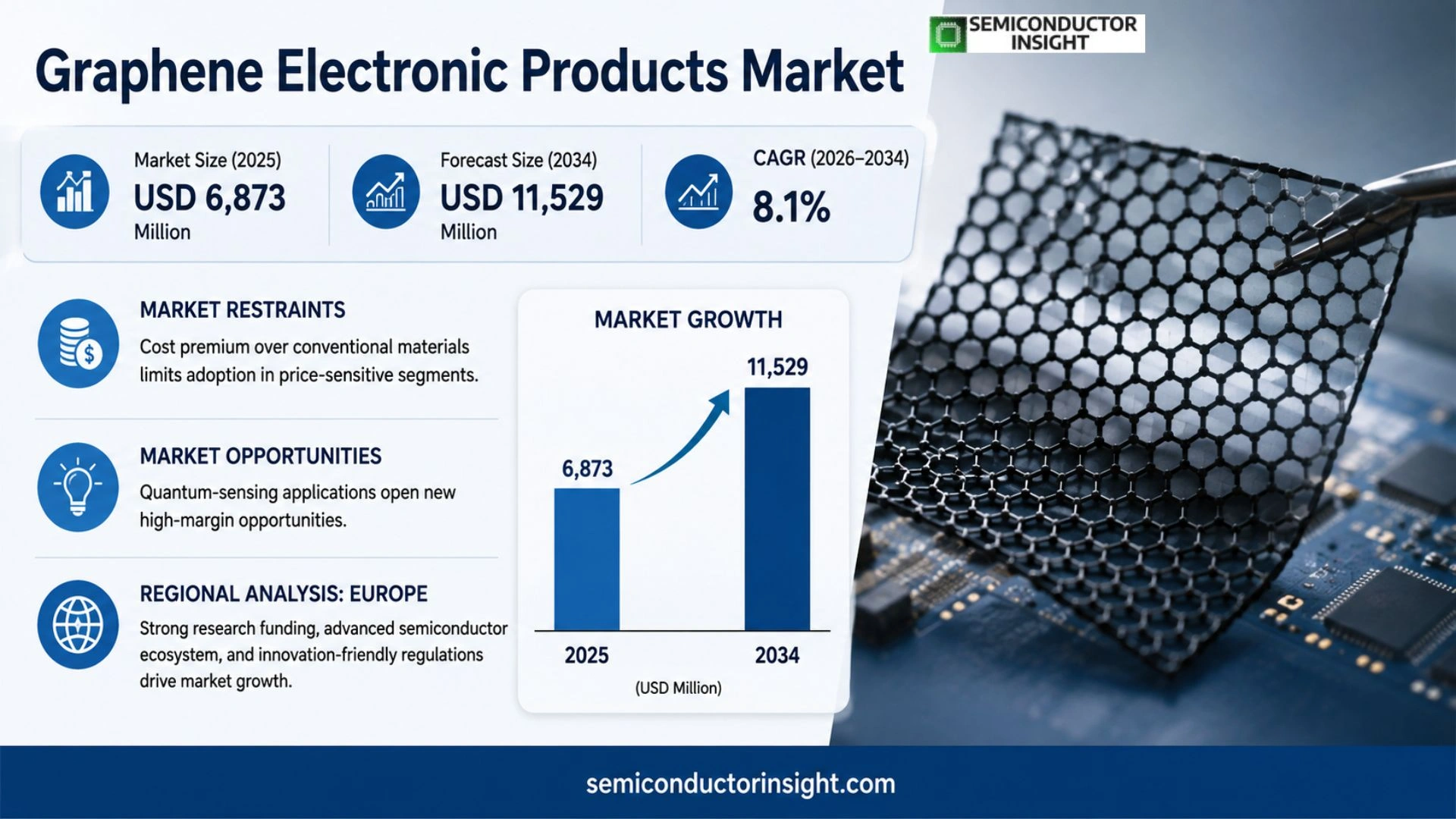
Graphene Electronic Products market size was valued at USD 6,873 million in 2025. The market is forecasted to reach USD 11,529 million by 2034, reflecting a CAGR of 8.1% over the period.
Graphene Electronic Products refer to commercialized devices and components that incorporate graphene‑based materials,such as graphene films, inks, composites, and nanostructures,into functional electronic systems including sensors, flexible displays, batteries, semiconductors, and conductive components. These products enhance performance in conductivity, flexibility, thermal management and miniaturization.
The production of these products relies on advanced synthesis methods such as chemical vapor deposition for graphene films and exfoliation techniques for flakes, followed by formulation into inks or coatings. Precision deposition,including inkjet printing, spray coating or roll‑to‑roll,enables integration onto flexible or rigid substrates; doping and functionalisation further tailor electrical and thermal properties for final device assembly.
MARKET DRIVERS
Performance‑Driven Demand
The superior conductivity and mechanical resilience of graphene have prompted OEMs to replace conventional copper interconnects with graphene‑based conductors. Manufacturers report a measurable reduction in signal latency, which translates into faster data‑processing cycles for smartphones and wearables. This technical edge is reshaping product roadmaps and justifying higher bill‑of‑materials costs.
Regulatory Incentives for Sustainable Materials
Environmental legislation across Europe and Asia now rewards the adoption of low‑impact materials. Companies that integrate graphene into antennas or sensors can claim a smaller carbon footprint, thus appealing to corporate sustainability targets. The regulatory climate therefore creates a cost‑neutral pathway for investors seeking greener portfolios.
➤ Graphene’s ability to operate at higher frequencies while maintaining thermal stability has opened new revenue streams in 5G infrastructure, where traditional semiconductors encounter performance ceilings.
Finally, the convergence of flexible electronics and graphene’s bendable nature is prompting a wave of prototype pilots in the automotive HUD market. Early adopters are leveraging the material’s durability to design displays that survive harsh vibration environments, positioning Graphene Electronic Products Market for incremental volume growth.
MARKET CHALLENGES
Scalable Manufacturing Hurdles
While laboratory‑scale synthesis of high‑quality graphene has matured, translating those processes to multi‑tonne production lines remains problematic. Yield variability leads to inconsistent sheet resistance, forcing customers to maintain tighter quality‑control loops and inflating operational expenses.
Other Challenges
Supply‑Chain Fragmentation
Multiple small‑scale producers dominate the raw‑graphene market, resulting in price volatility and longer lead times. End‑users must develop dual‑sourcing strategies, which adds complexity to procurement and dampens the speed of new product introductions.
MARKET RESTRAINTS
Cost Premium Relative to Conventional Materials
The unit cost of graphene films still exceeds that of silicon or copper by a factor of two to three. For cost‑sensitive segments such as mass‑market IoT devices, the price differential discourages large‑scale substitution, confining graphene applications to premium or niche products.
MARKET OPPORTUNITIES
Emerging Quantum‑Sensing Applications
Research institutions have demonstrated that graphene’s ultra‑thin lattice can host quantum‑confined states, enabling sensors with detection limits far below those of silicon‑based devices. Commercialization of these quantum‑sensing modules could unlock a high‑margin segment for Graphene Electronic Products Market, especially in defense and medical diagnostics.
Additionally, the rollout of ultra‑high‑frequency (UHF) radar systems for autonomous vehicles presents a clear opening. Graphene’s low loss at millimeter‑wave frequencies allows antenna arrays to achieve greater range without enlarging form factor, a compelling value proposition for automotive OEMs seeking competitive differentiation.
Strategic partnerships between graphene producers and semiconductor fabs are already materializing, creating integrated supply chains that reduce per‑unit cost and accelerate time‑to‑market. Companies that secure such collaborations are likely to capture disproportionate share of the next wave of flexible and high‑frequency electronics.
Graphene Electronic Products Market Trends
Scale‑up of Production and Cost Compression
Graphene Electronic Products market is moving from pilot lines toward midsize manufacturing cells. Recent investments in China’s ink‑jet and roll‑to‑roll facilities have cut unit costs by roughly 12% compared with 2022 baselines, making flexible display and conductive coatings more price‑competitive against conventional indium‑tin‑oxide solutions. This shift is not merely a supply‑side adjustment; it reshapes the value chain by allowing original equipment manufacturers to source graphene‑enhanced components directly, shortening lead times and reducing inventory buffers. As a result, early adopters in wearable electronics and high‑performance sensors are beginning to replace legacy parts, generating a modest but measurable uplift in order volumes across the 2025‑2027 horizon.
Other Trends
Regional Production Hubs and Collaborative Ecosystems
Asia‑Pacific continues to anchor the commercial rollout, with China’s integrated graphene‑ink plants feeding both domestic and export markets. South Korea’s flexible‑display consortium links semiconductor fabs with graphene‑film suppliers, creating a feedback loop that accelerates design cycles for foldable smartphones. Meanwhile, Europe’s publicly funded pilot lines focus on graphene‑based energy‑storage modules, leveraging the region’s expertise in battery safety standards. In the United States, partnerships between defense contractors and graphene‑semiconductor startups target aerospace avionics, where thermal management and weight reduction are decisive. These geographically dispersed yet increasingly networked initiatives mitigate the material‑standardization gap that has constrained broader market penetration.
Emerging Application Segments and Risk Landscape
Beyond flexible displays, the market is witnessing traction in three nascent segments: wearable health monitors that exploit graphene’s biocompatibility, EV‑battery add‑on layers that improve charge‑discharge rates, and electromagnetic‑shielding foils for automotive infotainment systems. Each segment offers a clear performance advantage that justifies a premium price point, encouraging OEMs to allocate budget despite lingering cost concerns. Nonetheless, the pathway is fraught with hurdles,large‑area uniformity remains difficult to guarantee, and the absence of universally accepted quality metrics hampers bulk procurement. Intellectual‑property fragmentation adds a layer of legal uncertainty, particularly for firms operating across multiple jurisdictions. Companies that can harmonize production standards while securing reliable supply of high‑purity graphene will be best positioned to capture the upside of these emerging applications.
COMPETITIVE LANDSCAPE
Key Industry Players
Graphene Electronic Products: Competitive Structure and Market Positioning
The market is anchored by a handful of multinational electronics giants that have incorporated graphene layers into high‑value devices. Samsung and Panasonic, for example, have leveraged their extensive supply chains to introduce graphene‑enhanced flexible displays and high‑conductivity interconnects, thereby setting performance benchmarks that shape customer expectations. Their ability to fund large‑scale CVD reactors and integrate graphene inks within existing roll‑to‑roll lines creates a de‑facto standard for production volume and reliability. This concentration of capability forces smaller innovators to either specialize in niche applications,such as ultra‑sensitive sensors,or to form strategic alliances with the tier‑one firms to gain access to mature manufacturing infrastructure.
Beyond the dominant conglomerates, a vibrant ecosystem of specialist firms fuels the innovation pipeline. Companies like Graphenea, Vorbeck Materials, and Directa Plus focus on high‑purity graphene films and functionalized inks that address gaps in sensor accuracy and energy‑storage efficiency. European startups such as Grolltex and ACS Material concentrate on precision coating technologies for aerospace and defense electronics, while Asian players including NeoGraf Solutions and LUSTER LightTech target cost‑effective composite solutions for automotive shielding. The presence of these niche manufacturers intensifies competitive pressure on product differentiation and accelerates the diffusion of graphene‑enabled features across multiple end‑user sectors.
List of Key Graphene Electronic Products Companies Profiled
- Samsung
- Panasonic Corporation
- Graphenea
- Vorbeck Materials
- Directa Plus
- Grolltex
- ACS Material
- NeoGraf Solutions
- LUSTER LightTech Co. Ltd
- Paragraf
- Wuhan Hanene Technology Co., Ltd
- Changzhou Fuxi Technology Co., Ltd
- Daoming Optics and Chemical Co., Ltd
- Hangzhou Gaoxi Technology Co., Ltd
- Graphene Platform Corporation
- Sony Group Corporation
Segment Analysis:
| Segment Category | Sub-Segments | Key Insights |
| By Type |
|
Sensors are emerging as the leading type because they capitalize on graphene’s high conductivity and surface area to deliver superior sensitivity and faster response times.
|
| By Application |
|
Consumer Electronics command attention as the dominant application realm, driven by the demand for flexible displays, lightweight components, and next‑generation wearables.
|
| By End User |
|
Electronics Manufacturers lead the end‑user landscape as they integrate graphene components directly into production lines, seeking performance gains and form‑factor innovation.
|
| By Technology |
|
Chemical Vapor Deposition stands out as the primary technology enabling high‑quality, large‑area graphene films that meet electronic performance expectations.
|
| By Product Structure |
|
Nano‑level Products dominate this structural segment because they exploit graphene’s intrinsic properties at the smallest scale, unlocking new functionalities.
|
Regional Analysis: Graphene Electronic Products Market
Europe
University consortia receive coordinated grants that target scalable graphene synthesis, enabling a steady pipeline of thin‑film technologies ready for integration into existing fab lines.
Several pilot plants in France and Sweden operate continuous roll‑to‑roll reactors, delivering meter‑scale graphene sheets that meet the stringent defect tolerances demanded by high‑frequency components.
The EU’s REACH‑aligned certification path for nanomaterials has been refined, shortening approval timelines for electronic applications while ensuring environmental compliance.
Automotive and aerospace sectors drive demand for graphene‑enhanced sensors, while consumer‑electronics firms experiment with flexible touch panels that leverage the material’s transparency.
North America
North America leverages its strong venture‑capital ecosystem to fund start‑ups that focus on graphene transistors and high‑speed interconnects. The United States benefits from defense‑related research programmes that prioritize low‑weight, high‑performance electronic modules for next‑generation platforms. While the market remains fragmented, strategic alliances between silicon manufacturers and graphene innovators are emerging, allowing faster integration of hybrid devices into mainstream supply chains.
Asia‑Pacific
The Asia‑Pacific region exhibits a rapid translation of laboratory results into mass production, driven largely by large‑scale electronics manufacturers in China, South Korea, and Taiwan. Government incentives for advanced material adoption encourage firms to replace traditional copper interconnects with graphene, aiming to meet the region’s burgeoning demand for 5G infrastructure and wearable technologies. Competitive pricing pressures are prompting consolidation among component suppliers seeking economies of scale.
South America
South America’s engagement with Graphene Electronic Products Market is still nascent, yet Brazil’s research institutes are establishing collaborative hubs with European partners. The focus is on niche applications such as low‑cost flexible displays for the agricultural technology sector. Limited local production capacity means most graphene inputs are imported, positioning the region as an emerging consumer rather than a manufacturer.
Middle East & Africa
In the Middle East & Africa, interest centers on high‑temperature electronic components for oil‑field monitoring and renewable‑energy installations. Strategic investments by sovereign wealth funds in research centres aim to build indigenous expertise, though the market remains reliant on partnerships with established European and Asian firms for technology transfer and supply.
Report Scope
This market research report provides a comprehensive analysis of the Graphene Electronic Products Market , covering the forecast period 2026–2034. It offers detailed insights into market dynamics, technological advancements, competitive landscape, and key trends shaping the industry.
Key focus areas of the report include:
- Market Overview: The report begins with an overview outlining its current market scenario, key growth indicators, and industry transformation drivers. It discusses macroeconomic factors, demand–supply balance, regulatory landscape, and the strategic role of semiconductors in powering advancements across industries such as automotive, telecommunications, consumer electronics, and industrial automation.
- Market Size & Forecast: Historical data and future projections for revenue, unit shipments, and market value across major regions and segments.
- Segmentation Analysis: Detailed breakdown by product type, technology, application, and end-user industry to identify high-growth segments and investment opportunities.
- Regional Insights: Insights into market performance across North America, Europe, Asia-Pacific, Latin America, and the Middle East & Africa, including country-level analysis where relevant.
- Competitive Landscape: Profiles of leading market participants, including their product offerings, R&D focus, manufacturing capacity, pricing strategies, and recent developments such as mergers, acquisitions, and partnerships.
- Technology Trends & Innovation: Assessment of emerging technologies, integration of AI/IoT, semiconductor design trends, fabrication techniques, and evolving industry standards.
- Market Drivers & Restraints: Evaluation of factors driving market growth along with challenges, supply chain constraints, regulatory issues, and market-entry barriers.
- Stakeholder Insights: Insights for component suppliers, OEMs, system integrators, investors, and policymakers regarding the evolving ecosystem and strategic opportunities.
Primary and secondary research methods are employed, including interviews with industry experts, data from verified sources, and real-time market intelligence to ensure the accuracy and reliability of the insights presented.
FREQUENTLY ASKED QUESTIONS:
What is the current market size of Graphene Electronic Products Market?
-> Graphene Electronic Products market is forecasted to reach USD 11,529 million by 2034, reflecting a CAGR of 8.1% over the period.
Which key companies operate in Graphene Electronic Products Market?
-> Key players include Graphenea, Paragraf, Grolltex, ACS Material, Samsung, NeoGraf Solutions, Bluestone Global Tech, Ltd, Vorbeck Materials, Graphene Square, Directa Plus, Wuhan Hanene Technology Co., Ltd, Changzhou Fuxi Technology Co., Ltd, Daoming Optics and Chemical Co., Ltd, Hangzhou Gaoxi Technology Co., Ltd, LUSTER LightTech Co. Ltd, Graphene Platform Corporation, Sony Group Corporation, Panasonic Corporation.
What are the key growth drivers?
-> Key growth drivers include demand for high‑performance electronic materials that provide flexibility, miniaturization, high conductivity and thermal management, rising adoption in sensors, energy storage and flexible electronics, and the expanding IoT and next‑generation consumer electronics markets.
Which region dominates the market?
-> Asia-Pacific dominates Graphene Electronic Products market, led by China, South Korea and Japan, while Europe maintains a strong research‑driven presence.
What are the emerging trends?
-> Emerging trends include flexible electronics, wearable devices, advanced energy‑storage systems, high‑performance sensors, automotive electronics such as EV‑battery enhancement and electromagnetic shielding, and the integration of graphene components into IoT ecosystems.

Get Sample Report PDF for Exclusive Insights
Report Sample Includes
- Table of Contents
- List of Tables & Figures
- Charts, Research Methodology, and more...