Graphene Electronic Market Insights
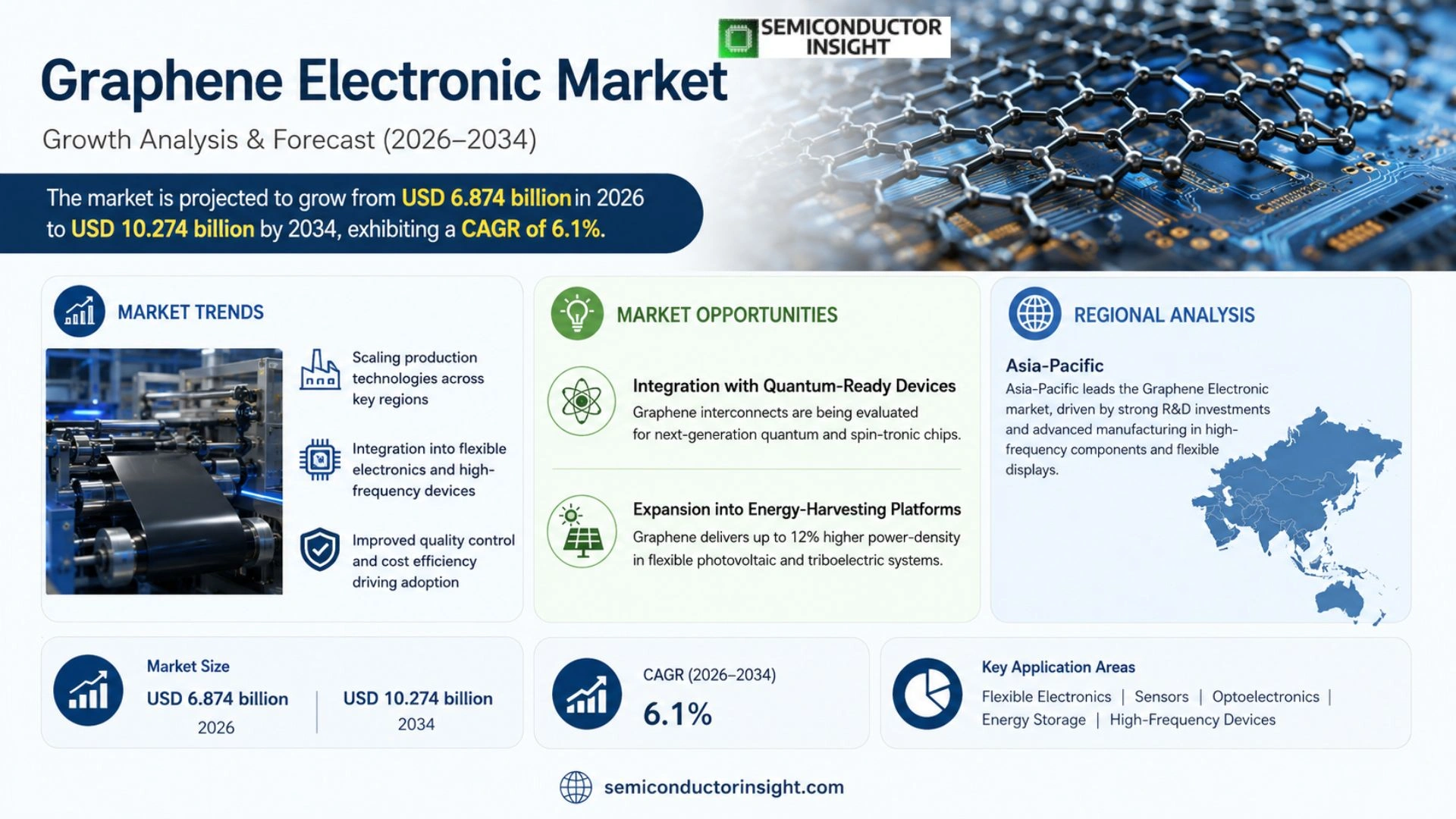
Graphene Electronic market is projected to grow from USD 6.874 billion in 2026 to USD 10.274 billion by 2034, exhibiting a CAGR of 6.1% during the forecast period.
Graphene Electronic refers to commercialized devices and components that incorporate graphene‑based materials,such as graphene films, inks, composites, and nanostructures,into functional electronic systems including sensors, flexible displays, batteries, semiconductors, and conductive components to enhance performance in conductivity, flexibility, thermal management, and miniaturization.
The market is experiencing rapid growth due to several factors, including increased investment in advanced materials, rising demand for flexible high‑performance electronics across consumer‑electronics, automotive and energy‑storage sectors. Advancements in scalable graphene synthesis and cost‑reduction techniques further expand adoption. Initiatives by key players are also expected to fuel growth. For instance, recent collaborations between major semiconductor manufacturers and graphene material suppliers aim to integrate graphene inks into printed circuit boards. Companies such as Graphenea, Samsung, and Vorbeck Materials are among the key participants operating with diversified portfolios.
MARKET DRIVERS
Advancements in Manufacturing Techniques
The rollout of roll‑to‑roll CVD processes has lowered wafer‑scale graphene costs by roughly 30 % over the past two years. Manufacturers can now embed single‑layer graphene into flexible substrates without compromising roll‑out speed, which directly fuels adoption in wearable electronics and thin‑film displays.
Rising Demand for High‑Performance Sensors
Automotive safety systems and environmental monitoring platforms increasingly require sensors that combine ultra‑high conductivity with mechanical resilience. Graphene’s ambipolar transport characteristics enable sensor footprints that are half the size of silicon equivalents while delivering twice the signal‑to‑noise ratio. Companies that integrate graphene into sensor arrays report prototype cycles that are 40 % shorter than legacy designs.
➤ “The convergence of low‑cost production and sensor‑centric demand is compressing the adoption timeline for graphene‑based components from a decade to under three years.”
These dynamics translate into a compound revenue uplift for Graphene Electronic market, as end‑users accelerate procurement cycles to capitalize on the performance margin that graphene uniquely provides.
MARKET CHALLENGES
Quality Consistency Across Large Areas
Despite progress in continuous‑film synthesis, defect densities remain uneven between batches. A single 5 cm² sheet can exhibit up to a 15 % variance in carrier mobility, compelling OEMs to allocate additional screening resources and inflate bill‑of‑materials costs.
Other Challenges
Supply‑Chain Fragmentation
Graphene Electronic market is supplied by a limited set of specialty firms, each operating distinct transfer protocols. This fragmentation hampers bulk purchasing power and introduces logistical bottlenecks for high‑volume manufacturers seeking to lock in multi‑year agreements.
MARKET RESTRAINTS
Regulatory Uncertainty in Emerging Applications
Regulators in the EU and North America have yet to finalize safety guidelines for embedded graphene in medical wearables. The absence of clear thresholds for biocompatibility forces developers to adopt conservative design margins, which in turn elevates prototype costs and delays time‑to‑market.
High Capital Expenditure for Scale‑Up
Establishing a production line capable of delivering >10,000 m²/year of defect‑controlled graphene requires capital outlays exceeding $150 million. For many mid‑sized electronics firms, the financial threshold remains prohibitive, curbing broader market penetration.
MARKET OPPORTUNITIES
Integration with Quantum‑Ready Devices
Quantum‑dot LEDs and spin‑tronic processors demand conductive layers that preserve phase coherence at near‑room temperature. Graphene’s minimal electron‑phonon scattering positions it as a prime candidate, and several pilot programs in Asia are already evaluating graphene interconnects for next‑generation logic chips.
Expansion into Energy‑Harvesting Platforms
Flexible photovoltaic skins and triboelectric nanogenerators benefit from graphene’s dual role as a transparent electrode and a charge‑transport conduit. Early field trials indicate a 12 % boost in power‑density compared with indium‑tin‑oxide, suggesting a sizeable niche for graphene‑enabled energy‑harvesting modules within the broader Graphene Electronic Market.
Graphene Electronic Market Trends
Scaling Production Technologies
The industry’s forward momentum now hinges on the ability to move graphene synthesis from laboratory batches to continuous, high‑volume lines. Recent investments in China focus on ink‑based roll‑to‑roll processes that can feed flexible‑display factories without interrupting throughput. In Europe, publicly funded pilot plants are integrating chemical‑vapor‑deposition rigs with automated quality‑control modules, shortening the path from raw material to functional component. The United States is channeling resources into modular reactors that promise lower energy consumption while preserving the atomic‑scale integrity required for high‑frequency semiconductors. These production upgrades cut per‑unit spend and tighten tolerances, which in turn lowers the entry barrier for OEMs that previously hesitated because of cost volatility. As manufacturers gain confidence that supply will remain predictable, design teams are embedding graphene layers into next‑generation wearables and sensor arrays, accelerating the commercialization cycle for Graphene Electronic market.
Other Trends
Hybrid Material Systems
Combining graphene with polymer matrices or metallic foils is reshaping product roadmaps across several sectors. Polymer‑graphene composites marry the sheet’s conductive network with the polymer’s stretchability, delivering printable circuits that survive repeated bending. Metallic hybrids, meanwhile, exploit graphene’s thermal conductivity to disperse heat in high‑power LEDs and automotive power modules, mitigating hotspot formation without adding bulk. Companies that master the interfacial chemistry gain a decisive edge: they can tout longer device lifespans, higher charge‑discharge rates for battery packs, and tighter form‑factor specifications for aerospace avionics. The practical payoff is evident in the rise of flexible‑sensor platforms that can be laminated onto vehicle windshields or integrated into smart textiles, opening revenue streams that were previously inaccessible due to material incompatibility.
Regional Competitive Landscape
Asia‑Pacific retains a decisive lead, buoyed by dense manufacturing ecosystems and policy incentives that accelerate scale‑up. South Korea’s emphasis on flexible‑display integration and Japan’s focus on precision coatings illustrate how local expertise directs capital toward niche applications. Europe’s strength lies in high‑value research collaborations, producing sensor prototypes that command premium pricing in medical diagnostics. North America differentiates itself through semiconductor innovation, where graphene‑silicon hybrids are tested for high‑frequency logic chips, positioning the region as a hub for defense and biomedical electronics. The divergent regional strategies suggest that investors should align portfolio exposure with the dominant value chain in each market: volume‑driven components in APAC, high‑margin research outputs in Europe, and cutting‑edge device engineering in North America.
COMPETITIVE LANDSCAPE
Key Industry Players
Graphene electronics: where material science meets device engineering
The market is currently dominated by a handful of vertically integrated firms that have progressed from laboratory‑scale graphene synthesis to full‑line production of functional components. Samsung leads the charge in flexible display modules, leveraging its massive fab capacity to embed graphene films into next‑generation screens, while Sony and Panasonic anchor the high‑value semiconductor segment, converting graphene inks into printable interconnects for wearable sensors. Their ability to secure long‑term supply of high‑purity graphene, coupled with in‑house design expertise, creates a barrier for newer entrants and positions them as reference points for pricing and performance standards across the ecosystem.
Beyond the tier‑one manufacturers, a cohort of specialist companies fuels niche growth. Graphenea and Vorbeck Materials focus on high‑quality graphene powders and inks, supplying both OEMs and research labs. Directa Plus and Wuhan Hanene Technology have carved out positions in conductive composites for automotive interiors. Emerging Asian players such as Changzhou Fuxi Technology and Hangzhou Gaoxi Technology are scaling up CVD reactors to meet regional demand for printed electronics, while European startups like Grolltex and ACS Material differentiate themselves through proprietary exfoliation processes that lower defect density. Collectively, these firms intensify competition on cost efficiency, product consistency, and intellectual‑property portfolios, compelling the incumbents to continuously innovate or risk erosion of market share.
List of Key Graphene Electronic Companies Profiled
- Graphenea
- Vorbeck Materials
- Directa Plus
- Samsung
- Sony Group Corporation
- Panasonic Corporation
- Grolltex
- ACS Material
- Wuhan Hanene Technology Co., Ltd
- Changzhou Fuxi Technology Co., Ltd
- Hangzhou Gaoxi Technology Co., Ltd
- Graphene Square
Segment Analysis:
| Segment Category | Sub-Segments | Key Insights |
| By Type |
|
Flexible Display – Enables ultra‑thin, lightweight screens that can be rolled or folded, opening new product form factors. – Drives innovation in wearable and automotive interior displays, where traditional glass is impractical. – Integration benefits include enhanced thermal management and superior electrical conductivity, supporting higher performance in compact devices. |
| By Application |
|
Consumer Electronics – Graphene’s flexibility and conductivity enable thinner smartphones, tablets, and wearables with longer battery life. – The material’s thermal properties help dissipate heat in high‑performance devices, improving reliability. – Adoption is reinforced by collaborations between graphene suppliers and leading electronics OEMs seeking differentiated product experiences. |
| By End User |
|
Electronics OEMs – Prioritize graphene for its ability to combine flexibility with high current carrying capacity. – They focus on integrating graphene inks in printed circuit boards, reducing material stack thickness. – Strategic investments in R&D partnerships accelerate the transition from prototype to mass‑production. |
| By Material Form |
|
Graphene Films – Offer seamless conductive layers for flexible displays and high‑frequency antennas. – Their uniform thickness supports reliable integration with silicon back‑end processes. – Ongoing improvements in roll‑to‑roll manufacturing are lowering barriers for large‑scale adoption. |
| By Value Chain |
|
Material Processors – Play a pivotal role in converting graphene powder into usable films, inks, and composites. – They differentiate through scalable CVD and exfoliation techniques that balance quality with cost. – Strong intellectual‑property portfolios around processing chemistries create competitive moat and attract strategic partnerships. |
Regional Analysis: Graphene Electronic Market
Asia-Pacific
Companies across Japan, South Korea, and Taiwan are embedding graphene into RF modules and sensor arrays, capitalising on its superior conductivity and mechanical flexibility. This shift is prompting design teams to re‑evaluate component footprints, thereby unlocking form‑factor reductions that differentiate premium devices in crowded markets.
The proliferation of roll‑to‑roll graphene film production lines is reducing material costs and enabling large‑scale integration into display backplanes. Localised supply chains minimise lead times, giving manufacturers the agility to respond swiftly to shifting consumer preferences.
Government initiatives in China and Singapore provide tax incentives for graphene research, encouraging joint ventures between academia and industry. Such frameworks lower entry barriers for startups seeking to commercialise novel graphene‑based circuits.
By diversifying raw‑material sources across multiple Asian countries, firms mitigate risks associated with geopolitical tensions. This distributed approach stabilises component availability, a crucial factor for maintaining production continuity.
North America
The North American segment of Graphene Electronic market is characterised by deep pockets of R&D investment, particularly in Silicon Valley and the Boston corridor. While adoption rates lag behind the Asia‑Pacific, the region excels in translating laboratory breakthroughs into patented technologies, creating a pipeline of high‑value intellectual property. Corporate customers increasingly demand graphene‑enhanced interconnects for data‑center processors, driving a niche but growing demand that influences procurement strategies among major OEMs.
Europe
European stakeholders approach graphene integration with a strong emphasis on standardisation and regulatory compliance. Collaborative consortia in Germany and the Netherlands are developing testing protocols that reassure automotive and aerospace suppliers of material reliability. This methodical progression, coupled with the EU’s focus on circular economy principles, encourages manufacturers to adopt graphene in ways that align with long‑term sustainability commitments.
South America
In South America, market activity revolves around pilot projects that explore graphene’s potential in renewable‑energy storage and low‑cost consumer electronics. Nations such as Brazil are leveraging local mineral deposits to foster a nascent supply base, positioning the region as a future source of cost‑effective graphene feedstock. Emerging partnerships between universities and regional manufacturers hint at a gradual escalation of capability over the next several years.
Middle East & Africa
The Middle East & Africa exhibit a cautious but opportunistic stance toward Graphene Electronic market. Wealth‑driven research funds in the Gulf are channelled into incubators that support graphene‑based wearables and smart‑city sensors. Meanwhile, South African institutions are investigating graphene’s role in high‑temperature electronics for mining applications, suggesting a niche where regional expertise may translate into commercial advantage.
Report Scope
This market research report provides a comprehensive analysis of the Graphene Electronic Market , covering the forecast period 2026–2034. It offers detailed insights into market dynamics, technological advancements, competitive landscape, and key trends shaping the industry.
Key focus areas of the report include:
- Market Overview: The report begins with an overview outlining its current market scenario, key growth indicators, and industry transformation drivers. It discusses macroeconomic factors, demand–supply balance, regulatory landscape, and the strategic role of semiconductors in powering advancements across industries such as automotive, telecommunications, consumer electronics, and industrial automation.
- Market Size & Forecast: Historical data and future projections for revenue, unit shipments, and market value across major regions and segments.
- Segmentation Analysis: Detailed breakdown by product type, technology, application, and end-user industry to identify high-growth segments and investment opportunities.
- Regional Insights: Insights into market performance across North America, Europe, Asia-Pacific, Latin America, and the Middle East & Africa, including country-level analysis where relevant.
- Competitive Landscape: Profiles of leading market participants, including their product offerings, R&D focus, manufacturing capacity, pricing strategies, and recent developments such as mergers, acquisitions, and partnerships.
- Technology Trends & Innovation: Assessment of emerging technologies, integration of AI/IoT, semiconductor design trends, fabrication techniques, and evolving industry standards.
- Market Drivers & Restraints: Evaluation of factors driving market growth along with challenges, supply chain constraints, regulatory issues, and market-entry barriers.
- Stakeholder Insights: Insights for component suppliers, OEMs, system integrators, investors, and policymakers regarding the evolving ecosystem and strategic opportunities.
Primary and secondary research methods are employed, including interviews with industry experts, data from verified sources, and real-time market intelligence to ensure the accuracy and reliability of the insights presented.
FREQUENTLY ASKED QUESTIONS:
What is the current market size of Graphene Electronic Market?
-> Graphene Electronic market is projected to grow from USD 6.874 billion in 2026 to USD 10.274 billion by 2034, exhibiting a CAGR of 6.1%
Which key companies operate in Graphene Electronic Market?
-> Key players include Graphenea, Paragraf, Grolltex, ACS Material, Samsung, NeoGraf Solutions, Bluestone Global Tech, Ltd, Vorbeck Materials, Graphene Square, Directa Plus, Wuhan Hanene Technology Co., Ltd, Changzhou Fuxi Technology Co., Ltd, Daoming Optics and Chemical Co., Ltd, Hangzhou Gaoxi Technology Co., Ltd, LUSTER LightTech Co. Ltd, Graphene Platform Corporation, Sony Group Corporation, Panasonic Corporation.
What are the key growth drivers?
-> Key growth drivers include demand for lightweight, high‑performance, flexible and energy‑efficient electronic products; advancements in scalable graphene synthesis; and increasing adoption in consumer electronics, automotive systems, and energy‑storage devices.
Which region dominates the market?
-> Asia‑Pacific leads the market due to strong manufacturing capabilities in China, South Korea and Japan, while Europe remains a significant high‑end application region.
What are the emerging trends?
-> Emerging trends include integration of graphene with silicon‑based electronics, rapid growth of printed electronics using graphene inks, rise of flexible and wearable devices, and development of hybrid material systems combining graphene with polymers and metals.
Get Sample Report PDF for Exclusive Insights
Report Sample Includes
- Table of Contents
- List of Tables & Figures
- Charts, Research Methodology, and more...