
GPS & GNSS Receiver Module Market Insights
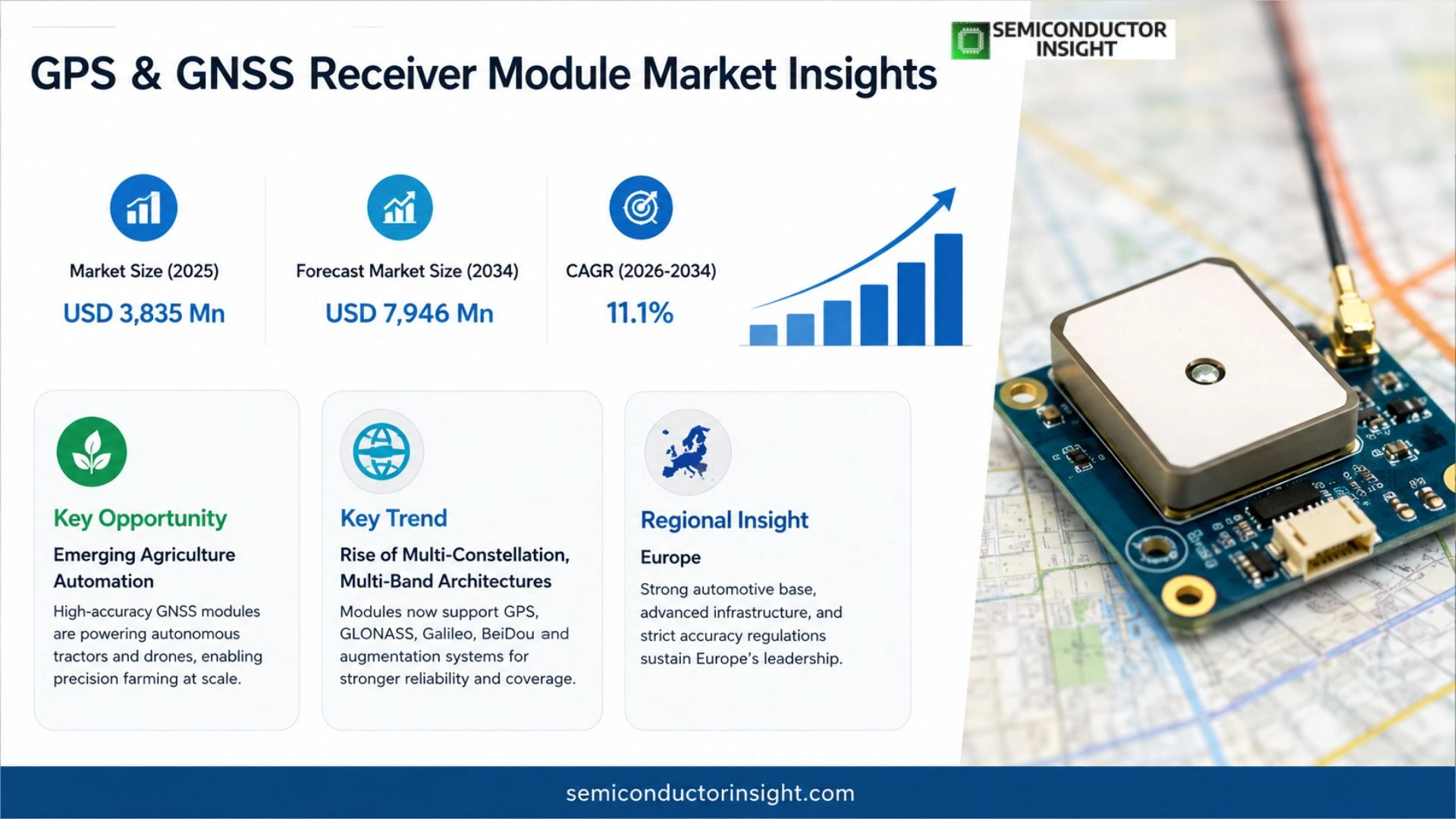
GPS & GNSS Receiver Module market was valued at USD 3,835 million in 2025 and is projected to reach USD 7,946 million by 2034, exhibiting a CAGR of 11.1% during the forecast period.
GPS and GNSS receiver modules are upstream core components that integrate satellite signal reception, RF front‑end circuitry, baseband processing, positioning computation, timing output and interface control into standardized devices. They provide stable positioning, navigation and timing capabilities for automotive OEMs and aftermarket suppliers, robotics and drone manufacturers, surveying equipment makers, asset‑tracking IoT terminals as well as infrastructure operators in telecommunications, electric power and data centres.
Product formats have progressed from traditional single‑band navigation units to high‑performance modules that support multi‑constellation reception, dual‑ or multi‑band operation and advanced techniques such as RTK, PPP or IMU fusion. Today’s portfolio includes centimeter‑level positioning modules, heading modules for autonomous systems and dedicated timing modules for critical infrastructure. Delivery options range from SMD surface‑mount devices and antenna‑integrated active receivers to OEM boards and development kits, enabling rapid system integration while offering firmware upgrades and correction‑service integration.
MARKET DRIVERS
Rising Demand Across Connected Devices
The proliferation of IoT ecosystems has placed location intelligence at the core of product design. Manufacturers of wearables, fleet‑management solutions, and smart‑city infrastructure now require compact, power‑efficient modules that can deliver reliable positioning without compromising device form‑factor. This shift pushes suppliers to innovate on integration density and to offer multi‑constellation support, which directly fuels adoption of GPS & GNSS Receiver Module Market.
Regulatory Momentum for Safety‑Critical Applications
Legislation mandating precise geolocation for autonomous vehicles, unmanned aerial systems, and critical‑infrastructure monitoring has raised the bar for accuracy and redundancy. Compliance requirements compel OEMs to source modules that support dual‑frequency reception and real‑time correction services, thereby expanding the addressable market for high‑performance receivers.
➤ Accurate timing and location are becoming differentiators in emerging services, prompting a surge in module specifications.
Beyond transportation, the agricultural sector is integrating precision‑guidance tools that rely on seamless GNSS data streams. As farms adopt variable‑rate technology, the demand for rugged, low‑cost receiver modules accelerates, creating a virtuous cycle of design iteration and volume growth for GPS & GNSS Receiver Module Market.
MARKET CHALLENGES
Integration Complexity Across Diverse Platforms
Designers must reconcile contradictory requirements such as ultra‑low power consumption, wide temperature tolerance, and support for multiple satellite constellations. Balancing these factors often leads to extended development cycles, which can erode time‑to‑market advantages for new products that depend on GNSS functionality.
Other Challenges
Cost Pressures
The price sensitivity of consumer‑grade devices forces module manufacturers to compress bill‑of‑materials without sacrificing performance, a tension that can limit investment in next‑generation chip architectures.
MARKET RESTRAINTS
Supply Chain Volatility
Global semiconductor shortages have exposed the fragility of component provisioning for GNSS receivers. Lead times for critical RF front‑ends and specialized antennas have lengthened, compelling end‑users to hold excess inventory or seek alternative suppliers, both of which stifle market fluidity.
MARKET OPPORTUNITIES
Emerging Agriculture Automation
Precision farming is transitioning from pilot projects to mainstream adoption, driven by the need to optimize input usage and meet sustainability targets. GNSS receiver modules that combine high‑accuracy positioning with enhanced multipath mitigation are poised to become standard components in autonomous tractors and drone‑based scouting tools, opening a sizable revenue channel for suppliers.
GPS & GNSS Receiver Module Market Trends
Rise of Multi‑Constellation, Multi‑Band Architectures
The industry is moving beyond single‑band navigation chips toward modules that concurrently process signals from GPS, GLONASS, Galileo, BeiDou, and regional augmentation systems. By embracing dual‑band and all‑band designs, manufacturers address the demand for centimeter‑level accuracy in urban canyons and high‑latitude zones where signal blockage is common. This architectural shift reduces the need for external correction services, lowers total system cost, and shortens time‑to‑market for premium positioning solutions. Consequently, OEMs in robotics, autonomous vehicles, and precision agriculture are able to embed higher‑resolution data directly into their products, creating a new revenue lever for module suppliers that extends beyond volume sales.
Other Trends
Diversified Delivery Formats
Module providers now ship a spectrum of form factors, ranging from compact SMD packages for mass‑produced IoT devices to antenna‑integrated active receivers designed for rugged field equipment. OEM‑level boards are gaining traction among manufacturers of surveying instruments and industrial automation controllers, where board‑level integration simplifies thermal management and compliance testing. Development kits, equipped with reference firmware and API libraries, accelerate prototype cycles for startups entering the drone and asset‑tracking markets. This broader portfolio enables vendors to capture value at multiple points in the supply chain, from low‑cost consumer gadgets to mission‑critical infrastructure.
Expansion of Application Horizons
Beyond traditional navigation, modules are becoming foundational to timing‑sensitive sectors such as telecommunications back‑haul, data‑center synchronization, and power‑grid management. The ability to deliver sub‑microsecond clock stability drives higher margins for timing‑focused products, encouraging established players to invest in hardened designs that meet telecom reliability standards. Simultaneously, the proliferation of AI‑enabled edge devices fuels demand for continuous positioning, pushing even entry‑level modules to incorporate basic RTK or PPP capabilities. This convergence of positioning and timing functions reshapes the competitive landscape, where algorithmic differentiation and service integration matter as much as silicon performance.
COMPETITIVE LANDSCAPE
Key Industry Players
Competitive dynamics in GPS & GNSS Receiver Module market
u‑blox AG dominates the high‑volume segment by leveraging a broad portfolio that spans single‑band, dual‑band and multi‑constellation modules. Its aggressive roadmap, which couples compact SMD formats with firmware that supports RTK and PPP, has cemented its position as the preferred supplier for automotive OEMs and large‑scale IoT deployments. Septentrio NV, on the other hand, focuses on ultra‑reliable timing and centimeter‑level positioning, targeting aerospace, defence and critical‑infrastructure customers that demand stringent anti‑spoofing and redundancy features. Quectel Wireless Solutions complements this tiered structure by offering cost‑effective, multi‑band kits that integrate DR and IMU fusion, thereby appealing to robotics and drone manufacturers that need continuous positioning without a steep price penalty. This three‑prong hierarchy,mass‑market, precision‑critical and hybrid‑value,structures the competitive arena and forces challengers to differentiate either through algorithmic sophistication or niche form‑factor innovation.
Niche innovators such as Antenova Ltd. and SkyTraq Technology concentrate on low‑power, antenna‑integrated modules that excel in consumer‑grade wearables and asset‑tracking devices. Allystar Technology (Shenzhen) Co., Ltd. distinguishes itself by embedding proprietary correction‑service chips, enabling centimeter‑level accuracy in a single packaged solution for agriculture and construction machinery. LOCOSYS Technology Inc. and ComNav Technology Ltd. have built credibility in the timing segment, supplying synchronized clocks for telecommunications base stations where drift tolerance is measured in picoseconds. Meanwhile, firms like Murata Manufacturing, INPAQ Technology and Unicore Communications enrich the ecosystem with specialized RF front‑ends and ruggedized industrial boards, ensuring that end‑users can source complete solutions without extensive third‑party integration.
List of Key GPS & GNSS Receiver Module Companies Profiled
- u‑blox AG
- Septentrio NV
- Quectel Wireless Solutions Co., Ltd.
- Trimble Inc.
- Murata Manufacturing Co., Ltd.
- NovAtel Inc.
- Furuno
- STMicroelectronics N.V.
- Antenova Ltd.
- SkyTraq Technology, Inc.
- Unicore Communications, Inc.
- LOCOSYS Technology Inc.
- Allystar Technology (Shenzhen) Co., Ltd.
- ComNav Technology Ltd.
- INPAQ Technology Co., Ltd.
Segment Analysis:
| Segment Category | Sub-Segments | Key Insights |
| By Type |
|
Standard‑precision Modules
|
| By Application |
|
Automotive & ADAS
|
| By End User |
|
Robotics & UAV manufacturers
|
| By Delivery Format |
|
SMD Surface‑Mount Modules
|
| By Positioning Capability |
|
Multi‑band & Multi‑Constellation Modules
|
Regional Analysis: GPS & GNSS Receiver Module Market
Europe
European carmakers accelerate adoption of multi‑constellation receiver modules to satisfy upcoming safety legislation. The shift toward level‑3 autonomy demands continuous satellite visibility, prompting OEMs to select chips with advanced interference‑mitigation features. Suppliers that can deliver rapid certification cycles gain foothold in high‑volume platforms.
Precision farming in the Netherlands and Spain relies on centimeter‑level positioning to optimise planting density and pesticide application. Local equipment manufacturers partner with module producers to embed dual‑band receivers that operate reliably across varied terrain, reducing input costs and environmental impact.
Tight tolerances demanded by infrastructure redevelopment in Eastern Europe push surveying firms toward high‑accuracy modules supporting real‑time kinematic (RTK) corrections. The regional grant programs that subsidise modern surveying equipment amplify this trend.
Wearable devices marketed in the UK and Scandinavia increasingly embed low‑power GNSS chips to extend battery life while delivering reliable outdoor navigation, a response to consumer expectations for seamless activity tracking.
North America
North America remains a hotbed for innovation in autonomous logistics, yet its market dynamics differ from Europe’s regulatory‑driven path. U.S. supply‑chain operators gravitate toward modular receiver solutions that can be retrofitted across heterogeneous vehicle fleets, emphasizing flexibility over strict certification. Canadian telecom operators explore integration of GNSS modules into 5G edge devices, leveraging precise timing for network synchronisation. The region’s venture‑capital ecosystem fuels startups that experiment with machine‑learning‑enhanced positioning, creating a pipeline of niche applications from drone delivery to augmented‑reality field services.
Asia‑Pacific
The Asia‑Pacific landscape is characterised by rapid urbanisation and burgeoning demand for smart‑infrastructure. Nations such as India and Indonesia invest heavily in public‑transport tracking, driving adoption of affordable, multi‑band modules that can operate in dense urban canyons. Meanwhile, China’s push for domestic chip design accelerates the development of indigenous GNSS solutions, reducing reliance on legacy suppliers. The region’s sheer scale encourages manufacturers to pursue high‑volume, cost‑optimised designs that still meet the accuracy thresholds required for emerging autonomous‑vehicle pilots in metropolitan corridors.
South America
In South America, GPS & GNSS Receiver Module Market is shaped by expansive agricultural territories and a growing interest in renewable‑energy projects. Brazilian agribusinesses demand robust modules that maintain lock across vast, low‑signal plains, prompting a shift toward ruggedised packages with extended temperature ranges. Parallelly, renewable‑energy developers in Chile and Argentina utilise precise positioning for solar‑farm alignment and wind‑turbine placement, creating a niche but steadily expanding demand for high‑precision receivers.
Middle East & Africa
The Middle East & Africa region presents a blend of infrastructure‑intensive megaprojects and resource‑exploration activities that rely on dependable positioning. In the United Arab Emirates, smart‑city initiatives incorporate GNSS modules into traffic‑management sensors, while oil‑field operators across the Gulf employ high‑accuracy receivers for drilling‑site surveying. African nations, focusing on mobile‑network expansion, view GNSS timing as a critical component for network reliability, encouraging adoption of low‑cost modules that can be mass‑deployed in rural tele‑medicine and education platforms.
Report Scope
This market research report provides a comprehensive analysis of the GPS & GNSS Receiver Module Market , covering the forecast period 2026–2034. It offers detailed insights into market dynamics, technological advancements, competitive landscape, and key trends shaping the industry.
Key focus areas of the report include:
- Market Overview: The report begins with an overview outlining its current market scenario, key growth indicators, and industry transformation drivers. It discusses macroeconomic factors, demand–supply balance, regulatory landscape, and the strategic role of semiconductors in powering advancements across industries such as automotive, telecommunications, consumer electronics, and industrial automation.
- Market Size & Forecast: Historical data and future projections for revenue, unit shipments, and market value across major regions and segments.
- Segmentation Analysis: Detailed breakdown by product type, technology, application, and end-user industry to identify high-growth segments and investment opportunities.
- Regional Insights: Insights into market performance across North America, Europe, Asia-Pacific, Latin America, and the Middle East & Africa, including country-level analysis where relevant.
- Competitive Landscape: Profiles of leading market participants, including their product offerings, R&D focus, manufacturing capacity, pricing strategies, and recent developments such as mergers, acquisitions, and partnerships.
- Technology Trends & Innovation: Assessment of emerging technologies, integration of AI/IoT, semiconductor design trends, fabrication techniques, and evolving industry standards.
- Market Drivers & Restraints: Evaluation of factors driving market growth along with challenges, supply chain constraints, regulatory issues, and market-entry barriers.
- Stakeholder Insights: Insights for component suppliers, OEMs, system integrators, investors, and policymakers regarding the evolving ecosystem and strategic opportunities.
Primary and secondary research methods are employed, including interviews with industry experts, data from verified sources, and real-time market intelligence to ensure the accuracy and reliability of the insights presented.
FREQUENTLY ASKED QUESTIONS:
What is the current market size of GPS & GNSS Receiver Module Market?
-> GPS & GNSS Receiver Module market is projected to reach USD 7,946 million by 2034, exhibiting a CAGR of 11.1% during the forecast period.
Which key companies operate in GPS & GNSS Receiver Module Market?
-> Key players include u-blox AG, Telit Cinterion, Trimble Inc., JAVAD GNSS, Inc., Antenova Ltd., NovAtel Inc., Septentrio NV, STMicroelectronics N.V., Furuno, Murata Manufacturing Co., Ltd., Braveridge Co., Ltd., ASCENKOREA Co., Ltd., KNCTEK, Quectel Wireless Solutions Co., Ltd., Unicore Communications, Inc., Allystar Technology (Shenzhen) Co., Ltd., ComNav Technology Ltd., Shenzhen Skylab Co., Ltd., LOCOSYS Technology Inc., SkyTraq Technology, Inc., INPAQ Technology Co., Ltd.
What are the key growth drivers?
-> Key growth drivers include increasing demand for high‑precision positioning in automotive ADAS and autonomous driving, rapid expansion of robotics and drone applications, growing IoT and asset‑tracking markets requiring low‑power multi‑band modules, heightened need for reliable timing in telecommunications, power‑grid and data‑center infrastructure, and the global rollout of advanced GNSS constellations (BeiDou, Galileo, QZSS) driving multi‑constellation module adoption.
Which region dominates the market?
-> Asia‑Pacific is the fastest‑growing region, while Europe remains a dominant market.
What are the emerging trends?
-> Emerging trends include multi‑constellation, multi‑band and RTK/PPP capable modules, integration of IMU/DR sensor fusion, AI‑enhanced positioning algorithms, and dedicated high‑reliability timing modules for 5G/edge computing and critical‑infrastructure applications.

Get Sample Report PDF for Exclusive Insights
Report Sample Includes
- Table of Contents
- List of Tables & Figures
- Charts, Research Methodology, and more...
