GNSS Splitter Market Insights
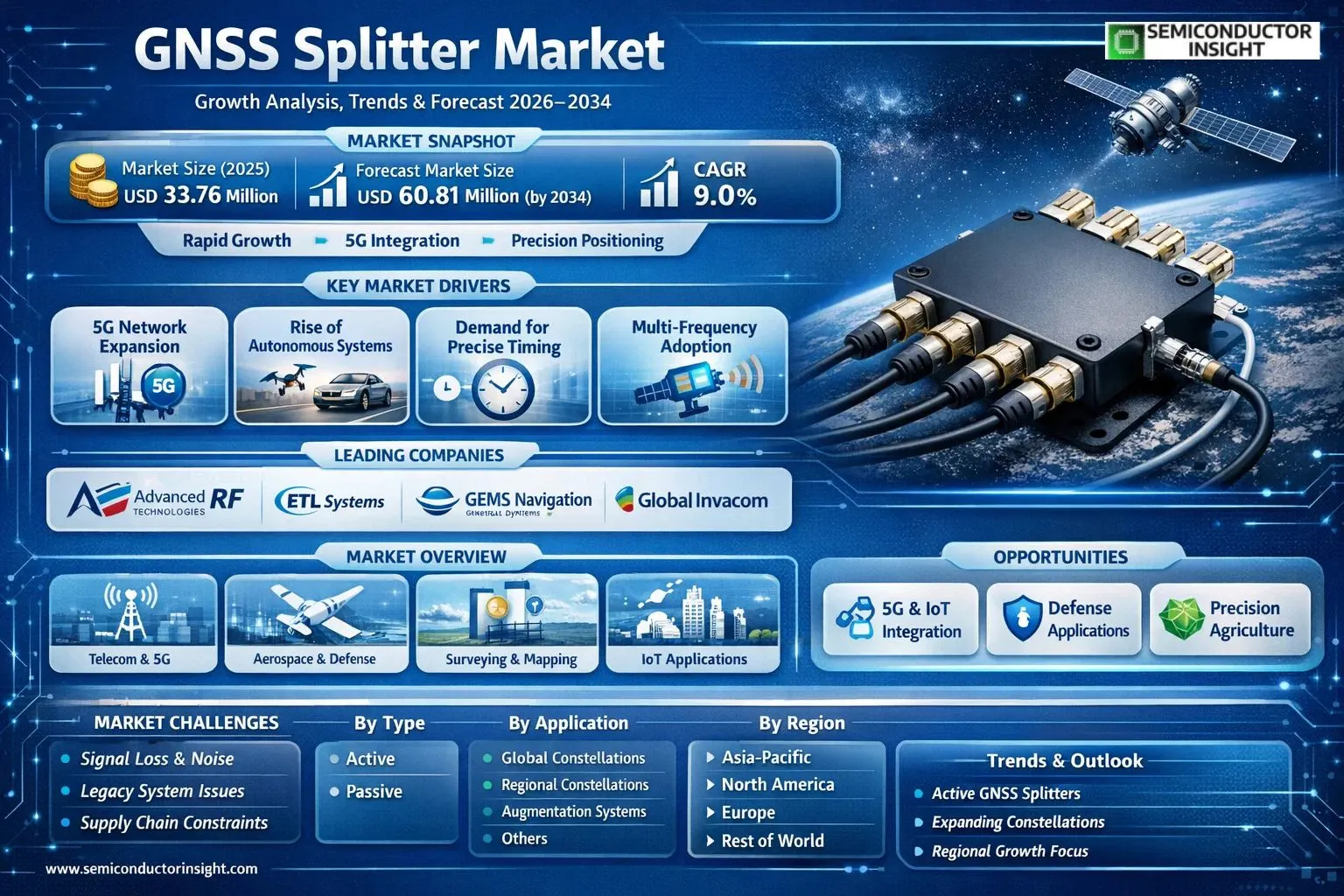
Global GNSS Splitter market size was valued at USD 33.76 million in 2025. The market is projected to grow from USD 36.80 million in 2026 to USD 60.81 million by 2034, exhibiting a CAGR of 9.0% during the forecast period.
A GNSS splitter is a specialized passive or active RF component designed to divide a single Global Navigation Satellite System signal from one antenna into multiple identical output signals for distribution to several receivers. This device is crucial for maintaining signal integrity, minimizing insertion loss, and ensuring proper impedance matching across systems. Splitters are engineered to support the entire GNSS frequency spectrum, including GPS, GLONASS, Galileo, and BeiDou signals, and are essential in applications ranging from telecommunications network synchronization and geodetic surveying to aerospace and defense systems.
The market is experiencing robust growth primarily driven by Global rollout of 5G infrastructure, which requires highly precise timing and synchronization provided by GNSS references. Furthermore, increasing demand for accurate positioning data in autonomous vehicles, unmanned aerial vehicles (UAVs), and precision agriculture is fueling adoption. The expansion of satellite-based augmentation systems (SBAS) and the modernization of existing global constellations also contribute to market expansion. Key industry players, including Advanced RF Technologies, ETL Systems, and Microsemi, are focusing on developing low-noise, high-isolation splitters to meet the stringent requirements of next-generation applications, thereby intensifying competition and innovation within the market.
MARKET DRIVERS
Advancements in Multi-Frequency GNSS Technology
GNSS Splitter Market is propelled by the growing adoption of multi-frequency receivers supporting GPS L1/L2/L5, Galileo E1/E5a, and BeiDou signals, necessitating reliable signal distribution to multiple endpoints without degradation. This trend is evident in precision agriculture and surveying, where splitters enable simultaneous data feeds to base stations and rovers, enhancing operational efficiency by up to 25% in field tests.
Expansion of Autonomous Vehicles and Drones
In the automotive and UAV sectors, the demand for GNSS splitters has surged due to requirements for redundant positioning systems. With autonomous vehicle testing projected to reach 15 million kilometers annually by 2025, splitters facilitate signal sharing between primary navigation units and backup sensors, ensuring continuity in challenging urban environments.
➤ In telecommunications, GNSS splitters support precise timing synchronization for 5G base stations, where network deployments grew by 40% in 2023, driving splitter volumes in timing applications.
Overall, these drivers underscore GNSS Splitter Market’s alignment with broader PNT ecosystem growth, forecasted at a 12% CAGR through 2030, bolstered by defense investments in resilient navigation infrastructure.
MARKET CHALLENGES
Signal Attenuation and Phase Noise
A primary challenge in GNSS Splitter Market is maintaining signal integrity, as splitting introduces attenuation typically around 3-6 dB per port, compounded by phase noise that affects carrier-to-noise ratios in low-signal scenarios. This is particularly problematic in urban canyons or foliage-heavy areas, where multipath interference already degrades performance.
Other Challenges
Compatibility with Legacy Systems
Many existing GNSS installations rely on single-frequency antennas, complicating integration of modern splitters designed for multi-constellation support, leading to retrofit costs that can exceed 20% of deployment budgets.
Supply chain disruptions for specialized RF components further hinder scalability, with lead times extending to 16 weeks amid global semiconductor shortages observed in 2023.
MARKET RESTRAINTS
High Costs of Active Splitters
GNSS Splitter Market faces restraints from the premium pricing of active splitters, which incorporate low-noise amplifiers to mitigate losses, often costing 2-3 times more than passive variants. This pricing barrier limits adoption in cost-sensitive sectors like consumer drones, where budgets prioritize affordability over redundancy.
Regulatory compliance adds another layer, with stringent FCC and ETSI standards for electromagnetic compatibility requiring extensive certification, delaying market entry for new designs by up to 12 months.
Competition from integrated SoC solutions in next-gen receivers also curbs standalone splitter demand, as manufacturers embed splitting functionality directly, potentially reducing the addressable market by 15% over the next five years.
MARKET OPPORTUNITIES
Integration with 5G and IoT Networks
GNSS Splitter Market holds significant potential in IoT ecosystems, where synchronized timing for edge devices is critical; with IoT connections expected to hit 25 billion by 2028, splitters can distribute GNSS clocks to sensor arrays in smart cities and industrial automation.
Emerging multi-band splitters compatible with L-band and future M-code signals open doors in defense applications, where secure PNT demands are rising amid geopolitical tensions.
Additionally, the Asia-Pacific region’s infrastructure boom, including precision farming initiatives covering 30% more arable land by 2030, positions GNSS splitters for growth in high-volume agricultural monitoring systems.
GNSS Splitter Market Trends
Growing Preference for Active GNSS Splitters
GNSS Splitter Market is witnessing a notable shift towards active splitters, which offer amplified signal distribution capabilities essential for maintaining signal integrity in complex environments. This trend stems from increasing demands in applications requiring high precision, such as timing synchronization in telecommunications and broadcasting. Industry surveys indicate that manufacturers are prioritizing active variants to meet performance needs across global constellations, where signal amplification counters losses effectively. Key players like ETL Systems and GEMS Navigation are enhancing their active splitter portfolios to capture this segment’s potential, driven by advancements in RF technology that improve noise reduction and phase stability.
Other Trends
Expansion in Global Constellations Applications
Applications supporting global constellations represent a dominant trend in GNSS Splitter Market, fueled by the proliferation of multi-frequency receivers in navigation systems. Distributors report heightened demand as satellite networks expand, necessitating reliable signal splitting for backup receivers and monitoring equipment. This segment benefits from compatibility with diverse GNSS signals, enabling seamless integration in defense and commercial aviation sectors. Challenges like signal interference are being addressed through innovative designs from suppliers such as General Dynamics Mission Systems, promoting wider adoption and fostering market growth through enhanced system redundancy.
Rising Focus on Regional Market Development
Regional constellations are emerging as a key growth area within GNSS Splitter Market, particularly in Asia and Europe, where localized satellite systems gain traction for sovereignty in positioning services. Surveys among industry experts highlight drivers like infrastructure investments in countries such as China and India, boosting the need for passive splitters suited to cost-sensitive deployments. Competitive dynamics are intensifying, with top manufacturers including Microlab and Tallysman Wireless expanding production to serve these markets, while obstacles like regulatory hurdles prompt strategic partnerships. This trend underscores the market’s adaptation to geopolitical shifts, ensuring robust supply chains and tailored solutions that align with regional technical standards and operational requirements.
COMPETITIVE LANDSCAPE
Key Industry Players
Top GNSS Splitter Manufacturers and Competitive Dynamics
GNSS Splitter Market exhibits a competitive landscape dominated by established manufacturers specializing in RF components for satellite navigation systems. Leading players such as Advanced RF Technologies, ETL Systems, and General Dynamics Mission Systems command significant market presence, driven by their expertise in producing reliable active and passive splitters compatible with global constellations like GPS, GLONASS, Galileo, and BeiDou. In 2025, the top five companies collectively held a substantial revenue share, reflecting a moderately concentrated market structure. These firms benefit from strong R&D capabilities, enabling innovations in low-loss, high-isolation splitters essential for applications in defense, telecommunications, and precision timing. The market’s growth at a 9.0% CAGR through 2034 intensifies competition, prompting leaders to expand portfolios for regional constellations and emerging multi-band requirements.
Beyond the frontrunners, a cadre of niche and specialized players contributes to the GNSS Splitter ecosystem’s dynamism. Companies like GEMS Navigation, GPS Networking, hopf Elektronik GmbH, INSTOCK Wireless Components, Microlab, Microsemi, Tallysman Wireless, NavtechGPS, and Calearo offer tailored solutions, focusing on cost-effective passive designs or high-performance active variants for verticals including aviation, surveying, and IoT. These mid-tier entities often excel in regional markets, such as North America and Europe, where demand for ruggedized splitters prevails amid challenges like signal interference and miniaturization. Their agile strategies, including mergers and product customizations, help them capture growth in underserved segments, fostering overall market innovation while the leaders maintain scale advantages in global supply chains.
List of Key GNSS Splitter Companies Profiled
- Advanced RF Technologies
- ETL Systems
- GEMS Navigation
- General Dynamics Mission Systems
- Global Invacom Group
- GPS Networking
- hopf Elektronik GmbH
- INSTOCK Wireless Components
- Microlab
- Microsemi
- Tallysman Wireless
- NavtechGPS
- Calearo
Segment Analysis:
| Segment Category | Sub-Segments | Key Insights |
| By Type |
|
Active leads due to its superior signal amplification capabilities.
|
| By Application |
|
Global Constellations dominates with broad compatibility and infrastructure maturity.
|
| By End User |
|
Aerospace & Defense holds the forefront with stringent reliability needs.
|
| By Frequency Band |
|
Multi-Band emerges as the frontrunner for future-proofing GNSS systems.
|
| By Port Configuration |
|
1:4 Splitter prevails for balanced signal distribution in compact setups.
|
Regional Analysis: GNSS Splitter Market
North America
In North America, GNSS splitters find extensive use in aviation for redundant receiver setups and in defense for secure positioning. Automotive sector leverages them for fleet management and precision navigation, while surveying benefits from multi-frequency signal sharing, ensuring accuracy in complex terrains without compromising performance.
Prominent firms in North America innovate GNSS splitters with low noise figures and broad bandwidth. Strategic partnerships with satellite providers enhance product reliability, focusing on rugged designs for harsh environments like maritime operations, solidifying regional dominance in GNSS Splitter Market.
Stringent yet supportive regulations promote GNSS interoperability, mandating splitter performance standards. Federal agencies drive adoption in public safety and transportation, creating a conducive environment for market penetration and technological advancements in signal distribution solutions.
Focus on miniaturized, active GNSS splitters with amplification capabilities addresses urban canyon challenges. R&D investments target multi-constellation compatibility, propelling North America’s GNSS Splitter Market toward resilient, future-proof solutions amid evolving navigation demands.
Europe
Europe exhibits strong growth in GNSS Splitter Market, fueled by the European GNSS Agency’s initiatives like Galileo deployment. Aerospace and automotive industries prioritize high-precision splitters for eCall systems and connected vehicles, ensuring signal integrity across diverse applications. Maritime sector benefits from robust GNSS splitters in vessel tracking and port automation. Regulatory harmony via EU standards accelerates adoption, emphasizing cybersecurity against jamming threats. Manufacturing hubs in Germany and France drive cost-effective, scalable solutions tailored for smart cities and agriculture precision farming. Collaborations between OEMs and research institutions foster next-gen splitters with anti-spoofing features. Challenges like spectrum congestion are met with innovative filtering technologies, positioning Europe as a key player in GNSS Splitter Market evolution through enhanced reliability and cross-border interoperability.
Asia-Pacific
Asia-Pacific emerges as a high-growth region in GNSS Splitter Market, propelled by rapid urbanization and expanding consumer electronics. China’s BeiDou integration alongside GPS boosts demand for versatile splitters in drones and IoT devices. India’s navigation programs enhance adoption in surveying and disaster management. Manufacturing prowess in Japan and South Korea yields affordable, high-volume GNSS splitters for automotive telematics and robotics. Infrastructure projects like smart highways integrate splitters for synchronized multi-receiver systems. Government subsidies and R&D incentives spur local innovations addressing dense signal environments. Despite challenges from counterfeit products, rising investments in quality standards elevate market maturity, making Asia-Pacific pivotal for GNSS Splitter Market scalability and global supply chain dynamics.
South America
South America shows promising potential in GNSS Splitter Market, driven by agriculture modernization and mining operations. Brazil’s vast farmlands utilize GNSS splitters for precision guidance in tractors and harvesters, optimizing yields. Infrastructure development in logistics demands reliable signal distribution for fleet tracking. Adoption in oil exploration enhances offshore positioning accuracy. Local manufacturers partner with international firms to develop weather-resistant splitters suited for tropical climates. Regulatory efforts promote GNSS standards, though infrastructure gaps pose hurdles. Growing telecom integration supports urban navigation apps, fostering steady market expansion amid economic recovery and tech localization trends in GNSS Splitter Market.
Middle East & Africa
Middle East & Africa witnesses accelerating GNSS Splitter Market growth, anchored by oil & gas and defense sectors. UAE and Saudi Arabia invest in smart cities and UAV surveillance, requiring advanced splitters for multi-GNSS support. Africa’s mining and agriculture leverage them for remote asset tracking and soil mapping. Harsh desert conditions drive demand for durable, low-power designs. Regional initiatives like African Union’s space programs promote adoption in border security. Challenges including power instability spur solar-powered innovations. Strategic alliances with global leaders enhance local capabilities, positioning the region for increased GNSS Splitter Market participation through tailored solutions and rising digital infrastructure.
Report Scope
This market research report provides a comprehensive analysis of GNSS Splitter Market, covering the forecast period 2026–2034. It offers detailed insights into market dynamics, technological advancements, competitive landscape, and key trends shaping the industry.
Key focus areas of the report include:
- Market Overview: The report begins with an overview outlining its current market scenario, key growth indicators, and industry transformation drivers. It discusses macroeconomic factors, demand–supply balance, regulatory landscape, and the strategic role of GNSS splitters in powering advancements across industries such as automotive, telecommunications, defense, surveying, and timing synchronization.
- Market Size & Forecast: Historical data and future projections for revenue, unit shipments, and market value across major regions and segments.
- Segmentation Analysis: Detailed breakdown by product type, technology, application, and end-user industry to identify high-growth segments and investment opportunities.
- Regional Insights: Insights into market performance across North America, Europe, Asia-Pacific, Latin America, and the Middle East & Africa, including country-level analysis where relevant.
- Competitive Landscape: Profiles of leading market participants, including their product offerings, R&D focus, manufacturing capacity, pricing strategies, and recent developments such as mergers, acquisitions, and partnerships.
- Technology Trends & Innovation: Assessment of emerging technologies, integration of AI/IoT, GNSS design trends, multi-constellation support, and evolving industry standards.
- Market Drivers & Restraints: Evaluation of factors driving market growth along with challenges, supply chain constraints, regulatory issues, and market-entry barriers.
- Stakeholder Insights: Insights for component suppliers, OEMs, system integrators, investors, and policymakers regarding the evolving ecosystem and strategic opportunities.
Primary and secondary research methods are employed, including interviews with industry experts, data from verified sources, and real-time market intelligence to ensure the accuracy and reliability of the insights presented.
FREQUENTLY ASKED QUESTIONS:
What is the current market size of GNSS Splitter Market?
-> GNSS Splitter Market was valued at USD 33.76 million in 2025 and is expected to reach USD 60.81 million by 2034, at a CAGR of 9.0% during the forecast period.
Which key companies operate in GNSS Splitter Market?
-> Key players include Advanced RF Technologies, ETL Systems, GEMS Navigation, General Dynamics Mission Systems, Global Invacom Group, among others.
What are the key growth drivers?
-> Key growth drivers include expansion of GNSS constellations, rising demand for precise positioning and timing, and advancements in RF splitter technology.
Which region dominates the market?
-> North America is the dominant region, while Asia is the fastest-growing market.
What are the emerging trends?
-> Emerging trends include active GNSS splitters, multi-constellation support, and integration in autonomous systems.

Get Sample Report PDF for Exclusive Insights
Report Sample Includes
- Table of Contents
- List of Tables & Figures
- Charts, Research Methodology, and more...
 Download Sample Report PDF