
Temperature Sensors in Household Appliances Market Overview
Temperature Sensors in Household Appliances are electronic devices integrated into appliances such as refrigerators, ovens, air conditioners, and washing machines. These sensors monitor and regulate temperature settings, ensuring that the appliances operate efficiently and maintain the desired temperature ranges for their respective functions.
This report provides a deep insight into the global Temperature Sensors in Household Appliances market covering all its essential aspects. This ranges from a macro overview of the market to micro details of the market size, competitive landscape, development trend, niche market, key market drivers and challenges, SWOT analysis, value chain analysis, etc.
The analysis helps the reader to shape the competition within the industries and strategies for the competitive environment to enhance the potential profit. Furthermore, it provides a simple framework for evaluating and accessing the position of the business organization. The report structure also focuses on the competitive landscape of the Global Temperature Sensors in Household Appliances Market, this report introduces in detail the market share, market performance, product situation, operation situation, etc. of the main players, which helps the readers in the industry to identify the main competitors and deeply understand the competition pattern of the market.
In a word, this report is a must-read for industry players, investors, researchers, consultants, business strategists, and all those who have any kind of stake or are planning to foray into the Temperature Sensors in Household Appliances market in any manner.
Temperature Sensors in Household Appliances Market Analysis:
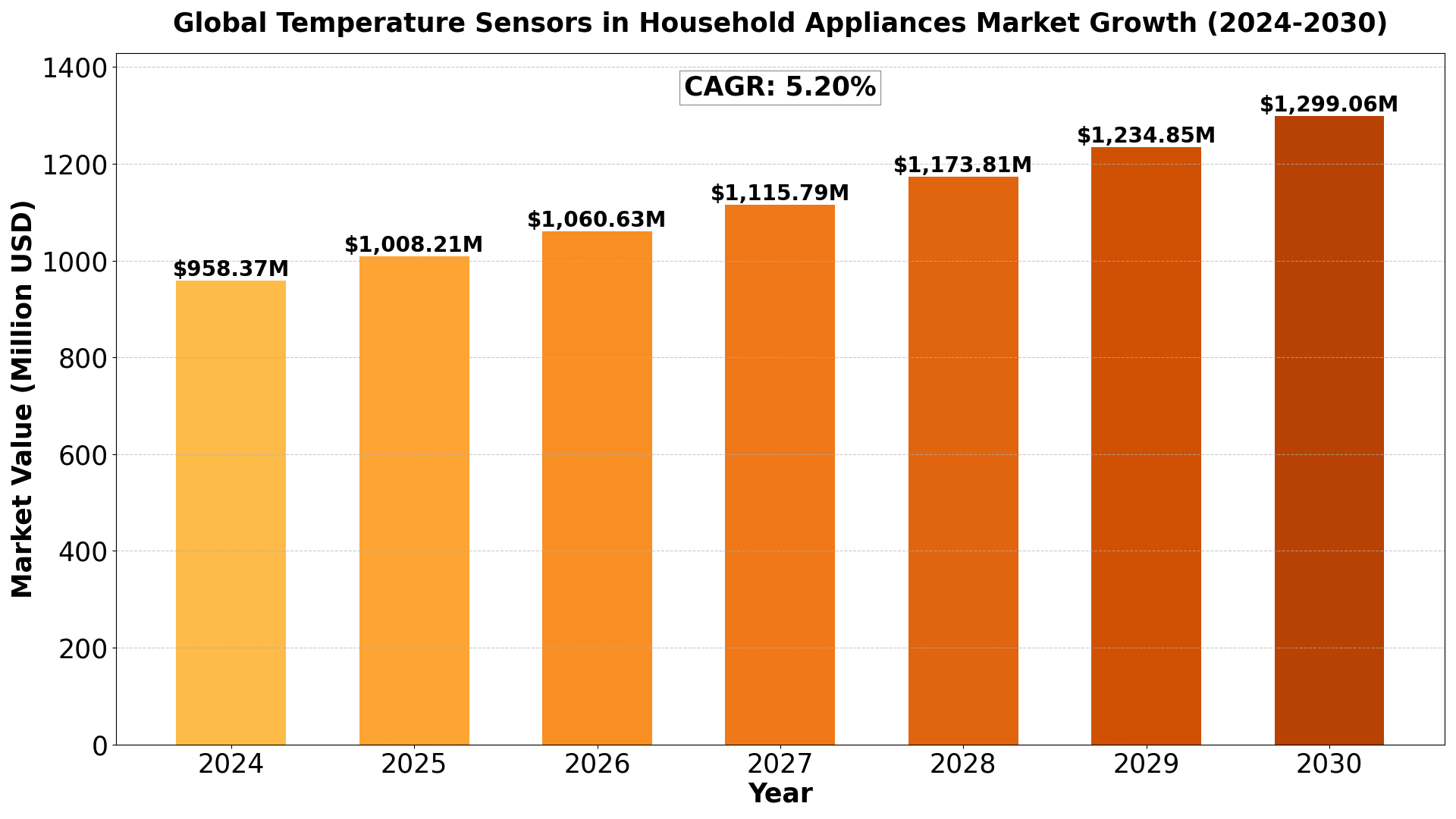
The Global Temperature Sensors in Household Appliances Market size was estimated at USD 911 million in 2023 and is projected to reach USD 1299.06 million by 2030, exhibiting a CAGR of 5.20% during the forecast period.
North America Temperature Sensors in Household Appliances market size was USD 237.38 million in 2023, at a CAGR of 4.46% during the forecast period of 2024 through 2030.
Temperature Sensors in Household Appliances Key Market Trends :
- Integration of Smart Home Technology
As smart home systems become more popular, temperature sensors are increasingly being integrated into connected household appliances, offering greater control and efficiency. - Energy-Efficient Appliances
With growing environmental concerns, manufacturers are focusing on energy-efficient temperature sensors that help reduce energy consumption in household appliances. - Miniaturization of Sensors
Advances in sensor technology are leading to the miniaturization of temperature sensors, enabling them to be incorporated into even smaller appliances without compromising performance. - Demand for Contactless Sensors
There is a rising demand for contactless temperature sensors, particularly in high-precision applications like ovens and air conditioners, for more accurate and safer temperature monitoring. - Growth of IoT-Enabled Appliances
The increasing use of IoT in household appliances has boosted the need for sensors that can communicate temperature data in real-time, allowing users to monitor and control appliances remotely.
Temperature Sensors in Household Appliances Market Regional Analysis :
-
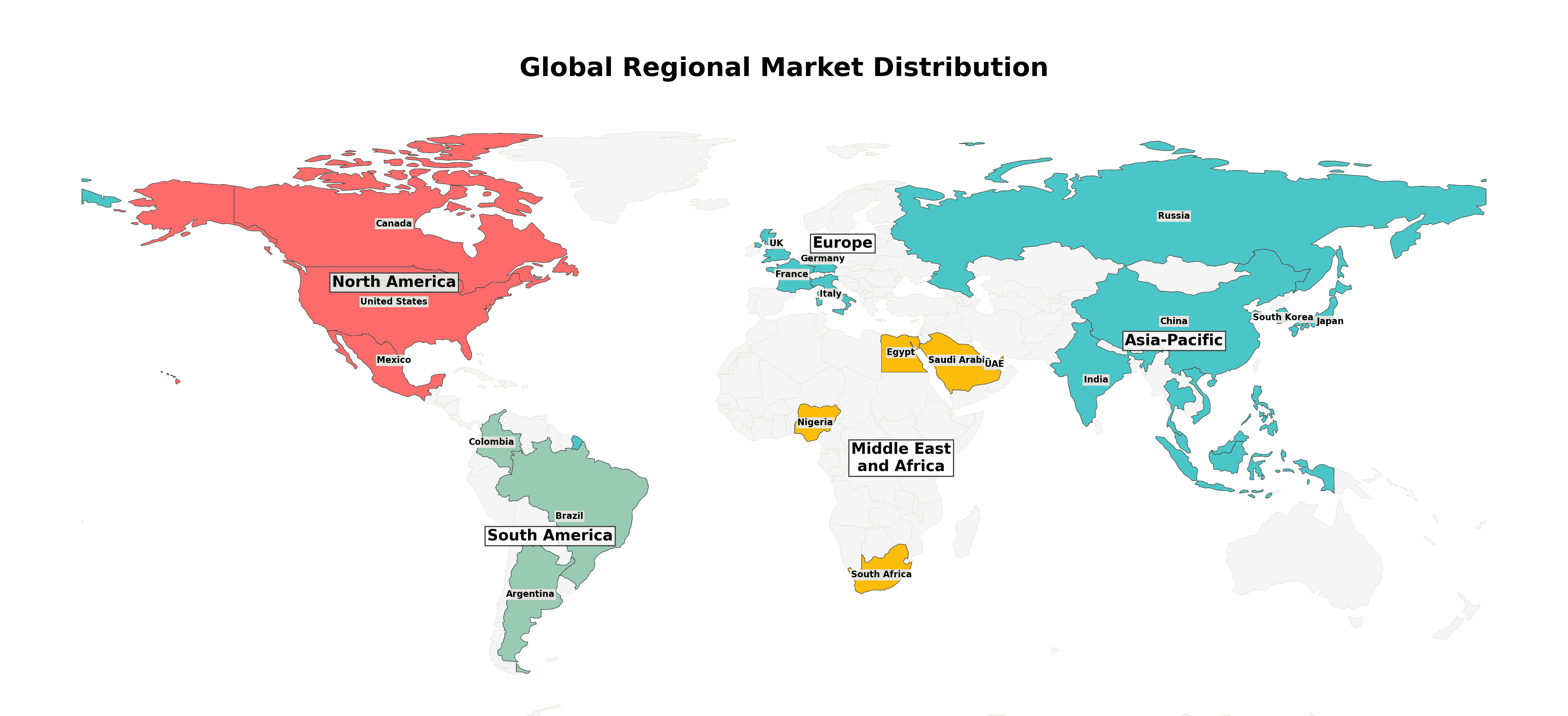
North America:
Strong demand driven by EVs, 5G infrastructure, and renewable energy, with the U.S. leading the market.
-
Europe:
Growth fueled by automotive electrification, renewable energy, and strong regulatory support, with Germany as a key player.
-
Asia-Pacific:
Dominates the market due to large-scale manufacturing in China and Japan, with growing demand from EVs, 5G, and semiconductors.
-
South America:
Emerging market, driven by renewable energy and EV adoption, with Brazil leading growth.
-
Middle East & Africa:
Gradual growth, mainly due to investments in renewable energy and EV infrastructure, with Saudi Arabia and UAE as key contributors.
Temperature Sensors in Household Appliances Market Segmentation :
The research report includes specific segments by region (country), manufacturers, Type, and Application. Market segmentation creates subsets of a market based on product type, end-user or application, Geographic, and other factors. By understanding the market segments, the decision-maker can leverage this targeting in the product, sales, and marketing strategies. Market segments can power your product development cycles by informing how you create product offerings for different segments.
Key Company
- Sensata
- Amphenol
- Texas Instruments
- TDK
- STMicroelectronics
- AMPRON
- Huagong Tech Company
- Shibaura Electronics
- TE Connectivity
- Thinking-Electronic
- Semitec
Market Segmentation (by Type)
- Contact
- Contactless
Market Segmentation (by Application)
- Large Home Appliances
- Small Home Appliances
Drivers
- Increasing Demand for Energy Efficiency
Consumers are seeking more energy-efficient appliances to lower energy bills and reduce environmental impact, driving the demand for advanced temperature sensors that optimize appliance performance. - Growing Adoption of Smart Home Devices
The rise of connected devices in smart homes enhances the need for temperature sensors that can integrate with other smart appliances, further promoting the market’s growth. - Technological Advancements in Sensor Technology
Continuous innovation in sensor technology is improving the accuracy, reliability, and affordability of temperature sensors, fueling their widespread adoption in household appliances.
Restraints
- High Cost of Advanced Sensors
The initial investment in high-end temperature sensors, especially those designed for premium appliances, can be a barrier for both manufacturers and consumers, limiting market penetration. - Limited Awareness in Developing Regions
While developed countries are quickly adopting temperature sensors, developing regions face challenges such as limited awareness and affordability, hindering market growth. - Complex Integration in Legacy Appliances
Retrofitting older appliances with advanced temperature sensors can be technically challenging and costly, reducing the demand for sensors in older household appliance models.
Opportunities
- Growth of Smart Appliances Market
As the smart appliances market expands, there is a significant opportunity for manufacturers to develop more sophisticated temperature sensors that cater to the growing demand for connected and efficient devices. - Rising Demand for Home Automation
The surge in home automation presents an opportunity for temperature sensor manufacturers to innovate and create sensors that offer higher precision, greater durability, and seamless integration with smart home systems. - Emerging Markets in Asia-Pacific
As economies in the Asia-Pacific region grow and consumers increasingly opt for modern household appliances, this region presents significant growth opportunities for temperature sensor manufacturers.
Challenges
- Price Sensitivity in Developing Markets
The price sensitivity of consumers in developing markets poses a challenge for manufacturers aiming to offer temperature sensors that are both cost-effective and high-quality. - Intense Competition in the Sensor Market
The temperature sensor market is highly competitive, with several key players vying for market share, which could pressure companies to lower prices and innovate constantly to maintain profitability. - Technological Challenges in Sensor Calibration
Ensuring the accuracy and reliability of temperature sensors, especially in highly sensitive appliances, remains a technical challenge, requiring continuous improvements in calibration and sensor design.
Key Benefits of This Market Research:
- Industry drivers, restraints, and opportunities covered in the study
- Neutral perspective on the market performance
- Recent industry trends and developments
- Competitive landscape & strategies of key players
- Potential & niche segments and regions exhibiting promising growth covered
- Historical, current, and projected market size, in terms of value
- In-depth analysis of the Temperature Sensors in Household Appliances Market
- Overview of the regional outlook of the Temperature Sensors in Household Appliances Market:
Key Reasons to Buy this Report:
- Access to date statistics compiled by our researchers. These provide you with historical and forecast data, which is analyzed to tell you why your market is set to change
- This enables you to anticipate market changes to remain ahead of your competitors
- You will be able to copy data from the Excel spreadsheet straight into your marketing plans, business presentations, or other strategic documents
- The concise analysis, clear graph, and table format will enable you to pinpoint the information you require quickly
- Provision of market value (USD Billion) data for each segment and sub-segment
- Indicates the region and segment that is expected to witness the fastest growth as well as to dominate the market
- Includes in-depth analysis of the market from various perspectives through Porters five forces analysis
- Provides insight into the market through Value Chain
- Market dynamics scenario, along with growth opportunities of the market in the years to come
- 6-month post-sales analyst support
Customization of the Report
In case of any queries or customization requirements, please connect with our sales team, who will ensure that your requirements are met.
FAQs
Q: What are the key driving factors and opportunities in the Temperature Sensors in Household Appliances market?
A: The main drivers include the growing demand for energy-efficient appliances, the increasing adoption of smart home devices, and technological advancements in sensor technology. Opportunities arise from the expansion of the smart appliances market, rising demand for home automation, and emerging markets in Asia-Pacific.
Q: Which region is projected to have the largest market share in the Temperature Sensors in Household Appliances market?
A: North America is expected to hold the largest market share, with a projected market size of USD 237.38 million in 2023 and a CAGR of 4.46% during the forecast period.
Q: Who are the top players in the global Temperature Sensors in Household Appliances market?
A: Key players in the market include Sensata, Amphenol, Texas Instruments, TDK, STMicroelectronics, AMPRON, Huagong Tech Company, Shibaura Electronics, TE Connectivity, and Thinking-Electronic.
Q: What are the latest technological advancements in the Temperature Sensors in Household Appliances industry?
A: Recent advancements include the miniaturization of sensors, the development of more energy-efficient and precise contactless temperature sensors, and increased integration with IoT technologies for smarter appliances.
Q: What is the current size of the global Temperature Sensors in Household Appliances market?
A: The global market size was estimated at USD 911 million in 2023 and is projected to reach USD 1.3 billion by 2030, growing at a CAGR of 5.20% during the forecast period.
Get Sample Report PDF for Exclusive Insights
Report Sample Includes
- Table of Contents
- List of Tables & Figures
- Charts, Research Methodology, and more...
 Download Sample Report PDF


