
Market Insights
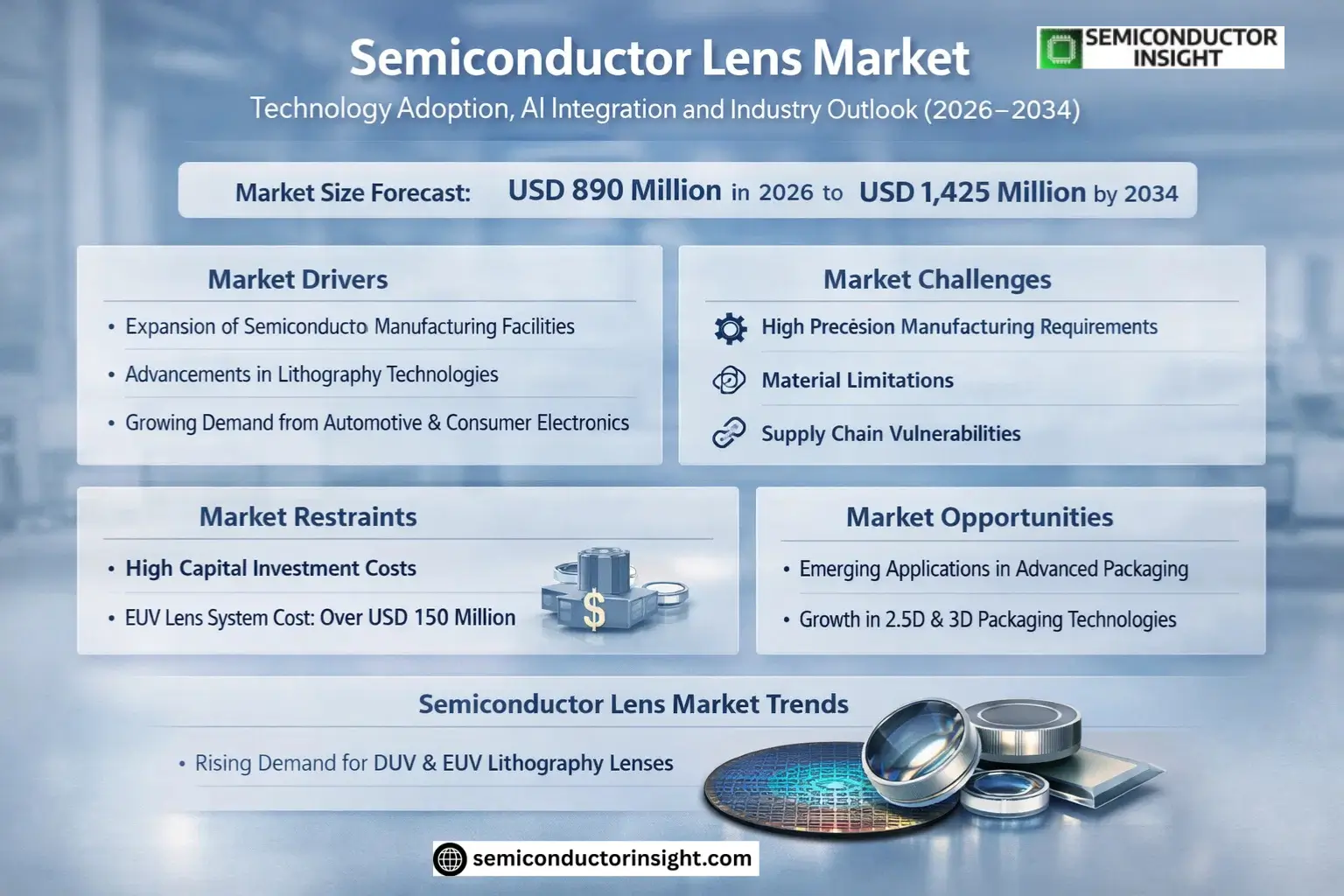
Global Semiconductor Lens Market size was valued at USD 828 million in 2025. The market is projected to grow from USD 890 million in 2026 to USD 1,425 million by 2034, exhibiting a CAGR of 8.3% during the forecast period.
Semiconductor lenses are precision optical components integral to semiconductor manufacturing equipment, enabling high-accuracy lithography and inspection processes. These lenses demand exceptional optical clarity, thermal stability, and minimal aberration to meet the stringent requirements of advanced chip fabrication. Key types include DUV (Deep Ultraviolet) and EUV (Extreme Ultraviolet) lithography lenses, which are critical for producing smaller transistor nodes.
The market growth is driven by escalating demand for miniaturized electronics, advancements in semiconductor fabrication technologies, and increased investments in foundry expansions. While the U.S. remains a dominant player, China’s rapid semiconductor industry growth presents significant opportunities. Leading manufacturers like Carl Zeiss and Nikon continue to innovate, addressing challenges such as yield optimization and cost pressures in next-generation lens development.
MARKET DRIVERS
Expansion of Semiconductor Manufacturing Facilities
The growing demand for semiconductor lenses is driven by the rapid expansion of semiconductor manufacturing facilities worldwide. With over 25 new fabs projected for construction by 2025, the need for high-precision semiconductor lenses for lithography and inspection systems is increasing significantly.
Advancements in Lithography Technologies
Semiconductor Lens Market is directly benefiting from advancements in extreme ultraviolet (EUV) and deep ultraviolet (DUV) lithography technologies. These technologies require increasingly sophisticated lens systems to achieve smaller node processes, driving demand for specialized optics.
Automotive and consumer electronics sectors continue to fuel demand for chips, creating secondary growth opportunities for semiconductor lens manufacturers supplying inspection and measurement equipment.
MARKET CHALLENGES
High Precision Manufacturing Requirements
Semiconductor lens production faces significant challenges due to the extreme precision required, with surface irregularities often needing to be less than 1 nanometer. This creates substantial barriers to entry and limits the supplier base to only the most advanced manufacturers.
Other Challenges
Material Limitations
Current optical materials struggle with EUV transmission efficiency, creating performance bottlenecks in next-generation semiconductor manufacturing processes.
Supply Chain Vulnerabilities
The specialized nature of semiconductor lens materials and coatings makes the supply chain particularly vulnerable to disruptions, as seen during recent global chip shortages.
MARKET RESTRAINTS
High Capital Investment Requirements
Semiconductor Lens Market faces constraints from the extremely high capital expenditure required for manufacturing facilities. A single EUV lens system can cost over USD 150 million, limiting market expansion to only the largest equipment manufacturers.
MARKET OPPORTUNITIES
Emerging Applications in Advanced Packaging
The growing adoption of 2.5D and 3D packaging technologies presents new opportunities for semiconductor lens manufacturers. These advanced packaging techniques require specialized inspection and alignment systems with custom optical solutions.
Semiconductor Lens Market Trends
Increased Demand for DUV and EUV Lithography Lenses
Semiconductor Lens Market is witnessing significant growth driven by the rising adoption of DUV (Deep Ultraviolet) and EUV (Extreme Ultraviolet) lithography lenses. These lenses are critical for advanced semiconductor manufacturing processes, enabling finer circuit patterning required for next-generation chips. Leading manufacturers are expanding production capacity to meet the growing demand from foundries and IDMs.
Other Trends
Shift Towards Advanced Packaging Applications
Semiconductor lenses are increasingly being utilized in advanced packaging applications such as 2.5D and 3D IC packaging. This trend is fueled by the need for high-performance optical inspection systems capable of handling complex package architectures with micron-level precision requirements.
Geographic Market Expansion
Asia Pacific continues to dominate the semiconductor lens market, with China, Japan, and South Korea accounting for substantial market share. The region’s strong semiconductor manufacturing ecosystem and government support for domestic semiconductor equipment development are key growth drivers. Meanwhile, North America and Europe remain important markets with steady demand for high-end optical components.
Technology Innovations Driving Market Growth
Manufacturers are investing in advanced coating technologies and ultra-precision manufacturing processes to enhance lens performance. Developments in aspherical lens designs and multi-element lens systems are enabling higher resolution and better aberration correction for semiconductor manufacturing applications.
Competitive Landscape and Supply Chain Developments
The market remains concentrated among a few key players, with Carl Zeiss, Nikon, and Canon maintaining leadership positions. However, Chinese manufacturers are gaining traction through technological advancements and government support. The industry is seeing increased collaboration between lens manufacturers and semiconductor equipment providers to develop integrated solutions.
COMPETITIVE LANDSCAPE
Key Industry Players
Optical Precision in Semiconductor Manufacturing Drives Competitive Dynamics
Carl Zeiss AG dominates the semiconductor lens market with its advanced lithography solutions, holding significant technological leadership in DUV and EUV lens systems. The German optics specialist commands approximately 40% revenue share globally, benefiting from its strategic partnerships with ASML in extreme ultraviolet lithography. Nikon and Canon follow as established Japanese players, collectively accounting for 35% market share through their comprehensive portfolios covering inspection and metrology applications.
Chinese manufacturers like Nanjing Wavelength Opto-Electronic are rapidly gaining traction with cost-competitive solutions for mid-tier semiconductor applications. Regional players including Shenzhen Canrill Technologies and Hefei Bohu Optoelectronic Technology specialize in customized lens systems for China’s growing semiconductor testing and packaging sectors. Emerging innovators such as JENOPTIK and Shin-Etsu Chemical are developing next-generation materials to enhance optical performance in advanced nodes.
List of Key Semiconductor Lens Companies Profiled
- Carl Zeiss AG
- Nikon Corporation
- Canon Inc.
- JENOPTIK AG
- Shin-Etsu Chemical Co., Ltd.
- Nanjing Wavelength Opto-Electronic Science & Technology
- Shenzhen Canrill Technologies
- Hefei Bohu Optoelectronic Technology
- Edmund Optics
- Laser Optik GmbH
- Laser Components GmbH
- HORIBA Scientific
- OptoSigma Corporation
- Opto-Line Corporation
- Precision Optical
Segment Analysis:
| Segment Category | Sub-Segments | Key Insights |
| By Type |
|
DUV Lithography Lens dominates the market due to:
|
| By Application |
|
Photolithography remains the primary application segment because:
|
| By End User |
|
Foundries represent the key end-user segment characterized by:
|
| By Technology Generation |
|
Advanced Nodes show the strongest growth potential due to:
|
| By Material Composition |
|
CaF2 (Calcium Fluoride) lenses are gaining prominence because of:
|
Regional Analysis: Semiconductor Lens Market
Taiwan’s semiconductor foundries create exceptional demand for high-NA EUV lenses, with continuous technology upgrades driving optical component innovation. The island’s vertically integrated supply chain enables rapid prototyping and testing of new lens designs specifically for advanced nodes.
South Korean memory manufacturers require specialized lens solutions for high-density chip production, particularly for 3D NAND stacking processes. Local lens producers have developed expertise in deep ultraviolet (DUV) optics optimized for memory fabrication.
China’s semiconductor independence initiatives are fostering growth in domestic lens manufacturing capabilities. While still behind in cutting-edge technologies, Chinese firms are rapidly advancing in mature-node lens production through technology transfers and strategic acquisitions.
Japanese manufacturers maintain leadership in specialized optical materials like calcium fluoride crystals vital for lithography systems. Their expertise in precision polishing and coating technologies enables production of lenses with exceptional surface quality and durability.
North America
North America remains a key innovation hub for Semiconductor Lens technologies, particularly in research and development. The region hosts leading lithography equipment makers and semiconductor research facilities that push the boundaries of optical performance. Silicon Valley’s ecosystem promotes collaboration between lens manufacturers, chip designers, and equipment vendors. US-based companies specialize in cutting-edge computational lithography solutions that reduce optical constraints. Growing investments in domestic semiconductor manufacturing under the CHIPS Act are creating new opportunities for localized lens production to serve leading-edge fabs.
Europe
European companies maintain strong positions in specialized Semiconductor Lens applications, particularly for automotive and industrial semiconductors. Germany leads in precision optics manufacturing, while Dutch firms collaborate closely with nearby EUV lithography developers. The region’s emphasis on quality and reliability makes it preferred for mission-critical applications. Research institutions across Europe contribute to advancements in aspheric lens design and nano-optics, supporting the transition to smaller semiconductor nodes.
Middle East & Africa
The Middle East is emerging as a potential growth area for Semiconductor Lens technologies amid economic diversification efforts. While currently not a major manufacturing hub, the region shows increasing investment in semiconductor-related infrastructure. Several Gulf nations are establishing technology parks and research centers that could drive future demand for optical components. Africa’s market remains nascent but shows potential for entry-level semiconductor packaging applications that utilize basic lens technologies.
South America
South America’s Semiconductor Lens Market is primarily focused on supporting regional electronics assembly operations. Brazil leads in localized production of optical components for industrial and consumer applications. While the region lacks advanced semiconductor manufacturing capabilities, growing technology adoption is creating opportunities for imaging and sensor-related lens applications. Government initiatives to develop local technology sectors could spur additional market growth in coming years.
Report Scope
This market research report provides a comprehensive analysis of the Semiconductor Lens Market , covering the forecast period 2025–2034. It offers detailed insights into market dynamics, technological advancements, competitive landscape, and key trends shaping the industry.
Key focus areas of the report include:
- Market Overview: The report begins with an overview outlining its current market scenario, key growth indicators, and industry transformation drivers. It discusses macroeconomic factors, demand–supply balance, regulatory landscape, and the strategic role of semiconductor lenses in precision machining and inspection processes across semiconductor manufacturing.
- Market Size & Forecast: Historical data and future projections for revenue, unit shipments, and market value across major regions and segments.
- Segmentation Analysis: Detailed breakdown by product type (DUV Lithography Lens, EUV Lithography Lens), application (Semiconductor Testing, Semiconductor Packaging), and end-user industry.
- Regional Insights: Insights into market performance across North America, Europe, Asia, South America, and Middle East & Africa, including country-level analysis.
- Competitive Landscape: Profiles of leading market participants, including their product offerings, R&D focus, manufacturing capacity, pricing strategies, and recent developments.
- Technology Trends & Innovation: Assessment of emerging technologies, precision optical performance requirements, and evolving industry standards.
- Market Drivers & Restraints: Evaluation of factors driving market growth along with challenges, supply chain constraints, and market-entry barriers.
- Stakeholder Insights: Insights for component suppliers, OEMs, system integrators, investors, and policymakers regarding the evolving ecosystem.
Primary and secondary research methods are employed, including interviews with industry experts, data from verified sources, and real-time market intelligence to ensure the accuracy and reliability of the insights presented.
FREQUENTLY ASKED QUESTIONS:
What is the current market size of Semiconductor Lens Market?
-> Semiconductor Lens Market size was valued at USD 828 million in 2025. The market is projected to grow from USD 890 million in 2026 to USD 1,425 million by 2034, exhibiting a CAGR of 8.3% during the forecast period.
Which key companies operate in Semiconductor Lens Market?
-> Key players include Carl Zeiss, Nikon, Canon, Nanjing Wavelength Opto-Electronic Science & Technology, Shenzhen Canrill Technologies, and Hefei Bohu Optoelectronic Technology, among others.
What are the key growth drivers?
-> Key growth drivers include increasing demand for precision optical components in semiconductor manufacturing, technological advancements in lithography processes, and growing semiconductor industry investments.
Which region dominates the market?
-> Asia is the largest market, with significant growth in China, Japan, and South Korea, while North America remains a key market with substantial U.S. presence.
What are the emerging trends?
-> Emerging trends include advancements in EUV lithography technology, increasing precision requirements in semiconductor fabrication, and integration of advanced optical materials.
Get Sample Report PDF for Exclusive Insights
Report Sample Includes
- Table of Contents
- List of Tables & Figures
- Charts, Research Methodology, and more...
 Download Sample Report PDF


