
The Report Covers :
This report provides a comprehensive analysis of the market, covering key aspects such as market size, growth trends, regional insights, and segmentation by type and application. It also highlights the competitive landscape, profiling key players, and offers valuable insights to help businesses make informed decisions.
Retimer (Redriver) Market Overview
Retimers and redrivers have enabled longer physical channels in servers and PCs since Peripheral Component Interface Express (PCIe) 3.0 was first introduced almost 10 years ago. A redriver is a mostly analog reach extension device designed to boost the high-frequency portions of a signal to counteract the frequency-dependent attenuation caused by the interconnect: the central processing unit (CPU) package, system board, connectors, and so on. A retimer is a mixed signal analog/digital device that is protocol-aware and has the ability to fully recover the data, extract the embedded clock, and retransmit a fresh copy of the data using a clean clock.
The analysis helps the reader to shape the competition within the industries and strategies for the competitive environment to enhance the potential profit. Furthermore, it provides a simple framework for evaluating and accessing the position of the business organization. The report structure also focuses on the competitive landscape of the Global Retimer (Redriver) Market, this report introduces in detail the market share, market performance, product situation, operation situation, etc., of the main players, which helps the readers in the semiconductor industry to identify the main competitors and deeply understand the competition pattern of the market.
Retimer (Redriver) Market Analysis:
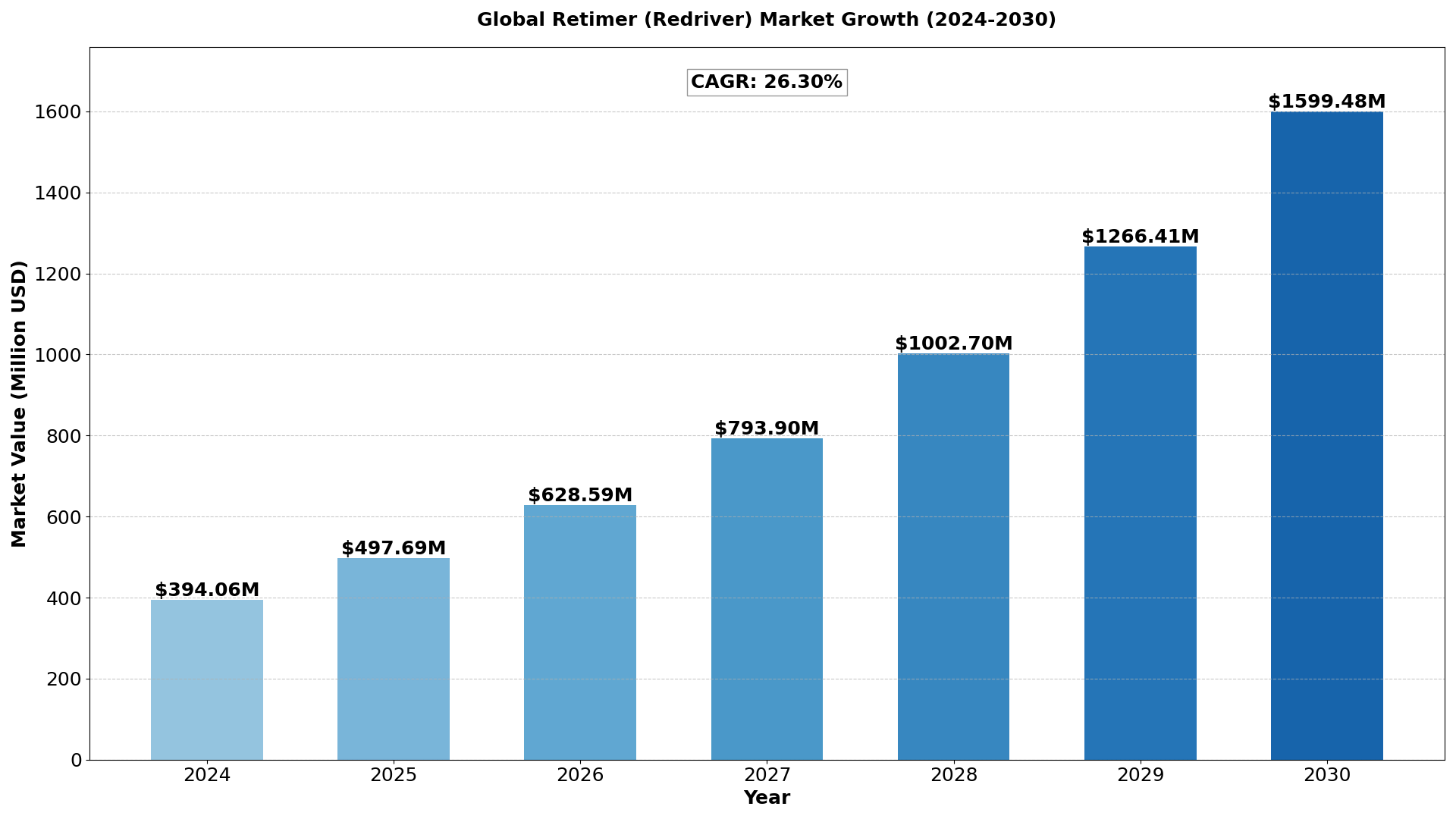
The Global Retimer (Redriver) Market size was estimated at USD 312 million in 2023 and is projected to reach USD 1599.48 million by 2030, exhibiting a CAGR of 26.30% during the forecast period.
North America Retimer (Redriver) market size was USD 81.30 million in 2023, at a CAGR of 22.54% during the forecast period of 2024 through 2030.
Access Your Free Sample Report Now
Retimer (Redriver) Key Market Trends :
1. Increasing Demand for High-Speed Data Transmission
- The rapid growth of high-performance computing, cloud infrastructure, and data centers is driving demand for retimers and redrivers to enable error-free, high-speed data transmission over extended distances.
- Adoption of standards like PCIe 5.0/6.0, USB 4.0, and HDMI 2.1 is creating opportunities for advanced retimer and redriver solutions.
2. Emergence of 5G and Edge Computing
- The rollout of 5G networks and edge computing systems requires reliable and low-latency data connectivity, further pushing demand for retimers and redrivers in telecom equipment, base stations, and edge devices.
- Retimers with clock recovery and signal integrity capabilities are gaining preference.
3. Proliferation of AI and Machine Learning Workloads
- AI and machine learning applications demand high-bandwidth and low-latency data communication between GPUs, CPUs, and storage devices.
- Retimers and redrivers play a crucial role in ensuring signal integrity in these complex, high-data-rate environments.
4. Adoption in Automotive Applications
- Advanced driver-assistance systems (ADAS), in-car infotainment, and autonomous driving technologies are increasing the adoption of retimers and redrivers for signal enhancement in high-speed automotive communication protocols such as Ethernet, USB, and PCIe.
- Automotive-grade components are seeing robust development to meet stringent reliability standards.
5. Focus on Power Efficiency and Miniaturization
- As device sizes shrink and energy efficiency becomes critical, there is a growing emphasis on low-power retimers and redrivers with smaller footprints.
- Integrated solutions combining retimer and redriver functionalities are being developed to reduce complexity and improve system performance.
Retimer (Redriver) Market Regional Analysis :

Get Free Sample Report of This Report
1. North America (USA, Canada, Mexico)
- USA: The largest market in the region due to advanced infrastructure, high disposable income, and technological advancements. Key industries include technology, healthcare, and manufacturing.
- Canada: Strong market potential driven by resource exports, a stable economy, and government initiatives supporting innovation.
- Mexico: A growing economy with strengths in automotive manufacturing, agriculture, and tourism, benefitting from trade agreements like the USMCA.
2. Europe (Germany, UK, France, Russia, Italy, Rest of Europe)
- Germany: The region’s industrial powerhouse with a focus on engineering, automotive, and machinery.
- UK: A hub for financial services, fintech, and pharmaceuticals, though Brexit has altered trade patterns.
- France: Strong in luxury goods, agriculture, and aerospace with significant innovation in renewable energy.
- Russia: Resource-driven economy with strengths in oil, gas, and minerals but geopolitical tensions affect growth.
- Italy: Known for fashion, design, and manufacturing, especially in luxury segments.
- Rest of Europe: Includes smaller yet significant economies like Spain, Netherlands, and Switzerland with strengths in finance, agriculture, and manufacturing.
3. Asia-Pacific (China, Japan, South Korea, India, Southeast Asia, Rest of Asia-Pacific)
- China: The largest market in the region with a focus on technology, manufacturing, and e-commerce. Rapid urbanization and middle-class growth fuel consumption.
- Japan: Technological innovation, particularly in robotics and electronics, drives the economy.
- South Korea: Known for technology, especially in semiconductors and consumer electronics.
- India: Rapidly growing economy with strengths in IT services, agriculture, and pharmaceuticals.
- Southeast Asia: Key markets like Indonesia, Thailand, and Vietnam show growth in manufacturing and tourism.
- Rest of Asia-Pacific: Emerging markets with growing investment in infrastructure and services.
4. South America (Brazil, Argentina, Colombia, Rest of South America)
- Brazil: Largest economy in the region, driven by agriculture, mining, and energy.
- Argentina: Known for agriculture exports and natural resources but faces economic instability.
- Colombia: Growing economy with strengths in oil, coffee, and flowers.
- Rest of South America: Includes Chile and Peru, which have strong mining sectors.
5. The Middle East and Africa (Saudi Arabia, UAE, Egypt, Nigeria, South Africa, Rest of MEA)
- Saudi Arabia: Oil-driven economy undergoing diversification with Vision 2030 initiatives.
- UAE: Financial hub with strengths in tourism, real estate, and trade.
- Egypt: Growing infrastructure development and tourism.
- Nigeria: Largest economy in Africa with strengths in oil and agriculture.
- South Africa: Industrialized economy with strengths in mining and finance.
- Rest of MEA: Includes smaller yet resource-rich markets like Qatar and Kenya with growing infrastructure investments.
Retimer (Redriver) Market Segmentation :
The research report includes specific segments by region (country), manufacturers, Type, and Application. Market segmentation creates subsets of a market based on product type, end-user or application, Geographic, and other factors. By understanding the market segments, the decision-maker can leverage this targeting in the product, sales, and marketing strategies. Market segments can power your product development cycles by informing how you create product offerings for different segments.
- Retimer
- Redriver
- Servers
- PC
- Others
Retimer (Redriver) Market Competitive landscape :
- Astera Labs
- Parade Technologies
- Texas Instruments
- Intel
- Analogix
- Diodes Incorporated
- NXP Semiconductors
- Microchip Technology
- Montage Technology
- THine Electronics
Download Your Complimentary Sample Report
Drivers
Increasing Demand for High-Speed Data Transmission
The surge in demand for high-speed data transmission is a significant driver for the retimer (redriver) market. As modern applications such as cloud computing, big data, and artificial intelligence (AI) continue to grow, the need for efficient and rapid data transfer solutions becomes more critical. Retimers and redrivers play a crucial role in enhancing signal integrity and extending the reach of high-speed interfaces, making them indispensable in various industries, including consumer electronics, automotive, and data centers.
Technological Advancements
Continuous advancements in technology are driving the development of more sophisticated retimer and redriver solutions. Innovations such as the transition from PCIe 3.0 to PCIe 4.0 and PCIe 5.0, along with the adoption of USB 4.0 and Thunderbolt 4, are pushing manufacturers to develop products that can support higher data rates while maintaining signal integrity over longer distances.
Restraints
High Cost of Advanced Retimers and Redrivers
One of the primary restraints in the retimer (redriver) market is the high cost associated with advanced retimer and redriver solutions. As these devices become more complex to support higher data rates and longer distances, their production costs increase, which can deter adoption, particularly in cost-sensitive markets.
Compatibility Issues
Compatibility issues can also pose a challenge in the retimer (redriver) market. Ensuring that retimers and redrivers are compatible with a wide range of devices and standards is essential, but it can be technically challenging and time-consuming, potentially slowing down the pace of adoption.
Opportunities
Expansion of Data Centers
The rapid expansion of data centers globally presents a significant opportunity for the retimer (redriver) market. With data centers requiring reliable and efficient data transfer solutions to manage large volumes of data, the demand for retimers and redrivers is expected to grow significantly.
Growth in the Automotive Industry
The growth of the automotive industry, particularly in the development of autonomous vehicles, presents another lucrative opportunity. Advanced driver-assistance systems (ADAS) and in-car entertainment systems require high-speed data transmission, creating a robust demand for retimers and redrivers.
Challenges
Design Complexity
The design complexity associated with developing advanced retimers and redrivers is a considerable challenge. Engineers must balance the need for higher performance with constraints related to power consumption, heat dissipation, and size, which can complicate the design and manufacturing process.
Rapid Technological Changes
The rapid pace of technological change in the semiconductor industry can be a double-edged sword. While it drives innovation, it also forces companies to continuously update their products, which can be resource-intensive and may lead to shorter product lifecycles.
Key Benefits of This Market Research:
- Industry drivers, restraints, and opportunities covered in the study
- Neutral perspective on the market performance
- Recent industry trends and developments
- Competitive landscape & strategies of key players
- Potential & niche segments and regions exhibiting promising growth covered
- Historical, current, and projected market size, in terms of value
- In-depth analysis of the Retimer (Redriver) Market
- Overview of the regional outlook of the Retimer (Redriver) Market:
Key Reasons to Buy this Report:
- Access to date statistics compiled by our researchers. These provide you with historical and forecast data, which is analyzed to tell you why your market is set to change
- This enables you to anticipate market changes to remain ahead of your competitors
- You will be able to copy data from the Excel spreadsheet straight into your marketing plans, business presentations, or other strategic documents
- The concise analysis, clear graph, and table format will enable you to pinpoint the information you require quickly
- Provision of market value (USD Billion) data for each segment and sub-segment
- Indicates the region and segment that is expected to witness the fastest growth as well as to dominate the market
- Analysis by geography highlighting the consumption of the product/service in the region as well as indicating the factors that are affecting the market within each region
- Competitive landscape which incorporates the market ranking of the major players, along with new service/product launches, partnerships, business expansions, and acquisitions in the past five years of companies profiled
- Extensive company profiles comprising of company overview, company insights, product benchmarking, and SWOT analysis for the major market players
- The current as well as the future market outlook of the industry concerning recent developments which involve growth opportunities and drivers as well as challenges and restraints of both emerging as well as developed regions
- Includes in-depth analysis of the market from various perspectives through Porters five forces analysis
- Provides insight into the market through Value Chain
- Market dynamics scenario, along with growth opportunities of the market in the years to come
- 6-month post-sales analyst support
Customization of the Report
In case of any queries or customization requirements, please connect with our sales team, who will ensure that your requirements are met.
Interested in related market reports? Click here to explore more!
About Semiconductor Insight:
Semiconductor Insight, founded in 2016, provides comprehensive semiconductor market data and analysis to help organizations make informed decisions in the dynamic semiconductor industry. We specialize in semiconductor industry reports, offering insights into market trends, competition analysis, technical breakthroughs, and market predictions. With nearly a decade of experience, we help clients stay ahead with strategic clarity, focusing on semiconductor market share, industry trends, and the semiconductor industry outlook 2025, ensuring they are well-equipped to navigate the semiconductor industry size and evolving landscape.
FAQs
Q. What is the current market size of the Retimer (Redriver) market?
A. USD 312 million in 2023.

Get Sample Report PDF for Exclusive Insights
Report Sample Includes
- Table of Contents
- List of Tables & Figures
- Charts, Research Methodology, and more...
 Download Sample Report PDF


