Market Insights
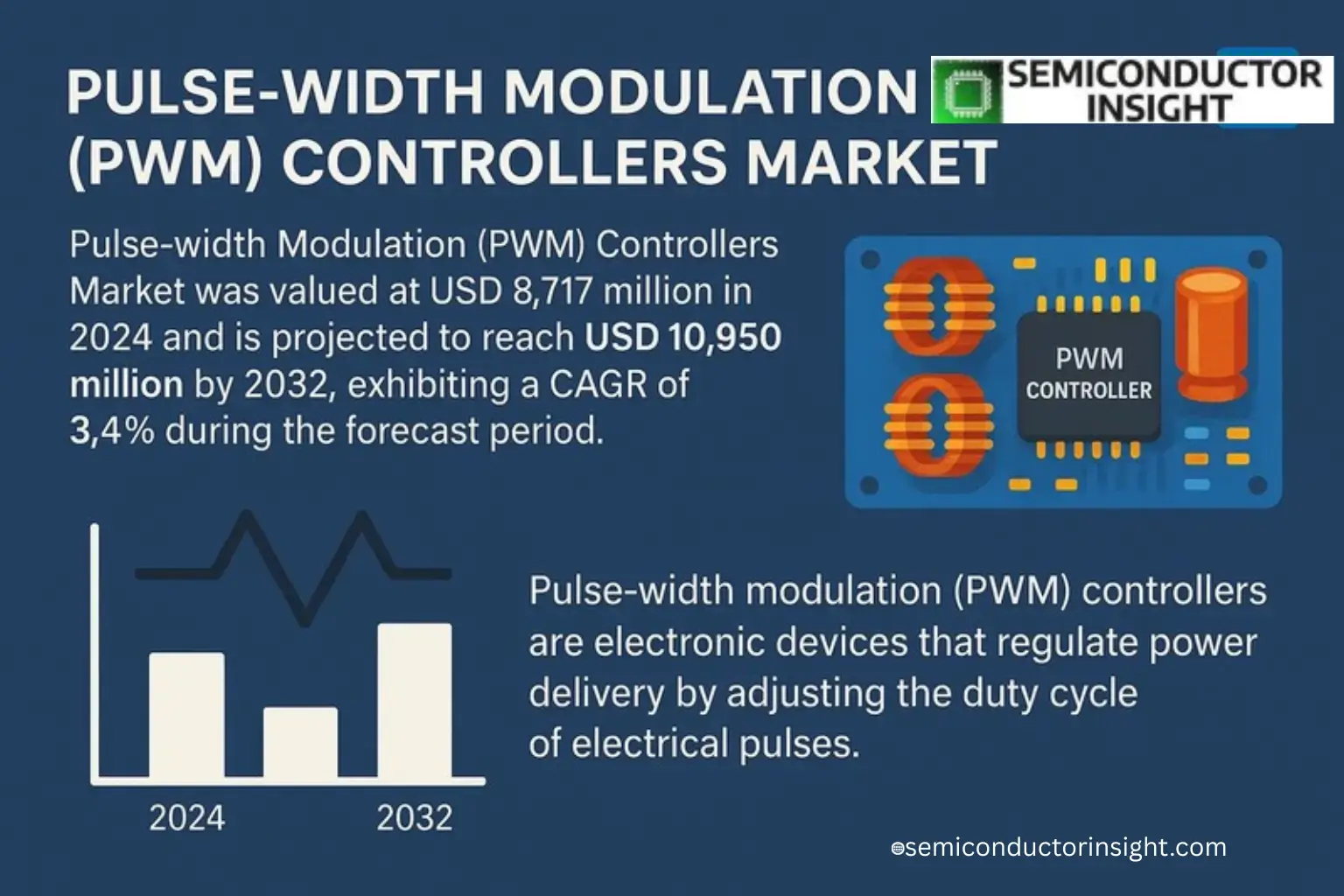
Global Pulse-width Modulation (PWM) Controllers Market was valued at USD 8,717 million in 2024 and is projected to reach USD 10,950 million by 2032, exhibiting a CAGR of 3.4% during the forecast period.
Pulse-width modulation (PWM) controllers are electronic devices that regulate power delivery by adjusting the duty cycle of electrical pulses. These components are critical in applications such as motor control, power supplies, LED lighting, and communication systems due to their high efficiency and precise voltage/current regulation capabilities. The technology enables energy savings by minimizing power loss while maintaining optimal performance across varying load conditions.
The market growth is driven by increasing demand for energy-efficient solutions in industrial automation and consumer electronics. The automotive sector’s shift toward electric vehicles has further accelerated adoption, with PWM controllers playing a vital role in battery management and motor drive systems. Recent advancements include integration with digital signal processors and IoT-enabled smart control features, allowing for adaptive performance optimization in real-time applications.
MARKET DRIVERS
Proliferation of Energy-Efficient Electronics
Global push for energy conservation is a primary driver for the Pulse-width Modulation (PWM) Controllers Market. These components are critical for managing power delivery with high efficiency in devices ranging from smartphones to industrial motor drives. The demand for longer battery life and reduced energy consumption in consumer electronics and electric vehicles directly fuels the adoption of advanced PWM controllers. Market analysis indicates that efficiency improvements of just 1-2% can lead to significant energy savings at scale, making PWM technology highly attractive.
Growth in Renewable Energy and Electric Vehicle Infrastructure
Expansion in renewable energy systems, such as solar inverters and wind turbine converters, relies heavily on precise power control provided by PWM controllers. Similarly, the rapid adoption of electric vehicles (EVs) necessitates efficient battery management systems and onboard chargers, which are core applications for these controllers. The automotive segment is projected to be one of the fastest-growing areas for the PWM Controllers Market, with annual growth rates exceeding 15%.
Furthermore, the miniaturization of electronic components and the Internet of Things (IoT) revolution are creating sustained demand. Compact, efficient power management is essential for IoT devices, and PWM controllers are at the heart of these solutions, supporting the market’s robust expansion.
MARKET CHALLENGES
Design Complexity and Thermal Management
As PWM controllers are integrated into more complex and power-dense systems, managing electromagnetic interference (EMI) and heat dissipation becomes a significant technical challenge. Designing controllers that operate reliably at high frequencies and under heavy loads requires sophisticated engineering and advanced materials, which can increase development costs and time-to-market. Ensuring stability across varying load conditions remains a key hurdle for manufacturers in the PWM Controllers Market.
Other Challenges
Intense Price Competition and Supply Chain Volatility
The market is highly competitive, with pressure to reduce costs while adding features. This can compress profit margins. Additionally, fluctuations in the availability and cost of essential raw materials, such as silicon wafers and specialized semiconductors, can disrupt production schedules and impact pricing stability for PWM controllers.
MARKET RESTRAINTS
High Initial Investment and Design-in Cycles
The development and certification of new PWM controller designs require substantial upfront investment in research and development. Furthermore, the lengthy design-in and qualification processes with large OEMs can act as a barrier to entry for newer players and slow down the adoption of next-generation products. This is a notable restraint on the growth momentum of the PWM Controllers Market.
Saturation in Mature Application Segments
Certain traditional application areas for PWM controllers, such as standard PC power supplies and consumer audio amplifiers, are mature markets with slow growth. This saturation limits volume expansion and forces suppliers to constantly innovate to find new application avenues to drive growth.
MARKET OPPORTUNITIES
Advancements in Wide Bandgap Semiconductors
The adoption of wide bandgap materials like Gallium Nitride (GaN) and Silicon Carbide (SiC) presents a major opportunity for the PWM Controllers Market. These materials allow controllers to operate at higher frequencies, temperatures, and efficiencies. Developing specialized PWM controllers optimized for GaN and SiC power transistors is a key frontier for innovation and market expansion.
Expansion of AI and Data Center Infrastructure
The massive growth in artificial intelligence, machine learning, and cloud computing is driving unprecedented demand for data centers. These facilities require highly efficient and reliable power delivery units, where advanced multi-phase PWM controllers are essential. This segment offers substantial growth potential for high-performance controllers capable of managing complex power loads with precision.
Pulse-width Modulation (PWM) Controllers Market Trends
Expansion into High-Growth Application Fields
The Pulse-width Modulation (PWM) Controllers Market is experiencing substantial growth, with its valuation projected to rise from USD 8717 million in 2024 to USD 10950 million by 2032. This expansion is primarily fueled by the critical role of PWM control technology in high-demand sectors. In new energy vehicles, 5G base station infrastructure, industrial automation, and consumer electronics, PWM controllers provide the core functionality for efficient power management due to their high conversion efficiency, precise control, and rapid response capabilities. Global push for energy efficiency, driven by green energy policies, is accelerating the adoption of high-performance PWM controllers in applications like solar inverters and advanced LED lighting systems.
Other Trends
Trend Towards Digitalization and Intelligence
The integration of digital PWM controllers with microcontrollers and sophisticated AI algorithms represents a significant trend. This evolution enables more intelligent power management, allowing for system optimization, predictive maintenance, and adaptive control. The move towards programmable and high-integration PWM chips is creating a new generation of smart controllers capable of fault detection and cloud-based coordination. This shift is essential for meeting the complex demands of next-generation applications such as smart grids and data center power supplies.
Addressing Technical and Standardization Challenges
A notable trend within the PWM Controllers market involves overcoming inherent disadvantages. The high technical threshold for accurate system modeling remains a challenge, prompting industry players to develop more user-friendly design tools and application-specific solutions. Furthermore, the lack of unified standards and compatibility between different PWM controllers is being addressed through industry-wide efforts to establish common interfaces, which would simplify equipment selection and system integration for manufacturers across the automotive, industrial, and communications sectors.
Supply Chain Resilience and Regional Dynamics
The market is also navigating the impacts of international trade policies and tariff structures. An analysis of the current U.S. tariff policies and diverse international responses is crucial for understanding their effects on competitive market structures and regional economic performance. Ensuring the resilience of the global supply chain for PWM controllers is a key focus, as demand continues to grow across North America, Asia, and Europe. The regional analysis of the market highlights varying growth potentials, with significant developments anticipated in the automotive and industrial segments in Asia and Europe.
COMPETITIVE LANDSCAPE
Key Industry Players
A Concentrated Market Driven by Technological Innovation and Broad Applications
Global Pulse-width Modulation (PWM) Controllers Market is characterized by the dominance of established, multinational semiconductor corporations that leverage extensive R&D capabilities and broad product portfolios to secure leading positions. Companies such as Texas Instruments, Analog Devices, and Infineon Technologies command significant market share, underpinned by their expertise in analog and power management integrated circuits. These key players compete intensely on performance parameters, including efficiency, power density, and integration, to serve demanding applications from automotive and industrial automation to consumer electronics and telecommunications. The competitive structure is further influenced by continuous innovation, strategic mergers and acquisitions, and a focus on providing complete system solutions to lower barriers for customers.
Beyond the top-tier incumbents, a number of specialized and highly-focused companies carve out substantial niches by addressing specific technical requirements or emerging application areas. Firms like Monolithic Power Systems and Richtek Technology are recognized for their high-performance, highly integrated solutions, while others such as Diodes Incorporated and ON Semiconductor offer cost-optimized components for high-volume markets. Niche players, particularly in regional markets like Asia, including Shenzhen CYT Semiconductor Technology, compete effectively by catering to local supply chain demands and offering application-specific support. The competitive dynamics are shaped by the ongoing demand for more efficient power conversion, the trend towards digital and intelligent PWM controllers, and the ability to navigate complex global supply chains and regulatory environments.
List of Key Pulse-width Modulation (PWM) Controllers Companies Profiled
- Analog Devices, Inc.
- Texas Instruments Incorporated
- STMicroelectronics N.V.
- ON Semiconductor
- Microchip Technology Inc.
- Renesas Electronics Corporation
- Vishay Intertechnology, Inc.
- Infineon Technologies AG
- Diodes Incorporated
- MaxLinear, Inc.
- Semtech Corporation
- NXP Semiconductors N.V.
- Richtek Technology Corporation
- Monolithic Power Systems, Inc.
- Shenzhen CYT Semiconductor Technology
Segment Analysis:
| Segment Category | Sub-Segments | Key Insights |
| By Type |
|
Voltage Based Mode controllers demonstrate a dominant position due to their widespread applicability and maturity. This method is integral to a vast array of standard power supply designs, offering a straightforward and efficient means of regulation that is well-understood by design engineers. The stability and robustness of voltage-mode control make it exceptionally suitable for applications requiring consistent output, such as consumer electronics power adapters and general-purpose industrial power modules, ensuring reliable performance across varying load conditions. |
| By Application |
|
Industrial applications represent the most significant segment, driven by the critical need for precision power control and high efficiency in automation systems. The deployment of PWM controllers in motor drives, robotics, and complex machinery is essential for achieving the fine-tuned operational control required for modern manufacturing. Furthermore, the transition towards industrial IoT and smarter, more energy-efficient factory environments necessitates advanced PWM solutions that offer superior reliability and integration capabilities, solidifying the segment’s leadership. |
| By End User |
|
Original Equipment Manufacturers (OEMs) constitute the cornerstone of market demand, as they integrate PWM controllers directly into their final products. Leading electronics, automotive, and industrial equipment manufacturers require high-volume, reliable components that are designed to meet stringent performance and longevity standards. This demand fosters deep relationships with top semiconductor suppliers and drives continuous innovation in controller specifications to align with the evolving feature sets of next-generation consumer devices, vehicles, and industrial machinery. |
| By Control Technology |
|
Digital PWM Controllers are emerging as a highly influential segment due to their advanced programmability and integration with intelligent systems. These controllers offer superior flexibility, allowing for real-time adjustments and adaptive control algorithms that are critical for applications like smart power management in data centers and electric vehicles. The ability to interface seamlessly with microcontrollers and support features like fault diagnostics and remote monitoring positions digital controllers for significant growth, especially as industries push towards greater automation and energy optimization. |
| By Power Rating |
|
Medium Power PWM controllers are the dominant category, striking an optimal balance between performance, cost, and application scope. They are extensively utilized in core markets such as industrial motor drives, automotive systems, and robust consumer appliances where reliable power conversion is paramount. This segment benefits from continuous design innovations aimed at improving thermal management and electromagnetic compatibility, ensuring they meet the rigorous demands of these applications without the excessive cost associated with very high-power specialized solutions. |
Regional Analysis: Global Pulse-width Modulation (PWM) Controllers Market
The concentration of global electronics manufacturing in the Asia-Pacific region is the single greatest driver for the Pulse-width Modulation (PWM) Controllers Market. Billions of devices requiring precise voltage regulation are produced here annually, creating an unparalleled, embedded demand for PWM controllers. This ecosystem encourages local development of cost-effective and highly integrated controller solutions.
Massive governmental pushes for solar and wind energy across China, India, and Australia are fueling demand for PWM controllers used in power conversion systems like inverters. The market for PWM Controllers is directly benefiting from these large-scale infrastructure projects aimed at achieving renewable energy targets and enhancing grid stability.
The ongoing Industry 4.0 transformation in countries like Japan, South Korea, and Thailand is accelerating the adoption of automated machinery and robotics. These advanced systems rely on sophisticated motor drives and power supplies that utilize PWM controllers for precise control and energy efficiency, creating a robust and growing industrial segment within the market.
The Asia-Pacific region is at the forefront of the electric vehicle revolution, with China being the world’s largest market. PWM controllers are essential components in EV charging infrastructure, battery management systems, and motor controllers. This rapid EV adoption presents a significant long-term growth vector for the regional PWM Controllers Market.
North America
North America represents a highly advanced and innovation-driven market for Pulse-width Modulation (PWM) Controllers, characterized by early adoption of cutting-edge technologies. The region’s strength lies in its sophisticated demand for high-performance computing, data centers, and telecommunications infrastructure, all of which require efficient and reliable power management solutions. The presence of major technology firms and aerospace & defense contractors fuels the need for specialized, high-reliability PWM controllers. Furthermore, stringent energy efficiency regulations and a growing focus on electric vehicles and renewable energy integration are pushing the development of next-generation PWM controller architectures. The market is distinguished by a focus on quality, miniaturization, and integration, with significant R&D activities aimed at enhancing the power density and intelligence of PWM-based systems.
Europe
The European market for Pulse-width Modulation (PWM) Controllers is shaped by rigorous environmental directives and a strong industrial base. The region’s commitment to the Green Deal and ambitious carbon neutrality goals is a primary driver, accelerating the deployment of renewable energy systems, electric vehicles, and energy-efficient appliances—all key application areas for PWM controllers. The automotive industry, particularly in Germany, is a major consumer, integrating advanced PWM controllers into increasingly electrified vehicle platforms. The industrial sector also presents steady demand for motor drives and automation equipment. European PWM Controllers Market growth is closely tied to adherence to strict efficiency standards like ErP, compelling manufacturers to develop controllers that minimize energy losses and support sustainable technology development.
South America
The South American Pulse-width Modulation (PWM) Controllers Market is an emerging region with growth potential linked to industrial development and infrastructure modernization. Key economies like Brazil and Argentina are seeing increased investment in industrial automation, which drives demand for motor controls and power supplies utilizing PWM technology. The renewable energy sector, especially wind and solar power generation, is gaining momentum and creating new applications for PWM controllers in inverters and power conditioning systems. While the market is smaller compared to other regions, it benefits from the gradual expansion of the consumer electronics base and the need for more efficient power management in various sectors, indicating a positive growth trajectory for PWM controller adoption.
Middle East & Africa
The Middle East & Africa region presents a diverse landscape for the Pulse-width Modulation (PWM) Controllers Market, with growth drivers varying by sub-region. In the Middle East, economic diversification plans are reducing reliance on oil, leading to investments in telecommunications, data centers, and industrial projects that incorporate PWM-based power management. The adoption of solar energy is also significant. In Africa, market growth is more nascent, driven by urbanization, the expansion of mobile networks, and gradual industrial development, which creates foundational demand for basic power supplies and controls. The overall market is characterized by potential for long-term growth as infrastructure develops and energy efficiency becomes a greater priority.
Report Scope
This market research report provides a comprehensive analysis of the Pulse-width Modulation (PWM) Controllers Market , covering the forecast period 2025–2032. It offers detailed insights into market dynamics, technological advancements, competitive landscape, and key trends shaping the industry.
Key focus areas of the report include:
- Market Overview: The report begins with an overview outlining its current market scenario, key growth indicators, and industry transformation drivers. It discusses macroeconomic factors, demand–supply balance, regulatory landscape, and the strategic role of semiconductors in powering advancements across industries such as automotive, telecommunications, consumer electronics, and industrial automation.
- Market Size & Forecast: Historical data and future projections for revenue, unit shipments, and market value across major regions and segments.
- Segmentation Analysis: Detailed breakdown by product type, technology, application, and end-user industry to identify high-growth segments and investment opportunities.
- Regional Insights: Insights into market performance across North America, Europe, Asia-Pacific, Latin America, and the Middle East & Africa, including country-level analysis where relevant.
- Competitive Landscape: Profiles of leading market participants, including their product offerings, R&D focus, manufacturing capacity, pricing strategies, and recent developments such as mergers, acquisitions, and partnerships.
- Technology Trends & Innovation: Assessment of emerging technologies, integration of AI/IoT, semiconductor design trends, fabrication techniques, and evolving industry standards.
- Market Drivers & Restraints: Evaluation of factors driving market growth along with challenges, supply chain constraints, regulatory issues, and market-entry barriers.
- Stakeholder Insights: Insights for component suppliers, OEMs, system integrators, investors, and policymakers regarding the evolving ecosystem and strategic opportunities.
Primary and secondary research methods are employed, including interviews with industry experts, data from verified sources, and real-time market intelligence to ensure the accuracy and reliability of the insights presented.
FREQUENTLY ASKED QUESTIONS:
What is the current market size of Pulse-width Modulation (PWM) Controllers Market?
-> Pulse-width Modulation (PWM) Controllers Market was valued at USD 8,717 million in 2024 and is projected to reach USD 10,950 million by 2032, exhibiting a CAGR of 3.4% during the forecast period.
Which key companies operate in Pulse-width Modulation (PWM) Controllers Market?
-> Key players include Analog Devices, Texas Instruments, STMicroelectronics, Onsemi, Microchip Technology, Renesas Electronics, Vishay, Infineon, Diodes Incorporated, and MaxLinear, among others.
What are the key growth drivers?
-> Key growth drivers include rising demand in new energy vehicles, 5G base stations, industrial automation, and smart grid applications, along with increasing adoption of digital PWM controllers with AI integration.
Which region dominates the market?
-> Asia is the dominant market, led by China and Japan, while North America remains a significant revenue contributor.
What are the emerging trends?
-> Emerging trends include integration of PWM controllers with microcontrollers, development of intelligent PWM solutions with adaptive control, and increasing focus on energy-efficient power management systems.

Get Sample Report PDF for Exclusive Insights
Report Sample Includes
- Table of Contents
- List of Tables & Figures
- Charts, Research Methodology, and more...
 Download Sample Report PDF