Global Printed Piezoresistive Sensors Market, Emerging Trends, Technological Advancements, and Business Strategies 2025-2032

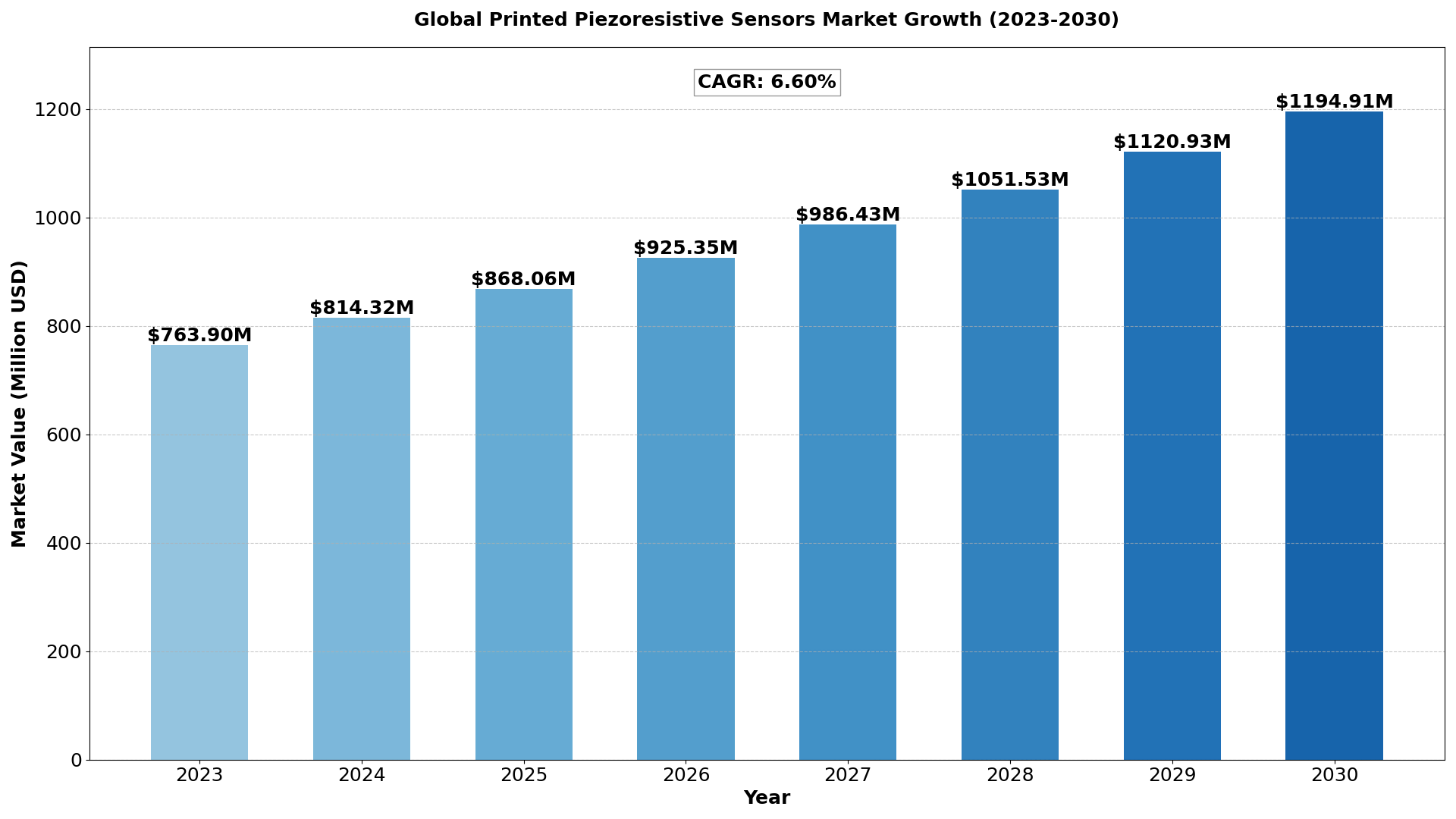
The Global Printed Piezoresistive Sensors Market size was estimated at USD 763.90 million in 2023 and is projected to reach USD 1194.91 million by 2030, exhibiting a CAGR of 6.60% during the forecast period.
PDF Icon Download Sample Report PDF
  • Quick Dispatch

    All Orders

  • Secure Payment

    100% Secure Payment

Price range: $1,500.00 through $4,250.00

Clear

Global Printed Piezoresistive Sensors Market Overview

Printed Piezoresistive Sensors are emerging as a key technology in the semiconductor industry, providing significant advantages in terms of cost-effectiveness, flexibility, and scalability. These sensors, which utilize the piezoresistive effect to measure mechanical stress or strain, are increasingly being integrated into various semiconductor applications due to their potential to enhance performance in devices such as sensors, actuators, and flexible electronics. The growing adoption of Printed Piezoresistive Sensors in the semiconductor market is driving the expansion of the Printed Piezoresistive Sensors Market. The Printed Piezoresistive Sensors Market size has been experiencing substantial growth, fueled by the demand for low-cost, high-performance solutions across industries like automotive, consumer electronics, and healthcare.

As the market continues to evolve, analysts predict a promising Printed Piezoresistive Sensors Market forecast for 2025, with substantial increases in market share and a shift toward advanced sensor technologies. Several Printed Piezoresistive Sensors Market companies are leading the way, contributing to the Printed Piezoresistive Sensors Market growth by innovating in manufacturing techniques and expanding product portfolios.

The Global Printed Piezoresistive Sensors Market size was estimated at USD 763.90 million in 2023 and is projected to reach USD 1194.91 million by 2030, exhibiting a CAGR of 6.60% during the forecast period.

North America Printed Piezoresistive Sensors market size was USD 199.05 million in 2023, at a CAGR of 5.66% during the forecast period of 2024 through 2030.

Piezoresistive sensors quantify force by sensing the corresponding change in electrical resistance of semiconductive materials such as silicone.

This report provides a deep insight into the global Printed Piezoresistive Sensors market covering all its essential aspects. This ranges from a macro overview of the market to micro details of the market size, competitive landscape, development trend, niche market, key market drivers and challenges, SWOT analysis, value chain analysis, etc.

The analysis helps the reader to shape the competition within the industries and strategies for the competitive environment to enhance the potential profit. Furthermore, it provides a simple framework for evaluating and accessing the position of the business organization. The report structure also focuses on the competitive landscape of the Global Printed Piezoresistive Sensors Market, this report introduces in detail the market share, market performance, product situation, operation situation, etc. of the main players, which helps the readers in the industry to identify the main competitors and deeply understand the competition pattern of the market.
In a word, this report is a must-read for industry players, investors, researchers, consultants, business strategists, and all those who have any kind of stake or are planning to foray into the Printed Piezoresistive Sensors market in any manner.

Global Printed Piezoresistive Sensors Market: Market Segmentation Analysis
The research report includes specific segments by region (country), manufacturers, Type, and Application. Market segmentation creates subsets of a market based on product type, end-user or application, Geographic, and other factors. By understanding the market segments, the decision-maker can leverage this targeting in the product, sales, and marketing strategies. Market segments can power your product development cycles by informing how you create product offerings for different segments.

Click Here to Download Your Free Sample Report
Key Company

  • Nissha
  • New Degree Technology
  • Citizen Electronics
  • Memtronik
  • Tekscan
  • Butler Technologies
  • Hanwei Electronics Group
  • FSRTEK
  • NextInput (Qorvo)
  • Interlink
  • Ohmite
  • Techprint
  • TAIWAN ALPHA ELECTRONIC
  • Tangio Printed Electronics (Sytek)
  • Ruihu
  • Sensitronics
  • Legact
  • Cubbison
  • CERADEX
  • Reid Industrial Graphic Products
  • fpsen

Market Segmentation (by Type)

  • Shunt Mode
  • Thru Mode

Market Segmentation (by Application)

  • Mobile Devices
  • Wearable Device
  • Automotive
  • Medical
  • Home Appliances
  • Others

Geographic Segmentation

  • North America (USA, Canada, Mexico)
  • Europe (Germany, UK, France, Russia, Italy, Rest of Europe)
  • Asia-Pacific (China, Japan, South Korea, India, Southeast Asia, Rest of Asia-Pacific)
  • South America (Brazil, Argentina, Columbia, Rest of South America)
  • The Middle East and Africa (Saudi Arabia, UAE, Egypt, Nigeria, South Africa, Rest of MEA)

Key Benefits of This Market Research:

  • Industry drivers, restraints, and opportunities covered in the study
  • Neutral perspective on the market performance
  • Recent industry trends and developments
  • Competitive landscape & strategies of key players
  • Potential & niche segments and regions exhibiting promising growth covered
  • Historical, current, and projected market size, in terms of value
  • In-depth analysis of the Printed Piezoresistive Sensors Market
  • Overview of the regional outlook of the Printed Piezoresistive Sensors Market:

Key Reasons to Buy this Report:

  • Access to date statistics compiled by our researchers. These provide you with historical and forecast data, which is analyzed to tell you why your market is set to change
  • This enables you to anticipate market changes to remain ahead of your competitors
  • You will be able to copy data from the Excel spreadsheet straight into your marketing plans, business presentations, or other strategic documents
  • The concise analysis, clear graph, and table format will enable you to pinpoint the information you require quickly
  • Provision of market value (USD Billion) data for each segment and sub-segment
  • Indicates the region and segment that is expected to witness the fastest growth as well as to dominate the market
  • Analysis by geography highlighting the consumption of the product/service in the region as well as indicating the factors that are affecting the market within each region
  • Competitive landscape which incorporates the market ranking of the major players, along with new service/product launches, partnerships, business expansions, and acquisitions in the past five years of companies profiled
  • Extensive company profiles comprising of company overview, company insights, product benchmarking, and SWOT analysis for the major market players
  • The current as well as the future market outlook of the industry concerning recent developments which involve growth opportunities and drivers as well as challenges and restraints of both emerging as well as developed regions
  • Includes in-depth analysis of the market from various perspectives through Porters five forces analysis
  • Provides insight into the market through Value Chain
  • Market dynamics scenario, along with growth opportunities of the market in the years to come
  • 6-month post-sales analyst support

Click Here to Download Your Free Sample Report

Customization of the Report
In case of any queries or customization requirements, please connect with our sales team, who will ensure that your requirements are met.

Drivers:

  1. Increasing Demand for Wearable Devices: As the demand for wearable health and fitness devices grows, printed piezoresistive sensors play a crucial role in monitoring physical activity, vital signs, and environmental factors. The compact size and flexibility of printed sensors make them ideal for integration into these devices, driving their market growth.
  2. Advancements in Flexible Electronics: The ongoing research and development in flexible electronics have opened up new avenues for printed piezoresistive sensors. These sensors can be incorporated into bendable or stretchable substrates, providing a significant advantage in various applications, from healthcare to consumer electronics.
  3. Cost-Effectiveness of Printed Technology: Printed piezoresistive sensors offer a lower manufacturing cost compared to traditional piezoresistive sensors, mainly due to their ability to be mass-produced using roll-to-roll printing processes. This affordability is a significant driver for adoption across various industries, especially in consumer electronics and healthcare.
  4. Increasing Automation and Industrial Applications: The growing automation in industries such as robotics, automotive, and aerospace demands high-performance, lightweight, and cost-effective sensors for real-time monitoring. Printed piezoresistive sensors, with their small form factor and durability, are well-suited for these applications, driving market demand.
  5. Environmental Monitoring and Sustainability Focus: Printed sensors are increasingly being used for environmental monitoring, especially in areas like air quality, soil conditions, and industrial emissions. The ability to print sensors on eco-friendly materials contributes to the growing emphasis on sustainability, aligning with global environmental goals.

Restraints:

  1. Limited Sensor Performance: Printed piezoresistive sensors, while cost-effective, often exhibit lower sensitivity and accuracy compared to their silicon-based counterparts. This can be a significant limitation in applications that demand high precision and performance, such as in medical diagnostics and advanced industrial monitoring.
  2. Material and Process Limitations: The performance of printed sensors is heavily dependent on the materials used in their production. While advancements are being made, there is still a reliance on specialized materials and processes that can limit the scalability of production. Issues related to material stability, durability, and uniformity can also affect the performance of these sensors.
  3. Competition from Alternative Sensing Technologies: Other sensing technologies, such as MEMS (Micro-Electro-Mechanical Systems) and capacitive sensors, can provide higher accuracy and reliability. This creates strong competition for printed piezoresistive sensors, particularly in high-end applications where performance is critical.
  4. Integration Challenges: Although printed piezoresistive sensors can be integrated into various flexible substrates, challenges in seamlessly integrating these sensors with existing electronic systems or creating compatible interfaces for complex applications persist. This can slow down their adoption in certain industries.

Opportunities:

  1. Growth in Healthcare Monitoring: The demand for non-invasive, real-time health monitoring solutions presents a significant opportunity for printed piezoresistive sensors. With their ability to be integrated into flexible, wearable devices, these sensors can enable continuous health monitoring, including monitoring vital signs, stress levels, and physical activity, driving growth in the healthcare sector.
  2. Development of Smart Textiles: Smart textiles, which incorporate sensors into fabrics, present a growing market for printed piezoresistive sensors. The sensors can be embedded into clothing and accessories, providing opportunities for innovations in sportswear, healthcare apparel, and even military uniforms.
  3. IoT and Smart Devices Expansion: As the Internet of Things (IoT) ecosystem continues to expand, printed piezoresistive sensors can provide cost-effective and scalable solutions for a wide range of connected devices. Their integration into smart home devices, automotive sensors, and industrial IoT systems offers significant opportunities for market growth.
  4. Environmental and Industrial Monitoring: The rise in environmental concerns and industrial safety regulations presents an opportunity for printed piezoresistive sensors to be used in monitoring applications. Sensors can be deployed in remote areas for continuous environmental monitoring, helping to detect changes in environmental conditions or equipment performance.
  5. Growth in Consumer Electronics: The increasing trend toward miniaturized consumer electronics, such as smartphones, wearables, and smartwatches, offers an opportunity for the integration of printed piezoresistive sensors. Their small size, flexibility, and low cost make them ideal for use in these devices, contributing to the growth of the consumer electronics sector.

Challenges:

  1. Reliability and Durability Concerns: One of the significant challenges facing printed piezoresistive sensors is their long-term reliability and durability. As these sensors are often printed on flexible or organic substrates, they may be more susceptible to wear and degradation over time, especially in harsh environmental conditions or under continuous mechanical stress.
  2. Scaling Up Manufacturing: While the cost-effectiveness of printed piezoresistive sensors is a key driver, scaling up production to meet the increasing demand in various sectors can be challenging. Ensuring consistent quality, performance, and reliability at larger production scales requires significant investment in R&D and infrastructure.
  3. Limited Standardization: The lack of standardized processes and materials in the printed sensor market can create challenges for widespread adoption. The absence of universally accepted testing methods and specifications can hinder the commercialization and integration of printed sensors across different industries.
  4. Consumer Education and Acceptance: Despite the advantages, there may be a lack of awareness and understanding among potential customers regarding the capabilities and applications of printed piezoresistive sensors. Educating end-users about the benefits and use cases of these sensors could be necessary for broader market acceptance.

Interested in related market reports? Click here to explore more!

About Semiconductor Insight:

Established in 2016, Semiconductor Insight specializes in providing comprehensive semiconductor industry research and analysis to support businesses in making well-informed decisions within this dynamic and fast-paced sector. From the beginning, we have been committed to delivering in-depth semiconductor market research, identifying key trends, opportunities, and challenges shaping the global semiconductor industry.

Our expertly developed semiconductor market reports offer actionable intelligence, including detailed semiconductor industry analysis, market forecasts, competitive analysis, and insights into technological advancements, enabling our clients to maintain a competitive edge. With nearly a decade of expertise, we remain at the forefront of innovation, delivering strategic clarity to businesses in the semiconductor sector.

Our commitment to providing insights into semiconductor market share and industry trends ensures that our clients have the information they need to succeed in the ever-evolving semiconductor market.

Global Printed Piezoresistive Sensors Market, Emerging Trends, Technological Advancements, and Business Strategies 2025-2032

Get Sample Report PDF for Exclusive Insights

Report Sample Includes

  • Table of Contents
  • List of Tables & Figures
  • Charts, Research Methodology, and more...

PDF Icon Download Sample Report PDF

Download Sample Report

Table of Content

Table of Contents
1 Research Methodology and Statistical Scope
1.1 Market Definition and Statistical Scope of Printed Piezoresistive Sensors
1.2 Key Market Segments
1.2.1 Printed Piezoresistive Sensors Segment by Type
1.2.2 Printed Piezoresistive Sensors Segment by Application
1.3 Methodology & Sources of Information
1.3.1 Research Methodology
1.3.2 Research Process
1.3.3 Market Breakdown and Data Triangulation
1.3.4 Base Year
1.3.5 Report Assumptions & Caveats
2 Printed Piezoresistive Sensors Market Overview
2.1 Global Market Overview
2.1.1 Global Printed Piezoresistive Sensors Market Size (M USD) Estimates and Forecasts (2019-2030)
2.1.2 Global Printed Piezoresistive Sensors Sales Estimates and Forecasts (2019-2030)
2.2 Market Segment Executive Summary
2.3 Global Market Size by Region
3 Printed Piezoresistive Sensors Market Competitive Landscape
3.1 Global Printed Piezoresistive Sensors Sales by Manufacturers (2019-2024)
3.2 Global Printed Piezoresistive Sensors Revenue Market Share by Manufacturers (2019-2024)
3.3 Printed Piezoresistive Sensors Market Share by Company Type (Tier 1, Tier 2, and Tier 3)
3.4 Global Printed Piezoresistive Sensors Average Price by Manufacturers (2019-2024)
3.5 Manufacturers Printed Piezoresistive Sensors Sales Sites, Area Served, Product Type
3.6 Printed Piezoresistive Sensors Market Competitive Situation and Trends
3.6.1 Printed Piezoresistive Sensors Market Concentration Rate
3.6.2 Global 5 and 10 Largest Printed Piezoresistive Sensors Players Market Share by Revenue
3.6.3 Mergers & Acquisitions, Expansion
4 Printed Piezoresistive Sensors Industry Chain Analysis
4.1 Printed Piezoresistive Sensors Industry Chain Analysis
4.2 Market Overview of Key Raw Materials
4.3 Midstream Market Analysis
4.4 Downstream Customer Analysis
5 The Development and Dynamics of Printed Piezoresistive Sensors Market
5.1 Key Development Trends
5.2 Driving Factors
5.3 Market Challenges
5.4 Market Restraints
5.5 Industry News
5.5.1 New Product Developments
5.5.2 Mergers & Acquisitions
5.5.3 Expansions
5.5.4 Collaboration/Supply Contracts
5.6 Industry Policies
6 Printed Piezoresistive Sensors Market Segmentation by Type
6.1 Evaluation Matrix of Segment Market Development Potential (Type)
6.2 Global Printed Piezoresistive Sensors Sales Market Share by Type (2019-2024)
6.3 Global Printed Piezoresistive Sensors Market Size Market Share by Type (2019-2024)
6.4 Global Printed Piezoresistive Sensors Price by Type (2019-2024)
7 Printed Piezoresistive Sensors Market Segmentation by Application
7.1 Evaluation Matrix of Segment Market Development Potential (Application)
7.2 Global Printed Piezoresistive Sensors Market Sales by Application (2019-2024)
7.3 Global Printed Piezoresistive Sensors Market Size (M USD) by Application (2019-2024)
7.4 Global Printed Piezoresistive Sensors Sales Growth Rate by Application (2019-2024)
8 Printed Piezoresistive Sensors Market Segmentation by Region
8.1 Global Printed Piezoresistive Sensors Sales by Region
8.1.1 Global Printed Piezoresistive Sensors Sales by Region
8.1.2 Global Printed Piezoresistive Sensors Sales Market Share by Region
8.2 North America
8.2.1 North America Printed Piezoresistive Sensors Sales by Country
8.2.2 U.S.
8.2.3 Canada
8.2.4 Mexico
8.3 Europe
8.3.1 Europe Printed Piezoresistive Sensors Sales by Country
8.3.2 Germany
8.3.3 France
8.3.4 U.K.
8.3.5 Italy
8.3.6 Russia
8.4 Asia Pacific
8.4.1 Asia Pacific Printed Piezoresistive Sensors Sales by Region
8.4.2 China
8.4.3 Japan
8.4.4 South Korea
8.4.5 India
8.4.6 Southeast Asia
8.5 South America
8.5.1 South America Printed Piezoresistive Sensors Sales by Country
8.5.2 Brazil
8.5.3 Argentina
8.5.4 Columbia
8.6 Middle East and Africa
8.6.1 Middle East and Africa Printed Piezoresistive Sensors Sales by Region
8.6.2 Saudi Arabia
8.6.3 UAE
8.6.4 Egypt
8.6.5 Nigeria
8.6.6 South Africa
9 Key Companies Profile
9.1 Nissha
9.1.1 Nissha Printed Piezoresistive Sensors Basic Information
9.1.2 Nissha Printed Piezoresistive Sensors Product Overview
9.1.3 Nissha Printed Piezoresistive Sensors Product Market Performance
9.1.4 Nissha Business Overview
9.1.5 Nissha Printed Piezoresistive Sensors SWOT Analysis
9.1.6 Nissha Recent Developments
9.2 New Degree Technology
9.2.1 New Degree Technology Printed Piezoresistive Sensors Basic Information
9.2.2 New Degree Technology Printed Piezoresistive Sensors Product Overview
9.2.3 New Degree Technology Printed Piezoresistive Sensors Product Market Performance
9.2.4 New Degree Technology Business Overview
9.2.5 New Degree Technology Printed Piezoresistive Sensors SWOT Analysis
9.2.6 New Degree Technology Recent Developments
9.3 Citizen Electronics
9.3.1 Citizen Electronics Printed Piezoresistive Sensors Basic Information
9.3.2 Citizen Electronics Printed Piezoresistive Sensors Product Overview
9.3.3 Citizen Electronics Printed Piezoresistive Sensors Product Market Performance
9.3.4 Citizen Electronics Printed Piezoresistive Sensors SWOT Analysis
9.3.5 Citizen Electronics Business Overview
9.3.6 Citizen Electronics Recent Developments
9.4 Memtronik
9.4.1 Memtronik Printed Piezoresistive Sensors Basic Information
9.4.2 Memtronik Printed Piezoresistive Sensors Product Overview
9.4.3 Memtronik Printed Piezoresistive Sensors Product Market Performance
9.4.4 Memtronik Business Overview
9.4.5 Memtronik Recent Developments
9.5 Tekscan
9.5.1 Tekscan Printed Piezoresistive Sensors Basic Information
9.5.2 Tekscan Printed Piezoresistive Sensors Product Overview
9.5.3 Tekscan Printed Piezoresistive Sensors Product Market Performance
9.5.4 Tekscan Business Overview
9.5.5 Tekscan Recent Developments
9.6 Butler Technologies
9.6.1 Butler Technologies Printed Piezoresistive Sensors Basic Information
9.6.2 Butler Technologies Printed Piezoresistive Sensors Product Overview
9.6.3 Butler Technologies Printed Piezoresistive Sensors Product Market Performance
9.6.4 Butler Technologies Business Overview
9.6.5 Butler Technologies Recent Developments
9.7 Hanwei Electronics Group
9.7.1 Hanwei Electronics Group Printed Piezoresistive Sensors Basic Information
9.7.2 Hanwei Electronics Group Printed Piezoresistive Sensors Product Overview
9.7.3 Hanwei Electronics Group Printed Piezoresistive Sensors Product Market Performance
9.7.4 Hanwei Electronics Group Business Overview
9.7.5 Hanwei Electronics Group Recent Developments
9.8 FSRTEK
9.8.1 FSRTEK Printed Piezoresistive Sensors Basic Information
9.8.2 FSRTEK Printed Piezoresistive Sensors Product Overview
9.8.3 FSRTEK Printed Piezoresistive Sensors Product Market Performance
9.8.4 FSRTEK Business Overview
9.8.5 FSRTEK Recent Developments
9.9 NextInput (Qorvo)
9.9.1 NextInput (Qorvo) Printed Piezoresistive Sensors Basic Information
9.9.2 NextInput (Qorvo) Printed Piezoresistive Sensors Product Overview
9.9.3 NextInput (Qorvo) Printed Piezoresistive Sensors Product Market Performance
9.9.4 NextInput (Qorvo) Business Overview
9.9.5 NextInput (Qorvo) Recent Developments
9.10 Interlink
9.10.1 Interlink Printed Piezoresistive Sensors Basic Information
9.10.2 Interlink Printed Piezoresistive Sensors Product Overview
9.10.3 Interlink Printed Piezoresistive Sensors Product Market Performance
9.10.4 Interlink Business Overview
9.10.5 Interlink Recent Developments
9.11 Ohmite
9.11.1 Ohmite Printed Piezoresistive Sensors Basic Information
9.11.2 Ohmite Printed Piezoresistive Sensors Product Overview
9.11.3 Ohmite Printed Piezoresistive Sensors Product Market Performance
9.11.4 Ohmite Business Overview
9.11.5 Ohmite Recent Developments
9.12 Techprint
9.12.1 Techprint Printed Piezoresistive Sensors Basic Information
9.12.2 Techprint Printed Piezoresistive Sensors Product Overview
9.12.3 Techprint Printed Piezoresistive Sensors Product Market Performance
9.12.4 Techprint Business Overview
9.12.5 Techprint Recent Developments
9.13 TAIWAN ALPHA ELECTRONIC
9.13.1 TAIWAN ALPHA ELECTRONIC Printed Piezoresistive Sensors Basic Information
9.13.2 TAIWAN ALPHA ELECTRONIC Printed Piezoresistive Sensors Product Overview
9.13.3 TAIWAN ALPHA ELECTRONIC Printed Piezoresistive Sensors Product Market Performance
9.13.4 TAIWAN ALPHA ELECTRONIC Business Overview
9.13.5 TAIWAN ALPHA ELECTRONIC Recent Developments
9.14 Tangio Printed Electronics (Sytek)
9.14.1 Tangio Printed Electronics (Sytek) Printed Piezoresistive Sensors Basic Information
9.14.2 Tangio Printed Electronics (Sytek) Printed Piezoresistive Sensors Product Overview
9.14.3 Tangio Printed Electronics (Sytek) Printed Piezoresistive Sensors Product Market Performance
9.14.4 Tangio Printed Electronics (Sytek) Business Overview
9.14.5 Tangio Printed Electronics (Sytek) Recent Developments
9.15 Ruihu
9.15.1 Ruihu Printed Piezoresistive Sensors Basic Information
9.15.2 Ruihu Printed Piezoresistive Sensors Product Overview
9.15.3 Ruihu Printed Piezoresistive Sensors Product Market Performance
9.15.4 Ruihu Business Overview
9.15.5 Ruihu Recent Developments
9.16 Sensitronics
9.16.1 Sensitronics Printed Piezoresistive Sensors Basic Information
9.16.2 Sensitronics Printed Piezoresistive Sensors Product Overview
9.16.3 Sensitronics Printed Piezoresistive Sensors Product Market Performance
9.16.4 Sensitronics Business Overview
9.16.5 Sensitronics Recent Developments
9.17 Legact
9.17.1 Legact Printed Piezoresistive Sensors Basic Information
9.17.2 Legact Printed Piezoresistive Sensors Product Overview
9.17.3 Legact Printed Piezoresistive Sensors Product Market Performance
9.17.4 Legact Business Overview
9.17.5 Legact Recent Developments
9.18 Cubbison
9.18.1 Cubbison Printed Piezoresistive Sensors Basic Information
9.18.2 Cubbison Printed Piezoresistive Sensors Product Overview
9.18.3 Cubbison Printed Piezoresistive Sensors Product Market Performance
9.18.4 Cubbison Business Overview
9.18.5 Cubbison Recent Developments
9.19 CERADEX
9.19.1 CERADEX Printed Piezoresistive Sensors Basic Information
9.19.2 CERADEX Printed Piezoresistive Sensors Product Overview
9.19.3 CERADEX Printed Piezoresistive Sensors Product Market Performance
9.19.4 CERADEX Business Overview
9.19.5 CERADEX Recent Developments
9.20 Reid Industrial Graphic Products
9.20.1 Reid Industrial Graphic Products Printed Piezoresistive Sensors Basic Information
9.20.2 Reid Industrial Graphic Products Printed Piezoresistive Sensors Product Overview
9.20.3 Reid Industrial Graphic Products Printed Piezoresistive Sensors Product Market Performance
9.20.4 Reid Industrial Graphic Products Business Overview
9.20.5 Reid Industrial Graphic Products Recent Developments
9.21 fpsen
9.21.1 fpsen Printed Piezoresistive Sensors Basic Information
9.21.2 fpsen Printed Piezoresistive Sensors Product Overview
9.21.3 fpsen Printed Piezoresistive Sensors Product Market Performance
9.21.4 fpsen Business Overview
9.21.5 fpsen Recent Developments
10 Printed Piezoresistive Sensors Market Forecast by Region
10.1 Global Printed Piezoresistive Sensors Market Size Forecast
10.2 Global Printed Piezoresistive Sensors Market Forecast by Region
10.2.1 North America Market Size Forecast by Country
10.2.2 Europe Printed Piezoresistive Sensors Market Size Forecast by Country
10.2.3 Asia Pacific Printed Piezoresistive Sensors Market Size Forecast by Region
10.2.4 South America Printed Piezoresistive Sensors Market Size Forecast by Country
10.2.5 Middle East and Africa Forecasted Consumption of Printed Piezoresistive Sensors by Country
11 Forecast Market by Type and by Application (2025-2030)
11.1 Global Printed Piezoresistive Sensors Market Forecast by Type (2025-2030)
11.1.1 Global Forecasted Sales of Printed Piezoresistive Sensors by Type (2025-2030)
11.1.2 Global Printed Piezoresistive Sensors Market Size Forecast by Type (2025-2030)
11.1.3 Global Forecasted Price of Printed Piezoresistive Sensors by Type (2025-2030)
11.2 Global Printed Piezoresistive Sensors Market Forecast by Application (2025-2030)
11.2.1 Global Printed Piezoresistive Sensors Sales (K Units) Forecast by Application
11.2.2 Global Printed Piezoresistive Sensors Market Size (M USD) Forecast by Application (2025-2030)
12 Conclusion and Key Findings