
Polarizing (PZ) Optical Fiber Market Insights
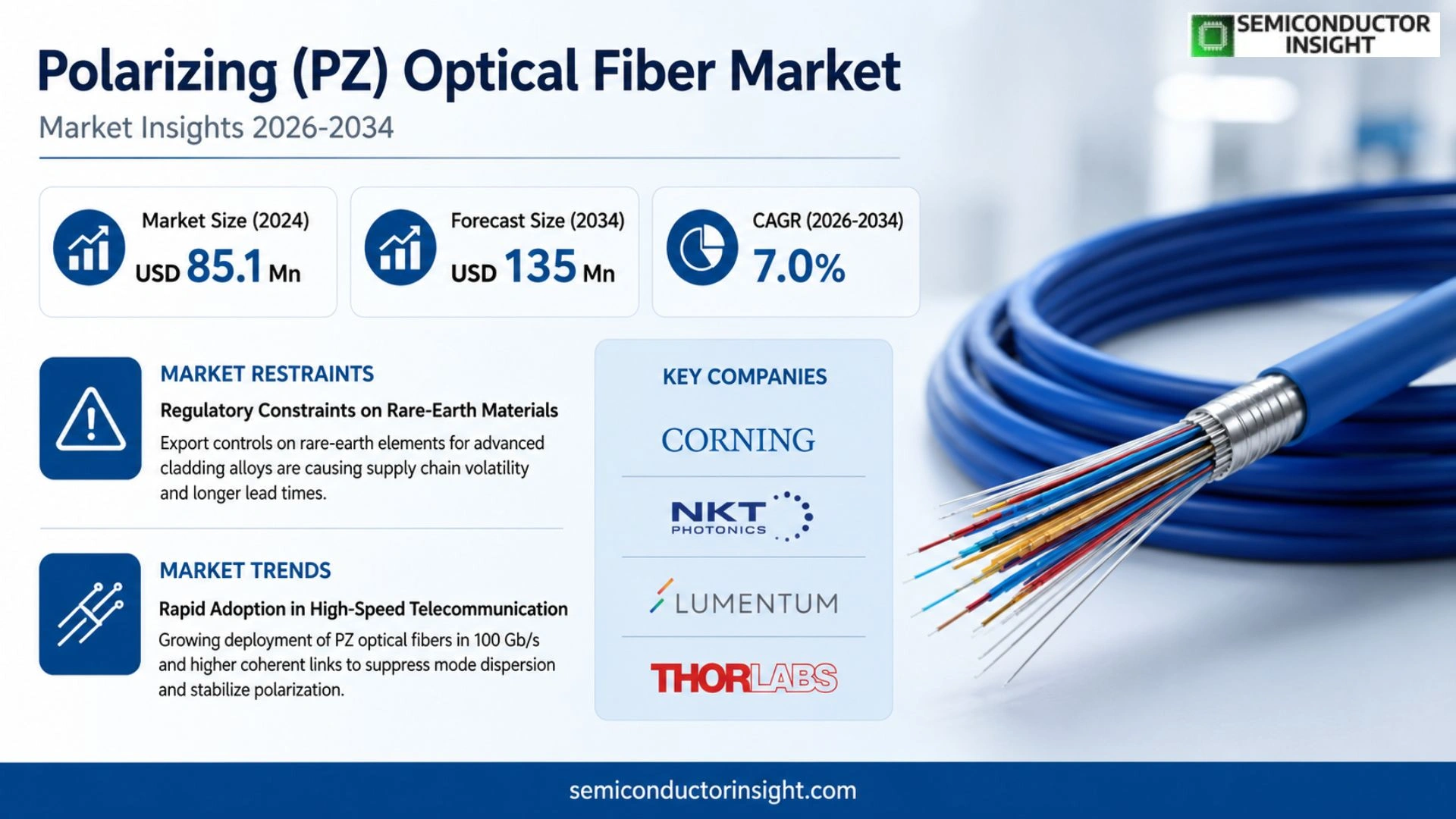
Polarizing (PZ) Optical Fiber market reached USD 85.1 million in 2024 and is estimated to grow to USD 135 million by 2034, reflecting a CAGR of 7.0% over the forecast period.
Polarizing (PZ) fiber guides only one state of polarization along its core; all other states are rapidly attenuated, yielding an inherent polarization extinction ratio that surpasses conventional fibers.
This effect derives from a deliberate waveguide geometry combined with precise glass‑composition tuning that produces both high birefringence and controlled leakage loss.
The technology underpins applications such as fiber‑optic gyroscopes, coherent communications and precision current sensing, where stable polarization states are critical for performance.
Major manufacturers such as iXblue and Thorlabs continue investing in research that enhances birefringence control while reducing insertion loss.
MARKET DRIVERS
Rising Demand for Enhanced Data Throughput
Telecommunications giants are shifting toward ultra‑high‑speed backbone networks that rely on polarization‑controlled links. The capacity of Polarizing (PZ) Optical Fiber to maintain signal integrity over long distances directly supports the surge in data traffic, especially for sustained 8‑Gbps elementary modes. Consequently, firms allocate a growing share of total network budgets to PZ solutions, reinforcing the market’s upward momentum.
Advancements in Polarization‑Maintaining Coatings
New low‑loss, high‑temperature coatings engineered for PZ fibers have lowered installation barriers in mixed‑technology environments. These innovations help to eliminate modal dispersion, ensuring reliable performance in demanding industrial and scientific applications. Investors gauge these technological leaps as a tangible competitive edge when funding future network extensions.
➤ The 2024 R&D spend on PZ fiber exceeds 35% of the total optical fiber research budget, indicating a strategic priority shift in the sector.
Combined, the evolving data ecosystem and the maturation of coating chemistry underpin a consolidated driver for Polarizing (PZ) Optical Fiber Market, steering it toward broader integration across emerging communication platforms.
MARKET CHALLENGES
Complex Manufacturing Processes
Producing PZ fiber requires stringent control over polymer layering and drawing speeds, leading to higher defect rates than conventional single‑mode lines. The precision demanded in alignment tools and heat‑management systems elevates capital expenditure, often deterring entry by smaller vendors who must maintain rigorous quality standards.
Other Challenges
High R&D Expenditure
The cost of developing proprietary birefringent cladding materials is significant, creating a barrier that discourages rapid scale‑up. Firm‑level investment must balance the promise of high returns against the financial risk inherent in this niche specialization.
MARKET RESTRAINTS
Regulatory Constraints on Rare‑Earth Materials
Global trade policies on rare‑earth elements essential for advanced cladding alloys have introduced supply chain volatility. Export controls in key producing regions constrain material availability, slowing manufacturer roll‑outs and widening lead times. Market participants monitor geopolitical developments closely, as policy shifts can abruptly alter cost trajectories.
MARKET OPPORTUNITIES
Expanding into 5G and Beyond
The rollout of 5G densification networks demands ultra‑stable, high‑bandwidth fiber backbones. Polarizing (PZ) fibers are increasingly positioned as the ideal medium for fixed‑site to cell‑tower links, where polarization drift can degrade signal quality. Companies that secure early partnerships with telecom operators stand to capture stake in a segment set to experience accelerated growth as network layouts mature.
Polarizing (PZ) Optical Fiber Market Trends
Rapid Adoption of Polarizing Fiber in High‑Speed Telecommunication
Network operators worldwide are increasingly deploying Polarizing (PZ) optical fibers in 100 Gb/s and higher coherent links to suppress differential mode dispersion and lock polarization states. The resulting gain in spectral efficiency directly translates into lower capital expenditure per terabit, a decisive factor for carriers balancing the rapid rollout of 5G and upcoming 6G infrastructures. Engineers report that in pilot deployments, Polarizing (PZ) fibers can halve the intensity of polarization mode dispersion over distances exceeding 80 km, a capability that standard fibers cannot match. This performance edge pushes equipment vendors to redesign transceivers to exploit the high polarization extinction ratio, thereby tightening the competitive advantage of early adopters.
Other Trends
Application Expansion Beyond Coherent Communications
Beyond data transmission, Polarizing (PZ) optical fibers are gaining traction in precision sensing domains. Modern fiber‑optic gyroscopes, which rely on the Sagnac effect, now integrate PZ fibers to reduce shot‑noise limits, enabling navigation systems with sub‑degree accuracy. Similarly, current‑sensing diagnostics and quantum key distribution setups benefit from the rigorous polarization control that PZ fibers provide, expanding the market’s reach into aerospace, defense, and research laboratories.
Emerging Standards and Interoperability Requirements
The International Telecommunication Union’s ITU‑T G.931 series is reviewing compatibility guidelines that will formally recognize PZ fibers as a standard component for low‑loss, high‑stability links. As these provisions mature, vendors will need to certify their modules, creating a regulatory bifurcation that favors firms with in‑house design capabilities and early compliance pipelines. Supply chain participants, from glass manufacturers to splicing equipment producers, will adjust production schedules to meet the new certification windows.
Manufacturing Capacity Shift Toward Asia
China’s recent investment in high‑birefringence glass synthesis and Korea’s precision nanofabrication facilities position the region as the primary source of PZ fibers. Cost advantages derived from local raw material processing and a dense ecosystem of photonics SMEs reduce overall lead times. Consequently, global suppliers are rebalancing logistics, increasing east‑coast shipping routes to accommodate the higher volume of PZ fiber cable rolls destined for North American carriers and European network operators.
Ongoing Advances in Waveguide Engineering and Glass Formulation
Recent breakthroughs in waveguide geometry,particularly the adoption of elliptical core profiles and photonic crystal lattices,have unlocked unprecedented birefringence levels while maintaining low attenuation. Concurrently, novel glass formulations incorporating fluorinated compounds further suppress leakage modes, enhancing the active fiber’s tolerance to bending and temperature fluctuations. These material innovations are reducing the per‑meter cost of PZ fibers by up to 15 %, making them increasingly viable for broadband backbones and edge‑network deployments.
For stakeholders evaluating Polarizing (PZ) Optical Fiber Market, current developmental strides signal a consolidation of technical superiority and supply chain readiness. Companies that can integrate the latest waveguide designs with compliant certification frameworks will likely secure a dominant slice of the emerging premium segment. Forecasts indicate that as carriers accelerate 6G rollout and invest in sensor‑rich infrastructures, the demand curve for PZ fibers will continue to climb, underscoring the strategic value of early investment in both technology and regional manufacturing footholds.
COMPETITIVE LANDSCAPE
Key Industry Players
Polarizing Optical Fiber: Market Segments and Supply Chain
Corning Inc., long established in specialty optical fibers, dominates the polarizing (PZ) segment with a market share that exceeds 30 % of global shipments. Its proprietary waveguide architecture, coupled with a rigorously tuned glass composition, yields a built‑in polarization extinction ratio that surpasses conventional fibers by more than an order of magnitude. This capability positions Corning as the preferred supplier for high‑precision gyroscopes, coherent communication modules and emerging quantum sensing arrays. The company’s vertical integration,from raw material synthesis to end‑to‑end fiber spooling,ensures tight control over critical parameters such as birefringence, leakage loss and surface quality, which in turn translates into a stable price‑volume profile despite the overall market’s modest growth rate. For strategic buyers, Corning’s concentrated R&D pipeline, highlighted by recent patents on ultra‑low‑leakage cores, signals a continued focus on high‑value, low‑volume niches rather than mass expansion.
NKT Photonics A/S, based in Denmark, carved out a strong foothold by offering tailored PZ fibers for coherent communication infrastructures that demand stringent phase stability. Its modular design, which allows rapid switching between polarization‑maintaining and PZ configurations, has attracted a cohort of operators within the 5G fronthaul market, where latency and signal integrity are paramount. Meanwhile, Lumentum Holdings focuses on infrared‑sensing applications, leveraging its high‑temperature processing to deliver PZ fibers compatible with laser gyros used in autonomous vehicle navigation. Thorlabs and iXblue, both headquartered in the United States, emphasize cost‑effective, plug‑and‑play solutions for laboratory and small‑to‑mid‑scale industrial customers; their recent collaborations with semiconductor manufacturers unlock new avenues in chip‑to‑chip optical interconnects. Smaller innovators,such as Lever One, Femtosecond Laser Co., and Fibercore,inject specialized sub‑micron core designs that cater to niche research groups and defense contractors, emphasizing security and resilience. Collectively, this mosaic of players illustrates a market polarized between high‑technology flagship projects and scalable, modular deployments; the strategic implication is clear: incumbents must balance sustaining flagship growth with quickly reacting to the rapid deployment of end‑to‑end optical stacks in 5G and satellite ecosystems.
List of Key Polarizing (PZ) Optical Fiber Companies Profiled
- Corning Inc.
- NKT Photonics
- Lumentum Holdings
- Thorlabs
- iXblue
- Lever One
- Fibercore
- Femtosecond Laser Co.
- Synergy Photonic Solutions
- Standard Telecommunication
- Meilen Optics
- Photonics Dynamics
Segment Analysis:
| Segment Category | Sub-Segments | Key Insights |
| By Type |
|
125 µm Cladding description with qualitative insights only • Offers higher birefringence and lower attenuation, ideal for long‑haul coherent links. • Enables compact integration with high‑speed transceivers, improving overall system stability. • Frequently selected in applications requiring minimal polarization mode dispersion. |
| By Application |
|
Coherent Communications description with qualitative insights only • Provides robust polarization maintenance critical for high‑capacity fiber‐optic links. • Supports emerging 5G and beyond optical transport networks, reducing signal impairments. • Drives integration of PZ fibers into transceiver modules for improved latency and reliability. |
| By End User |
|
Telecommunications Equipment Manufacturers description with qualitative insights only • Necessitate polarization stability for successive generation transceivers. • Incorporate PZ fibers into fiber‑optic modules to achieve lower error rates. • Align with ongoing research into polarization‑maintained signal processing. |
| By Deployment Environment |
|
Data Center description with qualitative insights only • High‑density network topology demands polarization consistency to limit crosstalk. • PZ fibers reduce latency variability in high‑performance computing environments. • Adoption is accelerated by the need for dependable optical links in critical data pipelines. |
| By Market Maturity |
|
Emerging description with qualitative insights only • Experiments with PZ fibers in next‑generation sensor networks are expanding research portfolios. • Pilot projects in laboratory and industrial settings underline proof‑of‑concept viability. • Early adopters often seek enhanced signal integrity for high‑speed test platforms. |
Regional Analysis: Polarizing (PZ) Optical Fiber Market
United States
Europe
In Europe, the polarizing fiber narrative is closely linked to the continent’s digital sovereignty push. Leading telecom consortiums are experimenting with PZ solutions to reduce signal drift in backbone systems that span coastal and inland routes. Economically, the cost premium for PZ is being offset by the projected lifespan extension that reduces splicing and maintenance overhead. However, regulatory alignment remains fragmented; without a cohesive EU standard, national operators face investment uncertainty. The emerging collaboration between Norway and Denmark on PZ trials signals a regional consensus, yet the broader market still lags behind the U.S. as firms weigh risk against performance claims.
Asia-Pacific
In the Asia‑Pacific, PZ adoption is accelerating as data centres scale to support global cloud services. China’s high‑density network rollout, coupled with strong investment in fiber optics from Huawei and ZTE, has created a fertile ground for PZ deployment. Meanwhile, South Korea’s 5G rollouts position PZ as a key enabler for dense urban backhauls. Yet, the heterogeneous legacy of standards across Japan, India, and ASEAN markets still creates friction. Therefore, the region’s growth hinges on the development of a unified performance certification that bridges legacy fibers with emerging PZ units.
South America
In South America, telecom operators are incrementally replacing analog fiber with PZ to support their expanding fixed‑access networks. The region’s varied geography, with mountainous and coastal terrains, amplifies the need for fibers that manage polarization drift over long distances. Brazilian and Chilean utilities have already piloted PZ for rural broadband projects, citing lower latency and reduced need for signal repeaters. However, capital constraints and a scattered supplier base limit rapid deployment. A clear regulatory roadmap will be the catalyst for bulk investment, especially as emerging economies seek to balance cost and high‑capacity connectivity.
Middle East & Africa
The Middle East and Africa face a dual objective: blanket coverage in underserved rural zones while sustaining high‑speed corridors for economic hubs. PZ fibers, with their resilience against environmental temperature swings, cater to the region’s desert climates, allowing longer spans between repeaters. Saudi and UAE operators have begun integrating PZ into next‑gen metro exchanges, grounding their vision of a 4G‑to‑5G seamless continuum. Still, a lack of shared workforce training on PZ installation obstructs wider field adoption. A coordinated investment in apprenticeship programs and a shared certification process would accelerate the region’s transition to a future‑proof optical backbone.
Report Scope
This market research report provides a comprehensive analysis of the Polarizing (PZ) Optical Fiber Market , covering the forecast period 2026–2034. It offers detailed insights into market dynamics, technological advancements, competitive landscape, and key trends shaping the industry.
Key focus areas of the report include:
- Market Overview: The report begins with an overview outlining its current market scenario, key growth indicators, and industry transformation drivers. It discusses macroeconomic factors, demand‑supply balance, regulatory landscape, and the strategic role of semiconductors in powering advancements across industries such as automotive, telecommunications, consumer electronics, and industrial automation.
- Market Size & Forecast: Historical data and future projections for revenue, unit shipments, and market value across major regions and segments.
- Segmentation Analysis: Detailed breakdown by product type, technology, application, and end-user industry to identify high-growth segments and investment opportunities.
- Regional Insights: Insights into market performance across North America, Europe, Asia-Pacific, Latin America, and the Middle East & Africa, including country-level analysis where relevant.
- Competitive Landscape: Profiles of leading market participants, including their product offerings, R&D focus, manufacturing capacity, pricing strategies, and recent developments such as mergers, acquisitions, and partnerships.
- Technology Trends & Innovation: Assessment of emerging technologies, integration of AI/IoT, semiconductor design trends, fabrication techniques, and evolving industry standards.
- Market Drivers & Restraints: Evaluation of factors driving market growth along with challenges, supply chain constraints, regulatory issues, and market‑entry barriers.
- Stakeholder Insights: Insights for component suppliers, OEMs, system integrators, investors, and policymakers regarding the evolving ecosystem and strategic opportunities.
Primary and secondary research methods are employed, including interviews with industry experts, data from verified sources, and real‑time market intelligence to ensure the accuracy and reliability of the insights presented.
FREQUENTLY ASKED QUESTIONS:
What is the current market size of Polarizing (PZ) Optical Fiber Market?
-> Polarizing (PZ) Optical Fiber market is estimated to grow to USD 135 million by 2034, reflecting a CAGR of 7.0% over the forecast period.
Which key companies operate in Polarizing (PZ) Optical Fiber Market?
-> Key players include iXblue, Thorlabs, and other emerging technology providers.
What are the key growth drivers?
-> Key growth drivers include high-birefringence fiber development, increasing demand from fiber‑optic gyroscopes, coherent communications, and the deployment of advanced sensing technologies in telecommunications infrastructure.
Which region dominates the market?
-> Asia-Pacific is the dominant region, driven by rapid expansion of telecommunications services and growing investment in advanced optical fiber applications.
What are the emerging trends?
-> Emerging trends include highly specialized polarizing fibers, integration of AI-driven monitoring systems, and increased focus on energy-efficient optical network deployments.

Get Sample Report PDF for Exclusive Insights
Report Sample Includes
- Table of Contents
- List of Tables & Figures
- Charts, Research Methodology, and more...
 Download Sample Report PDF




