Market Insights
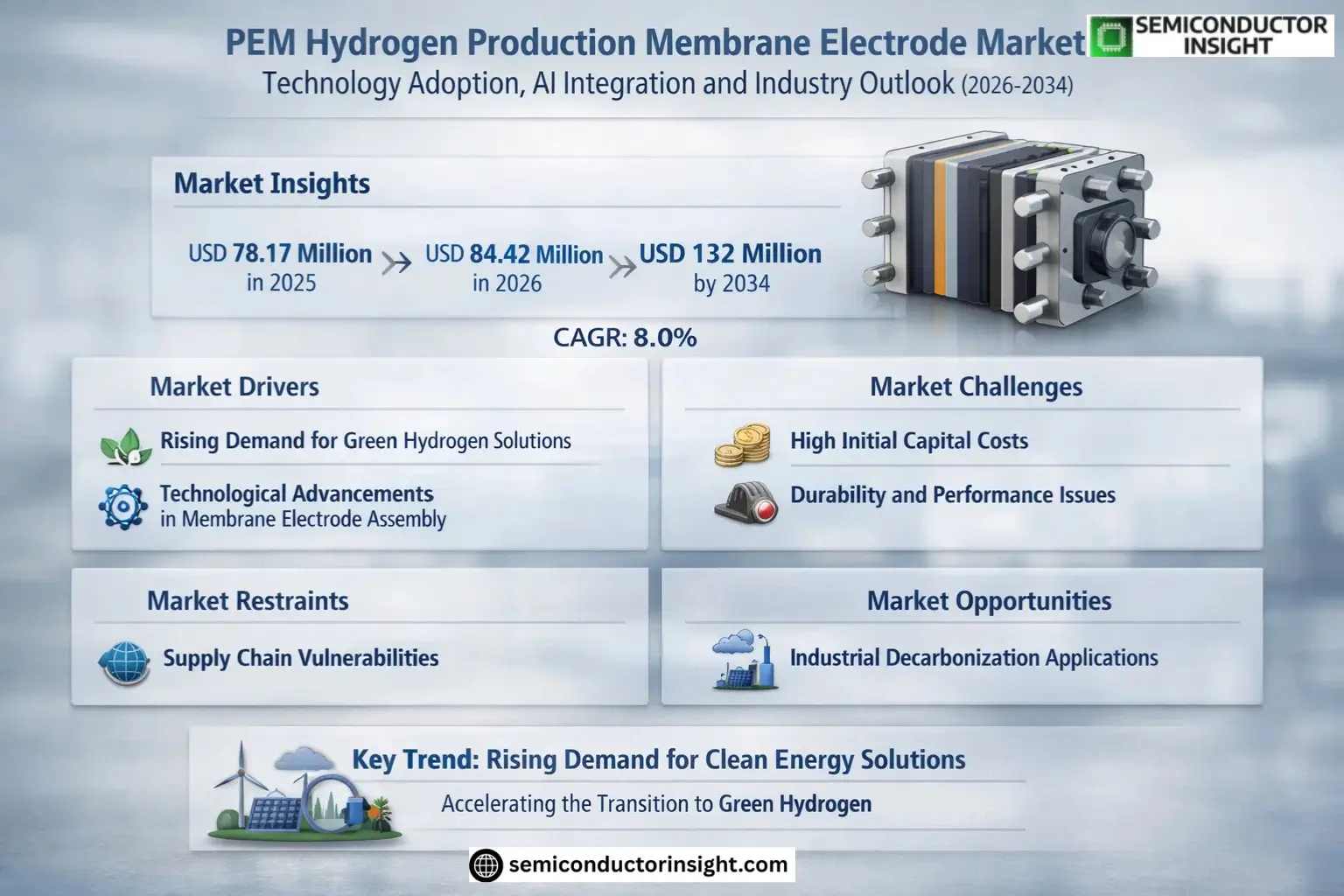
Global PEM Hydrogen Production Membrane Electrode Market size was valued at USD 78.17 million in 2025. The market is projected to grow from USD 84.42 million in 2026 to USD 132 million by 2034, exhibiting a CAGR of 8.0% during the forecast period.
PEM Hydrogen Production Membrane Electrodes are critical components in proton exchange membrane (PEM) water electrolysis systems, consisting of a proton exchange membrane, anode, and cathode. These electrodes facilitate proton conduction, catalytic reactions, gas separation, and thermal management, directly impacting electrolysis efficiency and system stability. They are widely used in hydrogen production applications across energy and automotive sectors.
The market growth is driven by increasing investments in green hydrogen technologies and Global shift toward renewable energy solutions. While North America currently leads in technological advancements, Asia-Pacific shows strong growth potential due to government initiatives supporting clean energy adoption. Key players like Siemens Energy and Bloom Energy are expanding their production capacities to meet rising demand for efficient hydrogen generation systems.
MARKET DRIVERS
Growing Demand for Green Hydrogen Solutions
PEM Hydrogen Production Membrane Electrode Market is experiencing significant growth due to rising global demand for clean energy solutions. Governments worldwide are implementing policies to reduce carbon emissions, with hydrogen playing a key role in energy transition strategies. The superior efficiency of PEM electrolysis compared to traditional alkaline methods is driving adoption.
Technological Advancements in Membrane Electrode Assembly
Recent innovations in catalyst materials and membrane durability have improved the performance and lifespan of PEM hydrogen production systems. These advancements are reducing the total cost of ownership, making PEM technology more accessible for industrial applications.
The automotive sector’s shift toward fuel cell vehicles is creating additional demand for efficient hydrogen production methods, benefiting the PEM Hydrogen Production Membrane Electrode Market.
MARKET CHALLENGES
High Initial Capital Costs
While operational costs are competitive, the upfront investment required for PEM hydrogen production systems remains a barrier for many potential adopters. The use of precious metal catalysts in membrane electrodes contributes significantly to system costs.
Other Challenges
Durability Concerns
Maintaining performance under fluctuating loads and variable operating conditions continues to challenge PEM membrane electrode developers. Corrosion and catalyst degradation remain technical hurdles that impact system longevity.
MARKET RESTRAINTS
Supply Chain Vulnerabilities
PEM Hydrogen Production Membrane Electrode Market faces constraints from limited availability of critical materials, particularly platinum group metals used in catalysts. Geopolitical factors and trade restrictions can disrupt supply chains, potentially slowing market growth in certain regions.
MARKET OPPORTUNITIES
Emerging Applications in Industrial Decarbonization
Heavy industries such as steel manufacturing and chemical processing present significant opportunities for PEM hydrogen production technology as they seek to reduce their carbon footprint. The ability to integrate PEM systems with renewable energy sources makes them particularly attractive for decarbonization projects.
Key Trends in PEM Hydrogen Production Membrane Electrode MarketRising Demand for Clean Energy Solutions
PEM Hydrogen Production Membrane Electrode Market is experiencing significant growth due to increasing global focus on clean energy transition. As governments and industries prioritize decarbonization, PEM electrolysis technology has emerged as a key solution for green hydrogen production. The superior efficiency and compact design of membrane electrodes make them ideal for renewable energy integration.
Other Trends
Technological Advancements in Electrode Materials
Manufacturers are investing heavily in R&D to improve membrane electrode durability and performance. Recent breakthroughs include advanced catalyst coatings and novel polymer membranes that enhance proton conductivity while reducing degradation. These innovations are extending operational lifetimes beyond 60,000 hours in some applications.
Growing Automotive Sector Adoption
The automotive industry is increasingly incorporating PEM hydrogen technology for fuel cell vehicles. Major automakers are establishing partnerships with membrane electrode suppliers to secure stable supply chains. This vertical integration is driving standardization in electrode manufacturing processes.
Geographic Market Expansion
Asia-Pacific is emerging as a key growth region, led by China’s substantial investments in hydrogen infrastructure. European markets continue to lead in technology adoption, while North America shows strong growth potential due to recent policy incentives. Regional production hubs are developing specialized supply chains for membrane electrode components.
Industry Consolidation and Partnerships
The competitive landscape is evolving through strategic mergers and joint ventures. Leading players are acquiring specialized manufacturers to enhance their technological capabilities. Collaborative projects between research institutions and industry players are accelerating commercial-scale deployment of next-generation membrane electrodes.
COMPETITIVE LANDSCAPE
Key Industry Players
Leading Players Dominate PEM Hydrogen Production Membrane Electrode Market
Siemens, Bloom Energy, and Ballard Power Systems collectively hold over 35% revenue share in Global PEM Hydrogen Production Membrane Electrode Market, demonstrating strong technological leadership. These players dominate through continuous R&D investments in membrane electrode assembly (MEA) technology and strategic partnerships with electrolyzer manufacturers. Siemens Energy recently launched next-generation PEM electrolysis stacks with 30% higher power density, while Ballard Power Systems expanded production capacity by 40% in 2023 to meet growing hydrogen economy demand.
Chinese manufacturers like Wuhan WUT HyPower Technology and SuZhou Hydrogine Power Technology are gaining market share through competitive pricing and government-backed hydrogen initiatives. Specialized players such as FUEL CELL CCM and Tsing Hydrogen focus on high-performance catalysts and membrane materials, catering to niche applications. The market also sees emerging innovators like Juna Tech developing ultra-thin PEM electrodes for compact electrolyzer designs.
List of Key PEM Hydrogen Production Membrane Electrode Companies Profiled
- Siemens Energy
- Bloom Energy
- Ballard Power Systems
- Wuhan WUT HyPower Technology
- FUEL CELL CCM
- SuZhou Hydrogine Power Technology
- Tsing Hydrogen (Beijing) Technology
- SinoHyKey
- Tangfeng Energy
- Maxim Fuel Cell
- Juna Tech
- Ningbo Zhongkeke Innovative Energy Technology
- Anhui Contango New Energy Technology
- Shanghai Penglan New Energy Technology
Segment Analysis:
| Segment Category | Sub-Segments | Key Insights |
| By Type |
|
Single Border Electrodes dominate due to their superior proton conductivity and simpler manufacturing process. Key advantages include:
|
| By Application |
|
Energy Storage leads adoption due to growing renewable energy integration needs:
|
| By End User |
|
Utility Companies are the primary adopters due to:
|
| By Technology Type |
|
Advanced Composite technology shows strongest growth potential:
|
| By Catalyst Type |
|
Iridium-based catalysts maintain leadership position:
|
Regional Analysis: Global PEM Hydrogen Production Membrane Electrode Market
North America’s dominance stems from proprietary PEM membrane technologies developed by leading electrochemical companies. The region holds over 40% of global patents for advanced catalyst coatings and durable polymer electrolytes.
The US Inflation Reduction Act and Canadian Clean Hydrogen Strategy provide substantial tax incentives for PEM electrolyzer deployment. State-level renewable hydrogen mandates further stimulate PEM membrane electrode adoption.
Major oil companies and utilities are integrating PEM hydrogen production into existing infrastructure. This vertical integration creates economies of scale for membrane electrode component manufacturers across the value chain.
National laboratories like NREL and academic institutions collaborate extensively with industry players to enhance PEM electrode durability and reduce precious metal catalyst loading through innovative deposition techniques.
Europe
Europe represents the second-largest PEM Hydrogen Production Membrane Electrode Market, driven by ambitious EU hydrogen strategies and cross-border hydrogen backbone projects. The region’s focus on renewable-powered electrolysis creates strong demand for high-efficiency PEM systems. Germany and France lead in commercial-scale PEM electrolyzer deployments, supported by comprehensive regulatory frameworks for green hydrogen certification. European membrane electrode suppliers benefit from well-established automotive and chemical industries transitioning to hydrogen. Collaborative R&D initiatives under Horizon Europe accelerate next-generation PEM material development.
Asia-Pacific
The Asia-Pacific PEM Hydrogen Production Membrane Electrode Market is experiencing rapid growth, particularly in Japan and South Korea. These nations prioritize PEM technology for their hydrogen economy roadmaps, with substantial investments in fuel cell vehicles and hydrogen refueling infrastructure. China’s growing electrolyzer manufacturing capacity and domestic material supply chains present both competition and collaboration opportunities. Emerging markets like Australia demonstrate increasing PEM adoption for industrial decarbonization and renewable energy storage applications.
Middle East & Africa
The Middle East is strategically transitioning from fossil fuels to green hydrogen production using PEM electrolyzers. Mega-projects in Saudi Arabia and Oman leverage abundant solar resources for cost-competitive hydrogen production. African nations show promising potential with pilot PEM installations for ammonia production and mining sector decarbonization. Both regions benefit from partnerships with established PEM technology providers to build local manufacturing capabilities.
South America
South America’s PEM Hydrogen Production Membrane Electrode Market is in nascent stages but shows strong growth potential. Chile and Brazil lead with PEM pilot projects utilizing hydropower and solar energy. The region’s excellent renewable resources and growing interest from international investors position it as an emerging hub for cost-effective green hydrogen production using PEM membrane electrode technology.
Report Scope
This market research report provides a comprehensive analysis of the PEM Hydrogen Production Membrane Electrode Market, covering the forecast period 2025–2034. It offers detailed insights into market dynamics, technological advancements, competitive landscape, and key trends shaping the industry.
Key focus areas of the report include:
- Market Overview: The report begins with an overview outlining its current market scenario, key growth indicators, and industry transformation drivers. It discusses macroeconomic factors, demand–supply balance, regulatory landscape, and the strategic role of PEM hydrogen production membrane electrodes across industries such as energy, automotive, and others.
- Market Size & Forecast: Historical data and future projections for revenue, unit shipments, and market value across major regions and segments.
- Segmentation Analysis: Detailed breakdown by product type (Single Border, Double Border), application (Energy, Automotive, Others), and end-user industry to identify high-growth segments and investment opportunities.
- Regional Insights: Insights into market performance across North America, Europe, Asia, South America, and the Middle East & Africa, including country-level analysis where relevant.
- Competitive Landscape: Profiles of leading market participants, including their product offerings, R&D focus, manufacturing capacity, pricing strategies, and recent developments such as mergers, acquisitions, and partnerships.
- Technology Trends & Innovation: Assessment of emerging technologies, integration of advanced materials, fabrication techniques, and evolving industry standards.
- Market Drivers & Restraints: Evaluation of factors driving market growth along with challenges, supply chain constraints, regulatory issues, and market-entry barriers.
- Stakeholder Insights: Insights for component suppliers, OEMs, system integrators, investors, and policymakers regarding the evolving ecosystem and strategic opportunities.
Primary and secondary research methods are employed, including interviews with industry experts, data from verified sources, and real-time market intelligence to ensure the accuracy and reliability of the insights presented.
FREQUENTLY ASKED QUESTIONS:
What is the current market size of PEM Hydrogen Production Membrane Electrode Market?
-> PEM Hydrogen Production Membrane Electrode Market size was valued at USD 78.17 million in 2025. The market is projected to grow from USD 84.42 million in 2026 to USD 132 million by 2034, exhibiting a CAGR of 8.0% during the forecast period.
What is the growth rate of PEM Hydrogen Production Membrane Electrode Market?
-> The market is expected to grow at a CAGR of 8.0% during the forecast period 2025-2034.
Which key companies operate in PEM Hydrogen Production Membrane Electrode Market?
-> Key players include Siemens, Bloom Energy, Ballard Power Systems, Wuhan WUT HyPower Technology, FUEL CELL CCM, SuZhou Hydrogine Power Technology, Tsing Hydrogen (Beijing) Technology, SinoHyKey, Tangfeng Energy, Maxim Fuel Cell, among others.
What are the key segments in this market?
-> The market is segmented by product type into Single Border and Double Border, and by application into Energy, Automotive, and Others.
Which region leads the PEM Hydrogen Production Membrane Electrode Market?
-> The U.S. market size is estimated at USD million in 2025 while China is expected to reach USD million during the forecast period.
Get Sample Report PDF for Exclusive Insights
Report Sample Includes
- Table of Contents
- List of Tables & Figures
- Charts, Research Methodology, and more...
 Download Sample Report PDF